

Description
Brass NPT Hose Barbs
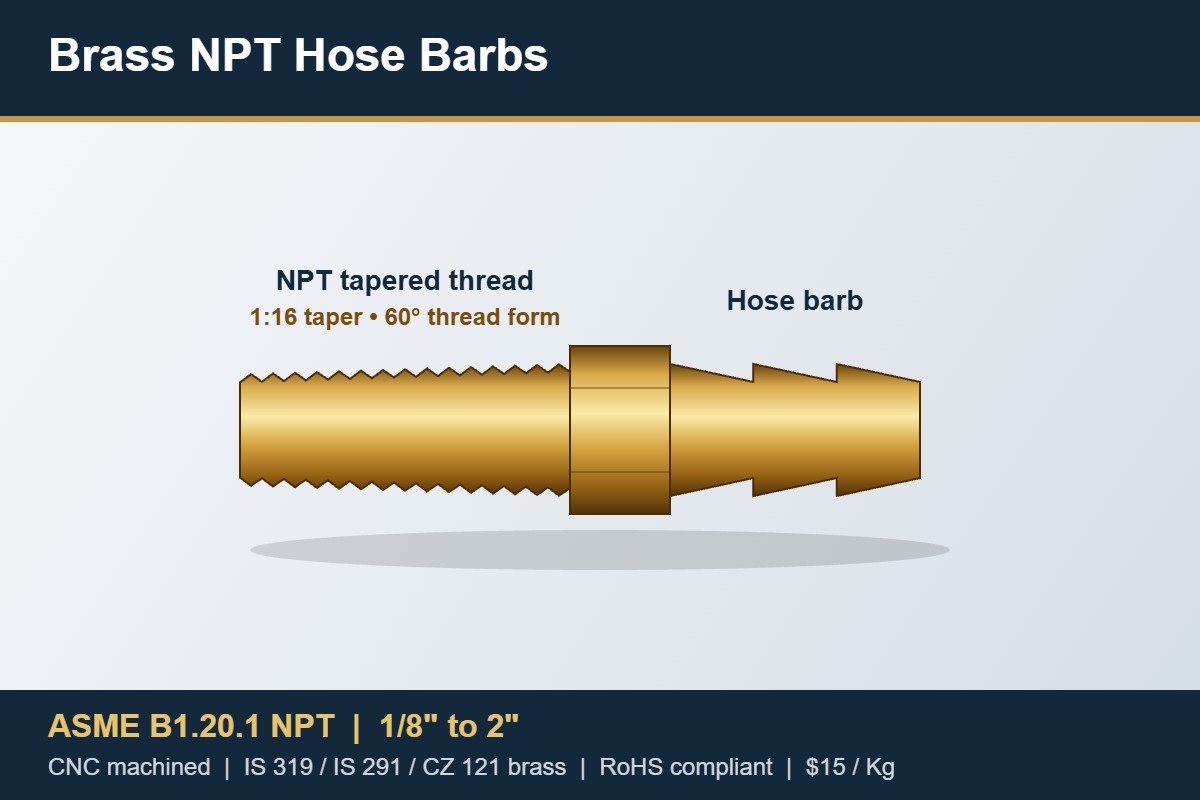
Brass NPT Hose Barbs connect flexible hose to equipment that uses the American National Standard Taper Pipe Thread. NPT, defined by ASME B1.20.1, is the dominant pipe thread in the United States, Canada and Latin America, and it is also widely used on imported machinery, compressors, boilers, pumps and instruments in India and the Middle East. Our NPT hose barbs are machined from IS 319 / IS 291 / CZ 121 brass with a precisely generated 60-degree tapered thread and a serrated barb for hose, and they are available in male, female, 90-degree elbow and tee configurations from 1/8″ to 2″ NPT.
Unlike our product pages organised by shape, this page is organised around the thread. It gives the real dimensions behind NPT – pitch, thread height, hand-tight engagement and effective length – along with tap drill sizes, sealing practice, identification tips and a comparison with BSPT, together with code-numbered size tables for all NPT styles. If you are shopping by shape, go to Brass Male Hose Barbs, Brass Female Hose Barbs, Brass 90 Degree Hose Barb Elbows or Brass Hose Barbed Tees. For the dryseal variant see Brass NPTF Hose Barbs.
Price: $15 / Kg for every NPT size and style | Minimum order: 5 Kg per size code | Bulk discounts available
Quick Specification of Brass NPT Hose Barbs
| Parameter | Specification |
|---|---|
| Product | Brass NPT Hose Barbs with tapered ASME B1.20.1 pipe threads |
| Thread form | 60°, taper 1:16 on diameter (3/4″ per foot) |
| Thread sizes | 1/8″ to 2″ NPT |
| Barb sizes | 3/16″ to 2″ |
| Styles | Male, female, 90° elbow, tee with NPT branch |
| Material | Brass IS 319 / IS 291 / CZ 121; DZR and low-lead on request |
| Finish | Natural brass, nickel plated, chrome plated |
| Working pressure | Up to 150 PSI (10.3 bar), hose permitting |
| Price | $15 per Kg |
| Minimum order | 5 Kg per size code |
| Lead time | 7 to 15 working days |
What Is NPT?
NPT stands for National Pipe Taper. Its thread has a 60-degree included angle, a flat crest and root, and a taper of 1 in 16 measured on the diameter, which is 3/4 inch of diameter change for each foot of length. Because the thread is tapered, the male and female parts wedge together as they are screwed in, and the flanks interfere to form a seal. The standard dates back more than a century and has been refined into ASME B1.20.1, which specifies the thread form, the gauging system and the dimensions for the pipe sizes used in fluid power, plumbing and process piping.
Pipe sizes in NPT are nominal: the number refers loosely to the bore of the original pipe and not to the thread diameter. A 1/2″ NPT male thread, for example, has an outside diameter of about 21.3 mm at the gauge point, not 12.7 mm. When you order a hose barb, the NPT size gives the thread; the barb size separately gives the hose inside diameter. Both appear in our part codes.
NPT Thread Data
The table lists the principal values from the standard that purchase engineers and designers need. L1 is the length of hand-tight engagement, which is the distance a male thread screws into a female thread by hand before it binds. L2 is the effective thread length, the full-form portion of the male thread. Values are from the ASME B1.20.1 basic dimensions, rounded to practical precision, and are given for reference; our production is gauged against the standard.
| NPT size | Threads per inch | Pitch (mm) | Thread height, 0.8 × pitch (mm) | Outside diameter at gauge point (mm) | L1 hand-tight engagement (mm) | L2 effective thread length (mm) |
|---|---|---|---|---|---|---|
| 1″ | 11.5 | 2.21 | 1.77 | 33.40 | 10.16 | 17.34 |
| 2″ | 11.5 | 2.21 | 1.77 | 60.33 | 11.07 | 19.20 |
| 1/8″ | 27 | 0.94 | 0.75 | 10.29 | 4.10 | 6.73 |
| 1/4″ | 18 | 1.41 | 1.13 | 13.72 | 5.78 | 10.19 |
| 3/8″ | 18 | 1.41 | 1.13 | 17.14 | 6.10 | 10.36 |
| 1/2″ | 14 | 1.81 | 1.45 | 21.34 | 8.13 | 13.56 |
| 3/4″ | 14 | 1.81 | 1.45 | 26.67 | 8.61 | 13.86 |
| 1-1/4″ | 11.5 | 2.21 | 1.77 | 42.16 | 10.67 | 17.86 |
| 1-1/2″ | 11.5 | 2.21 | 1.77 | 48.26 | 10.85 | 18.39 |
How an NPT Joint Seals
An NPT joint seals by the flanks of the male and female thread being pressed together as the taper wedges. In theory the crests and roots would fully close, but real threads have a small helical gap near the root that provides a spiral leak path. That is why NPT joints need a sealant: PTFE tape, an anaerobic sealant or a paste fills the spiral and prevents weeping. Tightening a taper joint to a particular position is therefore a balance. Too little and the thread does not wedge; too much and the female part, especially a cast iron or brass port, can split. The recommended practice is to start by hand to the L1 position, and then use a spanner for the number of turns shown in the tap drill table below.
| Sealant | Best for | Notes on brass NPT hose barbs |
|---|---|---|
| PTFE tape (2 to 3 wraps) | Water, air, light oil | Wrap in the direction of tightening; leave the first thread bare so no tape enters the bore |
| Anaerobic pipe sealant | Water, fuels, hydraulics, vibration | Cures between threads; helps lock the joint; allow cure time before high pressure |
| Non-hardening paste (pipe dope) | Fuel, oils, gas | Apply to male thread only; check compatibility with the medium |
| Dry (NPTF only) | Low-pressure air | NPTF threads can seal dry, but a sealant adds safety on fluids |
Tap Drill and Make-Up Reference
The tap drill is the hole diameter that is drilled before an NPT thread is tapped in the port or female fitting. The table is useful if you are machining a mating part for our male barbs or checking our female barbs. Turns past hand-tight are indicative guides for brass fittings on steel ports; always tighten until the joint seals, not to a fixed turn count.
| NPT size | Standard tap drill (inch) | Tap drill (mm) | Typical turns past hand-tight in brass |
|---|---|---|---|
| 1″ | 1-5/32″ | 29.4 | 1 to 1.5 |
| 2″ | 2-7/32″ | 56.4 | 1 to 1.5 |
| 1/8″ | 11/32″ | 8.7 | 1 to 2 |
| 1/4″ | 7/16″ | 11.1 | 1 to 2 |
| 3/8″ | 37/64″ | 14.7 | 1 to 2 |
| 1/2″ | 23/32″ | 18.3 | 1 to 2 |
| 3/4″ | 59/64″ | 23.4 | 1 to 2 |
| 1-1/4″ | 1-1/2″ | 38.1 | 1 to 1.5 |
| 1-1/2″ | 1-47/64″ | 44.0 | 1 to 1.5 |
Part-Code System for NPT Hose Barbs
NPT codes follow CX-NPT-[style]-[thread size][barb size]. The style letter is M for male hose barb, F for female hose barb, E for male 90-degree elbow and T for a tee with a male NPT branch. Sizes follow the dash convention in sixteenths of an inch: 02 = 1/8″, 04 = 1/4″, 06 = 3/8″, 08 = 1/2″, 12 = 3/4″, 16 = 1″, 20 = 1-1/4″, 24 = 1-1/2″, 32 = 2″; barb codes also include 03 (3/16″) and 10 (5/8″). The code CX-NPT-M-0812 is a male NPT hose barb with a 1/2″ NPT thread and a 3/4″ barb. Quoting a code gives us thread standard, style and both sizes in one reference.
Size Table: Standard NPT Hose Barbs
The table lists the standard equal combinations for all four NPT styles. Elbows and tees are made in the 1/4″ to 1″ range as standard; other sizes are available on request. Weights are approximate for the male barb and help estimate quantity per Kg at $15 / Kg.
| NPT thread × barb | Male barb code | Female barb code | 90° elbow code (male) | Tee code (male NPT branch) | Hose ID (mm) | Male length (mm) | Female length (mm) | Male weight (g) | Male pcs per Kg |
|---|---|---|---|---|---|---|---|---|---|
| 1″ × 1″ | CX-NPT-M-1616 | CX-NPT-F-1616 | CX-NPT-E-1616 | CX-NPT-T-1616 | 25.4 | 60 | 64 | 134 | 7 |
| 2″ × 2″ | CX-NPT-M-3232 | CX-NPT-F-3232 | On request | On request | 50.8 | 84 | 89 | 540 | 2 |
| 1/8″ × 3/16″ | CX-NPT-M-0203 | CX-NPT-F-0203 | On request | On request | 4.8 | 28 | 30 | 6 | 167 |
| 1/4″ × 1/4″ | CX-NPT-M-0404 | CX-NPT-F-0404 | CX-NPT-E-0404 | CX-NPT-T-0404 | 6.4 | 32 | 35 | 12 | 83 |
| 3/8″ × 3/8″ | CX-NPT-M-0606 | CX-NPT-F-0606 | CX-NPT-E-0606 | CX-NPT-T-0606 | 9.5 | 38 | 40 | 22 | 45 |
| 1/2″ × 1/2″ | CX-NPT-M-0808 | CX-NPT-F-0808 | CX-NPT-E-0808 | CX-NPT-T-0808 | 12.7 | 44 | 48 | 39 | 26 |
| 3/4″ × 3/4″ | CX-NPT-M-1212 | CX-NPT-F-1212 | CX-NPT-E-1212 | CX-NPT-T-1212 | 19 | 52 | 56 | 76 | 13 |
| 1-1/4″ × 1-1/4″ | CX-NPT-M-2020 | CX-NPT-F-2020 | On request | On request | 31.8 | 68 | 72 | 215 | 5 |
| 1-1/2″ × 1-1/2″ | CX-NPT-M-2424 | CX-NPT-F-2424 | On request | On request | 38.1 | 75 | 79 | 310 | 3 |
Size Table: NPT Reducing Combinations
These mixed pairings are common where the NPT port is set by the equipment and the hose by the flow required. We machine any combination between 1/8″ and 2″ on request using the code logic described above.
| NPT thread × barb | Male code | Female code | Hose ID (mm) | Male length (mm) | Female length (mm) | Male weight (g) | Male pcs per Kg |
|---|---|---|---|---|---|---|---|
| 1/8″ × 1/4″ | CX-NPT-M-0204 | CX-NPT-F-0204 | 6.4 | 30 | 32 | 7.5 | 133 |
| 1/4″ × 3/16″ | CX-NPT-M-0403 | CX-NPT-F-0403 | 4.8 | 30 | 33 | 10.5 | 95 |
| 1/4″ × 3/8″ | CX-NPT-M-0406 | CX-NPT-F-0406 | 9.5 | 36 | 39 | 16 | 63 |
| 1/4″ × 1/2″ | CX-NPT-M-0408 | CX-NPT-F-0408 | 12.7 | 39 | 42 | 21 | 48 |
| 3/8″ × 1/4″ | CX-NPT-M-0604 | CX-NPT-F-0604 | 6.4 | 34 | 36 | 18 | 56 |
| 3/8″ × 1/2″ | CX-NPT-M-0608 | CX-NPT-F-0608 | 12.7 | 41 | 43 | 27 | 37 |
| 1/2″ × 3/8″ | CX-NPT-M-0806 | CX-NPT-F-0806 | 9.5 | 41 | 45 | 34 | 29 |
| 1/2″ × 5/8″ | CX-NPT-M-0810 | CX-NPT-F-0810 | 15.9 | 46 | 50 | 46 | 22 |
| 1/2″ × 3/4″ | CX-NPT-M-0812 | CX-NPT-F-0812 | 19 | 49 | 53 | 52 | 19 |
| 3/4″ × 1/2″ | CX-NPT-M-1208 | CX-NPT-F-1208 | 12.7 | 47 | 51 | 63 | 16 |
| 3/4″ × 5/8″ | CX-NPT-M-1210 | CX-NPT-F-1210 | 15.9 | 49 | 53 | 70 | 14 |
| 3/4″ × 1″ | CX-NPT-M-1216 | CX-NPT-F-1216 | 25.4 | 56 | 60 | 92 | 11 |
| 1″ × 3/4″ | CX-NPT-M-1612 | CX-NPT-F-1612 | 19 | 56 | 60 | 118 | 8 |
| 1″ × 1-1/4″ | CX-NPT-M-1620 | CX-NPT-F-1620 | 31.8 | 65 | 69 | 157 | 6 |
NPT Versus BSPT: Do Not Mix
NPT and BSPT are both tapered, and several sizes have the same threads per inch, which makes them look interchangeable. They are not. NPT has a 60-degree flank angle and BSPT a 55-degree Whitworth angle, and the major diameters differ slightly. A mixed joint may thread in for a few turns but the flanks do not mate, and the thread will leak and can damage the port. Use a thread gauge or a pitch gauge with an angle template to identify an unknown thread before ordering. Our Brass BSP Hose Tails and Hose Connectors page has full BSP details.
| Size | NPT TPI | BSPT TPI | Risk when mixed |
|---|---|---|---|
| 1″ | 11.5 | 11 | Pitch differs slightly; cross-threading is likely |
| 2″ | 11.5 | 11 | Pitch differs slightly; cross-threading is likely |
| 1/8″ | 27 | 28 | Pitch differs slightly; cross-threading is likely |
| 1/4″ | 18 | 19 | Pitch differs slightly; cross-threading is likely |
| 3/8″ | 18 | 19 | Pitch differs slightly; cross-threading is likely |
| 1/2″ | 14 | 14 | High: same pitch, different 60° versus 55° flank; threads start but do not seal |
| 3/4″ | 14 | 14 | High: same pitch, different 60° versus 55° flank; threads start but do not seal |
| 1-1/4″ | 11.5 | 11 | Pitch differs slightly; cross-threading is likely |
| 1-1/2″ | 11.5 | 11 | Pitch differs slightly; cross-threading is likely |
NPT, NPTF and NPSM: What Is the Difference?
NPTF (dryseal) shares the pitch and taper of NPT but controls the crest and root truncation so that the threads interfere and seal without sealant; a male NPT screws into a female NPTF and the other way round, though a full dryseal joint needs both parts to be NPTF. NPSM is a straight (parallel) mechanical thread with the same pitch as NPT, used for swivel nuts; it does not seal on the thread and must not be mixed with NPT. See Brass NPTF Hose Barbs for NPTF detail.
Applications of Brass NPT Hose Barbs
North American and export-spec equipment
Compressors, pumps, boilers, water heaters, generators and other machinery built to US standards use NPT ports. Installers in the United States, Canada, Mexico and Latin America expect NPT parts.
Oilfield, process and utility lines
Low-pressure utility, drain and instrument-air lines on process plants use NPT barbs with oil-resistant hose. Brass is non-sparking and resists many hydrocarbons.
HVAC and refrigeration
Condensate drains, hydronic loops and chiller water lines use NPT ports on pumps, coils and header tanks, and barbs provide the flexible connection.
Irrigation and landscape
American irrigation components use NPT on valves, filters and manifolds. Barbs bridge to poly and rubber tubing.
Marine, RV and automotive
Raw-water cooling, fresh-water systems and engine coolant lines on boats, recreational vehicles and trucks frequently use NPT ports, and nickel-plated barbs add corrosion protection.
Water treatment and food equipment
Filter housings, softeners, RO skids and beverage dispensers use NPT ports. For potable service, request DZR or low-lead brass; certification to local drinking-water rules is the responsibility of the end user, and we can supply material reports to support it.
Manufacturing the NPT Thread
We cut NPT threads on CNC lathes using single-point or form tools that generate the 60-degree profile with the 1:16 taper, then verify with ring and plug gauges for L1 position. Female threads are tapped with controlled-feed spindles and checked with taper plug gauges. Raw material is certified IS 319 / IS 291 / CZ 121 brass, with 57–63% copper and 37–43% zinc, giving 120–150 HB and at least 360 MPa tensile strength. After machining, parts are deburred, tumbled, cleaned and, if required, plated. The plant works to ISO 9001:2015, keeps traceability from bar lot to carton, and supplies material test reports on request.
Selection Checklist
- Verify NPT, not BSPT: use a thread gauge; do not rely on appearance.
- Choose the style: male for female ports, female for male stubs, elbow for tight routing, tee for branching.
- Match barb to hose ID and check bore against flow needs.
- Decide on sealant appropriate for the medium.
- Pick finish and alloy: nickel for marine, DZR or low-lead for water.
Installation Guidelines
- Clean threads on both parts and check for burrs or damage.
- Apply sealant to the male thread, keeping the first thread free.
- Screw in by hand to the hand-tight position (L1).
- Tighten with a spanner on the hex for the recommended turns; stop when the joint seals.
- Push the hose fully onto the barb, fit a clamp over the ridges and tighten.
- Pressure test and re-tighten the clamp after the first thermal cycle.
Troubleshooting
Joint leaks despite sealant: check that the thread is genuinely NPT, because BSPT will not seal. Female port split: over-tightened; reduce the turns and use better sealant. Thread galls: use a lubricating sealant when brass meets stainless steel. Tape in the line: too many wraps or tape applied over the first thread; strip and rewrap. Fitting loosens in service: vibration; use an anaerobic sealant and support the hose.
Custom NPT Hose Barbs
We make NPT hose barbs to drawing, including double-ended barbs, swivel versions, extra-long threads and hose-stop shoulders. Send the drawing, finish and quantity for a quote at the same $15 / Kg brass-machining basis.
Pricing, Packing and Ordering
| Item | Details |
|---|---|
| Price | $15 per Kg, all NPT sizes and styles |
| Minimum order quantity | 5 Kg per size code |
| Lead time | 7 to 15 working days for standard sizes |
| Packaging | Polybag and carton; custom packaging on request |
| Quality | ISO 9001:2015, RoHS compliant, material traceability |
| Payment | T/T, LC at sight, PayPal for small orders |
| Shipping | Worldwide by sea, air or courier |
Send the code, quantity and destination for a quotation within 24 hours. See the main Brass Hose Barbs page for the whole range.
How to Identify an Unknown NPT Thread
When a spare part has no markings, you can identify an NPT male thread in about a minute with a pair of calipers and a thread pitch gauge. Measure the outside diameter of the thread at its widest, near the base, and compare it with the table; then count the threads over one inch (or match a pitch gauge) to confirm. Remember that a tapered thread is slightly smaller at the free end, so measure near the shoulder for the best result. If the measurement and the pitch agree with the NPT row, the thread is NPT; if the pitch is within one thread per inch of the NPT value but the flank looks rounder or the angle template shows 55 degrees, it is probably BSPT and you should order from our BSP range instead.
| Nominal NPT size | Measured outside diameter of male thread, inch (about) | Measured outside diameter, mm (about) | Count threads per inch |
|---|---|---|---|
| 1″ | 1.315 | 33.4 | 11.5 |
| 2″ | 2.375 | 60.3 | 11.5 |
| 1/8″ | 0.405 | 10.3 | 27 |
| 1/4″ | 0.540 | 13.7 | 18 |
| 3/8″ | 0.675 | 17.1 | 18 |
| 1/2″ | 0.840 | 21.3 | 14 |
| 3/4″ | 1.050 | 26.7 | 14 |
| 1-1/4″ | 1.660 | 42.2 | 11.5 |
| 1-1/2″ | 1.900 | 48.3 | 11.5 |
Gauging and Inspection of NPT Threads
NPT conformity is not judged by a simple pass-fail check of diameter alone, because the thread is tapered. The standard prescribes a gauge system in which the male thread is checked with a ring gauge, and the female thread with a plug gauge, each having a notch or step that defines how far the gauge may turn onto or into the part. The gauge position relative to the end of the part is the L1 position, and a part is accepted when the gauge face lies within the permitted tolerance range of one turn either way. We use this system on production batches, and a specified sampling plan can be agreed with the customer for larger orders. The pitch diameter, taper and lead are verified with optical or contact measuring equipment at setup and after tool changes, so that threads remain in tolerance through long runs.
The quality of the thread surface matters as much as its dimensions. Chatter marks, torn threads or burrs on the crests create leak paths that sealants cannot always fill, and they cause galling when brass meets stainless steel. We control surface finish by using sharp, correctly set-up tooling, appropriate coolant and a final tumbling and ultrasonic cleaning stage that removes swarf from the thread roots.
NPT Pressure and Temperature Considerations
A brass NPT joint is mechanically strong, and the limiting factor in a hose assembly is almost always the hose and clamp. The brass body and thread of a small fitting can hold many times the 150 PSI that a barbed hose joint is usually rated for. Where the pressure is high enough to demand a stronger connection than a barb can give, use a crimped or compression fitting on the hose end and keep the NPT thread only for the rigid side of the joint. Temperature affects sealants more than brass: PTFE tape is satisfactory to about 200°C, but many anaerobic sealants are limited to 150°C or less, and low-temperature service below -20°C may stiffen some pastes.
Ordering NPT Hose Barbs for the US and Canadian Market
Exporters and distributors in North America usually ask for a few additional things beyond the size and quantity: country-of-origin marking on cartons, a commercial invoice with the correct harmonised tariff classification, material certificates, and, for potable-water products, lead-content information. We can pack in the quantities and carton markings your channel needs, supply a material test report with the shipment and quote on low-lead brass where a lead-content limit applies. Please let us know your destination and any labelling requirement when you send the enquiry, so the quotation and the packing list match your requirements from the start.
Frequently Asked Questions
What is an NPT hose barb?
An NPT hose barb is a hose fitting whose threaded end follows the ASME B1.20.1 National Pipe Taper standard, with a 60-degree thread and a taper of 1:16, and whose other end is a serrated barb for flexible hose.
What sizes of NPT thread do you offer?
NPT sizes run from 1/8″ to 2″, with hose barb sizes from 3/16″ to 2″, in male, female, elbow and tee styles.
What does CX-NPT-M-0812 mean?
It means a male (M) hose barb with a 1/2″ NPT thread (08) and a 3/4″ barb (12).
Do NPT hose barbs need thread sealant?
Yes. Use PTFE tape, an anaerobic sealant or a paste on the male thread to fill the small spiral gap that tapered threads leave.
Can I screw an NPT barb into a BSPT port?
No. The flank angle differs (60 degrees versus 55 degrees) and the joint will leak even if it starts to thread.
What is the difference between NPT and NPTF?
NPTF has the same pitch and taper as NPT but controls the crest and root so that it seals without sealant. See our NPTF page for detail.
How tight should an NPT brass fitting be?
Tighten by hand to the L1 position and then use a spanner for one to two further turns in brass on steel, stopping as soon as the joint seals.
What is the price of NPT hose barbs?
The price is $15 per Kg for every size and style with a minimum order of 5 Kg per size code.
Is lead-free brass available for NPT hose barbs?
Yes. DZR and low-lead brass can be supplied on request, with material test reports to support compliance documentation.
Can you make NPT hose barbs to my drawing?
Yes. We machine custom NPT barbs, swivel versions and special lengths to your drawing.
Explore Related Brass Hose Barb Pages
Every fitting in this range is produced in the same brass grades and shipped on the same commercial terms of $15 per Kg. Use these pages to compare configurations, then return to the main Brass Hose Barbs page for the complete overview.
- Brass Male Hose Barbs – the classic threaded-to-barbed adapter for rigid-port-to-hose connections
- Brass Female Hose Barbs – hex-body adapters that receive male-threaded ports, valves and pump outlets
- Brass 90 Degree Hose Barb Elbows – right-angle fittings for hose routing in tight spaces without kinking
- Brass Hose Barbed Tees – three-way fittings for splitting, merging and manifold hose layouts
- Brass NPTF Hose Barbs – dryseal ASME B1.20.3 threads for fuel, hydraulic and tape-free service
- Brass BSP Hose Tails and Hose Connectors – BSP parallel and taper hose tails plus double-barb hose connectors
Reviews
There are no reviews yet.