
Description
Brass Male Hose Barbs
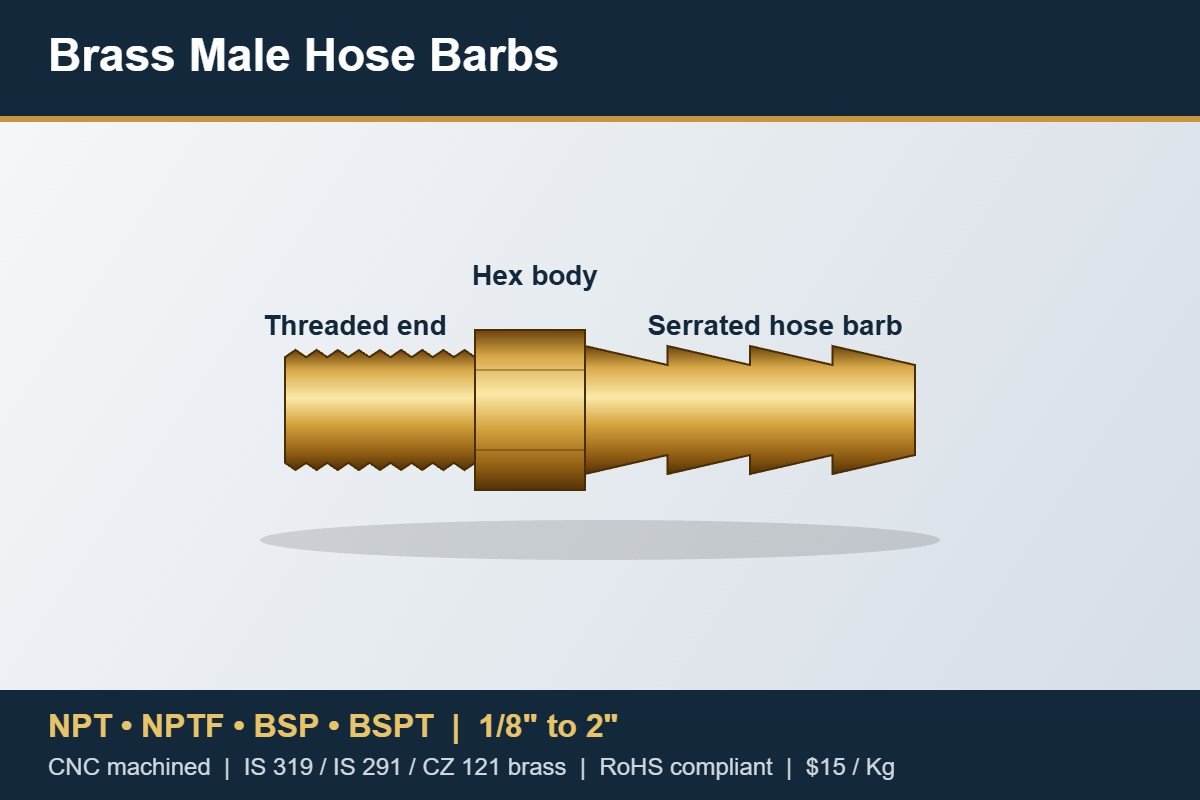
Brass Male Hose Barbs are the most widely used hose-to-pipe adapters in fluid handling. One end carries an external (male) pipe thread that screws into a female port, valve, manifold, pump casing or tank bung; the other end is a serrated, tapered shank that slides into a flexible hose and bites into the inner wall so the hose cannot pull free. The result is a compact, leak-free transition from rigid plumbing to flexible line in a single, inexpensive component. We machine our male hose barbs from IS 319 / IS 291 / CZ 121 brass in NPT, NPTF, BSPP and BSPT threads, with hose sizes from 3/16″ to 2″, and supply them in natural brass, nickel plated or chrome plated finishes.
This page is dedicated to the male configuration and gives you what a purchase engineer actually needs: a numbered part-code system, two complete size tables, weights and pieces per Kg (useful because we price by weight), hose compatibility guidance, pressure and clamping recommendations, installation steps and a troubleshooting section. If you are comparing configurations, the sister pages cover Brass Female Hose Barbs, Brass 90 Degree Hose Barb Elbows and Brass Hose Barbed Tees; the thread-specific pages are Brass NPT Hose Barbs, Brass NPTF Hose Barbs and Brass BSP Hose Tails and Hose Connectors.
Price: $15 / Kg for every size and thread type | Minimum order: 5 Kg per size code | Bulk discounts available on container quantities
Quick Specification of Brass Male Hose Barbs
| Parameter | Specification |
|---|---|
| Product | Brass Male Hose Barbs (threaded male end, serrated barb end) |
| Material | Brass IS 319 / IS 291 / CZ 121; DZR and low-lead grades on request |
| Thread standards | NPT, NPTF, BSPP (BSP parallel), BSPT (BSP taper) |
| Thread sizes | 1/8″ to 2″ |
| Hose (barb) sizes | 3/16″ to 2″ (4.8 mm to 50.8 mm) |
| Finish | Natural brass, nickel plated, chrome plated |
| Working temperature | -20°C to +120°C (hose permitting) |
| Working pressure | Up to 150 PSI (10.3 bar), derated for larger sizes |
| Price | $15 per Kg (all sizes and thread types) |
| Minimum order | 5 Kg per size code |
| Standard lead time | 7 to 15 working days |
Anatomy of a Male Hose Barb
Although it looks simple, a male hose barb is a carefully proportioned part with four functional zones. Understanding them helps you specify the right fitting and diagnose problems later.
1. The male threaded end
The threaded end carries the sealing function against the mating port. On tapered threads (NPT, NPTF and BSPT) the thread wedges into the female port and seals on the flanks, normally with PTFE tape or an anaerobic sealant; on NPTF the crests and roots are controlled so the thread can seal dry. On parallel threads (BSPP) the thread only locates and clamps, and the actual seal is made by a bonded washer, a copper or fibre washer, or an O-ring under the shoulder. This one distinction decides whether a fitting leaks or not, so always confirm the thread standard of the port before ordering. Our dedicated pages on NPT hose barbs and BSP hose tails explain the two families in depth.
2. The hex body or shoulder
Between the thread and the barb sits a hexagonal section sized for a standard open-ended spanner. The hex lets you tighten the fitting without gripping the barbs, which would damage the serrations and risk a leak path through the hose joint. On parallel-thread versions the hex face also acts as the sealing shoulder, so it is machined flat and square to the thread axis. Very small sizes can be supplied with a round collar instead of a hex when space is limited.
3. The serrated barb
The barb is a series of conical ridges. Each ridge rises smoothly from the tip toward the body and ends in a sharp shoulder, so the hose slides on easily but resists being pulled off. Our barbs are turned on CNC lathes so ridge height, pitch and shoulder angle are consistent from piece to piece; this consistency is what makes clamp torque and pull-off strength predictable. The maximum barb diameter is deliberately about 1.6 mm larger than the nominal hose bore so the hose is stretched and held firmly without being cut.
4. The through bore
A drilled bore runs the full length of the fitting. We size bores generously for flow, but the smallest section limits capacity, so for high-flow lines choose a thread size that is equal to or larger than the hose size rather than a heavily reduced combination. The bore diameters in the tables below let you check pressure drop against your flow requirement.
Part-Code System for Male Hose Barbs
To make ordering faster and avoid misunderstandings, every size carries a code number. The code is built as CX-MHB-[thread letter]-[thread size][barb size]. The thread letter is N for NPT, F for NPTF, P for BSPP (parallel) and T for BSPT (taper). Sizes use the familiar dash-size convention, which counts sixteenths of an inch: 02 = 1/8″, 04 = 1/4″, 06 = 3/8″, 08 = 1/2″, 12 = 3/4″, 16 = 1″, 20 = 1-1/4″, 24 = 1-1/2″ and 32 = 2″; the barb size also uses 03 for 3/16″ and 10 for 5/8″. For example, CX-MHB-N-0812 is a male hose barb with a 1/2″ NPT thread and a 3/4″ barb. Quoting the code in your enquiry or purchase order removes any doubt about thread and barb size.
Size Table: Equal and Standard Combinations
The first table lists the standard pairings in which the barb size matches the port size (3/16″ is paired with 1/8″ because a true 1/8″ barb is too small for practical hose). Dimensions are typical and are subject to normal machining tolerance of ±0.5 mm on length; weights are approximate and are given so you can estimate quantity per Kg at our price of $15 / Kg.
| Thread × barb | NPT code | NPTF code | BSPP code | BSPT code | Hose ID (mm) | Hex AF (mm) | Overall length (mm) | Approx. weight (g) | Pcs per Kg |
|---|---|---|---|---|---|---|---|---|---|
| 1/8″ × 3/16″ | CX-MHB-N-0203 | CX-MHB-F-0203 | CX-MHB-P-0203 | CX-MHB-T-0203 | 4.8 | 11 | 28 | 6 | 167 |
| 1/4″ × 1/4″ | CX-MHB-N-0404 | CX-MHB-F-0404 | CX-MHB-P-0404 | CX-MHB-T-0404 | 6.4 | 14 | 32 | 12 | 83 |
| 3/8″ × 3/8″ | CX-MHB-N-0606 | CX-MHB-F-0606 | CX-MHB-P-0606 | CX-MHB-T-0606 | 9.5 | 17 | 38 | 22 | 45 |
| 1/2″ × 1/2″ | CX-MHB-N-0808 | CX-MHB-F-0808 | CX-MHB-P-0808 | CX-MHB-T-0808 | 12.7 | 22 | 44 | 39 | 26 |
| 3/4″ × 3/4″ | CX-MHB-N-1212 | CX-MHB-F-1212 | CX-MHB-P-1212 | CX-MHB-T-1212 | 19 | 27 | 52 | 76 | 13 |
| 1″ × 1″ | CX-MHB-N-1616 | CX-MHB-F-1616 | CX-MHB-P-1616 | CX-MHB-T-1616 | 25.4 | 34 | 60 | 134 | 7 |
| 1-1/4″ × 1-1/4″ | CX-MHB-N-2020 | CX-MHB-F-2020 | CX-MHB-P-2020 | CX-MHB-T-2020 | 31.8 | 43 | 68 | 215 | 5 |
| 1-1/2″ × 1-1/2″ | CX-MHB-N-2424 | CX-MHB-F-2424 | CX-MHB-P-2424 | CX-MHB-T-2424 | 38.1 | 50 | 75 | 310 | 3 |
| 2″ × 2″ | CX-MHB-N-3232 | On request | CX-MHB-P-3232 | CX-MHB-T-3232 | 50.8 | 63 | 84 | 540 | 2 |
Size Table: Reducing and Mixed Combinations
Real installations often need a port size that differs from the hose size, for example a 1/4″ port feeding a 3/8″ hose to reduce velocity, or a 3/4″ pump port feeding a 1/2″ hose. These mixed combinations are produced from the same tooling with a different barb section, so they are stocked as standard rather than treated as specials. Any other combination between 1/8″ and 2″ can be made to order using the same code logic.
| Thread × barb | NPT code | NPTF code | BSPP code | BSPT code | Hose ID (mm) | Hex AF (mm) | Overall length (mm) | Approx. weight (g) | Pcs per Kg |
|---|---|---|---|---|---|---|---|---|---|
| 1/8″ × 1/4″ | CX-MHB-N-0204 | CX-MHB-F-0204 | CX-MHB-P-0204 | CX-MHB-T-0204 | 6.4 | 11 | 30 | 7.5 | 133 |
| 1/4″ × 3/16″ | CX-MHB-N-0403 | CX-MHB-F-0403 | CX-MHB-P-0403 | CX-MHB-T-0403 | 4.8 | 14 | 30 | 10.5 | 95 |
| 1/4″ × 3/8″ | CX-MHB-N-0406 | CX-MHB-F-0406 | CX-MHB-P-0406 | CX-MHB-T-0406 | 9.5 | 14 | 36 | 16 | 63 |
| 1/4″ × 1/2″ | CX-MHB-N-0408 | CX-MHB-F-0408 | CX-MHB-P-0408 | CX-MHB-T-0408 | 12.7 | 14 | 39 | 21 | 48 |
| 3/8″ × 1/4″ | CX-MHB-N-0604 | CX-MHB-F-0604 | CX-MHB-P-0604 | CX-MHB-T-0604 | 6.4 | 17 | 34 | 18 | 56 |
| 3/8″ × 1/2″ | CX-MHB-N-0608 | CX-MHB-F-0608 | CX-MHB-P-0608 | CX-MHB-T-0608 | 12.7 | 17 | 41 | 27 | 37 |
| 1/2″ × 3/8″ | CX-MHB-N-0806 | CX-MHB-F-0806 | CX-MHB-P-0806 | CX-MHB-T-0806 | 9.5 | 22 | 41 | 34 | 29 |
| 1/2″ × 5/8″ | CX-MHB-N-0810 | CX-MHB-F-0810 | CX-MHB-P-0810 | CX-MHB-T-0810 | 15.9 | 22 | 46 | 46 | 22 |
| 1/2″ × 3/4″ | CX-MHB-N-0812 | CX-MHB-F-0812 | CX-MHB-P-0812 | CX-MHB-T-0812 | 19 | 22 | 49 | 52 | 19 |
| 3/4″ × 1/2″ | CX-MHB-N-1208 | CX-MHB-F-1208 | CX-MHB-P-1208 | CX-MHB-T-1208 | 12.7 | 27 | 47 | 63 | 16 |
| 3/4″ × 5/8″ | CX-MHB-N-1210 | CX-MHB-F-1210 | CX-MHB-P-1210 | CX-MHB-T-1210 | 15.9 | 27 | 49 | 70 | 14 |
| 3/4″ × 1″ | CX-MHB-N-1216 | CX-MHB-F-1216 | CX-MHB-P-1216 | CX-MHB-T-1216 | 25.4 | 27 | 56 | 92 | 11 |
| 1″ × 3/4″ | CX-MHB-N-1612 | CX-MHB-F-1612 | CX-MHB-P-1612 | CX-MHB-T-1612 | 19 | 34 | 56 | 118 | 8 |
| 1″ × 1-1/4″ | CX-MHB-N-1620 | CX-MHB-F-1620 | CX-MHB-P-1620 | CX-MHB-T-1620 | 31.8 | 34 | 65 | 157 | 6 |
How to Read the Size Tables
The hose ID column is the inside diameter of the hose the barb is designed for. The hex across-flats value is the spanner size you will need. Overall length is measured from the end of the thread to the tip of the barb. The pieces-per-Kg figure rounds the weight to the nearest whole piece and lets you convert directly between pieces and price: a 1/4″ × 1/4″ male barb weighs about 12 g, so 1 Kg contains roughly 83 pieces and costs $15, working out at about 18 cents each, while a 1″ × 1″ barb weighs around 134 g and costs about $2.01 per piece. Because weight-based pricing rewards small, compact parts, male barbs are an economical way to standardise a plant on a single supplier.
Thread Options for Male Hose Barbs
NPT male hose barbs
NPT, defined by ASME B1.20.1, is the default in North America and is also common in Indian industrial equipment. The 60-degree thread tapers at 1:16 on diameter. Choose NPT when the female port is marked NPT or when the equipment came from a US manufacturer. See Brass NPT Hose Barbs for the full thread data.
NPTF male hose barbs
NPTF, from ASME B1.20.3, has the same angle and taper as NPT but with controlled crest and root truncation so the thread interferes metal-to-metal and seals without tape. It is specified on fuel, hydraulic and automotive lines. Details are on the Brass NPTF Hose Barbs page.
BSPP and BSPT male hose barbs
BSP threads, with a 55-degree Whitworth form, dominate in the UK, Europe, Australia, the Middle East and across Asia. BSPT (ISO 7, marked R) tapers and seals on the thread, while BSPP (ISO 228, marked G) is parallel and needs a washer. Never mix NPT and BSP: the pitch and flank angle differ and a forced joint will leak. For BSP-focused product detail, see Brass BSP Hose Tails and Hose Connectors.
Hose Compatibility Guide
A male hose barb is only as good as the hose it carries. The table below summarises how common hose materials behave on a brass barb, so you can pair the fitting with the right line.
| Hose material | Suitability on a brass male barb | Practical note |
|---|---|---|
| Natural / SBR rubber air and water hose | Excellent | Most common pairing; one clamp is enough up to about 30 PSI, two clamps above that. |
| EPDM water and steam-resistant hose | Excellent | Good for hot water to roughly 120°C; check the hose maker’s own temperature rating. |
| NBR / nitrile fuel and oil hose | Excellent | Preferred for diesel, petrol and lubricating oil lines; use fuel-rated clamps. |
| PVC clear and braided hose | Very good | Soften the hose end in warm water for the larger barbs; avoid cold-weather forcing. |
| Polyurethane (PU) hose | Good | Choose a shell-reinforced PU type; thin unreinforced PU may collapse under clamp load. |
| Silicone hose | Good | Silicone is soft, so use a wide-band clamp to avoid cutting into the wall. |
| PTFE or nylon tube | Not recommended | Rigid tube does not seal on serrations; use compression or push-in fittings instead. |
| Stainless steel braided flexible hose | Not recommended | Terminate with a crimped or welded end fitting rather than a barb. |
Pressure Ratings and Clamping Guidance
The brass body of a male hose barb can withstand far more pressure than the hose connection can. In practice the working pressure is set by the hose, the clamp and the barb size together. Our indicative ratings assume a reinforced hose of suitable grade, correct clamp placement and ambient temperature; they are not a substitute for the hose manufacturer’s published data.
| Hose ID | Indicative working pressure | Recommended clamping | Typical use |
|---|---|---|---|
| 3/16″ to 3/8″ | Up to 150 PSI (10.3 bar) | 1 worm-drive or ear clamp | Instrument air, lubrication, small coolant lines |
| 1/2″ | Up to 150 PSI (10.3 bar) | 1 clamp; 2 above 100 PSI | Compressor tails, water taps, fuel feed |
| 5/8″ to 3/4″ | Up to 125 PSI (8.6 bar) | 2 clamps recommended | Irrigation headers, pump discharge, washdown |
| 1″ | Up to 100 PSI (6.9 bar) | 2 clamps, spaced apart | Industrial water transfer, tank outlets |
| 1-1/4″ to 1-1/2″ | Up to 100 PSI (6.9 bar) | 2 clamps or crimp ferrule | Cooling circuits, bilge and drainage |
| 2″ | Up to 75 PSI (5.2 bar) | 2 heavy-duty clamps | Suction and gravity transfer, dewatering |
Place the clamp over the barbs, about 3 to 6 mm from the hose end, and never over the plain neck or the hex. For hot-water service allow for hose softening as temperature rises and re-tighten the clamp after the first thermal cycle. For vibration service use a clamp with a smooth band and, if possible, a spring-type clamp that compensates for hose creep.
Applications of Brass Male Hose Barbs
Compressed air and pneumatic systems
Workshops, assembly lines and paint shops use male barbs to connect air hoses to filter regulators, lubricators, receivers and tool manifolds. Brass is non-sparking, does not rust inside the air line, and the smooth bore keeps flow resistance low. NPT is typical for US-built compressors and BSP for European units.
Water supply, irrigation and washdown
Garden, farm and municipal systems use brass barbs on pump outlets, sprinkler headers, drip-irrigation mains and hose bibs. Brass resists UV, frost cracking and the chlorinated water that attacks many plastics. For drinking-water duty request DZR or low-lead brass.
Fuel, lubrication and oil transfer
Diesel generators, tractors, marine engines and lubrication skids rely on male barbs to attach rubber fuel and oil hose to tanks, filters and pumps. Nickel plating adds a further barrier on exposed marine installations.
Cooling circuits and heat exchangers
Coolant lines, chiller loops and hot-water circuits use barbs on radiators, header tanks and heat-exchanger ports. The good thermal behaviour of brass keeps the joint tight through repeated expansion cycles.
Industrial process, dosing and laboratory use
Chemical dosing pumps, water-treatment plants and laboratory rigs use small-bore barbs on flexible lines. Always check chemical compatibility: brass is excellent with water, air, oils and many fuels but unsuitable for ammonia, strong acids and some chlorinated solvents.
Agriculture, spraying and livestock
Sprayers, milking plant, livestock drinkers and fertiliser injectors use male barbs for quick, robust hose termination that survives rough handling.
Material and Manufacturing
Our male hose barbs are turned from certified brass hex or round bar. IS 319 and CZ 121 are 60/40 free-cutting brasses with 57–63% copper and 37–43% zinc, offering a hardness of about 120–150 HB and a minimum tensile strength of 360 MPa. Free-cutting grades produce clean threads and crisp barb shoulders on high-speed CNC lathes. Where the application demands it, we can supply dezincification-resistant (DZR) brass, which resists the selective zinc leaching that can occur in aggressive or high-chloride water, and low-lead brass that supports drinking-water compliance.
The production route is bar cutting, CNC turning of the thread, hex and barb profile, drilling of the through bore, deburring, tumbling, ultrasonic cleaning, optional plating, inspection and packing. Thread gauges are used on every batch, and barb diameters are verified with micrometers. Our factory operates under ISO 9001:2015 and maintains material traceability from bar lot to finished carton, and we can provide material test reports with each consignment on request.
How to Choose the Right Male Hose Barb
- Identify the port thread. Check the markings on the equipment or use a thread gauge. A mismatch between NPT and BSP is the most common cause of returns.
- Choose the hose size from flow, not convenience. Match the barb to the hose inside diameter, and keep the bore large enough for your flow rate.
- Decide the sealing method. Tapered threads need tape or sealant; parallel threads need a washer or O-ring.
- Check the medium. Water, air and fuel are ideal; aggressive chemicals may need stainless steel or plastic instead.
- Pick the finish. Natural brass for general service, nickel plating for marine or outdoor use, chrome plating for visible installations.
- Plan clamping. Order clamps of the right range with the barbs so the system is complete.
Installation Guidelines
- Inspect the port and the fitting threads for dirt and burrs and wipe both clean.
- On tapered threads apply two to three wraps of PTFE tape in the direction of the thread, or a thin film of anaerobic sealant, leaving the first thread bare.
- Screw the fitting in by hand until it is snug, then tighten with a spanner on the hex only. Typically one to two turns past hand-tight is enough on tapered threads; avoid overtightening, which can split a female port.
- On parallel threads fit the washer or O-ring under the shoulder and tighten until the shoulder seats; do not rely on the thread to seal.
- Cut the hose square, soften it if necessary, and push it fully onto the barb until it covers all the serrations.
- Fit the clamp over the barbs, tighten evenly, then pressure test with the working medium and re-check for weeping.
Troubleshooting Common Problems
Hose slips off under pressure: the clamp is too large, positioned on the neck, or the hose is too hard for the barb; fit a correctly sized clamp or a crimp ferrule. Leak at the thread: usually insufficient sealant on a tapered thread, a missing washer on a parallel thread, or mixed NPT and BSP threads. Cracked port: over-tightening a tapered male thread into a cast female port; use only the recommended turns past hand-tight. Hose splits at the barb: the hose is old or the barb is oversized for the hose; replace the hose and confirm the ID. Corrosion marks: usually from an incompatible medium or galvanic contact with aluminium; switch to a plated or stainless alternative.
Custom and OEM Male Hose Barbs
We manufacture male hose barbs to your drawing or sample: special thread forms, metric threads, longer or shorter barb sections, double-barb profiles, extra O-ring grooves, hose stops and reinforced shoulders. Non-standard combinations such as an NPT thread with a metric hose barb are routine. Tell us the quantity, material, finish and standards and we will quote against your drawing; custom jobs are priced on the same $15 / Kg weight basis wherever the design is within standard brass-bar machining.
Pricing, Packing and Ordering
| Item | Details |
|---|---|
| Price | $15 per Kg, all sizes and all thread types |
| Minimum order quantity | 5 Kg per size code |
| Standard lead time | 7 to 15 working days for standard sizes |
| Packaging | Polybags inside export cartons; custom branding available |
| Quality | ISO 9001:2015, RoHS compliant, material traceability |
| Payment | T/T, LC at sight, PayPal for small orders |
| Shipping | Worldwide by sea, air or courier |
Send us the code numbers from the tables above, your quantity and your destination country, and our team replies with a formal quotation within 24 hours. Mixed-size orders are welcome and each size code is counted separately for minimum quantity. See the main Brass Hose Barbs page for the overall range.
Frequently Asked Questions
What is a brass male hose barb?
A brass male hose barb is a fitting with an external pipe thread on one end and a serrated barb on the other. The thread screws into a female port and the barb grips a flexible hose, making a leak-free connection between rigid and flexible plumbing.
Which thread types are available on your male hose barbs?
We supply NPT, NPTF, BSPP (BSP parallel) and BSPT (BSP taper) threads. Specify the standard using the thread letter in the part code: N, F, P or T.
What size range do you offer?
Thread sizes run from 1/8″ to 2″ and hose barb sizes from 3/16″ to 2″, in equal and reducing combinations. Any combination in that range can be made to order.
What does the code CX-MHB-N-0812 mean?
It means a male hose barb (MHB) with an NPT thread (N), a 1/2″ thread (08) and a 3/4″ barb (12). The same logic applies to every size and thread letter.
What is the price of brass male hose barbs?
The price is $15 per Kg for all sizes and thread types, with a minimum order of 5 Kg per size code and discounts for larger quantities.
How many pieces are there in one Kg?
It depends on the size. A 1/4″ × 1/4″ barb weighs about 12 g (roughly 83 pieces per Kg) while a 1″ × 1″ barb weighs about 134 g (roughly 7 pieces per Kg). The size tables list approximate pieces per Kg.
Do I need a hose clamp with a male hose barb?
For low pressure a snug hose may hold, but above about 30 PSI, or with hot or vibrating lines, a clamp or crimp ferrule is strongly recommended.
Can male hose barbs be used for drinking water?
Yes, if you order dezincification-resistant or low-lead brass. State the requirement in your enquiry so the right alloy is supplied and the test report is provided.
Can I get nickel-plated or chrome-plated male hose barbs?
Yes. Natural brass, nickel plated and chrome plated finishes are available at the same $15 per Kg price for standard sizes; please mention the finish when ordering.
Can you make male hose barbs to my drawing?
Yes. We machine custom threads, barb profiles, lengths and combinations to drawings or samples and can quote against your specification.
Explore Related Brass Hose Barb Pages
Every fitting in this range is produced in the same brass grades and shipped on the same commercial terms of $15 per Kg. Use these pages to compare configurations, then return to the main Brass Hose Barbs page for the complete overview.
- Brass Female Hose Barbs – hex-body adapters that receive male-threaded ports, valves and pump outlets
- Brass 90 Degree Hose Barb Elbows – right-angle fittings for hose routing in tight spaces without kinking
- Brass Hose Barbed Tees – three-way fittings for splitting, merging and manifold hose layouts
- Brass NPT Hose Barbs – tapered ASME B1.20.1 threads used across North America and many Indian OEMs
- Brass NPTF Hose Barbs – dryseal ASME B1.20.3 threads for fuel, hydraulic and tape-free service
- Brass BSP Hose Tails and Hose Connectors – BSP parallel and taper hose tails plus double-barb hose connectors
Reviews
There are no reviews yet.