Description
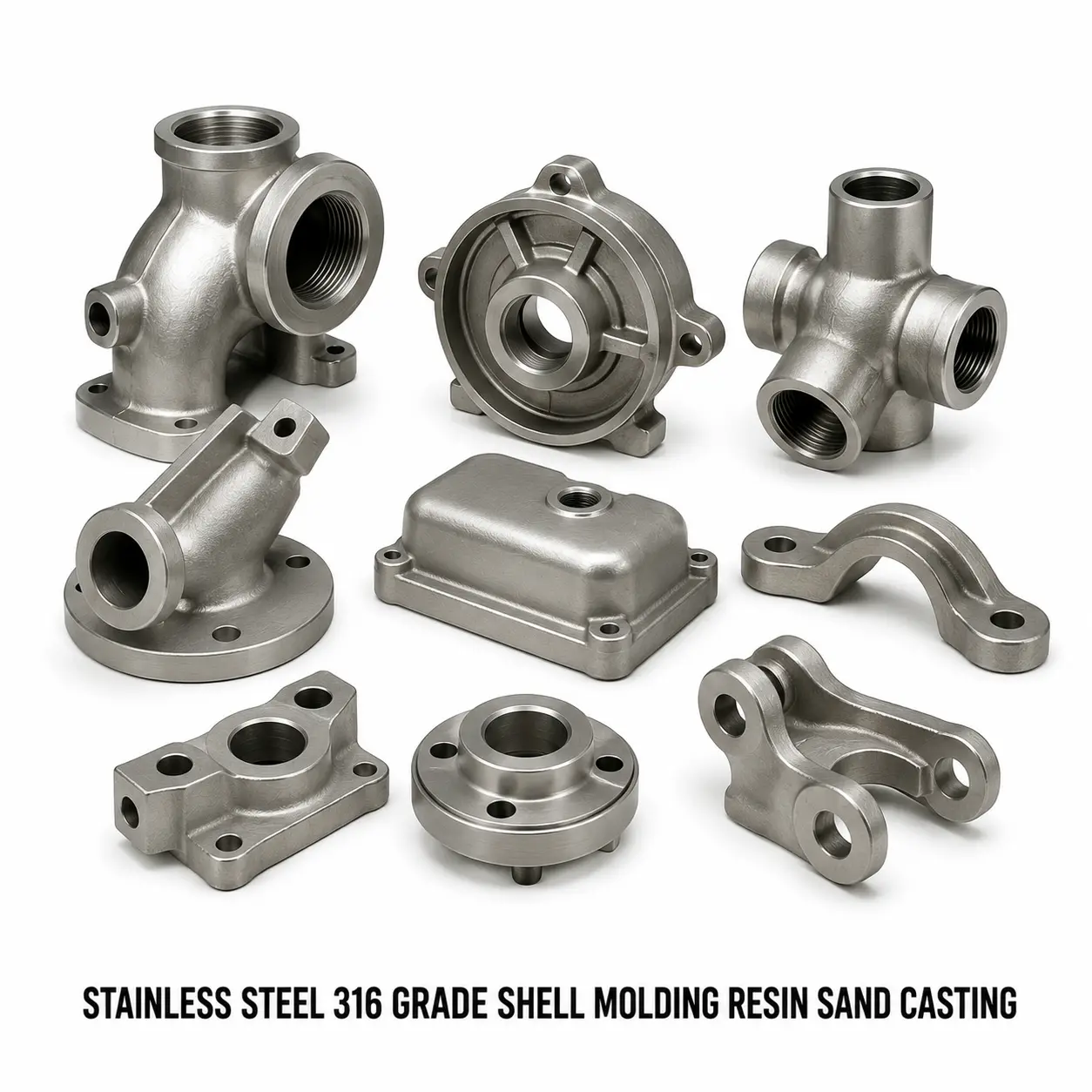
Stainless Steel 316 Grade Shell Molding & Resin Sand Casting
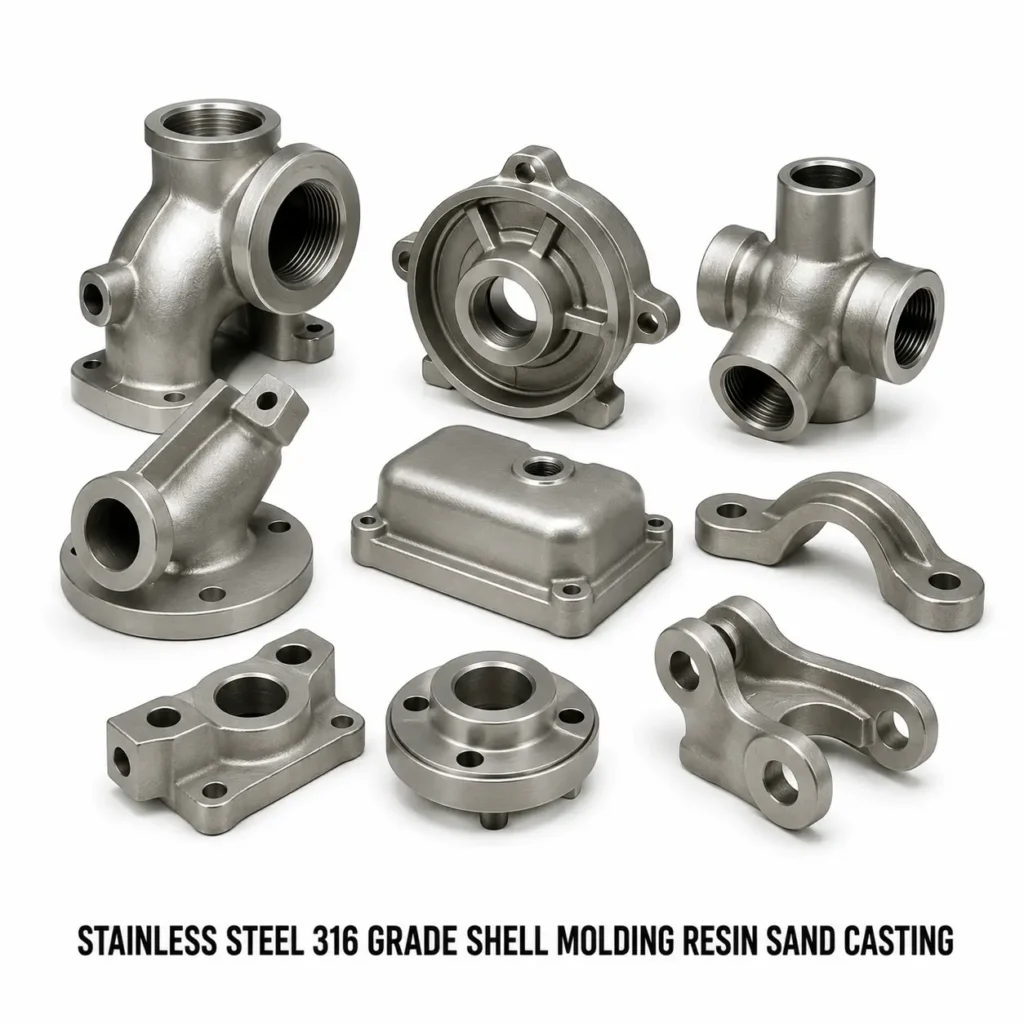
Stainless Steel Fittings India manufactures high-precision Stainless Steel 316 Grade Shell Molding and Resin Sand Castings for demanding industrial applications worldwide. Our SS 316 castings combine the superior corrosion resistance of grade 316 alloy with the dimensional accuracy of shell molding and the versatility of resin sand casting processes.
What is SS 316 Shell Molding Casting?
Shell molding is an advanced casting process where a resin-coated sand mixture is applied to a heated metal pattern, forming a thin, strong shell mold. This process produces castings with excellent surface finish (Ra 3.2–6.3 µm), tight tolerances (CT5–CT7), and minimal machining requirements. Combined with Stainless Steel 316 grade — which contains 16–18% chromium, 10–14% nickel, and 2–3% molybdenum — the result is a casting that resists chloride-induced corrosion, pitting, and crevice corrosion even in aggressive marine and chemical environments.
What is SS 316 Resin Sand Casting?
Resin sand casting uses chemically bonded sand molds to produce medium-to-large complex castings with superior dimensional stability. The no-bake resin process allows the production of intricate geometries with undercuts, large wall sections, and internal passages. Our SS 316 resin sand castings serve pumps, valves, heat exchangers, and chemical processing equipment.
Material Specifications
- Grade: SS 316 / SS 316L / SS 316Ti
- Standard: ASTM A351 CF8M (SS 316), ASTM A743/A744
- Chromium: 16–18%
- Nickel: 10–14%
- Molybdenum: 2–3%
- Carbon: Max 0.08% (316), Max 0.03% (316L)
- Tensile Strength: Min 515 MPa
- Yield Strength: Min 205 MPa
Casting Processes Available
- Shell Molding: Best for small-to-medium precision castings, excellent surface finish
- Resin Sand Casting: Ideal for medium-to-large complex components
- Investment Casting: For intricate components requiring near-net shape
Applications
- Marine hardware and offshore equipment
- Chemical and petrochemical processing valves and pump bodies
- Food and beverage processing equipment
- Pharmaceutical machinery components
- Desalination plant components
- Heat exchangers and pressure vessel parts
- Architectural and decorative hardware
Quality Standards
All SS 316 castings are manufactured under ISO 9001:2015 quality management systems and tested per ASTM, EN, and DIN standards. Radiographic testing, dye penetrant inspection, ultrasonic testing, and chemical composition verification are available per customer requirements.
Frequently Asked Questions (FAQs)
Q1: What is the difference between SS 316 and SS 316L grade castings?
SS 316 contains up to 0.08% carbon while SS 316L (low carbon) contains a maximum of 0.03% carbon. SS 316L offers superior resistance to sensitization (carbide precipitation at grain boundaries) during welding or exposure to elevated temperatures. For welded assemblies or high-temperature service, SS 316L is recommended.
Q2: What is the minimum and maximum weight range for your SS 316 shell mold castings?
Our SS 316 shell mold castings range from 0.1 kg to approximately 50 kg per piece. For heavier components up to 500 kg, we use resin sand casting. Please contact our engineering team for specific weight and size requirements.
Q3: What surface finish can I expect from SS 316 shell molding castings?
Shell molding produces castings with a surface finish of Ra 3.2 to 6.3 µm, significantly better than green sand casting. Resin sand castings typically achieve Ra 6.3–12.5 µm. Post-casting grinding, shot blasting, or machining can achieve finer finishes per specification.
Q4: Can SS 316 castings be used in food-grade applications?
Yes. SS 316 grade is widely accepted for food and beverage processing, dairy equipment, and pharmaceutical applications due to its excellent corrosion resistance, ease of cleaning, and compliance with FDA/EU food contact regulations. We can supply castings with electropolished or passivated finishes for hygienic applications.
Q5: What is the typical lead time for SS 316 shell molding castings?
Standard lead time for SS 316 shell mold castings is 4–6 weeks from approved drawings. For urgent requirements, we can offer expedited production in 2–3 weeks for standard configurations. Tooling development for new patterns typically requires an additional 2–4 weeks.
Q6: Do you offer machining services along with casting?
Yes. Stainless Steel Fittings India offers complete cast-and-machined solutions. We provide CNC turning, milling, drilling, and threading services in-house. This allows us to deliver ready-to-use components, eliminating the need for separate machining vendors.
Q7: What certifications do your SS 316 castings comply with?
Our castings comply with ASTM A351, ASTM A743, ASTM A744, EN 10283, and DIN 17445 standards. We provide 3.1 material test certificates per EN 10204. Additional certifications including PED, NACE MR0175, and third-party inspection (Lloyd’s, BV, TUV, SGS) are available on request.
Q8: What is the price of SS 316 shell molding castings?
The indicative price for SS 316 shell molding and resin sand castings is USD 11.30 per kilogram. Final pricing depends on quantity, complexity, machining requirements, and specific grade (316 vs 316L). Please request a formal quotation with your drawings for accurate pricing.
Q9: What countries do you export SS 316 castings to?
Stainless Steel Fittings India exports SS 316 castings to the USA, UK, Germany, France, Australia, Canada, UAE, Saudi Arabia, Singapore, Japan, South Korea, Brazil, and over 50 other countries. We have established logistics partnerships for reliable worldwide delivery.
Q10: Can you cast SS 316 in complex geometries with internal passages?
Yes. Both shell molding and resin sand casting support the use of sand cores to create internal passages, undercuts, and complex geometries. Investment casting is recommended for the most intricate forms. We work from customer-supplied 3D models (STEP, IGES) or 2D drawings.
Q11: What is the dimensional tolerance achievable in SS 316 shell mold castings?
Shell mold castings in SS 316 can achieve CT5 to CT7 tolerances per ISO 8062-3. Linear tolerances of ±0.3 mm to ±0.8 mm on critical dimensions are achievable. Resin sand castings typically achieve CT8–CT10. Post-machining tolerances can reach ±0.01 mm.
Q12: What non-destructive testing (NDT) options are available for SS 316 castings?
We offer a full range of NDT services including: Radiographic Testing (RT/X-ray), Dye Penetrant Inspection (DPI/LPI), Magnetic Particle Inspection (MPI) where applicable, Ultrasonic Testing (UT), and Hydrostatic pressure testing. All testing is performed to ASTM E94, ASTM E165, ASTM E709, and customer-specified standards.
Reviews
There are no reviews yet.