
Description
Brass Female Hose Barbs
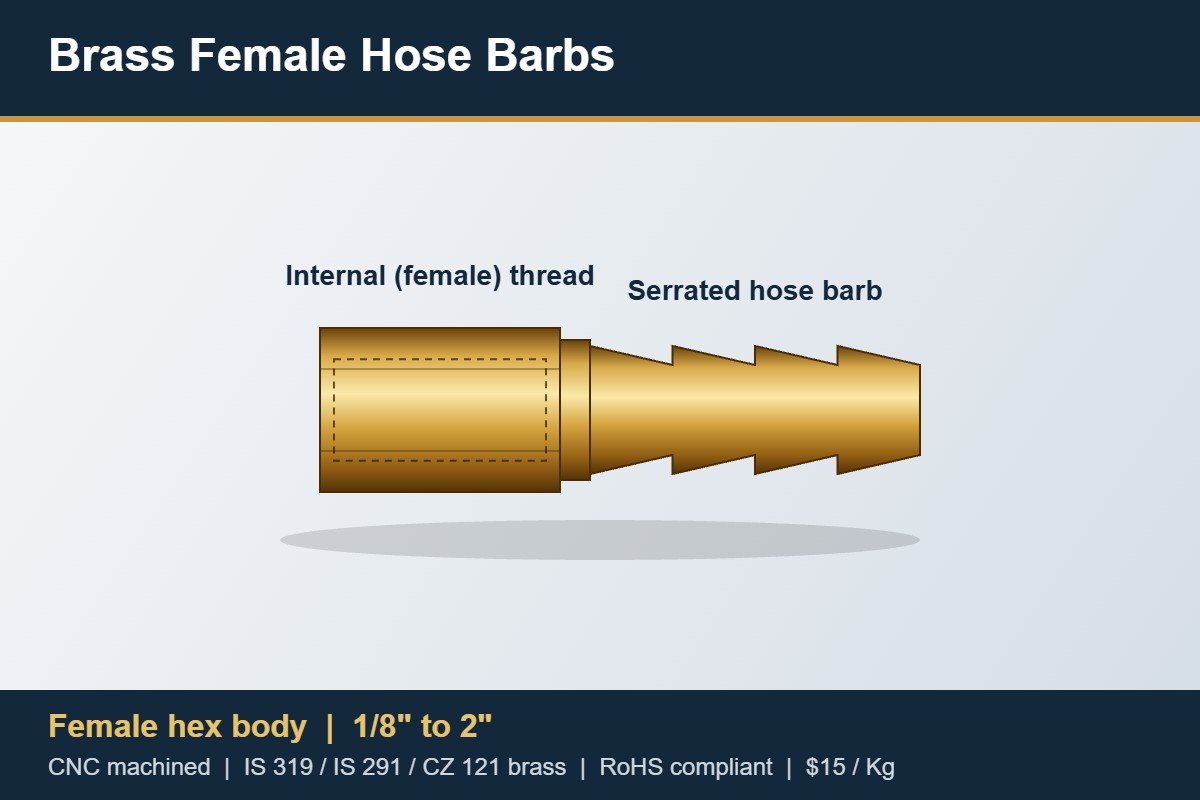
Brass Female Hose Barbs solve the opposite problem to a male barb: the equipment you are connecting to already has a male-threaded stub, and you need to put a hose on it. One end of the fitting is an internal (female) threaded hex body that screws over a male pipe nipple, valve spigot, pump outlet or tank connector; the other end is a serrated barb that grips a flexible hose. We manufacture them from IS 319 / IS 291 / CZ 121 brass with NPT, NPTF, BSPP and BSPT internal threads, in thread sizes from 1/8″ to 2″ and hose sizes from 3/16″ to 2″, in natural brass, nickel plated and chrome plated finishes.
This page concentrates on what makes the female style different: how internal threads seal, which male thread each female thread can safely accept, how much torque a brass hex body can take, and when a female barb is the better engineering choice. You will find code-numbered size tables, weights and pieces per Kg, a mating-thread guide, a tightening table, applications and a complete FAQ. For the opposite configuration see Brass Male Hose Barbs; for directional changes see Brass 90 Degree Hose Barb Elbows; for splitting a line see Brass Hose Barbed Tees.
Price: $15 / Kg for all female hose barb sizes and threads | Minimum order: 5 Kg per size code | Bulk discounts available
Quick Specification of Brass Female Hose Barbs
| Parameter | Specification |
|---|---|
| Product | Brass Female Hose Barbs (internal thread, hex body, serrated barb) |
| Material | Brass IS 319 / IS 291 / CZ 121; DZR and low-lead on request |
| Thread standards | NPT, NPTF, BSPP (G), BSPT (Rp) |
| Female thread sizes | 1/8″ to 2″ |
| Hose (barb) sizes | 3/16″ to 2″ |
| Body style | Full hexagon for spanner tightening |
| Finish | Natural brass, nickel plated, chrome plated |
| Working pressure | Up to 150 PSI (10.3 bar), hose and clamp permitting |
| Price | $15 per Kg |
| Minimum order | 5 Kg per size code |
| Lead time | 7 to 15 working days |
When a Female Hose Barb Is the Right Choice
Hose connections in real plants are rarely free to choose their own thread gender. Pumps are cast with threaded discharge ports or fitted with short male nipples. Ball valves and gate valves may end in a male spigot. Water meters, filters, pressure gauges and flow switches often come with male unions. Wherever a male stub is already present, a female hose barb is the shortest path: it threads straight over the stub with no extra adapter, and the hex body gives a wrench grip right where the torque is applied.
The female style also protects equipment. A male hose barb puts a relatively slender threaded shank into a port, and any side load from a heavy hose bends that shank against the port threads. A female barb carries the load on a thick-walled hex body that sits around the stub rather than inside it, which spreads stress over more metal. On vibrating machinery such as compressors and engine-driven pumps, this can reduce thread fatigue and loosening.
Anatomy of a Female Hose Barb
The internal thread
The internal thread is tapped into the hex body to a depth that accepts the full engagement length of the mating male thread. We use tap and thread-plug gauge control so the thread is neither tight enough to gall nor loose enough to leak. On taper threads (NPT, NPTF and BSPT) the internal thread tapers to match the male stub and the seal forms as the two wedges meet. On parallel BSPP threads the thread only locates the parts; the seal is made on the male-side face with a washer or O-ring that compresses against the end of the female hex.
The hex body
A female thread needs wall thickness around it to resist the hoop stress of tightening, so our hex bodies are generous. The across-flats dimensions in the size tables are larger than those of the equivalent male barb for exactly that reason. A hex also ensures that tightening torque is applied to a surface that cannot be damaged by the spanner, protecting the barb.
The transition and the barb
Behind the hex, a short neck leads to the serrated barb. Ridge height, pitch and shoulder angle are controlled on CNC lathes so that hoses seat consistently and clamp pressure is predictable. As on all of our hose fittings, the largest barb diameter is about 1.6 mm over the nominal hose inside diameter, so the hose is held under tension without being cut.
The bore
The through bore is drilled concentric with the thread and barb. We keep the bore as large as the wall thickness allows to preserve flow; the bore diameters used in our standard sizes match those on the male barb page, so you can compare pressure drop directly.
Part-Code System for Female Hose Barbs
Every size carries a code built as CX-FHB-[thread letter]-[thread size][barb size]. The thread letter is N (NPT), F (NPTF), P (BSPP) or T (BSPT). Sizes follow the dash-size convention in sixteenths of an inch: 02 = 1/8″, 04 = 1/4″, 06 = 3/8″, 08 = 1/2″, 12 = 3/4″, 16 = 1″, 20 = 1-1/4″, 24 = 1-1/2″, 32 = 2″, with 03 for a 3/16″ barb and 10 for 5/8″. For instance, CX-FHB-P-0608 is a female hose barb with a 3/8″ BSPP internal thread and a 1/2″ barb. Include the code in every enquiry and purchase order.
Size Table: Equal and Standard Combinations
Standard pairings match the barb to the thread size, except 1/8″, where a 3/16″ barb is used because a 1/8″ barb is too small for practical hose. Lengths are typical and carry ±0.5 mm tolerance; weights are approximate and are shown because we price by weight at $15 / Kg.
| Female thread × barb | NPT code | NPTF code | BSPP code | BSPT code | Hose ID (mm) | Hex AF (mm) | Overall length (mm) | Approx. weight (g) | Pcs per Kg |
|---|---|---|---|---|---|---|---|---|---|
| 1/8″ × 3/16″ | CX-FHB-N-0203 | CX-FHB-F-0203 | CX-FHB-P-0203 | CX-FHB-T-0203 | 4.8 | 14 | 30 | 8 | 125 |
| 1/4″ × 1/4″ | CX-FHB-N-0404 | CX-FHB-F-0404 | CX-FHB-P-0404 | CX-FHB-T-0404 | 6.4 | 17 | 35 | 16 | 63 |
| 3/8″ × 3/8″ | CX-FHB-N-0606 | CX-FHB-F-0606 | CX-FHB-P-0606 | CX-FHB-T-0606 | 9.5 | 22 | 40 | 29 | 34 |
| 1/2″ × 1/2″ | CX-FHB-N-0808 | CX-FHB-F-0808 | CX-FHB-P-0808 | CX-FHB-T-0808 | 12.7 | 27 | 48 | 51 | 20 |
| 3/4″ × 3/4″ | CX-FHB-N-1212 | CX-FHB-F-1212 | CX-FHB-P-1212 | CX-FHB-T-1212 | 19 | 32 | 56 | 99 | 10 |
| 1″ × 1″ | CX-FHB-N-1616 | CX-FHB-F-1616 | CX-FHB-P-1616 | CX-FHB-T-1616 | 25.4 | 41 | 64 | 174 | 6 |
| 1-1/4″ × 1-1/4″ | CX-FHB-N-2020 | CX-FHB-F-2020 | CX-FHB-P-2020 | CX-FHB-T-2020 | 31.8 | 50 | 72 | 280 | 4 |
| 1-1/2″ × 1-1/2″ | CX-FHB-N-2424 | CX-FHB-F-2424 | CX-FHB-P-2424 | CX-FHB-T-2424 | 38.1 | 55 | 79 | 403 | 2 |
| 2″ × 2″ | CX-FHB-N-3232 | On request | CX-FHB-P-3232 | CX-FHB-T-3232 | 50.8 | 70 | 89 | 702 | 1 |
Size Table: Reducing and Mixed Combinations
Mixed sizes are common on pump and valve ports, where the thread is set by the equipment but the hose size is set by flow. A 3/4″ pump port running 1/2″ hose, or a 1/4″ gauge port feeding 3/8″ tube, are typical examples. We stock these combinations as standard and can machine any other pairing between 1/8″ and 2″ using the same code logic.
| Female thread × barb | NPT code | NPTF code | BSPP code | BSPT code | Hose ID (mm) | Hex AF (mm) | Overall length (mm) | Approx. weight (g) | Pcs per Kg |
|---|---|---|---|---|---|---|---|---|---|
| 1/8″ × 1/4″ | CX-FHB-N-0204 | CX-FHB-F-0204 | CX-FHB-P-0204 | CX-FHB-T-0204 | 6.4 | 14 | 32 | 10 | 100 |
| 1/4″ × 3/16″ | CX-FHB-N-0403 | CX-FHB-F-0403 | CX-FHB-P-0403 | CX-FHB-T-0403 | 4.8 | 17 | 33 | 14 | 71 |
| 1/4″ × 3/8″ | CX-FHB-N-0406 | CX-FHB-F-0406 | CX-FHB-P-0406 | CX-FHB-T-0406 | 9.5 | 17 | 39 | 21 | 48 |
| 1/4″ × 1/2″ | CX-FHB-N-0408 | CX-FHB-F-0408 | CX-FHB-P-0408 | CX-FHB-T-0408 | 12.7 | 17 | 42 | 27 | 37 |
| 3/8″ × 1/4″ | CX-FHB-N-0604 | CX-FHB-F-0604 | CX-FHB-P-0604 | CX-FHB-T-0604 | 6.4 | 22 | 36 | 23 | 43 |
| 3/8″ × 1/2″ | CX-FHB-N-0608 | CX-FHB-F-0608 | CX-FHB-P-0608 | CX-FHB-T-0608 | 12.7 | 22 | 43 | 35 | 29 |
| 1/2″ × 3/8″ | CX-FHB-N-0806 | CX-FHB-F-0806 | CX-FHB-P-0806 | CX-FHB-T-0806 | 9.5 | 27 | 45 | 44 | 23 |
| 1/2″ × 5/8″ | CX-FHB-N-0810 | CX-FHB-F-0810 | CX-FHB-P-0810 | CX-FHB-T-0810 | 15.9 | 27 | 50 | 60 | 17 |
| 1/2″ × 3/4″ | CX-FHB-N-0812 | CX-FHB-F-0812 | CX-FHB-P-0812 | CX-FHB-T-0812 | 19 | 27 | 53 | 68 | 15 |
| 3/4″ × 1/2″ | CX-FHB-N-1208 | CX-FHB-F-1208 | CX-FHB-P-1208 | CX-FHB-T-1208 | 12.7 | 32 | 51 | 82 | 12 |
| 3/4″ × 5/8″ | CX-FHB-N-1210 | CX-FHB-F-1210 | CX-FHB-P-1210 | CX-FHB-T-1210 | 15.9 | 32 | 53 | 91 | 11 |
| 3/4″ × 1″ | CX-FHB-N-1216 | CX-FHB-F-1216 | CX-FHB-P-1216 | CX-FHB-T-1216 | 25.4 | 32 | 60 | 120 | 8 |
| 1″ × 3/4″ | CX-FHB-N-1612 | CX-FHB-F-1612 | CX-FHB-P-1612 | CX-FHB-T-1612 | 19 | 41 | 60 | 153 | 7 |
| 1″ × 1-1/4″ | CX-FHB-N-1620 | CX-FHB-F-1620 | CX-FHB-P-1620 | CX-FHB-T-1620 | 31.8 | 41 | 69 | 204 | 5 |
Internal Thread Data
For the purchasing engineer who wants to cross-check against a gauge or drawing, the table below gives the pitch of each thread family and the typical internal thread depth. NPT and NPTF share pitch values because NPTF is a dryseal variant of the same form; BSPT and BSPP share pitch within each size.
| Thread size | NPT threads per inch | BSP threads per inch | NPT effective thread length L2 (mm) | Typical internal thread depth in our body (mm) |
|---|---|---|---|---|
| 1″ | 11.5 | 11 | 17.34 | 18.8 |
| 2″ | 11.5 | 11 | 19.2 | 20.7 |
| 1/8″ | 27 | 28 | 6.73 | 8.2 |
| 1/4″ | 18 | 19 | 10.19 | 11.7 |
| 3/8″ | 18 | 19 | 10.36 | 11.9 |
| 1/2″ | 14 | 14 | 13.56 | 15.1 |
| 3/4″ | 14 | 14 | 13.86 | 15.4 |
| 1-1/4″ | 11.5 | 11 | 17.86 | 19.4 |
| 1-1/2″ | 11.5 | 11 | 18.39 | 19.9 |
Which Male Thread Does Each Female Barb Accept?
The most frequent cause of a leaking joint is mixing thread families. The 60-degree NPT flank and the 55-degree Whitworth BSP flank differ, and although a few sizes appear to start threading together, they will not seal and can damage both parts. Use this guide before ordering.
| Female thread on the barb | Correct mating male thread | Seals by | Do not mate with |
|---|---|---|---|
| NPT | Male NPT (ASME B1.20.1) | Taper interference plus tape or sealant | BSPP or metric parallel |
| NPTF | Male NPTF (preferred) or NPT | Dryseal metal-to-metal interference | BSP of any form |
| BSPT (Rp) | Male BSPT (R) or parallel male BSPP (R is the usual mate) | Taper interference plus tape or sealant | NPT, even though pitch can look similar on some sizes |
| BSPP (G) | Male BSPP (G) | Bonded washer, O-ring or flat gasket on the face | NPT or taper threads |
Our Brass NPT Hose Barbs and Brass NPTF Hose Barbs pages go further into the American thread forms, while Brass BSP Hose Tails and Hose Connectors covers the British standard in detail.
Male or Female? A Quick Decision Table
| Situation | Choose a female hose barb | Choose a male hose barb |
|---|---|---|
| The equipment port is a male thread (pump nipple, valve spigot, tank stub) | Yes | No |
| The equipment port is a female thread (tapped casting, manifold, bung) | No | Yes |
| You need to protect a delicate male thread from hose-side vibration | Yes, the hex body spreads the load | Possible, but thread end carries more bending |
| You want the lowest possible cost per fitting | Slightly heavier, so slightly higher cost per piece | Lighter body, lowest cost per piece |
| Frequent disconnection from a fixed male stub | Yes, standard hex tightening | Either |
Tightening Guidance for Brass Hex Bodies
Brass is softer than steel, so it takes less torque to seat a joint and less to damage one. The values below are indicative maximums for a brass female barb on a steel male stub; always tighten gradually and stop as soon as the joint seals under pressure test. Over-tightening is the leading cause of split female hex bodies.
| Thread size | Typical turns past hand-tight (tapered) | Indicative maximum torque, brass onto steel (N·m) |
|---|---|---|
| 1/8″ | 1 to 2 | 5 to 7 |
| 1/4″ | 1 to 2 | 9 to 12 |
| 3/8″ | 1 to 2 | 14 to 18 |
| 1/2″ | 1 to 2 | 22 to 28 |
| 3/4″ | 1 to 1.5 | 30 to 40 |
| 1″ | 1 to 1.5 | 45 to 60 |
| 1-1/4″ | 1 to 1.5 | 65 to 85 |
| 1-1/2″ | 1 to 1.5 | 80 to 105 |
| 2″ | 1 to 1.5 | 110 to 140 |
Applications of Brass Female Hose Barbs
Pump discharge and suction
Centrifugal, gear and diaphragm pumps often have a male nipple on the discharge or suction side. A female barb threads over it and connects the hose, with the hex body supporting the pipe stub against hose weight.
Tank outlets and bulkhead connectors
Water tanks, fuel tanks and drums use bulkhead fittings with an external male thread. Female barbs convert them to hose connections for transfer, drain and fill lines.
Valves and manifolds
Ball valves with male ends, hose bibs and manifold outlets use female barbs to feed irrigation lines, washdown hoses and process connections.
Water treatment and filtration
Reverse-osmosis units, softeners, cartridge housings and dosing skids use male stubs on housings and heads. Brass female barbs connect the flexible service lines; for potable service specify DZR or low-lead alloy.
Compressors and pneumatic equipment
Compressor outlets, air receivers and filter-regulators frequently end in male threads, and female barbs provide a robust hose tail with a spanner-friendly body that stands up to workshop use.
Irrigation and agriculture
Fertiliser injectors, sprayer booms, pivot-system tails and livestock drinkers use female barbs on male hose bibs and manifold stubs.
Marine and outdoor equipment
Bilge pumps, raw-water cooling circuits and deck washdown systems benefit from nickel-plated female barbs, which resist salt spray better than natural brass.
Sealing the Female Thread
On tapered threads, the male stub carries the sealant, not the female barb. Apply two or three wraps of PTFE tape to the male thread, or a thin film of anaerobic pipe sealant, leaving the first thread free. On NPTF dryseal threads a sealant is optional for low-pressure air but is recommended for fluids. On BSPP threads, use a bonded (Dowty) washer, a fibre or copper washer or an O-ring on the male stub or inside the female face, and tighten until the faces seat. Do not wrap PTFE tape on a parallel thread and expect it to seal under pressure.
Material, Machining and Quality Control
Female hose barbs are turned from certified free-cutting brass bar to IS 319, IS 291 or CZ 121 (57–63% copper, 37–43% zinc, about 120–150 HB, minimum tensile strength 360 MPa). The hex is formed on the lathe or taken from hex bar, the internal thread is tapped on a controlled-feed spindle, and the through bore is finished to size. Every batch is checked with taper plug gauges for NPT, NPTF and BSPT, or go/no-go plug gauges for BSPP, and barb diameters are verified with micrometers. Parts are deburred, tumbled and ultrasonically cleaned so no swarf remains in the thread. Our plant is ISO 9001:2015 certified and maintains traceability from bar lot to carton; material test reports are available on request. Where drinking-water or aggressive-water performance is required, we supply DZR or low-lead brass.
Selection Checklist
- Confirm the stub: measure its outside diameter and count threads per inch, or use a thread gauge, to distinguish NPT from BSP.
- Match the hose inside diameter: the barb size must equal the hose ID.
- Check for clearance: make sure the hex body clears neighbouring components so a spanner can turn it.
- Choose the seal: tape or sealant for tapered threads, washer or O-ring for parallel.
- Select the finish: natural brass for general service, nickel plating for outdoor and marine use.
- Pick the alloy: standard 60/40 brass, DZR for aggressive water, low-lead for potable water.
Installation Guidelines
- Clean the male stub and the female thread; remove old sealant and swarf.
- Apply tape or sealant to the male thread (tapered) or position the washer or O-ring (parallel).
- Start the female barb by hand and make sure it threads without cross-threading; it should turn freely for at least two or three turns.
- Hold the stub with a second spanner where possible so that you do not twist the pipe, then tighten the hex body only the recommended amount.
- Push the hose fully over the barb, fit a clamp over the serrations, tighten, and pressure test.
- Re-check after the first heat cycle or the first day of operation.
Troubleshooting
Leak at the threaded joint: check for mixed thread families, insufficient sealant on a taper thread, or a missing washer on a parallel thread. Split hex body: almost always over-tightening on a taper thread; stop one turn earlier next time and use a better sealant rather than more torque. Hose weeping at the barb: poor clamp placement or a hose that has hardened with age; replace the hose and fit a wider band clamp. Thread galling: dry brass on dry steel or stainless steel can gall; use a thread lubricant or sealant paste. Barb hard to fit: warm the hose end in hot water for ease of assembly.
Custom Female Hose Barbs
We machine female hose barbs to drawing or sample: special thread forms, metric threads, longer thread depth for large male unions, swivel-nut versions on request, integral O-ring grooves, extended barbs and reinforced hex sections. Tell us the quantity, finish and the standard to which you want the part made, and we will quote on a drawing basis at the same $15 / Kg weight pricing for brass bar machining.
Pricing, Packing and Ordering
| Item | Details |
|---|---|
| Price | $15 per Kg, all sizes and thread types |
| Minimum order quantity | 5 Kg per size code |
| Lead time | 7 to 15 working days for standard sizes |
| Packaging | Polybag and carton; custom packing on request |
| Quality | ISO 9001:2015, RoHS compliant, material traceability |
| Payment | T/T, LC at sight, PayPal for small orders |
| Shipping | Worldwide by sea, air or courier |
Send the code numbers, quantity and destination and we will respond with a formal quotation within 24 hours. The main Brass Hose Barbs page lists the full range of hose barb types.
Bore and Flow Reference for Female Hose Barbs
A fitting is a restriction in the line, so it is worth checking that its bore will not throttle the flow you need. The table below converts the bore of each barb size into an indicative water flow at two common design velocities. Two metres per second is a conservative figure for suction and long runs, while three metres per second is typical for short discharge lines. The values are simple continuity calculations (flow equals area times velocity) and ignore friction and entry losses, so treat them as upper limits for planning rather than guaranteed performance.
| Barb size | Bore diameter (mm) | Bore area (mm²) | Indicative water flow at 2 m/s (L/min) | Indicative water flow at 3 m/s (L/min) |
|---|---|---|---|---|
| 1″ | 19 | 283.5 | 34.0 | 51.0 |
| 2″ | 42 | 1385.4 | 166.3 | 249.4 |
| 3/16″ | 2.5 | 4.9 | 0.6 | 0.9 |
| 1/4″ | 3.5 | 9.6 | 1.2 | 1.7 |
| 3/8″ | 6 | 28.3 | 3.4 | 5.1 |
| 1/2″ | 8.5 | 56.7 | 6.8 | 10.2 |
| 5/8″ | 11 | 95.0 | 11.4 | 17.1 |
| 3/4″ | 14 | 153.9 | 18.5 | 27.7 |
| 1-1/4″ | 25 | 490.9 | 58.9 | 88.4 |
| 1-1/2″ | 31 | 754.8 | 90.6 | 135.9 |
Because a female barb places a thick hex wall around the internal thread, the bore on small thread sizes is limited by the minor diameter of the thread. If you need maximum flow from a small port, choose a barb size no larger than the thread allows and avoid steep reductions; a 1/2″ port feeding a 3/4″ hose is geometrically possible, but the flow is still governed by the narrowest section. For critical lines, move up one thread size or fit a larger port.
Handling, Storage and Corrosion Care
Brass hose barbs keep their quality for years if stored dry. Keep cartons off the floor, away from direct moisture and from acidic or ammoniacal vapours, which cause stress corrosion in brass. Natural brass develops a darker patina over time; this is cosmetic and does not affect sealing, but if appearance matters choose nickel or chrome plating. Avoid contact with aluminium in wet outdoor installations, because the galvanic couple can pit the aluminium; an isolating compound on the thread reduces the effect. Before fitting, inspect the thread for damage from transit, and never use a damaged part on a pressurised line.
Frequently Asked Questions
What is a brass female hose barb?
A brass female hose barb has an internal thread on one end that screws over a male-threaded stub, and a serrated barb on the other end that grips a flexible hose. It is used wherever the equipment port is male.
What is the difference between male and female hose barbs?
A male barb has an external thread that screws into a female port. A female barb has an internal thread that screws onto a male stub. The choice depends only on the gender of the equipment thread.
Which thread standards do you supply on female hose barbs?
We supply NPT, NPTF, BSPP (parallel) and BSPT (taper) internal threads from 1/8″ to 2″. The thread letter in the part code identifies the standard.
What does the code CX-FHB-N-0812 mean?
It identifies a female hose barb (FHB) with an NPT internal thread (N), a 1/2″ thread (08) and a 3/4″ barb (12).
Can I screw an NPT female barb onto a BSP male stub?
No. The thread angle and pitch differ and the joint will not seal reliably. Always match NPT to NPT and BSP to BSP.
How much torque can a brass female hex body take?
As a guide, a 1/2″ body takes roughly 22 to 28 N·m on a steel stub. Tighten gradually and stop when the joint seals, because over-tightening can split the hex body.
How do I seal a BSPP female hose barb?
Use a bonded washer, an O-ring or a flat gasket between the male and female faces. The parallel thread does not seal by itself.
What is the price and minimum order for female hose barbs?
The price is $15 per Kg for every size and thread type, and the minimum order is 5 Kg per size code.
Are DZR or lead-free female hose barbs available?
Yes. Dezincification-resistant and low-lead brass can be supplied for drinking-water and aggressive-water applications. State the requirement in your enquiry.
Can you produce swivel or custom female hose barbs?
Yes. Swivel-nut versions, special threads, extended barbs and other custom designs can be machined to your drawing; send the drawing for a quotation.
Explore Related Brass Hose Barb Pages
Every fitting in this range is produced in the same brass grades and shipped on the same commercial terms of $15 per Kg. Use these pages to compare configurations, then return to the main Brass Hose Barbs page for the complete overview.
- Brass Male Hose Barbs – the classic threaded-to-barbed adapter for rigid-port-to-hose connections
- Brass 90 Degree Hose Barb Elbows – right-angle fittings for hose routing in tight spaces without kinking
- Brass Hose Barbed Tees – three-way fittings for splitting, merging and manifold hose layouts
- Brass NPT Hose Barbs – tapered ASME B1.20.1 threads used across North America and many Indian OEMs
- Brass NPTF Hose Barbs – dryseal ASME B1.20.3 threads for fuel, hydraulic and tape-free service
- Brass BSP Hose Tails and Hose Connectors – BSP parallel and taper hose tails plus double-barb hose connectors
Reviews
There are no reviews yet.