Description
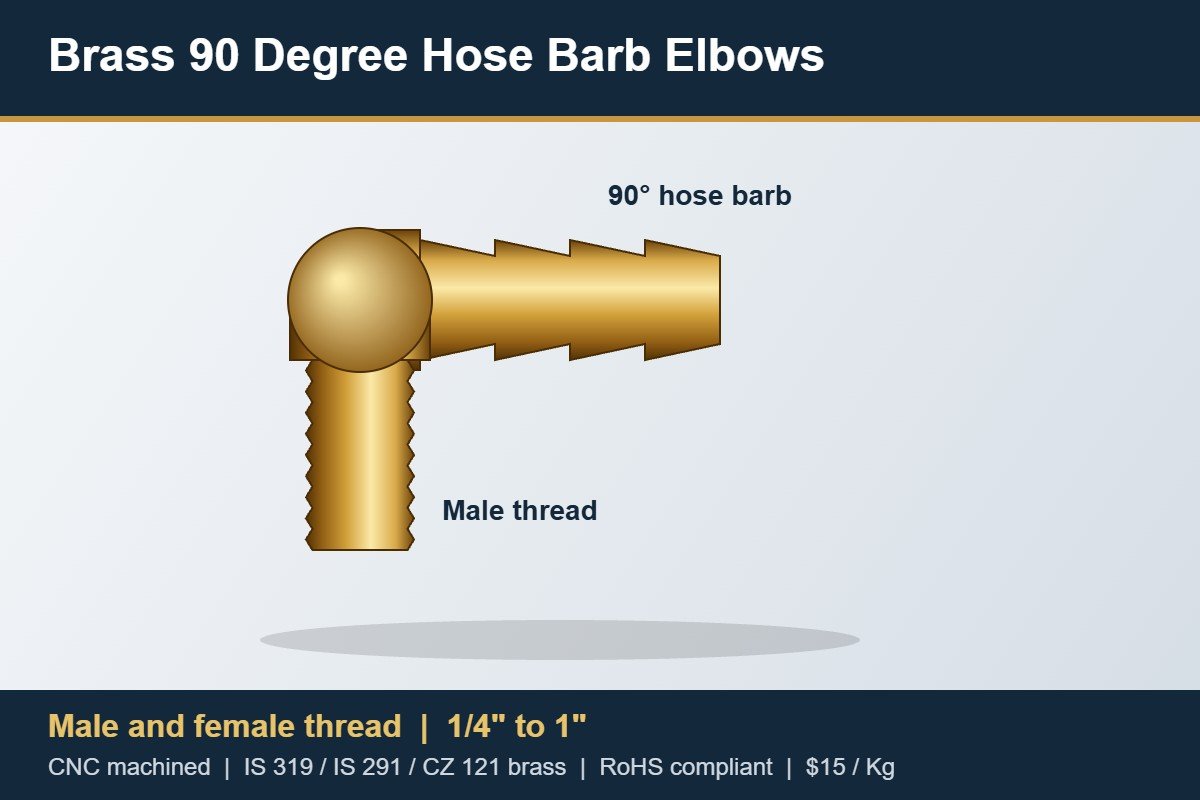
Brass 90 Degree Hose Barb Elbows
Brass 90 Degree Hose Barb Elbows turn a flexible hose through a right angle exactly where you need it. One end carries a male or female pipe thread that connects to the equipment port; the other end is a serrated barb for the hose, set at 90 degrees to the thread axis. The fitting replaces a loose hose loop that would otherwise kink, rub or take up scarce space, and it gives you a neat, repeatable hose exit on pumps, engines, appliances, manifolds and panels. We supply the elbows in NPT, NPTF, BSPP and BSPT threads, in male and female versions, with barb sizes from 1/4″ to 1″, machined from IS 319 / IS 291 / CZ 121 brass.
This page deals with what is specific to elbows: the geometry that matters when you design a hose run, centre-line dimensions for fitting layout, alignment issues when a taper thread must finish in a particular direction, equivalent length for pressure-drop calculation and the situations in which an elbow is better than a bent hose. For straight fittings see Brass Male Hose Barbs and Brass Female Hose Barbs; for a three-way branch see Brass Hose Barbed Tees.
Price: $15 / Kg for all elbow sizes, threads and genders | Minimum order: 5 Kg per size code | Bulk discounts available
Quick Specification of Brass 90 Degree Hose Barb Elbows
| Parameter | Specification |
|---|---|
| Product | Brass 90 Degree Hose Barb Elbows, threaded end at 90° to barbed end |
| Material | Brass IS 319 / IS 291 / CZ 121; DZR and low-lead on request |
| Thread types | NPT, NPTF, BSPP, BSPT, male or female |
| Thread sizes | 1/4″ to 1″ standard; 1-1/4″ on request |
| Barb sizes | 1/4″, 3/8″, 1/2″, 3/4″, 1″ |
| Angle | 90° (45° and swivel types on request) |
| Finish | Natural brass, nickel plated, chrome plated |
| Working pressure | Up to 150 PSI (10.3 bar), hose permitting |
| Price | $15 per Kg |
| Minimum order | 5 Kg per size code |
| Lead time | 7 to 15 working days |
Why Use a 90 Degree Hose Barb Elbow?
Every flexible hose has a minimum bend radius. Push it beyond that radius and the wall flattens, the flow area collapses and the hose may kink completely, starving the pump or overheating the engine. In open space the answer is a gentle loop, but on real machines hoses must leave a pump head parallel to the base plate, climb past a motor, or turn behind a panel in a space only a few centimetres deep. A barbed elbow takes the turn inside the fitting, where a drilled passage keeps the full flow area, and lets the hose leave at the angle you want without being bent at all.
The second benefit is mechanical. A hose that carries its own weight round a bend pulls sideways on the port thread, which loosens joints and fatigues threads under vibration. An elbow puts the direction change at the fitting, so the hose can run straight along its natural line and the load is carried by a body designed for it. Finally, an elbow improves appearance and serviceability: the hose exit position is the same on every machine, which makes assembly instructions, spares and maintenance simpler.
Anatomy of a Brass Hose Barb Elbow
The body and the corner
Our elbows are machined from solid brass bar, not fabricated from two joined pieces. A cross-drilled passage meets the main bore inside a compact hex or square-section body, leaving robust metal at the corner where stress concentrates. Because the part is a single piece of brass there is no brazed joint to fail from thermal cycling, and the internal junction is deburred so it does not shed chips into the line. The trade-off of a drilled elbow compared with a swept bend is a small amount of extra pressure drop, which is quantified in the equivalent-length table below.
The threaded leg
The threaded leg may be male or female in NPT, NPTF, BSPP or BSPT. A male leg screws into a port and puts the elbow close to the equipment face; a female leg screws over a stub and extends the hose exit away from the port. The choice is dictated by the thread already on the equipment, but the female type also lets you add height to clear obstructions.
The barbed leg
The barbed leg carries the same ridge geometry as our straight barbs: smooth entry, sharp rear shoulders, and a maximum diameter about 1.6 mm over the nominal hose ID. A short plain neck at the start of the barbs gives the clamp somewhere to sit without crushing the first ridge.
Part-Code System for Hose Barb Elbows
Elbow codes follow the pattern CX-EHB-[gender][thread]-[thread size][barb size]. Gender is M for male thread or F for female thread, and the thread letter is N for NPT, F for NPTF, P for BSPP or T for BSPT, so MN means male NPT and FP means female BSPP. Sizes use the dash convention in sixteenths of an inch: 04 = 1/4″, 06 = 3/8″, 08 = 1/2″, 12 = 3/4″, 16 = 1″. For example, CX-EHB-MN-0812 is a male-NPT elbow with a 1/2″ thread and a 3/4″ barb, and CX-EHB-FP-0606 is a female-BSPP elbow with a 3/8″ thread and a 3/8″ barb.
Size Table: Male Thread 90 Degree Elbows
Dimension A is measured from the centre line of the threaded leg to the tip of the barb, and dimension B from the centre line of the barbed leg to the end of the thread. Together they let you check clearances in your layout. Values are typical, with ±0.8 mm tolerance, and weights are approximate for the $15 / Kg price basis.
| Male thread × barb | NPT code | NPTF code | BSPP code | BSPT code | Hose ID (mm) | A: centre to barb tip (mm) | B: centre to thread end (mm) | Hex AF (mm) | Approx. weight (g) | Pcs per Kg |
|---|---|---|---|---|---|---|---|---|---|---|
| 1/4″ × 1/4″ | CX-EHB-MN-0404 | CX-EHB-MF-0404 | CX-EHB-MP-0404 | CX-EHB-MT-0404 | 6.4 | 25 | 23 | 14 | 20 | 50 |
| 3/8″ × 3/8″ | CX-EHB-MN-0606 | CX-EHB-MF-0606 | CX-EHB-MP-0606 | CX-EHB-MT-0606 | 9.5 | 30 | 26 | 17 | 37 | 27 |
| 1/2″ × 1/2″ | CX-EHB-MN-0808 | CX-EHB-MF-0808 | CX-EHB-MP-0808 | CX-EHB-MT-0808 | 12.7 | 36 | 32 | 22 | 66 | 15 |
| 3/4″ × 3/4″ | CX-EHB-MN-1212 | CX-EHB-MF-1212 | CX-EHB-MP-1212 | CX-EHB-MT-1212 | 19 | 44 | 38 | 27 | 129 | 8 |
| 1″ × 1″ | CX-EHB-MN-1616 | CX-EHB-MF-1616 | CX-EHB-MP-1616 | CX-EHB-MT-1616 | 25.4 | 52 | 46 | 34 | 228 | 4 |
| 1/4″ × 3/8″ | CX-EHB-MN-0406 | CX-EHB-MF-0406 | CX-EHB-MP-0406 | CX-EHB-MT-0406 | 9.5 | 29 | 23 | 14 | 27 | 37 |
| 3/8″ × 1/4″ | CX-EHB-MN-0604 | CX-EHB-MF-0604 | CX-EHB-MP-0604 | CX-EHB-MT-0604 | 6.4 | 26 | 26 | 17 | 31 | 32 |
| 3/8″ × 1/2″ | CX-EHB-MN-0608 | CX-EHB-MF-0608 | CX-EHB-MP-0608 | CX-EHB-MT-0608 | 12.7 | 33 | 26 | 17 | 46 | 22 |
| 1/2″ × 3/8″ | CX-EHB-MN-0806 | CX-EHB-MF-0806 | CX-EHB-MP-0806 | CX-EHB-MT-0806 | 9.5 | 33 | 32 | 22 | 58 | 17 |
| 1/2″ × 3/4″ | CX-EHB-MN-0812 | CX-EHB-MF-0812 | CX-EHB-MP-0812 | CX-EHB-MT-0812 | 19 | 41 | 32 | 22 | 88 | 11 |
| 3/4″ × 1/2″ | CX-EHB-MN-1208 | CX-EHB-MF-1208 | CX-EHB-MP-1208 | CX-EHB-MT-1208 | 12.7 | 39 | 38 | 27 | 107 | 9 |
| 3/4″ × 1″ | CX-EHB-MN-1216 | CX-EHB-MF-1216 | CX-EHB-MP-1216 | CX-EHB-MT-1216 | 25.4 | 48 | 38 | 27 | 156 | 6 |
| 1″ × 3/4″ | CX-EHB-MN-1612 | CX-EHB-MF-1612 | CX-EHB-MP-1612 | CX-EHB-MT-1612 | 19 | 48 | 46 | 34 | 201 | 5 |
Size Table: Female Thread 90 Degree Elbows
Female elbows add a larger hex body and extra dimension B because the internal thread needs a longer, thicker leg. Use them when the equipment presents a male stub, or when you need to lift the hose exit clear of the port face.
| Female thread × barb | NPT code | NPTF code | BSPP code | BSPT code | Hose ID (mm) | A: centre to barb tip (mm) | B: centre to thread end (mm) | Hex AF (mm) | Approx. weight (g) | Pcs per Kg |
|---|---|---|---|---|---|---|---|---|---|---|
| 1/4″ × 1/4″ | CX-EHB-FN-0404 | CX-EHB-FF-0404 | CX-EHB-FP-0404 | CX-EHB-FT-0404 | 6.4 | 25 | 26 | 17 | 25 | 40 |
| 3/8″ × 3/8″ | CX-EHB-FN-0606 | CX-EHB-FF-0606 | CX-EHB-FP-0606 | CX-EHB-FT-0606 | 9.5 | 30 | 28 | 20 | 46 | 22 |
| 1/2″ × 1/2″ | CX-EHB-FN-0808 | CX-EHB-FF-0808 | CX-EHB-FP-0808 | CX-EHB-FT-0808 | 12.7 | 36 | 36 | 25 | 82 | 12 |
| 3/4″ × 3/4″ | CX-EHB-FN-1212 | CX-EHB-FF-1212 | CX-EHB-FP-1212 | CX-EHB-FT-1212 | 19 | 44 | 42 | 30 | 160 | 6 |
| 1″ × 1″ | CX-EHB-FN-1616 | CX-EHB-FF-1616 | CX-EHB-FP-1616 | CX-EHB-FT-1616 | 25.4 | 52 | 50 | 37 | 281 | 4 |
| 1/4″ × 3/8″ | CX-EHB-FN-0406 | CX-EHB-FF-0406 | CX-EHB-FP-0406 | CX-EHB-FT-0406 | 9.5 | 29 | 26 | 17 | 34 | 29 |
| 3/8″ × 1/4″ | CX-EHB-FN-0604 | CX-EHB-FF-0604 | CX-EHB-FP-0604 | CX-EHB-FT-0604 | 6.4 | 26 | 28 | 20 | 38 | 26 |
| 3/8″ × 1/2″ | CX-EHB-FN-0608 | CX-EHB-FF-0608 | CX-EHB-FP-0608 | CX-EHB-FT-0608 | 12.7 | 33 | 28 | 20 | 57 | 18 |
| 1/2″ × 3/8″ | CX-EHB-FN-0806 | CX-EHB-FF-0806 | CX-EHB-FP-0806 | CX-EHB-FT-0806 | 9.5 | 33 | 36 | 25 | 71 | 14 |
| 1/2″ × 3/4″ | CX-EHB-FN-0812 | CX-EHB-FF-0812 | CX-EHB-FP-0812 | CX-EHB-FT-0812 | 19 | 41 | 36 | 25 | 109 | 9 |
| 3/4″ × 1/2″ | CX-EHB-FN-1208 | CX-EHB-FF-1208 | CX-EHB-FP-1208 | CX-EHB-FT-1208 | 12.7 | 39 | 42 | 30 | 132 | 8 |
| 3/4″ × 1″ | CX-EHB-FN-1216 | CX-EHB-FF-1216 | CX-EHB-FP-1216 | CX-EHB-FT-1216 | 25.4 | 48 | 42 | 30 | 193 | 5 |
| 1″ × 3/4″ | CX-EHB-FN-1612 | CX-EHB-FF-1612 | CX-EHB-FP-1612 | CX-EHB-FT-1612 | 19 | 48 | 50 | 37 | 248 | 4 |
Space Comparison: Elbow Versus Bent Hose
The table compares the free bend radius needed by a plain rubber hose with the centre-to-tip distance of the matching elbow. The figure for rubber hose is a general rule of thumb of about six times the hose inside diameter; actual limits depend on hose construction and are published by hose makers. The comparison shows how much space an elbow saves.
| Hose ID | Typical minimum bend radius of plain rubber hose (about 6 × ID), mm | Elbow centre-to-barb-tip A (mm), 1/2″ thread series | Space advantage |
|---|---|---|---|
| 1/4″ (6.4 mm) | 38 | ~25 | Elbow turns the corner in a footprint roughly half the free bend |
| 3/8″ (9.5 mm) | 57 | ~30 | Elbow saves a hand-width of clearance |
| 1/2″ (12.7 mm) | 76 | ~36 | Elbow fits where a bent hose would kink |
| 3/4″ (19 mm) | 114 | ~44 | Elbow is the only practical option in a tight panel |
| 1″ (25.4 mm) | 152 | ~52 | Elbow avoids a very large loop of hose |
Equivalent Length and Pressure Drop
A drilled elbow adds resistance to flow. Engineers usually account for a fitting by adding an equivalent straight length to the line. For a sharp 90-degree elbow the equivalent length is commonly estimated at about 30 times the bore diameter. The table gives this number for each barb size so you can add it to your pipework calculation. On short lines the effect is small; on long, high-velocity lines it is worth choosing the next larger size or keeping the number of elbows low.
| Barb size | Bore diameter (mm) | Typical equivalent straight length of one barbed 90° elbow (about 30 × bore), mm |
|---|---|---|
| 1/4″ | 3.5 | 105 |
| 3/8″ | 6 | 180 |
| 1/2″ | 8.5 | 255 |
| 3/4″ | 14 | 420 |
| 1″ | 19 | 570 |
Orientation and Alignment of Tapered Threads
Elbows have a direction, and this creates a practical issue on tapered threads. A tapered male thread seals as it is tightened, so the fitting stops wherever the thread locks up, which may leave the barb pointing anywhere. Backing off to align it breaks the seal. There are three accepted solutions. The first is to order the elbow in a thread standard that seals with a washer (BSPP), which allows exact orientation by positioning the washer thickness. The second is to apply a dryseal or thread-locking sealant and tighten slightly past the desired position, accepting no more than a quarter turn of adjustment. The third is to use a short nipple or a female elbow with a swivel nut, available as a custom option, to take up the alignment. In every case test pressure after alignment. Our Brass NPTF Hose Barbs and Brass BSP Hose Tails and Hose Connectors pages have more detail on the sealing behaviour of each thread family.
Applications of Brass 90 Degree Hose Barb Elbows
Automotive and engine cooling
Heater cores, thermostat housings, radiator header tanks and overflow bottles use elbows to route coolant hose around tight engine bays. Brass handles heat cycling and coolant additives well.
Compressed air tools and pneumatic panels
Elbows keep air hose clear of work surfaces on tool balancers, spray guns, air-actuated cylinders and control panels, avoiding kinks that cause unreliable pressure.
Hydraulic return and low-pressure oil lines
Low-pressure return, drain and case-drain lines on hydraulic power units use barbed elbows with oil-resistant hose. They are not intended for pressure lines, which require crimped or compression fittings rated for the pressure.
Refrigeration, chillers and heat exchangers
Condensate drains, glycol loops and chiller water lines often run through a cabinet that does not allow a large bend; elbows make the turn at the connection.
Domestic appliances, water dispensers and coffee machines
Beverage dispensers, washing machines, dishwashers and water purifiers use small elbows to connect flexible tubing inside crowded housings. For potable water, specify low-lead or DZR brass.
Irrigation, fertigation and aquarium systems
Drip headers, filter skids, sump pumps and aquarium plumbing use elbows so that hose leaves the equipment cleanly along the wall.
Fuel systems and marine
Fuel tank vents, engine day-tank supply and bilge pump outlets benefit from nickel-plated elbows that resist salt and fuel together.
Hose Routing Best Practice
Choose the elbow position so that the hose leaves the barb in line with the barb axis for at least two hose diameters before any further curve. Avoid pulling the hose tight against the elbow; leave a gentle slack to absorb vibration and thermal growth. Keep the plane of the elbow aligned with the natural hose route, support long hoses with clips so their weight is not carried by the barb, and fit the clamp over the ridges just behind the hose end. When two elbows are used in series on one hose, allow a straight section between them rather than butting them together, because turbulence from the first elbow increases the loss through the second.
Material and Manufacturing
All elbows are machined from certified IS 319 / IS 291 / CZ 121 brass bar with 57–63% copper and 37–43% zinc, delivering around 120–150 HB hardness and a minimum tensile strength of 360 MPa. The production route is bar cutting, CNC turning of the threaded leg and barb, milling of the hex or body flats, cross-drilling and boring of the passages, thread tapping or cutting, deburring of the internal junction, tumbling, ultrasonic cleaning and optional plating. Elbow bodies are checked with thread gauges and a through-bore probe to confirm the cross-drilled passage has no blockage. We run under ISO 9001:2015, maintain bar-to-carton traceability and can supply material test reports. DZR brass can be specified where dezincification would be a risk.
Selection Checklist
- Thread gender and standard: confirm whether the equipment port is male or female and whether it is NPT or BSP.
- Hose ID: match the barb to the hose, and check bore against the flow you need.
- Dimension A and B: verify there is room for the elbow body and a spanner.
- Alignment: decide how the hose will leave the elbow and choose a thread that allows orientation.
- Finish: nickel plating for marine and outdoor equipment, natural brass for general service.
- Medium and temperature: brass suits water, air, oils and fuels up to 120°C with suitable hose.
Installation Guidelines
- Clean the port and fitting threads and inspect them for burrs.
- Apply thread sealant or PTFE tape to tapered male threads; position the washer or O-ring on parallel threads.
- Start the elbow by hand and make sure it threads freely for several turns.
- Tighten with a spanner on the hex only, stopping when the barb is within a quarter turn of the desired direction.
- Push the hose fully over the barb, fit the clamp over the ridges, and tighten evenly.
- Run the system at working pressure, check for weeping and re-tighten the clamp after the first thermal cycle.
Troubleshooting
Elbow will not align without leaking: you have backed off a tapered thread; remove it, reseal with fresh sealant and tighten again to the target position, or use a parallel thread with a washer. Hose kinks just after the elbow: the hose leaves the barb at a sharp angle; support the hose or reroute it so it runs straight for a short distance. Noise or vibration: add a clip to support the hose near the elbow. Flow lower than expected: elbows add resistance; check the bore table and consider a larger size. Cracks at the corner: usually from over-tightening or from impact; choose nickel plated heavy-section elbows and avoid using the hose as a handle.
Custom Elbows and Variants
Besides the standard 90-degree style we machine 45-degree elbows, swivel-nut elbows, elbows with a mixed thread (for example NPT male leg with a BSP female leg), long-leg versions for deep panels, and double-barb elbows that connect two hoses at a right angle. Provide a drawing or sample with quantity and finish and we will quote against it, using the same $15 / Kg basis for brass bar machining wherever the design allows.
Pricing, Packing and Ordering
| Item | Details |
|---|---|
| Price | $15 per Kg, all elbow sizes and threads |
| Minimum order quantity | 5 Kg per size code |
| Lead time | 7 to 15 working days for standard sizes |
| Packaging | Polybag and carton; custom packaging available |
| Quality | ISO 9001:2015, RoHS compliant, material traceability |
| Payment | T/T, LC at sight, PayPal for small orders |
| Shipping | Worldwide by sea, air or courier |
Quote the code number, quantity and destination to receive a formal quotation in 24 hours. The main Brass Hose Barbs page lists the full range of fittings.
Elbow Fitting Versus Other Ways of Turning a Hose
An elbow is not the only way to change direction, and it is worth understanding the alternatives before you specify one. A pre-formed moulded hose with a built-in bend is neat but must be ordered to a particular length and angle and cannot be adapted in the field. A spring guard or hose support wire can allow a tighter bend in plain rubber hose, but it adds a part and still stresses the hose wall. Two straight barbs and a union can be fitted to make a turn but add length, cost and an extra leak path. Compared with all of these, a machined brass elbow gives a fixed, repeatable direction change with a single threaded joint, a robust body and standard hose.
The decision is easiest when you ask where the stress goes. A bent hose concentrates stress on the hose wall; a single elbow concentrates it in a thick brass corner that is designed for it. If the line is exposed to vibration, regular maintenance or temperature swings, move the turn into the fitting.
Weight and Cost Planning for Elbows
Because our price is set per kilogram, the cost of one elbow follows directly from its weight. The table shows the approximate cost per piece at $15 / Kg for the equal-size elbows. Heavier female elbows cost more per piece because their hex bodies contain more brass, but the price per Kg is the same. Use the figure to estimate project budgets, and remember that large orders attract volume discounts.
| Elbow size (thread × barb) | Male elbow weight (g) | Approx. cost per piece at $15/Kg (US cents) | Female elbow weight (g) | Approx. cost per piece at $15/Kg (US cents) |
|---|---|---|---|---|
| 1/4″ × 1/4″ | 20 | 30.0 | 25 | 37.5 |
| 3/8″ × 3/8″ | 37 | 55.5 | 46 | 69.0 |
| 1/2″ × 1/2″ | 66 | 99.0 | 82 | 123.0 |
| 3/4″ × 3/4″ | 129 | 193.5 | 160 | 240.0 |
| 1″ × 1″ | 228 | 342.0 | 281 | 421.5 |
Frequently Asked Questions
What is a brass 90 degree hose barb elbow?
It is a right-angle fitting with a threaded end (male or female) and a serrated barb for flexible hose. It lets a hose change direction without kinking.
Are the elbows available with male and female threads?
Yes. Both are available in NPT, NPTF, BSPP and BSPT. The codes use M or F to show the gender, for example CX-EHB-MN for male NPT.
What size range do you supply?
Thread sizes run from 1/4″ to 1″ as standard, with 1-1/4″ on request, and barb sizes of 1/4″, 3/8″, 1/2″, 3/4″ and 1″ in equal and reducing combinations.
What does the code CX-EHB-MN-0812 mean?
It identifies a male-NPT elbow (MN) with a 1/2″ thread (08) and a 3/4″ barb (12).
How do I align an elbow on a tapered thread?
Tighten until the barb is close to the desired direction and avoid backing off, which breaks the seal. For exact alignment use a parallel BSPP thread with a washer, or a swivel version.
Do elbows reduce flow?
A drilled 90-degree elbow adds resistance equal to roughly 30 bore diameters of straight pipe. Choose a larger size or fewer elbows for long, high-velocity lines.
Can I use a barbed elbow on a hydraulic pressure line?
No. Barbed fittings are for low-pressure return, drain and fluid lines. Pressure lines require crimped or compression fittings rated for the pressure.
What is the price and minimum order?
The price is $15 per Kg for every size and thread, and the minimum order is 5 Kg per size code.
Can you supply nickel-plated or DZR elbows?
Yes. Natural brass, nickel plated and chrome plated finishes are available, as well as DZR and low-lead brass for water service.
Do you make 45 degree or swivel elbows?
Yes. We machine 45-degree, swivel, mixed-thread and double-barb elbows to your drawing.
Explore Related Brass Hose Barb Pages
Every fitting in this range is produced in the same brass grades and shipped on the same commercial terms of $15 per Kg. Use these pages to compare configurations, then return to the main Brass Hose Barbs page for the complete overview.
- Brass Male Hose Barbs – the classic threaded-to-barbed adapter for rigid-port-to-hose connections
- Brass Female Hose Barbs – hex-body adapters that receive male-threaded ports, valves and pump outlets
- Brass Hose Barbed Tees – three-way fittings for splitting, merging and manifold hose layouts
- Brass NPT Hose Barbs – tapered ASME B1.20.1 threads used across North America and many Indian OEMs
- Brass NPTF Hose Barbs – dryseal ASME B1.20.3 threads for fuel, hydraulic and tape-free service
- Brass BSP Hose Tails and Hose Connectors – BSP parallel and taper hose tails plus double-barb hose connectors
Reviews
There are no reviews yet.