


Description
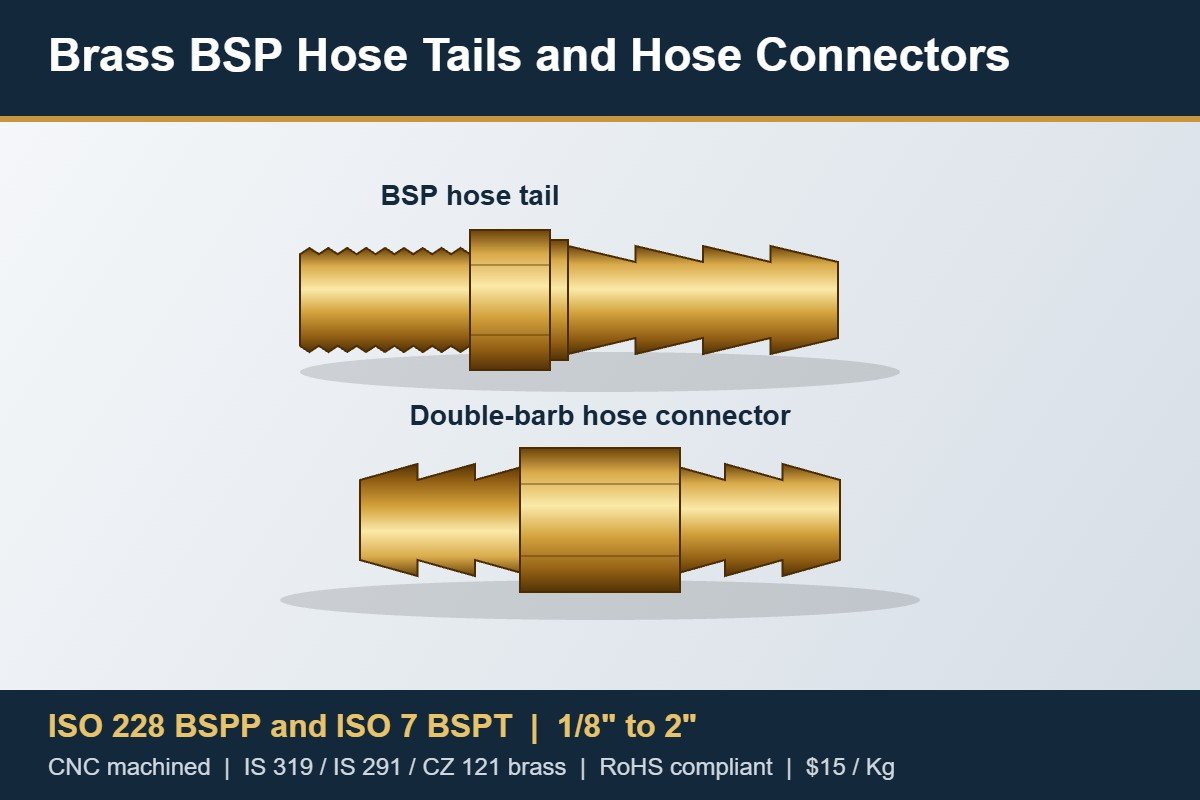
Brass BSP Hose Tails and Hose Connectors
Brass BSP Hose Tails and Hose Connectors are the standard way to join flexible hose to British Standard Pipe equipment and to join one hose to another. A hose tail has a BSP thread on one end and a serrated tail on the other; a swivel-nut hose tail carries a captive female BSPP nut so that it can be connected to a male stub without turning the hose; and a hose connector (or hose joiner) has a barb at each end for an in-line hose-to-hose connection. BSP threads are used throughout the United Kingdom, Europe, the Middle East, Africa, Australia, New Zealand and much of Asia, and a large share of the pumps, valves, boilers, washing machines and compressors sold in those markets is threaded BSP. We machine all three families from IS 319 / IS 291 / CZ 121 brass in BSPP and BSPT threads from 1/8″ to 2″, with tail sizes from 3/16″ to 2″.
This page is the place to start when your equipment is BSP. It explains the BSPP and BSPT thread families and their designations (G, R, Rc, Rp), provides full thread data, shows how to seal each type correctly, and lists code-numbered tables for hose tails, swivel-nut tails and connectors in equal and reducing sizes. For American thread equivalents see Brass NPT Hose Barbs and Brass NPTF Hose Barbs; for shape-based comparisons see Brass Male Hose Barbs, Brass Female Hose Barbs, Brass 90 Degree Hose Barb Elbows and Brass Hose Barbed Tees.
Price: $15 / Kg for every BSP hose tail and connector | Minimum order: 5 Kg per size code | Bulk discounts available
Quick Specification of Brass BSP Hose Tails and Hose Connectors
| Parameter | Specification |
|---|---|
| Product | Brass BSP hose tails (male and swivel-nut) and double-barb hose connectors |
| Thread standards | BSPP (ISO 228 / G) and BSPT (ISO 7 / R) |
| Thread sizes | 1/8″ to 2″ BSP |
| Tail and hose sizes | 3/16″ to 2″ |
| Material | Brass IS 319 / IS 291 / CZ 121; DZR and low-lead on request |
| Finish | Natural brass, nickel plated, chrome plated |
| Working pressure | Up to 150 PSI (10.3 bar), hose permitting |
| Price | $15 per Kg |
| Minimum order | 5 Kg per size code |
| Lead time | 7 to 15 working days |
Hose Tail, Swivel-Nut Tail and Hose Connector: Terminology
Different regions use different words for similar parts, and an unclear request is the commonest source of ordering errors. The table sets out the terms we use and the code family for each.
| Term | What it describes | Our code family |
|---|---|---|
| Hose tail | A threaded fitting with a serrated tail (barb) for hose; the thread screws into a port, a nut or a valve | CX-BHT |
| Swivel-nut hose tail | A hose tail with a captive female nut that rotates; the nut screws onto a male BSPP thread and seals on a washer | CX-BHN |
| Hose connector (hose joiner) | A straight fitting with a barb on each end that joins two hoses, equal or reducing | CX-BHC |
| Hose barb | General term for the serrated hose end; see our other hose barb pages | Various |
BSP Thread Families: G, R, Rc and Rp
BSP is not one thread but a pair of related families that share the same 55-degree Whitworth form and the same pitch for each size. The parallel family, standardised in ISO 228-1 and written G, has the same diameter along its length and does not seal on the thread. The taper family, standardised in ISO 7-1 and written R for external and Rc for internal threads, tapers at 1 in 16 and seals by wedging. A third designation, Rp, describes a parallel internal thread intended to mate with a taper external R thread; the combination seals as the taper wedges into the parallel female.
| Designation | Meaning | Standard | Mates with | Seals by |
|---|---|---|---|---|
| G (male or female) | Parallel (straight) pipe thread, Whitworth form, 55° | ISO 228-1 (BS 2779) | G with G | Bonded washer, O-ring or flat gasket under the shoulder |
| R (male) | Taper external thread, 1:16 | ISO 7-1 (BS 21) | Rp or Rc | Thread flank interference plus sealant |
| Rc (female) | Taper internal thread, 1:16 | ISO 7-1 | R | Thread flank interference plus sealant |
| Rp (female) | Parallel internal thread | ISO 7-1 | R | Thread flank interference plus sealant, with the male taper wedging into the parallel female |
In casual speech people say BSP when they mean BSPP and BSPT without saying which. Always confirm the family before ordering: parallel and taper hose tails are not interchangeable in service, although a taper male thread can often start into a parallel female thread and look correct.
BSP Thread Data
The following table gives the principal dimensions of the BSP thread sizes we supply. The depth of a Whitworth thread is approximately 0.64 of the pitch, and the minor diameter is the major diameter less twice the depth. The last column is a guide to the inside diameter of the bonded washer that suits a BSPP fitting; washers are normally a little larger than the major diameter so that they sit around the thread without catching it.
| BSP size | Threads per inch | Pitch (mm) | Major diameter (mm) | Thread depth, 0.64 × pitch (mm) | Minor diameter (mm) | Suggested bonded washer ID for BSPP (mm) |
|---|---|---|---|---|---|---|
| 1″ | 11 | 2.309 | 33.249 | 1.479 | 30.292 | 33.6 |
| 2″ | 11 | 2.309 | 59.614 | 1.479 | 56.657 | 60.0 |
| 1/8″ | 28 | 0.907 | 9.728 | 0.581 | 8.566 | 10.1 |
| 1/4″ | 19 | 1.337 | 13.157 | 0.856 | 11.445 | 13.6 |
| 3/8″ | 19 | 1.337 | 16.662 | 0.856 | 14.950 | 17.1 |
| 1/2″ | 14 | 1.814 | 20.955 | 1.162 | 18.632 | 21.4 |
| 3/4″ | 14 | 1.814 | 26.441 | 1.162 | 24.118 | 26.8 |
| 1-1/4″ | 11 | 2.309 | 41.910 | 1.479 | 38.953 | 42.3 |
| 1-1/2″ | 11 | 2.309 | 47.803 | 1.479 | 44.846 | 48.2 |
Sealing BSPP and BSPT Hose Tails
Sealing a BSPP (parallel) hose tail
A parallel thread locates the part but cannot create a seal. The seal is made on the shoulder, by compressing a washer or O-ring between the face of the fitting and the face of the port. The most common seal is a bonded washer (often called a Dowty seal), which has a steel outer ring and a rubber inner ring that deforms to fill the sealing gap. Fibre, fibre-reinforced and copper washers, and O-rings in a groove, are alternatives. Tighten until the shoulder seats firmly and the washer is compressed; do not use tape or paste on the parallel thread as a substitute for a washer, since the thread does not carry the pressure.
Sealing a BSPT (taper) hose tail
A taper hose tail seals on its thread, using PTFE tape, anaerobic sealant or paste. The same practices as NPT apply: clean threads, two or three wraps of tape without covering the first thread, hand-tightening and then a spanner for one to two further turns. Remember that BSPT and NPT are not compatible, even though several sizes share the same pitch.
Part-Code System for BSP Hose Tails and Connectors
Hose tails use CX-BHT-[thread letter]-[thread size][tail size], with P for BSPP (parallel) and T for BSPT (taper). Swivel-nut hose tails use CX-BHN-P-[thread size][tail size], since the swivel nut is a parallel female thread. Hose connectors use CX-BHC-[small hose size][large hose size]. Sizes are expressed as dash numbers in sixteenths of an inch: 02 = 1/8″, 04 = 1/4″, 06 = 3/8″, 08 = 1/2″, 12 = 3/4″, 16 = 1″, 20 = 1-1/4″, 24 = 1-1/2″, 32 = 2″, with 03 for 3/16″ and 10 for 5/8″. For example, CX-BHT-P-0812 is a BSPP hose tail with a G1/2 thread and a 3/4″ tail; CX-BHN-P-1216 is a swivel-nut tail with a G3/4 nut and a 1″ tail; and CX-BHC-0812 is a hose connector joining 1/2″ and 3/4″ hose.
Size Table: Standard BSP Hose Tails
These are the equal and standard combinations. The length is measured from the thread end to the tip of the tail and includes the shoulder. Dimensions are typical (±0.5 mm) and weights approximate for the $15 / Kg price basis.
| BSP thread × tail | BSPP (parallel) code | BSPT (taper) code | Hose ID (mm) | Hex AF (mm) | Overall length (mm) | Approx. weight (g) | Pcs per Kg |
|---|---|---|---|---|---|---|---|
| 1/8″ × 3/16″ | CX-BHT-P-0203 | CX-BHT-T-0203 | 4.8 | 11 | 31 | 6 | 167 |
| 1/4″ × 1/4″ | CX-BHT-P-0404 | CX-BHT-T-0404 | 6.4 | 14 | 35 | 11 | 91 |
| 3/8″ × 3/8″ | CX-BHT-P-0606 | CX-BHT-T-0606 | 9.5 | 17 | 41 | 21 | 48 |
| 1/2″ × 1/2″ | CX-BHT-P-0808 | CX-BHT-T-0808 | 12.7 | 22 | 47 | 37 | 27 |
| 3/4″ × 3/4″ | CX-BHT-P-1212 | CX-BHT-T-1212 | 19 | 27 | 55 | 72 | 14 |
| 1″ × 1″ | CX-BHT-P-1616 | CX-BHT-T-1616 | 25.4 | 34 | 63 | 127 | 8 |
| 1-1/4″ × 1-1/4″ | CX-BHT-P-2020 | CX-BHT-T-2020 | 31.8 | 43 | 71 | 204 | 5 |
| 1-1/2″ × 1-1/2″ | CX-BHT-P-2424 | CX-BHT-T-2424 | 38.1 | 50 | 78 | 295 | 3 |
| 2″ × 2″ | CX-BHT-P-3232 | CX-BHT-T-3232 | 50.8 | 63 | 87 | 513 | 2 |
Size Table: Reducing and Mixed BSP Hose Tails
Pump and valve ports are fixed in size, while hose sizes depend on flow. These combinations are stocked as standard; any other pairing between G1/8 and G2 can be machined to order.
| BSP thread × tail | BSPP (parallel) code | BSPT (taper) code | Hose ID (mm) | Hex AF (mm) | Overall length (mm) | Approx. weight (g) | Pcs per Kg |
|---|---|---|---|---|---|---|---|
| 1/8″ × 1/4″ | CX-BHT-P-0204 | CX-BHT-T-0204 | 6.4 | 11 | 33 | 7 | 143 |
| 1/4″ × 3/16″ | CX-BHT-P-0403 | CX-BHT-T-0403 | 4.8 | 14 | 33 | 10 | 100 |
| 1/4″ × 3/8″ | CX-BHT-P-0406 | CX-BHT-T-0406 | 9.5 | 14 | 39 | 15 | 67 |
| 1/4″ × 1/2″ | CX-BHT-P-0408 | CX-BHT-T-0408 | 12.7 | 14 | 42 | 20 | 50 |
| 3/8″ × 1/4″ | CX-BHT-P-0604 | CX-BHT-T-0604 | 6.4 | 17 | 37 | 17 | 59 |
| 3/8″ × 1/2″ | CX-BHT-P-0608 | CX-BHT-T-0608 | 12.7 | 17 | 44 | 26 | 38 |
| 1/2″ × 3/8″ | CX-BHT-P-0806 | CX-BHT-T-0806 | 9.5 | 22 | 44 | 32 | 31 |
| 1/2″ × 5/8″ | CX-BHT-P-0810 | CX-BHT-T-0810 | 15.9 | 22 | 49 | 44 | 23 |
| 1/2″ × 3/4″ | CX-BHT-P-0812 | CX-BHT-T-0812 | 19 | 22 | 52 | 49 | 20 |
| 3/4″ × 1/2″ | CX-BHT-P-1208 | CX-BHT-T-1208 | 12.7 | 27 | 50 | 60 | 17 |
| 3/4″ × 5/8″ | CX-BHT-P-1210 | CX-BHT-T-1210 | 15.9 | 27 | 52 | 67 | 15 |
| 3/4″ × 1″ | CX-BHT-P-1216 | CX-BHT-T-1216 | 25.4 | 27 | 59 | 87 | 11 |
| 1″ × 3/4″ | CX-BHT-P-1612 | CX-BHT-T-1612 | 19 | 34 | 59 | 112 | 9 |
| 1″ × 1-1/4″ | CX-BHT-P-1620 | CX-BHT-T-1620 | 31.8 | 34 | 68 | 149 | 7 |
Size Table: Swivel-Nut BSPP Hose Tails
A swivel-nut tail lets you connect the hose side first and then screw the nut onto the equipment stub, which is useful when the hose cannot be rotated: washing machine inlet hoses, pressure-washer feed lines and flexible tap connectors are typical examples. The nut seals on a flat washer that sits inside it.
| Nut thread × tail | Code | Hose ID (mm) | Nut hex AF (mm) | Overall length (mm) | Approx. weight (g) | Pcs per Kg |
|---|---|---|---|---|---|---|
| 1/4″ × 1/4″ | CX-BHN-P-0404 | 6.4 | 19 | 36 | 17 | 59 |
| 3/8″ × 3/8″ | CX-BHN-P-0606 | 9.5 | 22 | 42 | 32 | 31 |
| 1/2″ × 1/2″ | CX-BHN-P-0808 | 12.7 | 27 | 48 | 57 | 18 |
| 1/2″ × 5/8″ | CX-BHN-P-0810 | 15.9 | 27 | 50 | 67 | 15 |
| 1/2″ × 3/4″ | CX-BHN-P-0812 | 19 | 27 | 53 | 75 | 13 |
| 3/4″ × 3/4″ | CX-BHN-P-1212 | 19 | 32 | 56 | 110 | 9 |
| 3/4″ × 1″ | CX-BHN-P-1216 | 25.4 | 32 | 60 | 133 | 8 |
| 1″ × 1″ | CX-BHN-P-1616 | 25.4 | 39 | 64 | 194 | 5 |
| 1″ × 1-1/4″ | CX-BHN-P-1620 | 31.8 | 39 | 69 | 228 | 4 |
| 1-1/4″ × 1-1/4″ | CX-BHN-P-2020 | 31.8 | 48 | 72 | 312 | 3 |
| 1-1/2″ × 1-1/2″ | CX-BHN-P-2424 | 38.1 | 55 | 79 | 450 | 2 |
| 2″ × 2″ | CX-BHN-P-3232 | 50.8 | 68 | 88 | 783 | 1 |
Size Table: Double-Barb Hose Connectors (Hose Joiners)
A hose connector joins two hoses end to end. Equal types join the same size; reducing types step down from one hose size to another. Our connectors have a central hex or collar to resist hose stops and to give a spanner flat for installation in tight spots.
| Connector | Code | Hose ID (mm) | Overall length (mm) | Approx. weight (g) | Pcs per Kg |
|---|---|---|---|---|---|
| Equal 1″ | CX-BHC-1616 | 25.4 | 90 | 115 | 9 |
| Equal 2″ | CX-BHC-3232 | 50.8 | 143 | 434 | 2 |
| Equal 3/16″ | CX-BHC-0303 | 4.8 | 36 | 9 | 111 |
| Equal 1/4″ | CX-BHC-0404 | 6.4 | 41 | 13 | 77 |
| Equal 3/8″ | CX-BHC-0606 | 9.5 | 52 | 24 | 42 |
| Equal 1/2″ | CX-BHC-0808 | 12.7 | 61 | 37 | 27 |
| Equal 5/8″ | CX-BHC-1010 | 15.9 | 68 | 56 | 18 |
| Equal 3/4″ | CX-BHC-1212 | 19 | 77 | 72 | 14 |
| Equal 1-1/4″ | CX-BHC-2020 | 31.8 | 106 | 178 | 6 |
| Equal 1-1/2″ | CX-BHC-2424 | 38.1 | 120 | 259 | 4 |
| Reducing 1/4″ × 3/8″ | CX-BHC-0406 | 6.4 / 9.5 | 48 | 18 | 56 |
| Reducing 1/4″ × 1/2″ | CX-BHC-0408 | 6.4 / 12.7 | 54 | 25 | 40 |
| Reducing 3/8″ × 1/2″ | CX-BHC-0608 | 9.5 / 12.7 | 58 | 30 | 33 |
| Reducing 3/8″ × 3/4″ | CX-BHC-0612 | 9.5 / 19 | 69 | 48 | 21 |
| Reducing 1/2″ × 5/8″ | CX-BHC-0810 | 12.7 / 15.9 | 66 | 47 | 21 |
| Reducing 1/2″ × 3/4″ | CX-BHC-0812 | 12.7 / 19 | 72 | 55 | 18 |
| Reducing 1/2″ × 1″ | CX-BHC-0816 | 12.7 / 25.4 | 81 | 76 | 13 |
| Reducing 5/8″ × 3/4″ | CX-BHC-1012 | 15.9 / 19 | 74 | 64 | 16 |
| Reducing 3/4″ × 1″ | CX-BHC-1216 | 19 / 25.4 | 86 | 94 | 11 |
| Reducing 1″ × 1-1/4″ | CX-BHC-1620 | 25.4 / 31.8 | 101 | 146 | 7 |
| Reducing 1-1/4″ × 1-1/2″ | CX-BHC-2024 | 31.8 / 38.1 | 116 | 218 | 5 |
| Reducing 1-1/2″ × 2″ | CX-BHC-2432 | 38.1 / 50.8 | 137 | 346 | 3 |
Applications of Brass BSP Hose Tails and Connectors
Domestic and commercial water appliances
Washing machines, dishwashers, water heaters, tap connectors and water filters in BSP markets use swivel-nut tails and male tails with washers. Brass tolerates the hot-and-cold cycling of household water.
Central heating and boilers
Filling loops, drain points, expansion vessels and pump connections use hose tails with BSP threads. For potable water, specify DZR or low-lead brass.
Pumps, pressure washers and irrigation
Centrifugal and diaphragm pumps use BSP ports, and garden and agricultural hose is joined with tails and connectors; connectors in 1/2″, 3/4″ and 1″ are common repair parts.
Compressed air and industrial lines
Compressors, regulators and air tools in Europe and Asia use BSP threads. Tails with washers form leak-free connections to air hose.
Beverage, dairy and food-adjacent equipment
Dispensers, chillers and carbonation equipment use hose tails on water and CO2-driven lines; check the approvals required by your local food-contact rules and tell us if you need low-lead alloys.
Marine, caravan and mobile applications
Fresh-water, grey-water and bilge systems use BSP tails and connectors; nickel-plated types offer extra corrosion protection.
Agriculture and spraying
Sprayers, fertiliser injectors and livestock drinkers use BSP hose tails on ports and connectors on hose repairs.
Hose Clips and Fitting the Hose
A hose tail relies on a hose clip. In British usage the common types are worm-drive clips (often called Jubilee clips), constant-tension clips and crimp ferrules. Choose a clip whose diameter range covers the hose when it is on the tail, which is the hose outside diameter plus the stretch caused by the barb; a clip near the top of its range is less able to follow hose creep. Fit the clip over the ridges, about 3 to 6 mm from the hose end; on larger sizes fit two clips. If the hose is stiff, soften the end in hot water or use a recommended lubricant such as a hose-fitting paste; do not use oil on hoses that are sensitive to petroleum products.
Fitting a Swivel-Nut Hose Tail
- Check that the washer is present inside the nut and that it is not damaged.
- Fit the hose onto the tail and secure it with a clip before connecting to the equipment.
- Offer the nut to the male stub, square, and start it by hand to avoid cross-threading.
- Tighten with a spanner until the washer is compressed and the nut seats; do not use tape on the thread.
- Pressure test, and re-tighten gently if the joint weeps.
BSP Versus NPT: Avoid Mixing Threads
Some BSP and NPT sizes share the same pitch, such as 1/2″ and 3/4″ at 14 threads per inch, and a male NPT can often start into a female BSP. They differ in flank angle (60 degrees versus 55 degrees) and in diameter, so they do not seal and may damage each other. Identify the thread with a pitch gauge and an angle template, or measure diameter and pitch against the data table. If your equipment mixes standards, we can supply BSP-to-NPT adapters and mixed-thread hose tails; see Brass NPT Hose Barbs for NPT data.
Pressure, Temperature and Hose Compatibility
Brass BSP hose tails are rated for working pressure up to about 150 PSI (10.3 bar) when used with a suitable reinforced hose and clip, derated for large sizes. The working temperature range is -20°C to +120°C, limited by the hose and any rubber seals. Washers and O-rings add their own limits: standard bonded washers are rated to about 100°C in water. For higher temperatures use fibre or copper washers. Check the hose against the fluid and temperature, and never exceed the hose maker’s rating.
Material and Manufacturing
Hose tails, nuts and connectors are turned from IS 319 / IS 291 / CZ 121 brass, a 60/40 free-cutting alloy with 57–63% copper and 37–43% zinc, around 120–150 HB hardness and 360 MPa minimum tensile strength. BSPP threads are checked with go and no-go ring gauges, BSPT with taper gauges, and swivel nuts are tested for free rotation. The shoulder face of parallel-thread tails is machined square and flat to give the washer a reliable seat. Parts are deburred, tumbled, ultrasonically cleaned and, if ordered, nickel or chrome plated. For potable water we supply DZR and low-lead alloys and can provide material test reports; local approvals for drinking-water products are specific to the product and should be discussed when you send your enquiry. The plant operates to ISO 9001:2015 with traceability from bar lot to carton.
Selection Checklist
- BSPP or BSPT? Parallel needs a washer; taper needs sealant.
- Tail, swivel nut or connector? Choose by whether the hose or the equipment can rotate and whether you are joining hose to hose.
- Hose ID sets the tail size.
- Washer type sets the temperature and chemical limits for parallel joints.
- Finish and alloy follow the environment and the medium.
Troubleshooting
Leak at the shoulder of a BSPP tail: washer missing, damaged or the wrong size; fit a new bonded washer and re-tighten. Leak at a BSPT thread: insufficient sealant or a mixed NPT thread. Swivel nut will not turn smoothly: dirt or damaged thread; clean or replace. Hose slips at the tail: poor clip fit, or an oily or hard hose; use a correct clip and soften the hose end. Connector leaks: hose not pushed fully onto both barbs, or hoses of different wall thickness stretched unevenly; refit and use two clips on larger sizes.
Custom BSP Hose Tails and Connectors
We make BSP tails and connectors to drawing: tails with extra-long barbs, hose tails with integral O-ring grooves, 60-degree cone seats, metric-thread versions, connectors with a centre stop, and mixed BSP and NPT hose tails. Send us your drawing, quantity and finish for a quotation at the same $15 / Kg weight basis for brass machining.
Pricing, Packing and Ordering
| Item | Details |
|---|---|
| Price | $15 per Kg, all BSP hose tails, nut tails and connectors |
| Minimum order quantity | 5 Kg per size code |
| Lead time | 7 to 15 working days for standard sizes |
| Packaging | Polybag and carton; washers supplied separately on request |
| Quality | ISO 9001:2015, RoHS compliant, material traceability |
| Payment | T/T, LC at sight, PayPal for small orders |
| Shipping | Worldwide by sea, air or courier |
Send the code, quantity and destination for a quotation within 24 hours. See the main Brass Hose Barbs page for the complete range of hose barb fittings.
Frequently Asked Questions
What is a BSP hose tail?
A BSP hose tail is a fitting with a British Standard Pipe thread on one end and a serrated tail on the other, used to connect flexible hose to BSP ports, valves and appliances.
What is the difference between a hose tail and a hose connector?
A hose tail connects a hose to a threaded port. A hose connector, or hose joiner, has a barb at each end and joins two hoses.
What is the difference between BSPP and BSPT?
BSPP (G) is a parallel thread that needs a washer or O-ring to seal. BSPT (R) is tapered and seals on the thread with tape or sealant.
What does the code CX-BHT-P-0812 mean?
It is a BSP hose tail (BHT) with a parallel thread (P), a G1/2 thread (08) and a 3/4″ tail (12).
What is a swivel-nut hose tail?
It is a hose tail with a captive female BSPP nut that rotates, so it can be screwed onto a male stub without turning the hose. It seals on a washer.
Do I need a washer on a BSPP hose tail?
Yes. A parallel thread does not seal by itself, so use a bonded washer, an O-ring or a flat washer under the shoulder.
Can I use a BSP hose tail on an NPT port?
No. The thread angle differs (55 degrees versus 60 degrees) and the joint will not seal. Use an NPT fitting or a mixed-thread adapter.
What sizes of hose connectors do you supply?
Equal connectors from 3/16″ to 2″ and a range of reducing connectors, with others made to order.
What is the price and minimum order?
The price is $15 per Kg for all BSP hose tails, nut tails and connectors, with a minimum order of 5 Kg per size code.
Are DZR and low-lead options available?
Yes. DZR and low-lead brass can be supplied for water service, with material test reports on request.
Explore Related Brass Hose Barb Pages
Every fitting in this range is produced in the same brass grades and shipped on the same commercial terms of $15 per Kg. Use these pages to compare configurations, then return to the main Brass Hose Barbs page for the complete overview.
- Brass Male Hose Barbs – the classic threaded-to-barbed adapter for rigid-port-to-hose connections
- Brass Female Hose Barbs – hex-body adapters that receive male-threaded ports, valves and pump outlets
- Brass 90 Degree Hose Barb Elbows – right-angle fittings for hose routing in tight spaces without kinking
- Brass Hose Barbed Tees – three-way fittings for splitting, merging and manifold hose layouts
- Brass NPT Hose Barbs – tapered ASME B1.20.1 threads used across North America and many Indian OEMs
- Brass NPTF Hose Barbs – dryseal ASME B1.20.3 threads for fuel, hydraulic and tape-free service
Reviews
There are no reviews yet.