
Description
Brass NPTF Hose Barbs
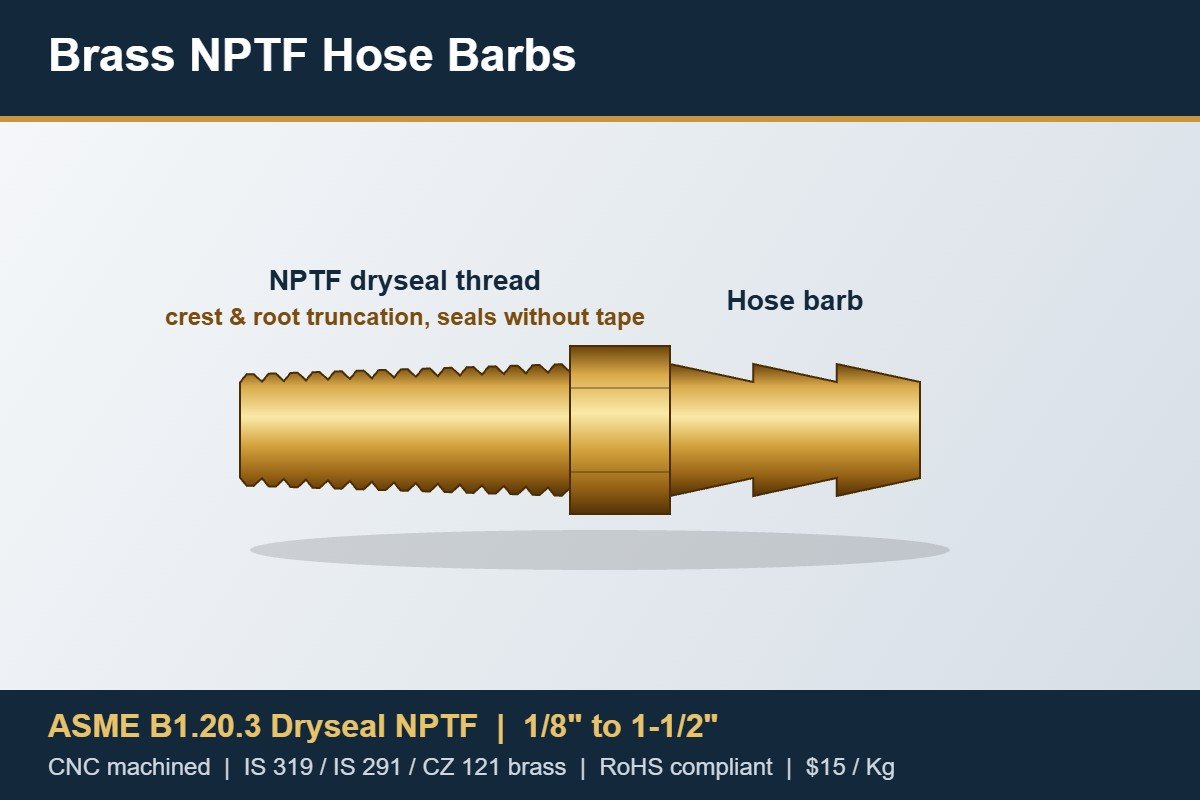
Brass NPTF Hose Barbs use the Dryseal American National Standard Taper Pipe Thread for Fuels, designated NPTF and defined in ASME B1.20.3. The thread has the same 60-degree angle and 1:16 taper as ordinary NPT, but its crests and roots are controlled so that the male and female threads meet metal-to-metal and close the helical leak path that ordinary pipe threads leave. That is why NPTF is the thread of choice for fuel systems, hydraulic lines, automotive and engine installations, and other applications in which a sealant would be a contamination risk or a maintenance nuisance. We machine our NPTF hose barbs from IS 319 / IS 291 / CZ 121 brass in male, female, 90-degree elbow and tee styles, with threads from 1/8″ to 1-1/2″ as standard.
This page explains what NPTF actually is, how it differs from NPT and BSP, how it behaves with different fuels and fluids, and how to order it using our code system. If you want the general-purpose American thread, read Brass NPT Hose Barbs; if your equipment is British standard, see Brass BSP Hose Tails and Hose Connectors. Shape-based pages are available for Brass Male Hose Barbs, Brass Female Hose Barbs, Brass 90 Degree Hose Barb Elbows and Brass Hose Barbed Tees.
Price: $15 / Kg for every NPTF size and style | Minimum order: 5 Kg per size code | Bulk discounts available
Quick Specification of Brass NPTF Hose Barbs
| Parameter | Specification |
|---|---|
| Product | Brass NPTF (Dryseal) Hose Barbs, ASME B1.20.3 threads with serrated hose barb |
| Thread form | 60°, taper 1:16, controlled crest and root truncation |
| Thread sizes | 1/8″ to 1-1/2″ NPTF standard; 2″ on request |
| Barb sizes | 3/16″ to 1-1/2″ standard |
| Styles | Male, female, 90° elbow, tee with NPTF branch |
| Material | Brass IS 319 / IS 291 / CZ 121; DZR and low-lead on request |
| Finish | Natural brass, nickel plated, chrome plated |
| Working pressure | Up to 150 PSI (10.3 bar), hose permitting |
| Price | $15 per Kg |
| Minimum order | 5 Kg per size code |
| Lead time | 7 to 15 working days |
What Makes NPTF Different from NPT?
An ordinary NPT thread seals by wedging the flanks together, but the crest of one thread does not touch the root of the other, so a spiral channel remains. A sealant or tape must fill it. In the Dryseal design, the crests of the male thread and the roots of the female thread are made to a specified truncation, so that when the parts are tightened the crests and roots contact before the flanks are fully engaged. The contact deforms the thread slightly and closes the spiral channel, producing a pressure-tight joint without a compound. Dryseal threads are also gauged more strictly, with a system of gauges that checks both the taper and the form of the thread, not only the pitch diameter.
The result is a joint with no sealant to contaminate a fuel injector or hydraulic valve, no tape shreds to clog a filter and no cure time before the line is pressurised. In practice, many users still apply a small amount of sealant on fluid lines for added assurance, and some fitting makers recommend it. Dry sealing is dependable on clean, undamaged threads at low and moderate pressure, and a sealant is a prudent addition when the thread has been reused several times.
Comparison of Common Pipe Thread Standards
| Thread | Standard | Flank angle | Taper | Seals without sealant? | Mechanism | Typical field |
|---|---|---|---|---|---|---|
| NPT | ASME B1.20.1 | 60° | 1:16 | No, sealant needed | Flank wedge plus sealant fills the spiral gap | General plumbing, water, air |
| NPTF (Dryseal) | ASME B1.20.3 | 60° | 1:16 | Yes, in suitable service | Crests and roots interfere metal-to-metal, closing the spiral gap | Fuel, hydraulics, automotive, test equipment |
| BSPT (R) | ISO 7 / BS 21 | 55° | 1:16 | No, sealant needed | Flank wedge plus sealant | UK, Europe, Asia |
| BSPP (G) | ISO 228 | 55° | Parallel | No, needs washer or O-ring | Face seal at the shoulder | Hydraulic and general fittings in Europe and Asia |
NPTF Thread Data
NPTF and NPT share their pitch, taper and nominal diameters, so the principal dimensions are the same. The table lists the basic dimensions for the sizes we supply as standard; our threads are produced and gauged against the dryseal standard.
| NPTF size | Threads per inch | Pitch (mm) | Outside diameter at gauge point (mm) | L1 hand-tight engagement (mm) | L2 effective thread length (mm) | Typical use |
|---|---|---|---|---|---|---|
| 1/8″ | 27 | 0.94 | 10.29 | 4.10 | 6.73 | Gauge ports, instrument air, small fuel lines |
| 1/4″ | 18 | 1.41 | 13.72 | 5.78 | 10.19 | Fuel filters, carburettor and injector feeds, pressure ports |
| 3/8″ | 18 | 1.41 | 17.14 | 6.10 | 10.36 | Fuel pumps, oil coolers, hydraulic drains |
| 1/2″ | 14 | 1.81 | 21.34 | 8.13 | 13.56 | Fuel tanks, return lines, compressor outlets |
| 3/4″ | 14 | 1.81 | 26.67 | 8.61 | 13.86 | Fuel transfer, large coolers, tank outlets |
| 1″ | 11.5 | 2.21 | 33.40 | 10.16 | 17.34 | Bulk fuel, hydraulic reservoirs |
| 1-1/4″ | 11.5 | 2.21 | 42.16 | 10.67 | 17.86 | Large reservoirs, transfer manifolds |
| 1-1/2″ | 11.5 | 2.21 | 48.26 | 10.85 | 18.39 | Bulk transfer and tank connections |
Interchangeability with NPT
A male NPTF thread will screw into a female NPT, and a male NPT into a female NPTF, and the combination will normally seal when a sealant is used. However, only an NPTF male in an NPTF female provides a fully dry seal. For the best performance and the simplest maintenance, specify NPTF at both ends of a joint. NPTF is never interchangeable with BSP of any form, nor with straight (parallel) threads such as NPSM, nor with metric tapered threads.
Part-Code System for NPTF Hose Barbs
NPTF codes follow CX-NPTF-[style]-[thread size][barb size]. The style letter is M (male hose barb), F (female hose barb), E (male 90-degree elbow) or T (tee with male NPTF branch). Sizes are expressed in sixteenths of an inch: 02 = 1/8″, 04 = 1/4″, 06 = 3/8″, 08 = 1/2″, 12 = 3/4″, 16 = 1″, 20 = 1-1/4″, 24 = 1-1/2″, with barb codes 03 (3/16″) and 10 (5/8″) as well. Thus CX-NPTF-M-0606 is a male NPTF hose barb with a 3/8″ NPTF thread and a 3/8″ barb, and CX-NPTF-F-0408 is a female NPTF hose barb with a 1/4″ thread and a 1/2″ barb.
Size Table: Standard NPTF Hose Barbs
The table lists standard equal combinations for the four NPTF styles. Elbows and tees are standard between 1/4″ and 1″ and available on request outside that range. Weights are approximate for the male barb and let you estimate pieces per Kg at $15 / Kg. A 2″ NPTF is available on request.
| NPTF thread × barb | Male barb code | Female barb code | 90° elbow code (male) | Tee code (male NPTF branch) | Hose ID (mm) | Male length (mm) | Female length (mm) | Male weight (g) | Male pcs per Kg |
|---|---|---|---|---|---|---|---|---|---|
| 1/8″ × 3/16″ | CX-NPTF-M-0203 | CX-NPTF-F-0203 | On request | On request | 4.8 | 28 | 30 | 6 | 167 |
| 1/4″ × 1/4″ | CX-NPTF-M-0404 | CX-NPTF-F-0404 | CX-NPTF-E-0404 | CX-NPTF-T-0404 | 6.4 | 32 | 35 | 12 | 83 |
| 3/8″ × 3/8″ | CX-NPTF-M-0606 | CX-NPTF-F-0606 | CX-NPTF-E-0606 | CX-NPTF-T-0606 | 9.5 | 38 | 40 | 22 | 45 |
| 1/2″ × 1/2″ | CX-NPTF-M-0808 | CX-NPTF-F-0808 | CX-NPTF-E-0808 | CX-NPTF-T-0808 | 12.7 | 44 | 48 | 39 | 26 |
| 3/4″ × 3/4″ | CX-NPTF-M-1212 | CX-NPTF-F-1212 | CX-NPTF-E-1212 | CX-NPTF-T-1212 | 19 | 52 | 56 | 76 | 13 |
| 1″ × 1″ | CX-NPTF-M-1616 | CX-NPTF-F-1616 | CX-NPTF-E-1616 | CX-NPTF-T-1616 | 25.4 | 60 | 64 | 134 | 7 |
| 1-1/4″ × 1-1/4″ | CX-NPTF-M-2020 | CX-NPTF-F-2020 | On request | On request | 31.8 | 68 | 72 | 215 | 5 |
| 1-1/2″ × 1-1/2″ | CX-NPTF-M-2424 | CX-NPTF-F-2424 | On request | On request | 38.1 | 75 | 79 | 310 | 3 |
Size Table: NPTF Reducing Combinations
Port threads are fixed by the equipment, so mixed combinations are common in fuel and hydraulic work. The following are stocked as standard, and any other pairing can be machined to order.
| NPTF thread × barb | Male code | Female code | Hose ID (mm) | Male length (mm) | Female length (mm) | Male weight (g) | Male pcs per Kg |
|---|---|---|---|---|---|---|---|
| 1/8″ × 1/4″ | CX-NPTF-M-0204 | CX-NPTF-F-0204 | 6.4 | 30 | 32 | 7.5 | 133 |
| 1/4″ × 3/16″ | CX-NPTF-M-0403 | CX-NPTF-F-0403 | 4.8 | 30 | 33 | 10.5 | 95 |
| 1/4″ × 3/8″ | CX-NPTF-M-0406 | CX-NPTF-F-0406 | 9.5 | 36 | 39 | 16 | 63 |
| 1/4″ × 1/2″ | CX-NPTF-M-0408 | CX-NPTF-F-0408 | 12.7 | 39 | 42 | 21 | 48 |
| 3/8″ × 1/4″ | CX-NPTF-M-0604 | CX-NPTF-F-0604 | 6.4 | 34 | 36 | 18 | 56 |
| 3/8″ × 1/2″ | CX-NPTF-M-0608 | CX-NPTF-F-0608 | 12.7 | 41 | 43 | 27 | 37 |
| 1/2″ × 3/8″ | CX-NPTF-M-0806 | CX-NPTF-F-0806 | 9.5 | 41 | 45 | 34 | 29 |
| 1/2″ × 5/8″ | CX-NPTF-M-0810 | CX-NPTF-F-0810 | 15.9 | 46 | 50 | 46 | 22 |
| 1/2″ × 3/4″ | CX-NPTF-M-0812 | CX-NPTF-F-0812 | 19 | 49 | 53 | 52 | 19 |
| 3/4″ × 1/2″ | CX-NPTF-M-1208 | CX-NPTF-F-1208 | 12.7 | 47 | 51 | 63 | 16 |
| 3/4″ × 5/8″ | CX-NPTF-M-1210 | CX-NPTF-F-1210 | 15.9 | 49 | 53 | 70 | 14 |
| 3/4″ × 1″ | CX-NPTF-M-1216 | CX-NPTF-F-1216 | 25.4 | 56 | 60 | 92 | 11 |
| 1″ × 3/4″ | CX-NPTF-M-1612 | CX-NPTF-F-1612 | 19 | 56 | 60 | 118 | 8 |
| 1″ × 1-1/4″ | CX-NPTF-M-1620 | CX-NPTF-F-1620 | 31.8 | 65 | 69 | 157 | 6 |
Fuel and Fluid Compatibility Guide
NPTF is closely associated with fuel and hydraulic service, so the compatibility of brass with common media is a practical question. The guidance below is general and based on typical behaviour of brass; confirm with your fluid supplier and hose manufacturer for the exact blend, temperature and duty.
| Medium | Brass NPTF hose barb | Comment |
|---|---|---|
| Diesel and biodiesel blends (B5 to B20) | Suitable | Check hose and clamp compatibility; high biodiesel blends can degrade some rubbers |
| Petrol / gasoline (E10) | Suitable | Use fuel-grade hose rated for ethanol blends |
| High-ethanol fuels (E85) | Check | Corrosion and rubber swelling risks; nickel plating or stainless steel is often preferred |
| Kerosene and light fuel oil | Suitable | Standard for generator and heater feeds |
| Mineral hydraulic oil (low pressure return) | Suitable | Not for pressure lines above hose-barb rating |
| Automatic transmission fluid, engine oil | Suitable | Common on oil cooler and drain lines |
| LPG (liquid) | Check | Barbed hose joints are not normally used on LPG; use gas-rated hose assemblies and crimped fittings |
| Coolant (glycol mixes) | Suitable | Use inhibited coolant to protect brass |
| Compressed air | Suitable | Standard use |
| Ammonia, strong acids | Not suitable | Brass is attacked; use stainless steel or plastic |
Design Notes for Fuel and Hydraulic Return Installations
Fuel lines should be as short and direct as practical, and routed away from heat sources and sharp edges. Support the hose near the fitting so that engine vibration does not move the hose against the barb, and fit clamps rated for fuel. Choose hose with a fuel-resistant inner liner and an outer cover suited to the environment. For hydraulic return and drain lines, ensure that the maximum pressure, including pressure spikes, remains below the rating of the hose and clamp; a barbed joint is not suitable for a pressure line. In both cases, use NPTF at both ends of the thread joint and tighten only until the joint seals, since over-tightening a dryseal thread deforms the crests that provide the seal and can reduce reusability.
Reusing and Re-Making NPTF Joints
Dryseal joints rely on thread deformation. After several make-and-break cycles the crests flatten, and the dry seal becomes less reliable. In service, use sealant on re-made joints or replace the fitting when the thread shows visible wear. Always inspect threads for dirt, swarf and damage before reassembly, because a single hard particle can score the sealing surface and create a leak path that tightening alone cannot cure.
Applications of Brass NPTF Hose Barbs
Diesel and petrol fuel systems
Fuel pumps, filters, injectors, tanks and return lines on engines, generators, tractors and construction equipment commonly use NPTF ports.
Hydraulic power units and reservoirs
Drain, case-drain and low-pressure return connections on power packs and reservoirs use NPTF barbs with oil-resistant hose.
Automotive and motorsport
Oil coolers, breather lines, fuel-pressure gauge feeds and catch-tank connections use NPTF fittings; brass is easy to machine and non-sparking.
Test rigs and ground-support equipment
Dynamometers, fuel-flow benches and servicing carts use dryseal threads where sealant contamination would harm instruments or injectors.
Compressed air and instrumentation
Instrument air manifolds and pneumatic control panels use NPTF where tape fragments could clog small orifices.
Lubrication systems
Centralised lubrication, oil mist and grease systems use small NPTF barbs on feed lines.
Material and Manufacturing
We produce NPTF fittings from certified IS 319 / IS 291 / CZ 121 brass, with 57–63% copper and 37–43% zinc, 120–150 HB hardness and a minimum tensile strength of 360 MPa. CNC lathes cut the dryseal thread form with controlled truncation, and thread conformity is checked using dryseal ring and plug gauges for L1 position. Because the dryseal seal depends on crest and root condition, the finishing process is gentle: parts are deburred and tumbled without damaging the thread, then ultrasonically cleaned. The plant works to ISO 9001:2015 with traceability from bar lot to carton. Where nickel or chrome plating is requested, we control plating build-up on the thread so that it does not exceed the gauging limits.
Selection Checklist
- Confirm NPTF on both parts of the joint for a dry seal.
- Select the style for the port or stub gender and the hose route.
- Choose barb and bore for the hose size and flow.
- Check the fluid against the compatibility table and the hose liner.
- Choose the finish: natural brass for fuels, nickel plating for marine or aggressive environments.
Installation Guidelines
- Inspect and clean both threads; discard parts with damaged crests.
- Start by hand and check that the thread engages smoothly to the hand-tight position.
- Tighten with a spanner on the hex until the joint seals; avoid over-tightening.
- For added assurance on fluid lines, apply a small amount of sealant compatible with the fuel.
- Push the hose fully on, fit a fuel-rated clamp over the ridges and tighten.
- Pressure test with the working fluid or air and check each joint.
Troubleshooting
Weeping at the thread: mixed thread families, damaged crests or particle contamination; clean, replace or add sealant. Hose slips: clamp too small or hose too hard; use a fuel-rated clamp and soften the hose end. Thread galling: brass on stainless steel; use a compatible lubricating sealant. Leak after repeated assembly: thread wear; replace the fitting. Hose cracks near the barb: ageing and heat; replace the hose with fuel-grade material.
Custom NPTF Hose Barbs
We make NPTF barbs to drawing, including long-thread versions, swivel designs, extra-long barbs for thick-wall hose, and mixed-thread parts such as NPTF to BSP. Send the drawing, quantity and finish for a quotation at the same $15 / Kg brass-machining basis.
Pricing, Packing and Ordering
| Item | Details |
|---|---|
| Price | $15 per Kg, all NPTF sizes and styles |
| Minimum order quantity | 5 Kg per size code |
| Lead time | 7 to 15 working days for standard sizes |
| Packaging | Individual polybags prevent thread damage; cartons for export |
| Quality | ISO 9001:2015, RoHS compliant, material traceability |
| Payment | T/T, LC at sight, PayPal for small orders |
| Shipping | Worldwide by sea, air or courier |
Send the code, quantity and destination for a quotation within 24 hours. The main Brass Hose Barbs page lists the entire range.
Thread Gauging for Dryseal Fittings
The dryseal standard defines a family of gauges so that crests, roots and taper can be verified, not only the pitch diameter. In general terms, a dryseal male thread is checked with ring gauges that confirm the position of the thread relative to the end of the part, and a female thread is checked with plug gauges that confirm the same position from the inside, with additional gauges checking the roots and crests. Parts are accepted when the gauge face falls inside the permitted band. We use this approach for production and can agree a sampling plan and gauge reports with the customer for larger orders. Because plated threads grow in thickness, the plating specification is considered before machining, so that plated parts remain inside the gauge limits.
Contamination Control for Fuel and Hydraulic Parts
The reason many users pick NPTF is to keep the system clean, so the fittings themselves must be clean. After machining, every part is deburred to remove edge flash at the thread start and in the bore, tumbled to break sharp edges and ultrasonically washed to remove oil, swarf and polishing residue from the threads and passages. Parts are dried and packed individually or in small groups in polybags, so that threads cannot strike each other in transit. For critical customers we can supply parts packed in sealed bags after a documented cleanliness check, and we recommend that installers keep fittings bagged until the moment of assembly and flush new hose assemblies before connecting them to injectors or valves.
Selecting Hose and Clamps for Fuel and Oil Lines
The brass barb is only one half of the hose joint. For fuel and oil service, choose a hose with a liner designed for the specific fuel and a cover designed for the environment, such as a heat- or oil-resistant jacket under the bonnet. Fuel hoses are classified by recognised standards, such as the SAE J30 family for different construction and pressure classes; select the grade that matches your system pressure and the manufacturer’s recommendations. Match the clamp to the hose and size, as shown in the table, and always fit the clamp over the ridges just behind the hose end.
| Hose ID | Suggested clamp type for fuel and oil | Clamps per end | Comment |
|---|---|---|---|
| 3/16″ to 1/4″ | Fuel-injection (ear or constant-tension) clamp or small worm-drive | 1 | Constant-tension clamps follow hose creep and temperature |
| 3/8″ to 1/2″ | Solid-band worm-drive or constant-tension clamp | 1 | Use stainless steel clamps; avoid slotted bands that cut soft liners |
| 5/8″ to 3/4″ | Solid-band worm-drive clamp | 1 to 2 | Two clamps when vibration is high |
| 1″ to 1-1/2″ | Wide-band worm-drive clamp | 2 | Space clamps over different ridges |
Leak Testing Dryseal Joints
After assembly, test the line with the working medium or dry air at a pressure appropriate to the system, using a soap solution or an approved leak detector on each joint. Watch for bubbles at the thread and at the hose end for at least a minute. If the joint weeps, depressurise and remake it rather than tightening further, since additional torque on a dryseal thread can distort the crests without improving the seal. Document the test pressure and the person who performed it for traceability on regulated installations such as fuel storage and generator sets.
Finish Options and Their Effect on Dryseal Threads
A dryseal thread depends on closely controlled crest and root condition, so anything that adds material to the thread, including plating, must be controlled. The table shows how each finish affects an NPTF thread. If your installation requires nickel or chrome, tell us when you quote so that plating allowance is built into the thread machining and the finished part still passes the gauge.
| Finish | Best for | Effect on NPTF thread | Our practice |
|---|---|---|---|
| Natural brass | Fuel, oil, air, general indoor use | None | Standard; lowest cost |
| Nickel plated | Marine, outdoor, visible installations, high-ethanol fuels | Adds a few microns on thread flanks | Plating thickness controlled so threads stay inside gauge limits |
| Chrome plated | Decorative or exposed installations | Hard, thin layer; thread may feel tighter | Used mainly on hex and barb area; thread masked on request |
NPTF in International Supply Chains
NPTF is specified in North American engine, fuel and hydraulic equipment, and that equipment is exported to every region, including India, the Middle East, Africa and Latin America. Service teams and distributors in those regions often have difficulty sourcing correct dryseal fittings because stockists carry BSP and NPT in greater quantity. Buying NPTF barbs directly from a manufacturer, with code numbers that identify thread, style and both sizes, removes the guesswork and the risk of an incompatible thread being substituted. We can hold a program stock of your most-used codes, ship them in mixed cartons to your distribution centres and label cartons with your own part numbers where required.
Frequently Asked Questions
What does NPTF mean?
NPTF stands for National Pipe Taper Fuel, also called Dryseal. It is an ASME B1.20.3 thread with the same angle and taper as NPT but with controlled crest and root truncation for sealing without sealant.
Do NPTF hose barbs need sealant?
They can seal dry on clean, undamaged threads, but many users add a small amount of compatible sealant on fluid lines, especially if a thread has been reused.
Is NPTF compatible with NPT?
A male NPTF will screw into a female NPT and vice versa, and with sealant the joint normally seals. A fully dry seal needs NPTF on both parts.
Is NPTF compatible with BSP?
No. NPTF has a 60-degree flank angle and BSP has 55 degrees, so they cannot seal together.
What does CX-NPTF-M-0606 mean?
It means a male (M) NPTF hose barb with a 3/8″ thread (06) and a 3/8″ barb (06).
What size range of NPTF do you supply?
NPTF threads from 1/8″ to 1-1/2″ are standard, with 2″ on request, and barbs from 3/16″ to 1-1/2″.
Can I use NPTF barbs with diesel and petrol?
Yes, with fuel-rated hose and clamps. For high-ethanol fuels check compatibility, since nickel plating or stainless steel may be preferred.
Are NPTF barbs suitable for hydraulic pressure lines?
No. They are suitable for low-pressure return, drain and fluid lines. Pressure lines require fittings rated for the system pressure.
What is the price and minimum order?
The price is $15 per Kg for all NPTF sizes and styles, with a minimum order of 5 Kg per size code.
Can you make custom NPTF fittings?
Yes. We make long-thread, swivel, mixed-thread and special-barb NPTF fittings to your drawing.
Explore Related Brass Hose Barb Pages
Every fitting in this range is produced in the same brass grades and shipped on the same commercial terms of $15 per Kg. Use these pages to compare configurations, then return to the main Brass Hose Barbs page for the complete overview.
- Brass Male Hose Barbs – the classic threaded-to-barbed adapter for rigid-port-to-hose connections
- Brass Female Hose Barbs – hex-body adapters that receive male-threaded ports, valves and pump outlets
- Brass 90 Degree Hose Barb Elbows – right-angle fittings for hose routing in tight spaces without kinking
- Brass Hose Barbed Tees – three-way fittings for splitting, merging and manifold hose layouts
- Brass NPT Hose Barbs – tapered ASME B1.20.1 threads used across North America and many Indian OEMs
- Brass BSP Hose Tails and Hose Connectors – BSP parallel and taper hose tails plus double-barb hose connectors
Reviews
There are no reviews yet.