


Description
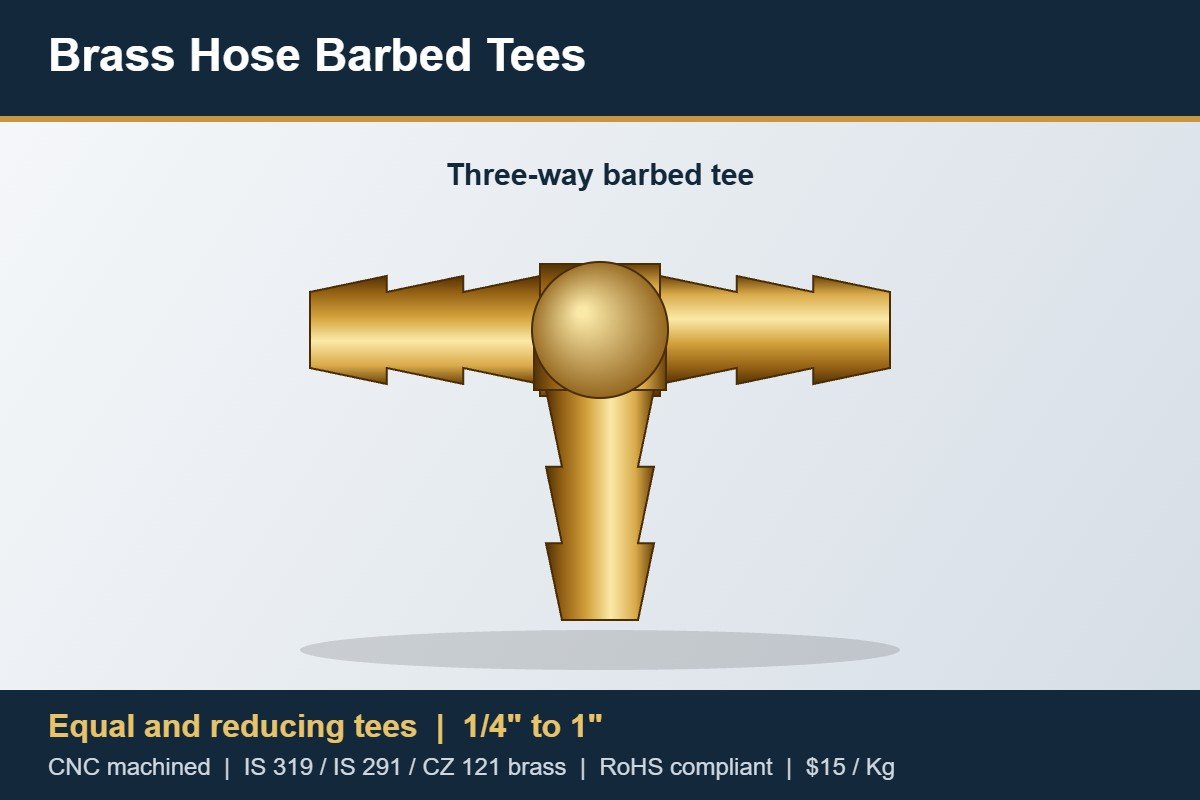
Brass Hose Barbed Tees
Brass Hose Barbed Tees are T-shaped fittings that split one hose line into two, merge two lines into one, or tap a hose to feed a gauge, sensor, vent or drain. In the all-barbed version, all three ends carry serrated barbs for flexible hose; in the threaded-branch version, the two run ends are barbed and the centre branch has a male or female pipe thread. We machine them from IS 319 / IS 291 / CZ 121 brass in equal sizes (all three barbs the same) and reducing sizes (branch smaller or larger than the run), in barb sizes from 1/4″ to 1″, with NPT, NPTF, BSPP and BSPT threads for the threaded-branch types, in natural brass, nickel plated or chrome plated finishes.
This page is organised around the questions a designer asks when laying out a branching line: how big should the tee be, how will the flow divide, how many clamps and tees does a manifold need, and which code should I quote? It contains three complete size tables with code numbers, a flow table and a manifold planning table. The straight and angled equivalents are on the pages for Brass Male Hose Barbs, Brass Female Hose Barbs and Brass 90 Degree Hose Barb Elbows.
Price: $15 / Kg for every tee size and type | Minimum order: 5 Kg per size code | Bulk discounts available
Quick Specification of Brass Hose Barbed Tees
| Parameter | Specification |
|---|---|
| Product | Brass Hose Barbed Tees, three-way fittings for splitting, merging and tapping hose lines |
| Types | All-barbed equal tee, all-barbed reducing tee, tee with male threaded branch, tee with female threaded branch |
| Material | Brass IS 319 / IS 291 / CZ 121; DZR and low-lead on request |
| Thread types (threaded branch) | NPT, NPTF, BSPP, BSPT |
| Barb sizes | 1/4″, 3/8″, 1/2″, 3/4″, 1″ |
| Finish | Natural brass, nickel plated, chrome plated |
| Working pressure | Up to 150 PSI (10.3 bar), hose permitting |
| Price | $15 per Kg |
| Minimum order | 5 Kg per size code |
| Lead time | 7 to 15 working days |
Types of Brass Hose Barbed Tees
Equal tees
All three barbs share the same size. Equal tees are the default for splitting a line into two equal outlets, or for joining two feeders into a common return. They are the simplest to specify and the most economical to stock because one size covers every position.
Reducing tees
The run barbs are one size and the branch is another. A common example is a 1/2″ × 1/2″ × 1/4″ tee that feeds a small instrument or dosing line from a main water line. Reducing tees keep the main line at full bore while allowing small side connections, and they avoid the pressure loss that results from using an equal tee and then reducing at the end of the branch.
Tees with a threaded branch
These have barbs on the run and a male or female thread in the centre branch. They are ideal for fitting a pressure gauge, a pressure switch, a temperature probe, a drain valve or a vent into a hose line without an extra adapter. They are also used as sampling points on process lines. See our Brass NPT Hose Barbs and Brass BSP Hose Tails and Hose Connectors pages when you need to confirm which thread standard your instruments use.
Part-Code System for Hose Barbed Tees
Tee codes begin CX-THB. For all-barbed tees the format is CX-THB-A-[run size][branch size] using dash sizes in sixteenths of an inch: 04 = 1/4″, 06 = 3/8″, 08 = 1/2″, 12 = 3/4″, 16 = 1″. For example CX-THB-A-0804 is an all-barbed tee with 1/2″ run barbs and a 1/4″ branch barb. For tees with a threaded branch the format is CX-THB-[gender][thread letter]-[run barb size][branch thread size], where the gender is M for male or F for female and the thread letter is N (NPT), F (NPTF), P (BSPP) or T (BSPT). CX-THB-MN-0804 is a tee with 1/2″ run barbs and a 1/4″ male NPT branch.
Size Table: All-Barbed Equal Tees
Dimension L is the overall length across the two run barbs and H is the height from the run centre line to the tip of the branch barb. Dimensions are typical (±0.8 mm) and weights are approximate for the price basis of $15 / Kg.
| Run × run × branch | Type | Code | Hose ID run / branch (mm) | Run length L (mm) | Branch height H (mm) | Approx. weight (g) | Pcs per Kg |
|---|---|---|---|---|---|---|---|
| 1/4″ × 1/4″ × 1/4″ | Equal | CX-THB-A-0404 | 6.4 / 6.4 | 46 | 23 | 18 | 56 |
| 3/8″ × 3/8″ × 3/8″ | Equal | CX-THB-A-0606 | 9.5 / 9.5 | 59 | 29 | 35 | 29 |
| 1/2″ × 1/2″ × 1/2″ | Equal | CX-THB-A-0808 | 12.7 / 12.7 | 69 | 35 | 55 | 18 |
| 3/4″ × 3/4″ × 3/4″ | Equal | CX-THB-A-1212 | 19 / 19 | 89 | 44 | 109 | 9 |
| 1″ × 1″ × 1″ | Equal | CX-THB-A-1616 | 25.4 / 25.4 | 107 | 53 | 174 | 6 |
Size Table: All-Barbed Reducing Tees
The table lists the combinations we stock as standard, including both reducing branches and a few enlarging branches where a small main line feeds a larger outlet. Any other combination between 1/4″ and 1″ can be made to order by quoting the code logic above.
| Run × run × branch | Type | Code | Hose ID run / branch (mm) | Run length L (mm) | Branch height H (mm) | Approx. weight (g) | Pcs per Kg |
|---|---|---|---|---|---|---|---|
| 3/8″ × 3/8″ × 1/4″ | Reducing | CX-THB-A-0604 | 9.5 / 6.4 | 59 | 25 | 31 | 32 |
| 1/2″ × 1/2″ × 1/4″ | Reducing | CX-THB-A-0804 | 12.7 / 6.4 | 69 | 28 | 46 | 22 |
| 1/2″ × 1/2″ × 3/8″ | Reducing | CX-THB-A-0806 | 12.7 / 9.5 | 69 | 32 | 50 | 20 |
| 3/4″ × 3/4″ × 3/8″ | Reducing | CX-THB-A-1206 | 19 / 9.5 | 89 | 36 | 91 | 11 |
| 3/4″ × 3/4″ × 1/2″ | Reducing | CX-THB-A-1208 | 19 / 12.7 | 89 | 39 | 96 | 10 |
| 1″ × 1″ × 1/2″ | Reducing | CX-THB-A-1608 | 25.4 / 12.7 | 107 | 44 | 145 | 7 |
| 1″ × 1″ × 3/4″ | Reducing | CX-THB-A-1612 | 25.4 / 19 | 107 | 49 | 158 | 6 |
| 1/4″ × 1/4″ × 3/8″ | Enlarging branch | CX-THB-A-0406 | 6.4 / 9.5 | 46 | 27 | 22 | 45 |
| 3/8″ × 3/8″ × 1/2″ | Enlarging branch | CX-THB-A-0608 | 9.5 / 12.7 | 59 | 32 | 40 | 25 |
| 1/2″ × 1/2″ × 3/4″ | Enlarging branch | CX-THB-A-0812 | 12.7 / 19 | 69 | 40 | 68 | 15 |
Size Table: Tees with Male Threaded Branch
The branch is a male pipe thread that screws into a female port, for example a gauge boss or a valve inlet. The thread letter in the code selects NPT, NPTF, BSPP or BSPT.
| Run barbs × branch thread | NPT code | NPTF code | BSPP code | BSPT code | Run length L (mm) | Branch height H (mm) | Approx. weight (g) | Pcs per Kg |
|---|---|---|---|---|---|---|---|---|
| 1/4″ barbs × 1/4″ male branch | CX-THB-MN-0404 | CX-THB-MF-0404 | CX-THB-MP-0404 | CX-THB-MT-0404 | 46 | 21 | 22 | 45 |
| 3/8″ barbs × 1/4″ male branch | CX-THB-MN-0604 | CX-THB-MF-0604 | CX-THB-MP-0604 | CX-THB-MT-0604 | 59 | 23 | 35 | 29 |
| 3/8″ barbs × 3/8″ male branch | CX-THB-MN-0606 | CX-THB-MF-0606 | CX-THB-MP-0606 | CX-THB-MT-0606 | 59 | 25 | 39 | 26 |
| 1/2″ barbs × 1/4″ male branch | CX-THB-MN-0804 | CX-THB-MF-0804 | CX-THB-MP-0804 | CX-THB-MT-0804 | 69 | 26 | 50 | 20 |
| 1/2″ barbs × 3/8″ male branch | CX-THB-MN-0806 | CX-THB-MF-0806 | CX-THB-MP-0806 | CX-THB-MT-0806 | 69 | 28 | 54 | 19 |
| 1/2″ barbs × 1/2″ male branch | CX-THB-MN-0808 | CX-THB-MF-0808 | CX-THB-MP-0808 | CX-THB-MT-0808 | 69 | 31 | 60 | 17 |
| 3/4″ barbs × 1/2″ male branch | CX-THB-MN-1208 | CX-THB-MF-1208 | CX-THB-MP-1208 | CX-THB-MT-1208 | 89 | 35 | 101 | 10 |
| 3/4″ barbs × 3/4″ male branch | CX-THB-MN-1212 | CX-THB-MF-1212 | CX-THB-MP-1212 | CX-THB-MT-1212 | 89 | 38 | 115 | 9 |
| 1″ barbs × 3/4″ male branch | CX-THB-MN-1612 | CX-THB-MF-1612 | CX-THB-MP-1612 | CX-THB-MT-1612 | 107 | 43 | 164 | 6 |
| 1″ barbs × 1″ male branch | CX-THB-MN-1616 | CX-THB-MF-1616 | CX-THB-MP-1616 | CX-THB-MT-1616 | 107 | 47 | 187 | 5 |
Size Table: Tees with Female Threaded Branch
The branch is an internal thread that accepts a male instrument, plug or valve. This is the usual choice for gauge tees, drain points and sampling connections, because the female branch is more robust against knocks than a male stub.
| Run barbs × branch thread | NPT code | NPTF code | BSPP code | BSPT code | Run length L (mm) | Branch height H (mm) | Approx. weight (g) | Pcs per Kg |
|---|---|---|---|---|---|---|---|---|
| 1/4″ barbs × 1/4″ female branch | CX-THB-FN-0404 | CX-THB-FF-0404 | CX-THB-FP-0404 | CX-THB-FT-0404 | 46 | 24 | 25 | 40 |
| 3/8″ barbs × 1/4″ female branch | CX-THB-FN-0604 | CX-THB-FF-0604 | CX-THB-FP-0604 | CX-THB-FT-0604 | 59 | 26 | 38 | 26 |
| 3/8″ barbs × 3/8″ female branch | CX-THB-FN-0606 | CX-THB-FF-0606 | CX-THB-FP-0606 | CX-THB-FT-0606 | 59 | 27 | 44 | 23 |
| 1/2″ barbs × 1/4″ female branch | CX-THB-FN-0804 | CX-THB-FF-0804 | CX-THB-FP-0804 | CX-THB-FT-0804 | 69 | 29 | 53 | 19 |
| 1/2″ barbs × 3/8″ female branch | CX-THB-FN-0806 | CX-THB-FF-0806 | CX-THB-FP-0806 | CX-THB-FT-0806 | 69 | 30 | 59 | 17 |
| 1/2″ barbs × 1/2″ female branch | CX-THB-FN-0808 | CX-THB-FF-0808 | CX-THB-FP-0808 | CX-THB-FT-0808 | 69 | 35 | 69 | 14 |
| 3/4″ barbs × 1/2″ female branch | CX-THB-FN-1208 | CX-THB-FF-1208 | CX-THB-FP-1208 | CX-THB-FT-1208 | 89 | 39 | 110 | 9 |
| 3/4″ barbs × 3/4″ female branch | CX-THB-FN-1212 | CX-THB-FF-1212 | CX-THB-FP-1212 | CX-THB-FT-1212 | 89 | 42 | 132 | 8 |
| 1″ barbs × 3/4″ female branch | CX-THB-FN-1612 | CX-THB-FF-1612 | CX-THB-FP-1612 | CX-THB-FT-1612 | 107 | 47 | 181 | 6 |
| 1″ barbs × 1″ female branch | CX-THB-FN-1616 | CX-THB-FF-1616 | CX-THB-FP-1616 | CX-THB-FT-1616 | 107 | 51 | 219 | 5 |
Flow Capacity of the Run
A tee must be sized for the total flow in the run, and the branches then carry fractions of it. The table gives the indicative total flow through the run bore at 2 metres per second and the flow in each branch when the line is divided into two equal outlets. These are simple continuity figures (flow equals area times velocity) intended for planning; they ignore losses and are not a performance guarantee.
| Run barb size | Run bore (mm) | Bore area (mm²) | Max total flow at 2 m/s (L/min) | Split into two equal branches (L/min each) |
|---|---|---|---|---|
| 1/4″ | 3.5 | 9.6 | 1.2 | 0.6 |
| 3/8″ | 6 | 28.3 | 3.4 | 1.7 |
| 1/2″ | 8.5 | 56.7 | 6.8 | 3.4 |
| 3/4″ | 14 | 153.9 | 18.5 | 9.2 |
| 1″ | 19 | 283.5 | 34.0 | 17.0 |
Planning a Hose Manifold with Tees
Chaining tees in series is a quick, inexpensive way to feed several outlets from one source. Each additional outlet requires one extra tee and three clamps. The table shows what that means as the outlet count grows. Remember that flow is not shared equally along a chain: the outlet closest to the source sees the highest pressure and takes the most flow, so place the highest-demand outlet nearest the source or restrict upstream outlets with smaller branch sizes.
| Number of outlets needed | Tees required in series | Hose clamps required (3 per tee) | Notes |
|---|---|---|---|
| 2 | 1 | 3 | Simple split; equal tee ideal |
| 3 | 2 | 6 | Use reducing tees to branches if outlets are smaller |
| 4 | 3 | 9 | Consider a manifold block if flow balance is critical |
| 5 | 4 | 12 | Pressure falls along the chain; place the largest demand nearest the source |
| 6 | 5 | 15 | Review pressure drop; a drilled manifold may be more efficient |
Applications of Brass Hose Barbed Tees
Water distribution and irrigation
Farm and nursery lines use tees to run laterals off a main hose, to feed drip headers and to split a pump discharge between several sprinkler lines. Brass resists UV and weather and outlasts plastic fittings in outdoor installations.
Compressed air supply manifolds
Workshops use all-barbed tees on air hose to feed several tools from a single receiver connection, and threaded-branch tees to add a pressure gauge or a drain valve.
Fuel splitting and return lines
Engine rooms, generators and test rigs use tees to feed two filters from one tank outlet or to merge return lines. Choose fuel-grade hose and fuel-rated clamps.
Chemical dosing and water treatment
Small reducing tees allow injection of dosing chemicals into a main water line or the connection of a sampling point. Check chemical compatibility before use: brass is not suitable for ammonia or strong acids.
Instrument and gauge connections
A threaded-branch tee lets you fit a pressure gauge, transmitter or switch exactly where you need to measure, with no extra pipework.
Aquariums, hydroponics and laboratories
Circulation loops, nutrient feed lines and experimental rigs use small tees for splitting flow between tanks or chambers.
Cooling circuits and heating loops
Chiller and hot-water loops use tees to feed parallel heat exchangers or to provide bleed and drain points.
Design Guidance for Branching Lines
Place the tee so that the branch leaves in a plane that suits the hose route, and keep at least two hose diameters of straight hose on every leg before any bend. Avoid dead legs, which are lengths of branch hose that carry no flow, because they can trap air or sediment and allow bacteria to grow in water lines; when a gauge tee must exist, fit it close to the main line. Support the tee body by clamping it to a bracket on larger sizes, so that hose weight does not hang on the barbs. Use clamps on every barb – three per tee – and stagger the screw positions so that you can reach them with a screwdriver. When hot water is used, allow for hose expansion by leaving slack between tees and fixed points.
Material and Manufacturing
Tees are machined from certified brass bar and finished with a cross-drilled branch. The run barbs are turned on CNC lathes, the branch is milled or turned from a boss on the body and the three passages are drilled to meet in a single junction. The junction is deburred so no chips remain in the line. Material is IS 319 / IS 291 / CZ 121 free-cutting brass with 57–63% copper and 37–43% zinc, giving approximately 120–150 HB and a minimum tensile strength of 360 MPa. For potable and aggressive-water duty we supply DZR or low-lead alloys. Batches are checked for barb diameters, branch alignment and thread fit; the plant is ISO 9001:2015 certified with bar-to-carton traceability and material test reports on request.
Selection Checklist
- Decide the type: all-barbed for hose-to-hose splits, threaded-branch for instruments, valves and drains.
- Size the run for total flow and the branch for its share.
- Use reducing tees to keep the main bore without extra adapters.
- Confirm the branch thread standard (NPT, NPTF, BSPP or BSPT) against the instrument.
- Choose the finish and alloy that suit the medium and environment.
- Allow clamp access to all three barbs.
Installation Guidelines
- Cut hose ends square and clean; soften the hose in warm water for large sizes.
- Seal a threaded branch with tape or sealant (tapered) or with a washer or O-ring (parallel), and do not over-tighten.
- Push each hose fully over its barb until it covers all ridges.
- Fit a clamp on each barb just behind the hose end and tighten evenly.
- Pressure test and check each joint; re-tighten after the first heat cycle.
Troubleshooting
Weeping at one barb: clamp misplaced or too small for the hose; refit. Uneven flow between branches: the first outlet in a chain takes the most flow; fit a smaller branch or move the largest demand upstream. Branch thread leaks: mixed thread standards, insufficient sealant, or a damaged instrument thread. Hose collapses on suction side: use a reinforced suction hose and avoid sharp bends near the tee. Noise: turbulence from a sudden size change; use a reducing tee that matches the flows.
Custom Tees and Manifold Pieces
We manufacture four-way crosses, Y-tees, tees with two threaded outlets, tees with mixed threads, long-run tees and drilled manifold blocks to drawing. Send your sketch, quantity and finish and we will quote on the same $15 / Kg weight basis for brass machining.
Pricing, Packing and Ordering
| Item | Details |
|---|---|
| Price | $15 per Kg, all tee sizes and types |
| Minimum order quantity | 5 Kg per size code |
| Lead time | 7 to 15 working days for standard sizes |
| Packaging | Polybag and carton; custom packaging on request |
| Quality | ISO 9001:2015, RoHS compliant, material traceability |
| Payment | T/T, LC at sight, PayPal for small orders |
| Shipping | Worldwide by sea, air or courier |
Send your code numbers, quantity and destination for a quotation within 24 hours. The main Brass Hose Barbs page lists the full range of hose barb types.
Choosing Between Equal, Reducing and Threaded-Branch Tees
The choice starts from the purpose of the branch. If the branch carries a substantial share of the flow, such as a second pump feed or a parallel heat exchanger, use an equal tee, or a reducing tee whose branch is sized for that share. If the branch only feeds a small consumer, such as a dosing line, a gauge or a vent, use a reducing tee with a small branch so that the main run remains at full bore. If the branch must connect to something rigid, such as a gauge, a valve or a sensor, choose a threaded-branch tee so that you avoid an extra adapter and an extra leak path.
A frequent mistake is to use an equal tee and then fit a reducing barb or adapter on the branch. That adds two joints and increases length. A reducing tee is cheaper in the long run, and its code is as easy to quote as any other: for example, CX-THB-A-0804 in place of an equal 1/2″ tee and a separate reducer.
Gauge, Sensor and Drain Connections on Threaded-Branch Tees
Instruments are normally supplied with a fixed thread, so the tee must match it. The table lists common instrument threads and a suggested tee configuration. Where there is any doubt about the thread of an instrument, check the data plate or datasheet, or send us the instrument model and we will identify the correct thread letter for the code.
| Instrument or accessory | Typical connection thread | Suggested tee type | Notes |
|---|---|---|---|
| Pressure gauge, 40 to 63 mm dial | 1/8″ or 1/4″ NPT, or G1/8 / G1/4 BSPP | Female threaded branch, run barbs 1/4″ to 1/2″ | Use a washer on BSPP; tape or sealant on NPT |
| Pressure gauge, 100 mm dial | 1/4″ or 1/2″ NPT, or G1/4 / G1/2 BSPP | Female threaded branch, run barbs 1/2″ or 3/4″ | Fit a snubber on pulsating lines |
| Pressure switch or transmitter | 1/4″ NPT or G1/4 | Female threaded branch | Check the sensor’s wetted-material limit |
| Temperature probe or thermowell | 1/2″ NPT or G1/2 | Female threaded branch, run barbs 3/4″ or 1″ | Locate in a well-mixed section of the line |
| Drain or sampling valve | 1/4″ or 3/8″ NPT, or G1/4 / G3/8 | Male or female threaded branch | Close to the main line to avoid a dead leg |
| Air bleed or vent valve | 1/8″ or 1/4″ NPT, or G1/8 / G1/4 | Female threaded branch at the highest point | Orient the branch upward |
Temperature, Expansion and Hose Slack
A tee fixes three hoses at one point, so any thermal movement of the hoses concentrates there. Rubber hose grows as it warms and shrinks as it cools, and brass expands slightly too. Leave a little slack on every leg and avoid tight runs between rigid anchor points. On hot-water lines, place the clamp screws away from surfaces that can be touched, and use clamps with an insulating sleeve if staff may contact the hardware. Brass tees can be used from -20°C to +120°C, but the limit for the assembly is always the hose, so confirm its rating before specifying high-temperature service.
Frequently Asked Questions
What is a brass hose barbed tee?
A brass hose barbed tee is a three-way T-shaped fitting that splits, merges or taps a flexible hose line. The ends are barbed for hose, and in some versions the centre branch is threaded.
What is the difference between an equal tee and a reducing tee?
An equal tee has the same size on all three barbs, while a reducing tee has a branch of a different size from the run. Reducing tees keep the main line at full bore.
Can the branch be threaded instead of barbed?
Yes. Tees with a male or female threaded branch are supplied in NPT, NPTF, BSPP and BSPT for gauges, drains, valves and sampling points.
What does the code CX-THB-A-0804 mean?
It is an all-barbed tee (A) with 1/2″ run barbs (08) and a 1/4″ branch barb (04).
What size range do you offer?
Barb sizes from 1/4″ to 1″ are standard. Custom sizes outside this range can be machined to order.
How many clamps do I need for one tee?
Use one clamp per barb, so three clamps per all-barbed tee, and two clamps if the branch is threaded.
Will flow divide equally between the branches?
Not automatically. Flow depends on the downstream resistance of each branch. In a chain of tees the outlet nearest the source receives more flow.
What is the price and minimum order?
The price is $15 per Kg for all tee sizes and types, with a minimum order of 5 Kg per size code.
Are DZR, lead-free and plated tees available?
Yes. Natural, nickel plated and chrome plated finishes and DZR or low-lead brass are available on request.
Can you supply crosses, Y-tees or manifold blocks?
Yes. We machine four-way crosses, Y-tees and drilled manifold blocks to your drawing.
Explore Related Brass Hose Barb Pages
Every fitting in this range is produced in the same brass grades and shipped on the same commercial terms of $15 per Kg. Use these pages to compare configurations, then return to the main Brass Hose Barbs page for the complete overview.
- Brass Male Hose Barbs – the classic threaded-to-barbed adapter for rigid-port-to-hose connections
- Brass Female Hose Barbs – hex-body adapters that receive male-threaded ports, valves and pump outlets
- Brass 90 Degree Hose Barb Elbows – right-angle fittings for hose routing in tight spaces without kinking
- Brass NPT Hose Barbs – tapered ASME B1.20.1 threads used across North America and many Indian OEMs
- Brass NPTF Hose Barbs – dryseal ASME B1.20.3 threads for fuel, hydraulic and tape-free service
- Brass BSP Hose Tails and Hose Connectors – BSP parallel and taper hose tails plus double-barb hose connectors
Reviews
There are no reviews yet.