Description
Cold Forged Stainless Steel Components – Manufacturer & Exporter from India
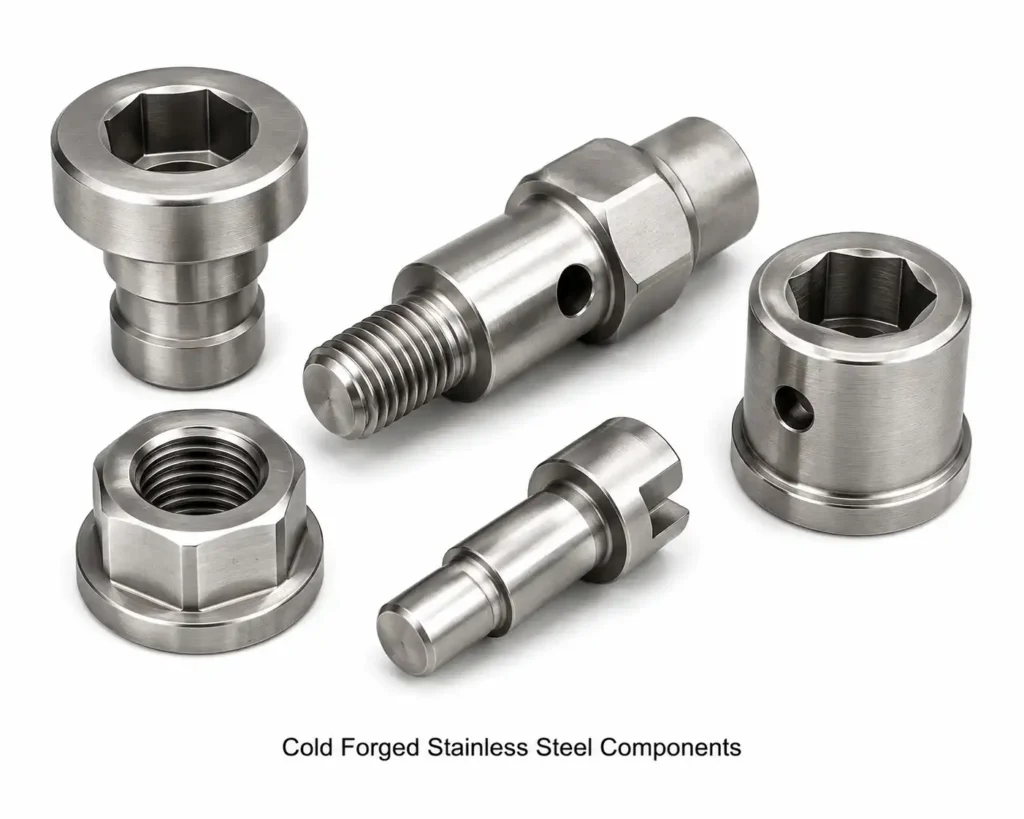
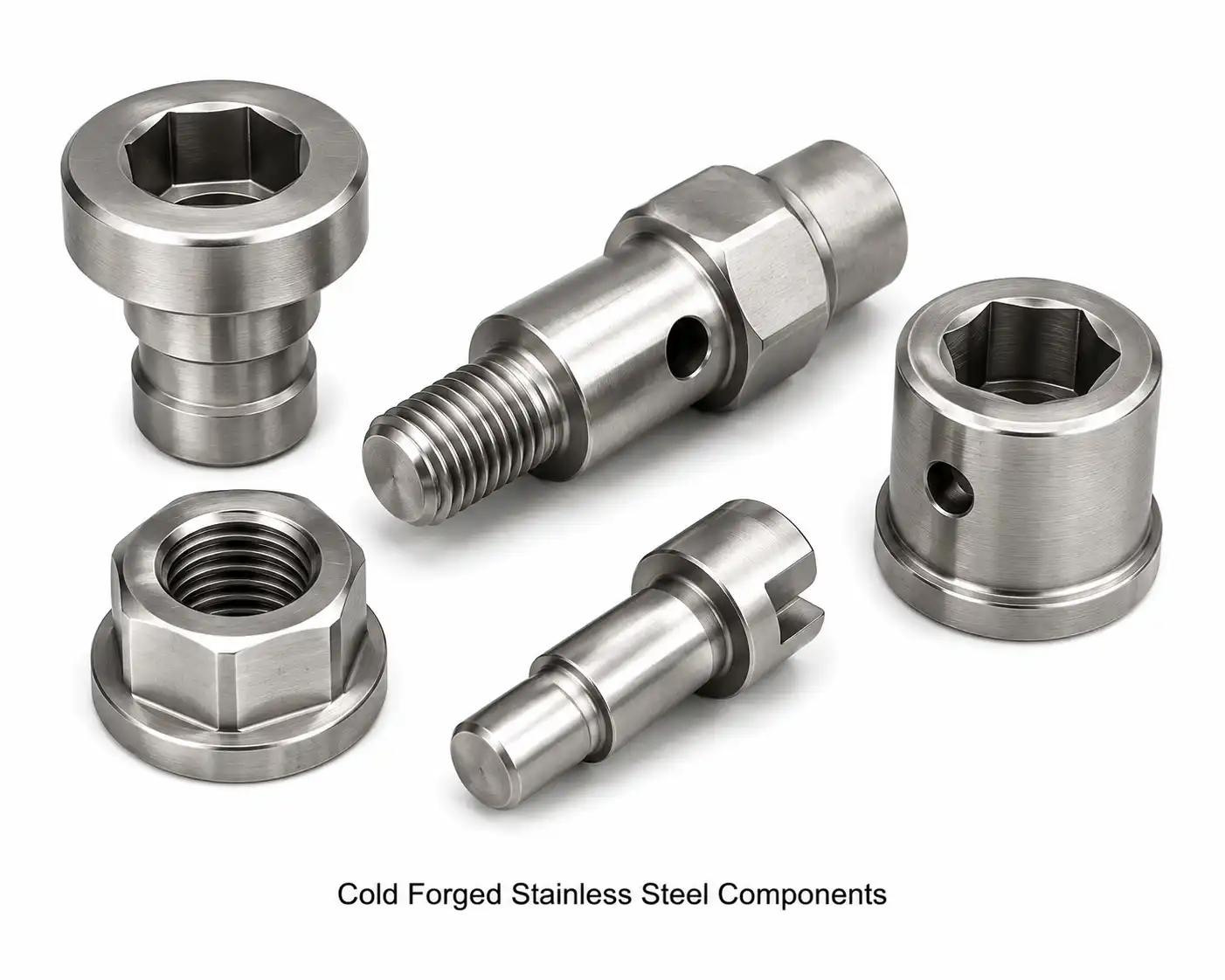
Cold Forged Stainless Steel Components from Stainless Steel Fittings India are precision-formed parts manufactured by applying high compressive force to stainless steel billets or blanks at room temperature (or slightly warm) — without the need for heating to forging temperatures. This process produces components with superior dimensional accuracy, excellent surface finish, strain-hardened mechanical properties, and high production efficiency compared to hot-forged or machined-from-bar alternatives. Available in SS 304, 304L, 316, 316L, and 430 grades, cold forged SS components are widely used in fastener manufacturing, instrument fittings, compression fitting bodies, electrical connectors, valve stems, and precision industrial hardware. Price: SS 316 Cold Forged Components from US$ 11.50/kg ex-works India.
Product Overview
The Cold Forging Process for Stainless Steel
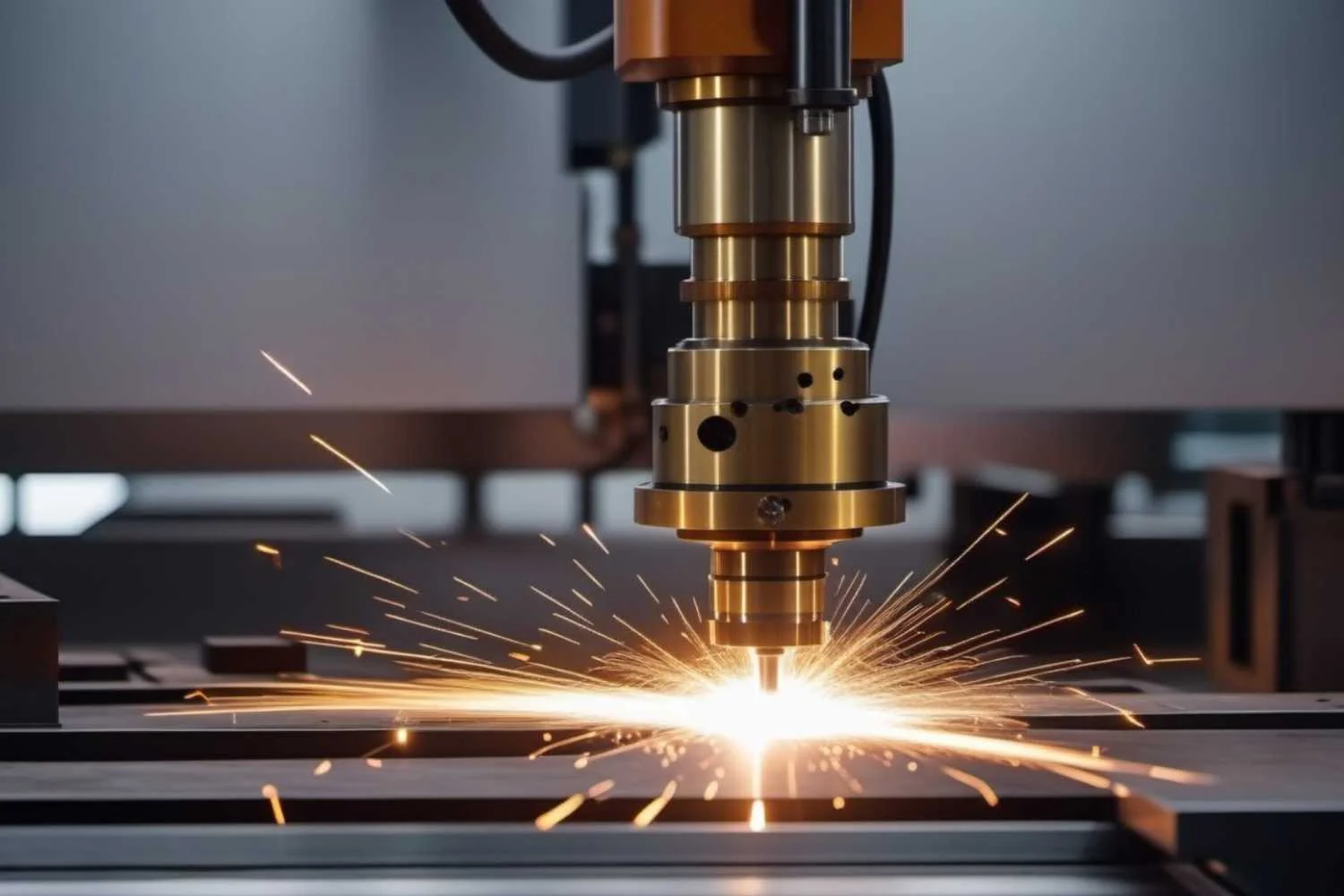
Cold forging (also called cold heading or cold forming) of stainless steel is performed at room temperature using multi-stage transfer presses, horizontal cold headers, or vertical forging presses with carbide or hardened tool steel dies. The metal blank is placed in a die cavity and formed by applying pressure of up to 2,500 MPa through precision punch-and-die tooling. Key cold forging operations include: forward extrusion (reducing diameter by pushing metal forward), backward extrusion (forming cup-shaped cavities), upsetting (increasing cross-section), coining (precision coining of flat surfaces to ±0.01 mm), and combined multi-stage forming. Austenitic grades SS 304 and 316 exhibit high work-hardening rates during cold forging, requiring carefully designed forming sequences and inter-stage process annealing for complex geometries.
Cold Forging vs. Hot Forging vs. Machining
Cold forging offers three key advantages over alternative manufacturing routes. Versus machining from bar: cold forging eliminates 60–75% of material waste (no chips), reduces cycle time by 4–8× for high-volume production, and improves mechanical properties through work hardening. Versus hot forging: cold forging achieves tighter dimensional tolerances (±0.05 mm vs. ±1.5 mm), better surface finish (Ra 1.6 µm vs. Ra 12.5 µm as-forged), and eliminates heat treatment steps for certain grades. Versus casting: cold forged components are fully dense (zero porosity), have superior fatigue strength, and do not require heat treatment to achieve structural properties. For high-volume precision components (bolts, nuts, fitting bodies, connectors, inserts), cold forging is the most cost-effective manufacturing route.
Material Behavior During Cold Forging
Austenitic stainless steel grades (SS 304, 316) are more challenging to cold forge than carbon or alloy steels due to their high work-hardening exponent (n ≈ 0.50 for SS 304 vs. n ≈ 0.15 for carbon steel). A single cold forging operation on SS 316 can increase tensile strength from 515 MPa (annealed) to over 900 MPa through strain hardening, increasing hardness from 200 HBW to 320+ HBW. Multi-stage complex parts require intermediate process annealing at 1040–1100°C to soften work-hardened intermediate preforms before subsequent forming stages. Lubrication is critical: calcium soap-coated and phosphate-coated wire/bar is used to reduce die wear and enable forming without galling (adhesive wear) at the die-metal interface.
Product Range of Cold Forged SS Components
Stainless Steel Fittings India’s cold forging production covers: fastener blanks (hexagonal bolts, socket head cap screws, set screws, studs), compression fitting bodies (ferrule fittings, push-fit bodies, tube unions), instrument valve stems and gland nuts, terminal and connector bodies (cable glands, DIN rail terminal inserts), sleeve anchors and insert nuts, pipe nipple and coupling bodies, hex nuts and locknuts, precision inserts for hydraulic manifolds, contact pins and sockets, and custom precision industrial hardware per buyer drawings. Production volumes: 500 to 5,000,000 pieces per month per component depending on size and complexity.
Dimensional Accuracy and Surface Quality
Cold forged stainless steel components achieve dimensional tolerances of ±0.02–0.10 mm on formed surfaces as a direct result of the high-precision die tooling. This is typically 10–20× better than as-forged hot forging tolerances, often eliminating the need for secondary machining on non-threaded features. Surface roughness of cold forged faces: Ra 0.8–3.2 µm, significantly better than hot forged surfaces (Ra 6.3–25 µm). Thread rolling (as applied to cold-headed bolt blanks) further improves thread root strength by 20–30% versus cut threads, as rolling work-hardens the thread root and introduces compressive residual stresses that improve fatigue life under vibratory loading — critical for electrical OEM and automotive applications.
Electrical OEM and Industrial Fastener Applications
Cold forged SS 316 components are widely specified by electrical OEMs for: switchgear fasteners and terminal hardware in coastal/marine substations, cable gland bodies for IP68 environmental protection, DIN rail mounting hardware for corrosive environments, transformer tank fasteners, bus bar connector bodies, and grounding/earthing lug inserts. The combination of corrosion resistance (SS 316 PREN 24–26), dimensional precision (±0.05 mm), and high production volumes (thousands of pieces per order) makes cold forged SS components the specification standard for electrical panel manufacturers and marine-grade enclosure hardware.
Quality Control in Cold Forging Production
Statistical Process Control (SPC) using in-line vision inspection systems and automatic gauging ensures dimensional consistency across high-volume cold forging production runs. Critical dimensions are tracked on control charts with Cpk targets ≥ 1.67 for safety-critical features. 100% visual inspection and thread gauge verification on threaded components. First Article Inspection (FAI) per AS9102 or PPAP (Production Part Approval Process) documentation available for automotive and electrical OEM customers. Traceability is maintained through work order linkage to raw material coil/bar heat numbers and daily production records.
Key Features
- Net-shape or near-net-shape forming — minimal material waste versus machining
- Work hardening increases tensile strength from 515 MPa to 900+ MPa for SS 316
- Dimensional tolerance: ±0.02–0.10 mm on formed surfaces
- Surface finish: Ra 0.8–3.2 µm — eliminates grinding in many applications
- Thread rolling on bolts/studs: 20–30% stronger roots versus cut threads
- High volume production: up to 5 million pieces/month per item
- Full SPC with Cpk ≥ 1.67 for critical OEM dimensions
- PPAP / FAI documentation for electrical OEM and automotive supply chains
Work Hardening and Strength Enhancement
Cold forging of SS 316 at true strains of 0.3–0.8 increases UTS from annealed 515 MPa to 700–950 MPa and yield strength from 205 MPa to 600–800 MPa through the Ludwigson hardening equation. This work hardening effect eliminates the need for heat treatment in many precision component applications, saving energy and reducing lead time. Hardness increase from 200 HBW (annealed) to 280–350 HBW is achieved in a single cold heading pass. This makes cold headed SS 316 bolts significantly stronger than hot-forged equivalents of the same material in annealed condition, important for high-vibration electrical OEM assembly applications where fatigue life of fasteners is critical.
Tool Steel and Die Design for SS Cold Forging
Dies for stainless steel cold forging use: Tungsten carbide (WC-Co) for forming cavities (wear resistance under high contact pressure), PM high-speed steel (M2, M4) for punches, and D2 tool steel for peripheral tooling. Die preload systems with split-die rings extend die life from 50,000 to 500,000+ strokes for SS 316. Die re-conditioning and re-polishing services maintain tooling investment across multiple production campaigns. Tooling design for SS cold forging incorporates higher draft angles, larger corner radii, and lower area reductions per pass (maximum 30–40% area reduction per cold forging stage for austenitic SS) compared to carbon steel tooling practices.
Lubrication Systems for Stainless Steel Cold Forging
Wire/bar lubrication for SS cold forging uses a multi-layer system: phosphate coating (zinc phosphate conversion, 5–20 g/m²) + calcium soap lubricant (calcium stearate) applied by immersion. This phosphate-soap system provides a dry lubricant film that separates the workpiece from the die surface, reducing friction coefficient from 0.15–0.20 (unlubricated) to 0.04–0.08. For food-grade, pharmaceutical, or electropolished final part applications, phosphate-free lubrication systems using synthetic polymer lubricants are used to avoid contamination of final surface chemistry. Lubricant residue is fully removed by ultrasonic degreasing followed by alkaline washing and passivation per ASTM A967.
Post-Forming Operations and Surface Treatment
Post-cold-forming operations include: process annealing (inter-stage softening at 1040°C WQ for complex multi-stage parts), CNC thread rolling (for threaded fastener bodies), CNC turning/drilling for secondary machined features, degreasing and pickling (ASTM A380 acid pickling in HNO₃/HF), passivation (ASTM A967), electropolishing (for pharmaceutical/hygienic parts), and bead blasting for uniform matte finish. All post-forging heat treatment (annealing) and surface treatment records are maintained as part of the documented quality system and included in the material traceability package.
Technical Specifications
| Parameter | Details |
| Product | Cold Forged Stainless Steel Components (Custom & Standard) |
| Process | Cold Heading, Cold Extrusion, Cold Upsetting, Coining |
| Material Grades | SS 304 / 304L, 316 / 316L, 430, 410, 17-4PH |
| Size Range | Ø 1.5 mm to Ø 80 mm; Weight 0.002 kg to 2 kg/piece |
| Dimensional Tolerance | ±0.02–0.10 mm (formed surfaces); ±0.01 mm (coined surfaces) |
| Surface Finish | Ra 0.8–3.2 µm (as-cold-forged); Ra ≤ 0.4 µm (electropolished) |
| Production Volume | 500 – 5,000,000 pieces/month per item |
| Tensile Strength (SS 316) | 700–950 MPa (work hardened from 515 MPa annealed) |
| Thread Standard | ISO Metric (M), UNC, UNF, BSW (rolled threads) |
| Certifications | ISO 9001:2015, EN 10204 3.1, PPAP, NABL |
| Surface Treatment | Passivated, Electropolished, Bead Blasted, Zinc Phosphate (in-process) |
| HS Code | 73181500 (fasteners) / 73261900 (other) |
| Price (SS 316) | US$ 11.50 / kg ex-works India |
Material Grade International Equivalents
| Grade | UNS | EN / DIN | BS | JIS | GOST |
| SS 304 / 304L | S30400/S30403 | 1.4301/1.4307 | 304S31 | SUS304 | 08Kh18N10 |
| SS 316 / 316L | S31600/S31603 | 1.4401/1.4404 | 316S31 | SUS316 | 10Kh17N13M2 |
| SS 430 | S43000 | 1.4016 | 430S15 | SUS430 | 12Kh17 |
| SS 410 | S41000 | 1.4006 | 410S21 | SUS410 | 12Kh13 |
| 17-4PH | S17400 | 1.4542 | — | SUS630 | — |
Product Types / Variants
| Component Type | Cold Forging Method | Industries Served |
| Bolt/Screw Blanks | Cold Heading + Thread Rolling | Electrical OEM, Construction, Marine |
| Nut Blanks (Hex, Lock, Flange) | Cold Heading + Tapping | General Industry, Power, Marine |
| Compression Fitting Bodies | Cold Extrusion + Machining | Instrumentation, Process Piping |
| Cable Gland Bodies | Cold Extrusion + Machining | Electrical OEM, Marine, Offshore |
| Valve Stem Blanks | Cold Forging + CNC Turning | Instrumentation, Chemical, Oil & Gas |
| Terminal Insert Bodies | Cold Heading + Drilling | Electrical OEM, Panel Builders |
| Sleeve Anchor Bodies | Cold Extrusion | Construction, Infrastructure |
| Custom Precision Hardware | Multi-Stage Cold Forming | Any industrial sector |
Applications by Industry
| Industry | Cold Forged SS Component Application |
| Electrical OEMs | Terminal hardware, cable gland bodies, DIN rail inserts, switchgear fasteners |
| Instrumentation | Compression fitting bodies, ferrule sets, valve stem blanks |
| Power Utilities | Transformer tank fasteners, substation grounding hardware, busbar connectors |
| Marine / Offshore | Deck fitting fasteners, hull hardware, anti-vibration insert nuts |
| Oil & Gas | High-pressure fitting bodies, instrument tube fittings, coupling inserts |
| Pharmaceutical | Hygienic fasteners, vessel insert nuts, bioreactor hardware |
| Construction | Sleeve anchors, threaded inserts, curtain wall fasteners |
| Automotive / Transport | Exhaust system fasteners, structural inserts (17-4PH grade) |
Quality Standards and Certifications
| Standard / Certificate | Scope |
| ISO 9001:2015 | Quality Management System |
| EN 10204 3.1 | Material Test Report |
| ASTM A276 / A479 | SS bar material standard |
| ISO 3269 | Fastener acceptance inspection |
| ASME B18.3 / B18.6 | Socket head and machine screw dimensional standard |
| PPAP Level 1–3 | Production Part Approval Process for OEM supply |
| SPC / Cpk ≥ 1.67 | Statistical process control for critical OEM dimensions |
| NABL Accredited Lab | Chemical and mechanical testing |
Why Choose Stainless Steel Fittings India?
- ISO 9001:2015 certified cold forging facility with SPC quality system
- High-volume capability: up to 5 million pieces/month per component
- Tungsten carbide tooling for extended die life and consistent dimensional quality
- SS 316 cold forged components from US$ 11.50/kg ex-works India
- PPAP and FAI documentation available for electrical OEM and industrial supply chains
- Quick prototyping: first samples in 7–10 days from approved drawings
- Full EN 10204 3.1 material traceability; NABL-accredited mechanical and chemical testing
- Export packaging and documentation for smooth customs clearance in 40+ countries
Frequently Asked Questions (FAQ)
Q1: What is cold forging and how does it differ from hot forging?
Cold forging shapes metal at or near room temperature using high compressive force in precision dies. Hot forging heats the metal above its recrystallization temperature first. Cold forging produces tighter tolerances (±0.02–0.10 mm), better surface finish (Ra 0.8–3.2 µm), and work-hardened stronger parts, but is limited to simpler shapes and smaller sizes compared to hot forging.
Q2: What stainless steel grades can be cold forged?
SS 304, 304L, 316, 316L (austenitic grades), SS 430 (ferritic), SS 410 (martensitic), and precipitation-hardened grade 17-4PH can all be cold forged. Austenitic grades (304, 316) require more careful process design due to their high work-hardening rates, typically limiting area reduction to 30–40% per stage without intermediate annealing.
Q3: What is the minimum order quantity (MOQ) for cold forged SS components?
MOQ for standard cold forged components is typically 1,000–5,000 pieces per item to justify tooling cost amortization. For high-volume commodity items (standard bolts, nuts, compression fitting bodies), smaller MOQs of 500 pieces are possible. Custom tooling for new parts has a tooling contribution cost shared with the buyer.
Q4: Can you supply cold forged SS 316 components to electrical OEM specifications?
Yes. We supply cold forged SS 316 components to electrical OEM specifications including PPAP Level 1–3 documentation, dimensional capability studies (Cpk ≥ 1.67), material traceability per EN 10204 3.1, and packaging per OEM requirements. IATF 16949 alignment is available for automotive-adjacent electrical OEM customers.
Q5: What is the price of cold forged SS 316 components per kg?
Cold forged SS 316 stainless steel components are priced from US$ 11.50/kg ex-works India. Final price depends on component complexity, tooling amortization, quantity, and certification requirements. Contact us with drawings and target quantities for accurate quotation.
Q6: What is thread rolling and why is it used for cold forged fastener components?
Thread rolling is a cold-forming process that displaces material to form thread geometry (rather than cutting and removing material). Rolled threads have 20–30% higher fatigue strength than cut threads due to work-hardened thread roots and compressive residual stresses. All threaded cold forged components from Stainless Steel Fittings India use rolled threads as standard.
Q7: Do cold forged SS 316 components require post-forging heat treatment?
For simple geometries (single-stage forming), no heat treatment is required — the work-hardened condition provides increased strength. For complex multi-stage parts with area reductions >40%, intermediate process annealing (1040–1100°C, WQ) is applied after each major forming stage to restore ductility. Full solution annealing is applied where dimensional stability under thermal cycling is critical.
Q8: What surface treatment is standard for cold forged SS components?
Standard: degreasing, pickling (ASTM A380), and passivation (ASTM A967 Method A) to restore the passive chromium oxide film and ensure maximum corrosion resistance. Optional: electropolishing (Ra ≤ 0.4 µm) for pharmaceutical/hygienic use, bead blasting for matte finish, or zinc-phosphate for in-process lubrication (not retained on finished parts).
Q9: Can cold forged components replace cast stainless steel components?
Yes, for components under approximately 2 kg weight. Cold forged components have zero internal porosity (unlike castings), superior surface finish, better dimensional consistency, and equivalent or higher mechanical strength. Common casting-to-forging conversions: valve bodies, coupling bodies, terminal housings, fitting bodies, and structural inserts. We can review customer cast component drawings and assess forging feasibility at no charge.
Q10: What documentation is supplied with cold forged SS 316 components?
Standard documentation: EN 10204 3.1 Material Test Report, dimensional inspection report (first article), thread gauge certificate (100% inspection), passivation certificate, and packing list. For OEM customers: PPAP documentation (Level 1–3), SPC control charts, Cpk study report, and FAI per AS9102 are available. All documents in PDF format with digital traceability archive.
Equivalent Terms – International Languages
| Language | Terms |
| Spanish | Componentes forjados en frío de acero inoxidable, Piezas trefiladas en frío inox, Estampado en frío acero inoxidable SS 316, Forja en frío inoxidable |
| Russian | Холоднокованые компоненты из нержавеющей стали, Холодная ковка SS 316, Детали холодной объёмной штамповки нержавейка, Холодноштампованные изделия из нержавеющей стали |
| French | Composants forgés à froid en acier inoxydable, Pièces matricées à froid inox SS 316, Forgeage à froid acier inoxydable, Frappe à froid acier inox |
| Portuguese | Componentes forjados a frio em aço inoxidável, Trefilagem a frio inox SS 316, Forjamento a frio aço inoxidável, Peças estampadas a frio inox |
| Italian | Componenti forgiati a freddo in acciaio inossidabile, Forgiatura a freddo SS 316, Parti stampate a freddo inox, Componenti pressofusi a freddo acciaio inox |
Related Products – Stainless Steel Forgings
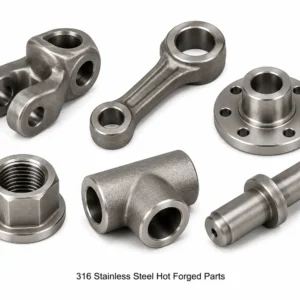
- 316 Stainless Steel Hot Forged Parts
- Stainless Steel Component Forging / Forged Parts
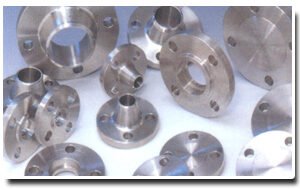
- Stainless Steel Forged Flanges
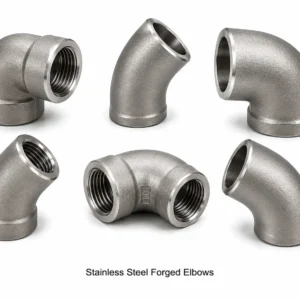
- Stainless Steel Forged Elbows
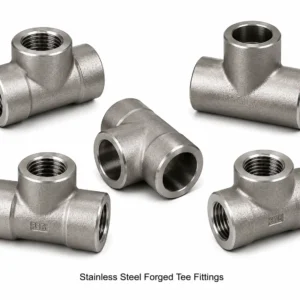
- Stainless Steel Forged Tee Fittings
Request a Quote – Cold Forged SS Components
Stainless Steel Fittings India is a leading manufacturer and exporter of cold forged stainless steel components. SS 316 cold forged parts from US$ 11.50/kg ex-works India. Share your drawings, specifications, grade, and target quantity for a prompt quotation with full PPAP and material certification support.
📧 Email: info@stainlesssteel-fittings-india.com | Serving electrical OEMs, EPC contractors, power utilities, and distributors in USA, UAE, UK, Germany, Singapore, Australia & 40+ countries.
{
“@context”: “https://schema.org”,
“@type”: “Product”,
“name”: “Cold Forged Stainless Steel Components”,
“description”: “SS 316, 304, 316L cold forged components per ASTM A276/A479. Bolt blanks, fitting bodies, cable gland bodies, valve stems. Tolerance ±0.02mm. PPAP available. Price: US$ 11.50/kg. Manufacturer from India.”,
“brand”: { “@type”: “Brand”, “name”: “Stainless Steel Fittings India” },
“manufacturer”: {
“@type”: “Organization”,
“name”: “Stainless Steel Fittings India”,
“address”: { “@type”: “PostalAddress”, “addressCountry”: “IN”, “addressRegion”: “Maharashtra” },
“areaServed”: [“US”,”AE”,”GB”,”SG”,”DE”,”AU”,”BR”,”IN”,”SA”,”QA”]
},
“category”: “Stainless Steel Forgings”,
“offers”: {
“@type”: “Offer”,
“priceCurrency”: “USD”,
“price”: “11.50”,
“priceSpecification”: { “@type”: “UnitPriceSpecification”, “price”: “11.50”, “priceCurrency”: “USD”, “unitText”: “kg” },
“availability”: “https://schema.org/InStock”
},
“material”: [“SS 304″,”SS 316″,”SS 316L”,”SS 430″,”17-4PH”],
“additionalProperty”: [
{ “@type”: “PropertyValue”, “name”: “Process”, “value”: “Cold Heading, Cold Extrusion, Coining” },
{ “@type”: “PropertyValue”, “name”: “Tolerance”, “value”: “±0.02–0.10 mm” },
{ “@type”: “PropertyValue”, “name”: “Standard”, “value”: “ASTM A276, ISO 9001:2015” },
{ “@type”: “PropertyValue”, “name”: “Origin”, “value”: “India” },
{ “@type”: “PropertyValue”, “name”: “Production Volume”, “value”: “500 to 5,000,000 pieces/month” }
]
}
Reviews
There are no reviews yet.