
Introduction to Stainless Steel Pressed Boxes
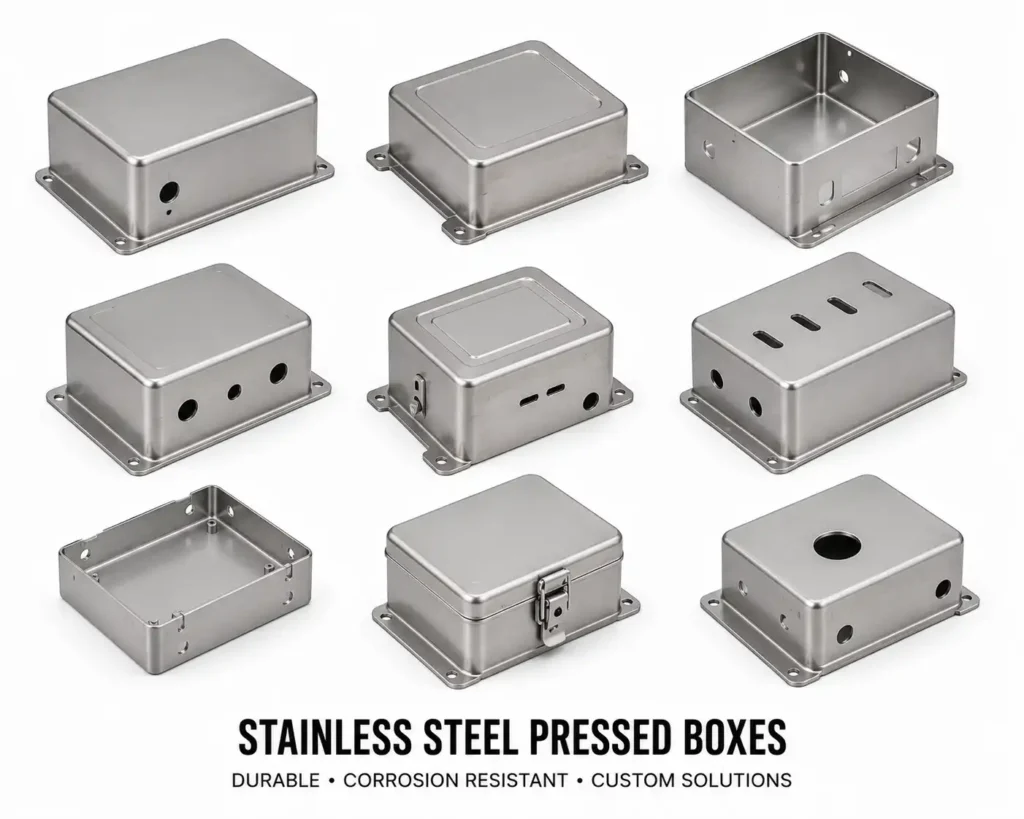
Stainless steel pressed boxes are precision-formed enclosures, housings, and containment components manufactured from flat stainless steel sheet through cold-pressing, deep drawing, and multi-stage forming operations. Unlike fabricated (welded) boxes, pressed stainless steel boxes are formed without welded joints at the corners and base, providing seamless construction with superior structural integrity, pressure containment, and hygienic properties. As a specialist manufacturer and exporter of stainless steel pressed boxes from India, we supply components for the electronics, electrical, medical, food processing, pharmaceutical, chemical, marine, and defence industries worldwide.
What Are Stainless Steel Pressed Boxes?
Pressed stainless steel boxes are hollow, open-top or closed enclosures formed by drawing, bending, and flanging operations on flat stainless steel blanks. The pressing process creates the box body in a single multi-stage die sequence, eliminating the need for corner welds that are typical in sheet metal fabricated boxes. This seamless construction makes pressed boxes ideal for applications requiring corrosion resistance, pressure tightness, cleanability, and electromagnetic shielding.
Pressed stainless steel boxes include a broad range of geometries: rectangular boxes with flanged lids, deep-drawn cylindrical cans, tray-form boxes with radiused corners, tiered stepped enclosures, and complex multi-featured boxes produced in progressive dies. The minimum corner radius for pressed boxes is typically 1.0xT (material thickness), which dramatically reduces crevice formation compared to welded boxes.
Material Alloys for Stainless Steel Pressed Boxes
Austenitic Grades
- AISI 304 / EN 1.4301 / UNS S30400: Standard choice for stainless steel pressed boxes in food service, HVAC control enclosures, laboratory equipment, and industrial junction boxes. 18% Cr, 8% Ni. Tensile strength 515 MPa min. Excellent formability (n-value ~0.5), enabling tight radii and complex profiles in pressed box construction.
- AISI 304L / EN 1.4307 / UNS S30403: Low-carbon 304 for pressed boxes with post-press welding of flanges, covers, or mounting brackets. Max 0.03% C prevents weld sensitisation.
- AISI 304DDQ / EN 1.4301 DDQ: Deep drawing quality 304 for complex pressed box geometries requiring high depth-to-width ratios without material fracture.
- AISI 316 / EN 1.4401 / UNS S31600: For pressed boxes in marine, coastal, and chemical processing environments. 2-3% Mo provides superior chloride resistance. Used for offshore junction boxes, marine electrical enclosures, and chemical dosing system housings.
- AISI 316L / EN 1.4404 / UNS S31603: The preferred grade for pharmaceutical GMP equipment enclosures, food-grade pressed boxes, and medical device housings. Max 0.03% C. Electropolishable to Ra 0.25 micron.
- AISI 316Ti / EN 1.4571 / UNS S31635: Titanium-stabilised 316 for pressed boxes in high-temperature chemical or exhaust environments up to 800 degrees C.
- AISI 321 / EN 1.4541 / UNS S32100: For pressed boxes in elevated-temperature industrial applications up to 900 degrees C, including furnace component housings and heat exchanger end boxes.
- AISI 310S / EN 1.4845 / UNS S31008: 25% Cr, 20% Ni. For pressed boxes in high-temperature furnace applications up to 1100 degrees C.
- AISI 317L / EN 1.4438 / UNS S31703: 3-4% Mo for pressed boxes handling highly corrosive media including chlorinated solvents, bleach solutions, and seawater.
- Alloy 20 / UNS N08020: For pressed boxes in sulfuric acid environments. Chemical plant distribution boxes, acid pickling tank components.
- 254 SMO / EN 1.4547 / UNS S31254: 6% Mo super austenitic. For ultra-severe chloride service pressed enclosures in desalination and FGD applications.
Ferritic Grades
- AISI 430 / EN 1.4016 / UNS S43000: 16-18% Cr ferritic. For indoor control panels, appliance enclosures, and decorative pressed boxes. Magnetic, lower cost than austenitic. High r-value (~1.4) provides good deep drawing formability.
- AISI 409 / EN 1.4512 / UNS S40900: 11% Cr. For automotive and exhaust system pressed boxes where weight and cost are primary drivers.
- AISI 441 / EN 1.4509 / UNS S44100: Nb+Ti stabilised. For appliance and automotive pressed enclosures with improved weldability and drawability.
- AISI 444 / EN 1.4521 / UNS S44400: 18% Cr, 2% Mo. Alternative to 316 for pressed boxes in mildly chloride-bearing environments.
Duplex and Super Duplex Grades
- Duplex 2205 / EN 1.4462 / UNS S32205: For high-strength pressed boxes in offshore, chemical, and process industries. Yield strength ~480 MPa – ideal where wall thickness (and therefore box weight) must be minimised while maintaining pressure integrity.
- Super Duplex 2507 / EN 1.4410 / UNS S32750: For severely corrosive environment pressed enclosures including subsea control module housings and seawater treatment equipment boxes.
Precipitation Hardening Grades
- 17-4 PH / EN 1.4542 / UNS S17400: For aerospace, defence, and precision instrument pressed boxes where maximum strength with minimal wall thickness is required. Age-hardened to Condition H900 after pressing: tensile strength 1310 MPa.
Manufacturing Process for Pressed Stainless Steel Boxes
- Blank Development: Precise blank dimensions calculated using established bending allowance formulas (BA = pi/180 x r x angle + K-factor x T). For complex drawn boxes, FEM simulation determines optimal blank shape to minimise earing and material waste.
- Blanking: Flat blanks sheared or punched from coil or sheet with positional accuracy to +/-0.05 mm. CNC punch/plasma/laser cutting for prototypes and low-volume; progressive die blanking for high volume.
- Deep Drawing (for drawn boxes): Multi-pass deep drawing with intermediate annealing for boxes with depth-to-width ratio greater than 0.5. Draw reductions of 35-45% per pass. Rectangular box forming requires corner ironing to prevent fracture at box corners.
- CNC Press Brake Bending (for fabricated-style pressed boxes): 4-sided bending sequence on CNC servo press brake with angle accuracy to +/-0.1 degree. Minimum inside bend radius: 0.5xT (304), 1.0xT (316), 1.5xT (duplex).
- Notching: Corner notching on press or laser cutting to enable corner jointing and seaming. Clean notch profiles prevent corner stress concentration.
- Corner Forming and Seaming: Box corners formed by folding, seaming, or spot welding. Laser welded corners with full penetration welds for pressure-tight boxes. TIG welded corners with gas-purged root for corrosion-critical applications.
- Flanging and Curling: Flanges pressed to +/-0.2 mm flatness for lid sealing. Rolled or curled edges for safety and aesthetics. Integral mounting flanges pierced and formed in the same press operation.
- Surface Finishing: Electropolishing (Ra 0.25-0.4 micron), passivation per ASTM A967, 2B cold-rolled, No.4 brushed, or bead-blasted finish per customer specification.
- Quality Control: CMM dimensional inspection, salt spray per ASTM B117, IP rating test (immersion/spray for IP65/IP67/IP68 rated enclosures), leak test for sealed boxes, and PMI by XRF.
Technical Specifications of Pressed Stainless Steel Boxes
- Sheet Thickness Range: 0.5 mm to 6.0 mm
- Minimum Internal Corner Radius: 1.0xT (standard) to 0.5xT (precision tooling)
- Maximum Box Size: 600 mm x 400 mm x 300 mm (standard presses)
- Dimensional Tolerance: +/-0.2 mm on formed dimensions, +/-0.1 mm on punched features
- Surface Flatness: Lid sealing face: +/-0.15 mm/300 mm
- IP Ratings: IP54, IP65, IP67, IP68 available with appropriate sealing provisions
- Standards: ISO 9001:2015, EN 60529 (IP ratings), NEMA 250 (enclosure ratings), ASTM A240, EN 10088
Applications of Pressed Stainless Steel Boxes
- Electrical and Electronic: Junction boxes, control panel enclosures, instrument housing boxes, DIN rail enclosures, explosion-proof ATEX-rated pressed boxes for Zone 1/Zone 2 hazardous areas
- Food and Beverage: Hygienic stainless steel equipment enclosures, junction boxes for wet areas, conveyor control boxes, CIP/SIP-capable enclosures
- Pharmaceutical and Medical: Cleanroom equipment housing, GMP-compliant instrument enclosures, surgical tray boxes, sterile packaging components
- Marine and Offshore: Watertight instrument enclosures, deckhead junction boxes, HVAC control boxes, subsea housing prototypes
- Defence and Aerospace: Avionics enclosures, military field equipment housings, ruggedised equipment boxes, EMI/RFI shielded stainless steel enclosures
- Chemical and Process: Corrosion-resistant distribution boxes, chemical dosing system housings, analyser enclosures, fieldbus junction boxes
- Consumer Electronics: Premium product enclosures, speaker cabinets, amplifier housings, luxury consumer goods packaging
International Terminology Table — Stainless Steel Pressed Boxes
| Term (English) | German | Russian | Spanish | Portuguese | French | Italian |
|---|---|---|---|---|---|---|
| Stainless Steel Pressed Box | Edelstahlpressgehause | Прессованный корпус из нержавеющей стали | Caja prensada de acero inoxidable | Caixa prensada de aco inoxidavel | Boitier presse en acier inoxydable | Scatola pressata in acciaio inossidabile |
| Stainless Steel Enclosure | Edelstahlgehause / Edelstahlkasten | Корпус из нержавеющей стали | Carcasa de acero inoxidable | Carcaca de aco inoxidavel | Boitier en acier inoxydable | Involucro in acciaio inossidabile |
| Junction Box (Stainless) | Edelstahl-Klemmkasten / Abzweigdose | Коробка разветвления из нержавеющей стали | Caja de derivacion de acero inoxidable | Caixa de derivacao em aco inoxidavel | Boite de derivation en acier inoxydable | Scatola di derivazione in acciaio inossidabile |
| Sheet Metal Box | Blechkasten / Blechgehause | Корпус из листового металла | Caja de chapa metalica | Caixa de chapa metalica | Boite en tole metallique | Scatola in lamiera metallica |
| Deep Drawn Box | Tiefgezogener Kasten | Корпус глубокой вытяжки | Caja embutida profunda | Caixa estampada profunda | Boitier embouti profond | Scatola imbutita profonda |
| Watertight Enclosure | Wasserdichtes Gehause | Водонепроницаемый корпус | Carcasa estanca al agua | Carcaca a prova d’agua | Boitier etanche a l’eau | Involucro impermeabile |
| Control Enclosure | Steuergehause / Schaltkasten | Шкаф управления | Carcasa de control | Caixa de controle | Coffret de commande | Quadro di controllo |
| Hygienic Box/Housing | Hygienisches Gehause | Гигиенический корпус | Caja higienica / Carcasa higienica | Caixa higienica | Boitier hygienique | Involucro igienico |
Frequently Asked Questions
Q1: What is the advantage of a pressed stainless steel box over a fabricated (welded) box?
A: Pressed stainless steel boxes have several fundamental advantages over welded fabricated boxes: (1) Seamless corners with tight radii (minimum 1xT) are easier to clean and prevent microbial contamination – critical for food and pharmaceutical applications; (2) No weld heat-affected zones means no risk of sensitisation or reduced corrosion resistance at corner joints; (3) Work hardening during pressing increases corner strength by 20-40% above base metal yield strength; (4) Lower per-unit cost for production volumes above 500 pieces as tooling cost is amortised; (5) Better dimensional repeatability (±0.1 mm vs ±0.5 mm typical for fabricated boxes); (6) Improved pressure tightness for sealed enclosures without corner weld porosity.
Q2: What IP rating can pressed stainless steel boxes achieve?
A: Pressed stainless steel boxes can achieve IP65 (dust-tight and water jet resistant), IP67 (30-minute immersion to 1 m), or IP68 (continuous immersion beyond 1 m) per IEC/EN 60529, depending on the sealing provisions integrated. IP65/67/68 rated pressed boxes require: a precisely formed lid sealing groove or face; elastomeric seal (EPDM or silicone O-ring or gasket); corrosion-resistant A4-grade stainless fasteners; and cable entry glands rated to the same IP level. The pressed box base and sides inherently provide IP protection – the sealing performance depends entirely on the lid-to-body interface design.
Q3: What are the dimensional limits for pressing stainless steel boxes?
A: For standard pressed box production on hydraulic forming presses, practical limits are: maximum planar dimension approximately 600 mm x 400 mm; maximum depth 300 mm (using deep drawing sequence for high-depth boxes); minimum depth 10 mm; minimum wall thickness 0.5 mm; minimum inside corner radius 0.5xT. Beyond these dimensions, the box must be fabricated from individual pressed panels or formed sections. Large custom sizes up to 1200 mm x 800 mm are achievable using heavy-duty hydraulic presses with custom tooling.
Q4: Can pressed stainless steel boxes be used in ATEX Zone 1 and Zone 2 environments?
A: Yes. Stainless steel pressed boxes can be designed and certified for ATEX Zone 1 (Ex d – flameproof, Ex e – increased safety) and Zone 2 applications per IEC 60079. Key requirements for ATEX-rated pressed stainless steel boxes include: minimum 3 mm wall thickness (Ex d); flame path dimensions per IEC 60079-1 (flameproof enclosures); surface temperature classification (T1 to T6); impact strength testing per IEC 60079-0; and third-party certification from a Notified Body such as DEKRA, TUV, or SIRA. Grade 316L is preferred for offshore ATEX enclosures due to its superior corrosion resistance in Zone 1 oil and gas environments.
Q5: What surface finish is required for pharmaceutical GMP pressed boxes?
A: For pharmaceutical cGMP equipment enclosures per 21 CFR Part 211 and GAMP 5 guidelines: external surfaces Ra 0.8 micron (standard 2B or No.4 finish acceptable); surfaces in contact with product or in cleanroom environments Ra 0.4 micron (mechanically polished or 2B); surfaces requiring aseptic processing compliance Ra 0.25 micron (electropolished, measured per ASME BPE). All 316L pressed boxes for pharmaceutical use should be passivated per ASTM A967 after all machining, welding, and surface finishing operations are complete. Documentation including PMI certification, EN 10204 Type 3.1 material certificates, and Ra measurement records should be provided with each batch.
Q6: How are EMI/RFI shielding requirements achieved with stainless steel pressed boxes?
A: Stainless steel provides inherent EMI/RFI shielding effectiveness due to its electrical conductivity (304 electrical resistivity: 72 nOhm.m vs ~17 nOhm.m for copper). For pressed stainless steel enclosures requiring EMI shielding per MIL-STD-285 or IEC 61000: wall thickness of 1.0 mm provides approximately 80-100 dB shielding effectiveness at 10 MHz; EMI gaskets (beryllium copper mesh, silver-plated silicone, or conductive fabric-over-foam) must be used at all lid-to-body and cable entry interfaces; all joints must achieve electrical continuity below 2.5 mOhm; and ventilation apertures must use honeycomb waveguide-below-cutoff structures for openings requiring ventilation.
Why Choose Our Pressed Stainless Steel Boxes from India?
- Custom pressed stainless steel boxes in any grade from 304 to super duplex 2507
- Full in-house capability: blanking, deep drawing, press braking, seaming, welding, finishing
- IP65/67/68 rated box designs with sealing groove formation in the same press operation
- ISO 9001:2015 certified with full documentation including EN 10204 Type 3.1 MTCs
- Electropolishing, passivation, and Ra measurement certification for pharmaceutical grade boxes
- Export supply to 45+ countries including Germany, USA, UK, Australia, UAE, and Singapore
Get a Quote for Stainless Steel Pressed Boxes
Looking for a precision manufacturer of stainless steel pressed boxes from India? Whether you need hygienic enclosures in 316L for pharmaceutical use, IP68-rated marine junction boxes, ATEX-rated pressed stainless boxes for Zone 1, or custom instrument housings in 17-4 PH for aerospace, our expert team is ready to help.
Contact us today with your drawings, specifications, quantity, and application requirements. We will provide a complete techno-commercial proposal including tooling cost, piece price, and lead time within 24 hours. We export pressed stainless steel boxes to Germany, USA, UK, France, Italy, Netherlands, Australia, UAE, Singapore, and 40+ countries worldwide.