Stainless Steel 304 Screw Machine Parts Introduction: The Engineering Case for SS 304 in Precision Machining

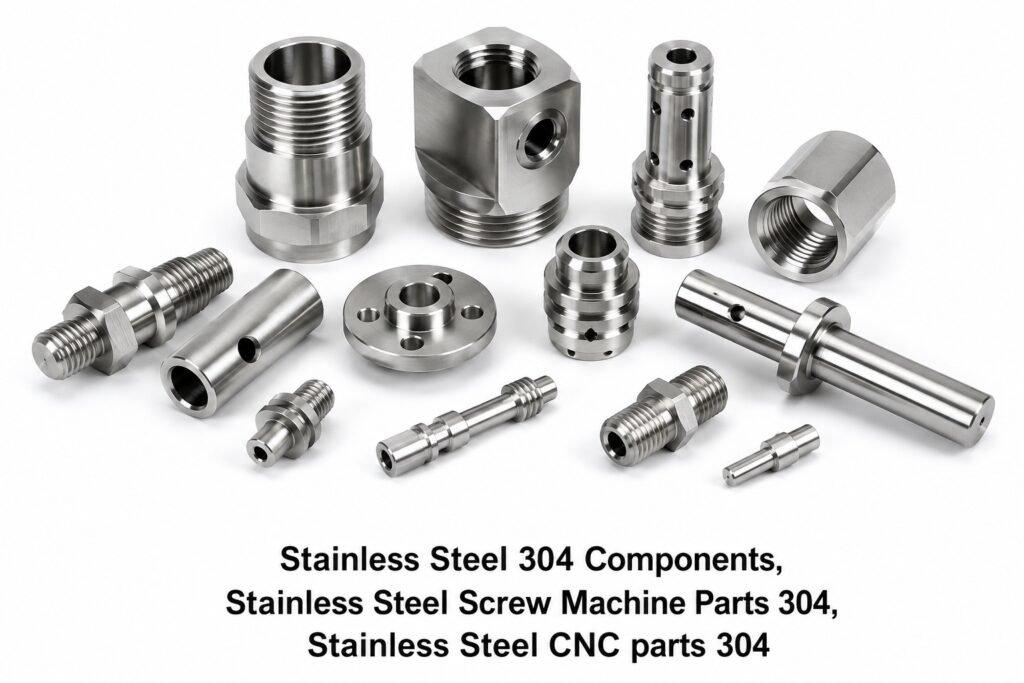
In the world of precision manufacturing, few materials command as much respect — or as much engineering scrutiny — as stainless steel. From aerospace fasteners to pharmaceutical fittings, from food-grade conveyor hardware to offshore fluid systems, stainless steel components are the silent workhorses of modern industry. Among all the grades available in the austenitic family, AISI 304 stands out as the most widely specified and most frequently machined grade globally.
This comprehensive technical blog covers everything engineers, procurement specialists, and quality managers need to know about Stainless Steel 304 Screw Machine Parts and CNC Machined Components — their properties, manufacturing methods, tolerances, surface finishing options, and industry applications.
What Are Screw Machine Parts?
Screw machine parts are precision-turned components produced on automatic screw machines — either the traditional cam-driven Swiss-type or Brown & Sharpe multi-spindle machines, or the modern CNC-controlled turning centers that have largely replaced them. Despite the old-fashioned name, screw machine parts represent one of the most cost-effective methods for producing high-volume, tight-tolerance cylindrical components.
These parts include, but are not limited to:
- Screws, bolts, and studs with precision-machined threads
- Bushings and spacers with controlled bore dimensions
- Standoffs for PCB and electronic assemblies
- Nipples and connectors for fluid handling
- Pins, shafts, and axles
- Custom fittings with multiple diameters and thread forms
- Knurled thumb screws and adjusting elements
- Stepped and shouldered turned parts
When these components are manufactured from Stainless Steel Grade 304 (UNS S30400), they combine the inherent advantages of austenitic stainless — corrosion resistance, hygienic surface quality, mechanical strength — with the economics of high-speed precision turning.
SS 304 Material Specification Overview
Stainless Steel 304 is defined under multiple international standards. The table below summarises the cross-references:
| Standard Body | Grade Designation |
|---|---|
| AISI / SAE | 304 |
| EN (European) | 1.4301 |
| BS (British) | 304 S31 |
| IS (Indian) | 10 Cr 17 Ni |
| JIS (Japan) | SUS 304 |
| DIN (German) | X5CrNi18-10 |
Chemical Composition (Nominal)
| Element | Range (% by weight) |
|---|---|
| Carbon (C) | ≤ 0.08 |
| Chromium (Cr) | 18.0 – 20.0 |
| Nickel (Ni) | 8.0 – 10.5 |
| Manganese (Mn) | ≤ 2.0 |
| Silicon (Si) | ≤ 1.0 |
| Phosphorus (P) | ≤ 0.045 |
| Sulfur (S) | ≤ 0.030 |
| Iron (Fe) | Balance |
The chromium-nickel balance (commonly called “18-8”) is what gives SS 304 its excellent passivation layer — a self-healing, invisible oxide film that provides corrosion resistance without any surface coating. For screw machine parts, this is critically important because machining removes surface material, yet the passive layer reforms instantly upon exposure to oxygen-containing environments.
SS 304 Mechanical Properties (Annealed Condition)
| Property | Value |
|---|---|
| Tensile Strength (UTS) | 515 MPa (75 ksi) min |
| Yield Strength (0.2% offset) | 205 MPa (30 ksi) min |
| Elongation at Break | ≥ 40% |
| Hardness (Brinell) | ≤ 201 HBW |
| Hardness (Rockwell B) | ≤ 92 HRB |
| Elastic Modulus | 193 GPa |
| Density | 7.93 g/cm³ |
| Thermal Conductivity | 16.2 W/m·K |
CNC Turning and Machining of SS 304: Technical Considerations
CNC machining of SS 304 presents specific challenges that distinguish it from machining carbon steel or aluminum. Engineers and buyers must understand these challenges to set realistic expectations for cycle times, tooling costs, and achievable tolerances.
1. Work Hardening
SS 304 work-hardens rapidly during cutting. If the cutting tool “rubs” rather than cuts — due to insufficient feed rate, a worn insert, or excessive tool deflection — the workpiece surface hardens ahead of the tool, leading to increased cutting forces, heat generation, and premature tool failure. Best practice is to use sharp, positive-geometry carbide inserts and maintain aggressive feed rates to ensure the tool is always cutting below the previously work-hardened layer. Recommended cutting speeds typically range from 100–200 m/min (330–650 SFM) with carbide tooling.
2. Built-Up Edge (BUE) Formation
Stainless steel has a tendency to adhere to cutting tool edges, forming a built-up edge that alters the effective rake angle and compromises surface finish. Use PVD-coated carbide inserts (TiAlN or AlTiN coatings) and avoid cutting speeds below 90 m/min. Coolant application — ideally through-spindle high-pressure coolant — dramatically reduces BUE formation.
3. Chip Control
Long, stringy chips are characteristic of austenitic stainless steels including SS 304. These chips can wrap around the tool or workpiece, causing part damage, machine stoppages, or safety hazards in high-volume screw machine production. Tooling selection should prioritize chip-breaker geometry.
4. Thermal Management
SS 304 has approximately 40% lower thermal conductivity compared to carbon steel, concentrating heat at the tool-chip interface and accelerating tool wear. High-pressure coolant (≥70 bar for drilling operations) delivered precisely to the cutting zone is essential. For CNC milling, emulsion coolants at 8–10% concentration are standard.
Achievable Tolerances in SS 304 CNC Machining
| Feature | Typical Tolerance | High-Precision Tolerance |
|---|---|---|
| Turned OD/ID | ±0.05 mm | ±0.005 mm |
| Thread Pitch Diameter | 6g/6H class | 4g/4H class |
| Surface Roughness (Ra) | 1.6 – 3.2 µm | 0.2 – 0.8 µm |
| Concentricity | 0.05 mm TIR | 0.005 mm TIR |
| Flatness / Squareness | 0.02 mm | 0.005 mm |
| Bore diameter | ±0.025 mm | ±0.005 mm |
Types of SS 304 CNC Machined Components
A. Precision Turned Components (CNC Lathe / Swiss Turn)
Precision turning centers produce cylindrical, conical, and threaded components with excellent concentricity. Common SS 304 turned components include hex head bolts, studs and tie rods, hollow spindles and tubes with cross-drilled holes, valve stems and actuator shafts, custom threaded inserts for embedded fastening applications, and hygienic end caps and plugs for food processing equipment.
B. CNC Milled and Multi-Axis Machined Components
5-axis CNC machining centers allow the production of geometrically complex SS 304 components that cannot be produced on a lathe alone. These include manifolds and valve bodies with intersecting bores, custom flanges with complex bolt patterns and raised faces, impellers and pump housings, instrument fittings for analytical equipment, and surgical and medical device components.
C. CNC Ground and Lapped Components
For applications requiring ultra-precise fits and finishes: precision pins and gauge pins with h6/g6 tolerance fits, valve seats requiring Ra < 0.4 µm finish, and injector nozzle components.
Thread Standards and Forms in SS 304 Screw Machine Parts
| Thread System | Standards | Common Application |
|---|---|---|
| Unified National (UN) | ASME B1.1 | North American OEM |
| Metric Coarse/Fine (M) | ISO 261/262 | Global industrial |
| British Standard Whitworth (BSW) | BS 84 | Legacy UK equipment |
| British Standard Pipe (BSP) | BS 21 / ISO 7 | Plumbing, fluid systems |
| NPT / NPTF | ASME B1.20.1 | North American pipe work |
| Acme / Trapezoidal | ASME B1.5 / DIN 103 | Lead screws, actuators |
| UNJ / MJ (aerospace) | ASME B1.15 / AS8879 | Aerospace fasteners |
Surface Finishing Options for SS 304 CNC Machined Components
SS 304 naturally produces an attractive, bright surface when machined and finished correctly. Additional surface finishing options include:
- 2B finish — Standard industrial finish, Ra ≈ 0.5 µm
- #4 Brushed finish — Directional, uniform satin, Ra ≈ 0.5–1.0 µm
- #8 Mirror Polish — Highly reflective, Ra < 0.1 µm; used in architectural and pharma
- Bead blasting — Matte, isotropic finish, excellent for hiding machining marks
- Passivation (ASTM A967) — Removal of free iron and restoration of chromium-rich passive layer using citric acid or nitric acid solutions. Mandatory for aerospace and medical applications.
- Electropolishing — Electrochemical material removal that smooths microscopic surface peaks, improving corrosion resistance and cleanability. Reduces Ra by 30–50%.
- PTFE / Xylan coatings — Applied to SS 304 fasteners to reduce galling and enable torque-controlled assembly
Industries Served by SS 304 Screw Machine Parts
Food & Beverage Processing: FDA-compliant, hygienic screw machine parts for conveyor systems, processing equipment, filling machines, and sanitary piping connections.
Pharmaceutical & Biotechnology: cGMP-compliant machined components where surface cleanliness, passivation certification, and material traceability (MTR/MTC documentation) are mandatory.
Chemical Processing: Custom fittings, valve internals, and instrumentation components for mild to moderately corrosive chemical environments.
Electronics & Semiconductor: Precision standoffs, spacers, and non-magnetic fasteners for PCB assemblies and semiconductor fabrication equipment.
Automotive: High-volume screw machine parts for exhaust systems, fuel delivery, and sensor housings where stainless is specified for its thermal and corrosion resistance.
Architectural & Interior Design: Precision fasteners and hardware for visible, aesthetic applications where stainless appearance is part of the design specification.
Quality Documentation for SS 304 Machined Components
When sourcing SS 304 screw machine parts, a complete specification should include the following quality documentation: Mill Test Certificate (EN 10204 3.1 / 3.2) with full chemical composition and mechanical properties; dimensional inspection report with critical dimensions verified by CMM or optical comparator; passivation certificate referencing ASTM A967 method used; RoHS/REACH compliance declaration; and certificate of conformance (C of C) signed by the authorized quality representative.
Call to Action: Partner with India’s Leading SS 304 Precision Component Manufacturer
Are you sourcing Stainless Steel 304 screw machine parts, precision turned components, or CNC machined fittings for your project? We are one of India’s most trusted manufacturers and exporters of SS 304 precision components, supplying clients across USA, UK, Europe, Middle East, and Southeast Asia.
- ✅ High-volume SS 304 screw machine parts with full dimensional inspection reports
- ✅ Custom CNC machined components to your drawing — any thread form, any tolerance class
- ✅ Passivated and electropolished finishes certified to ASTM A967
- ✅ Full material traceability with Mill Test Certificates (EN 10204 3.1 / 3.2)
- ✅ Export packing and global shipping
📩 Request a Quote Today — Send us your drawing or specification and receive a competitive quotation within 24 hours. Our applications engineers can assist with material selection, tolerance review, and value engineering to optimize your component design for machinability and cost.
🌐 Explore our complete range of Stainless Steel Fittings, Forged Components, Screw Machine Parts, and Custom Machined Products — engineered for demanding industrial applications worldwide.