

Description
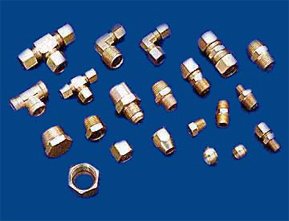
Brass Flare Nuts

Brass nuts for Flare Fittings– Manufacturer, Exporter & Supplier from India
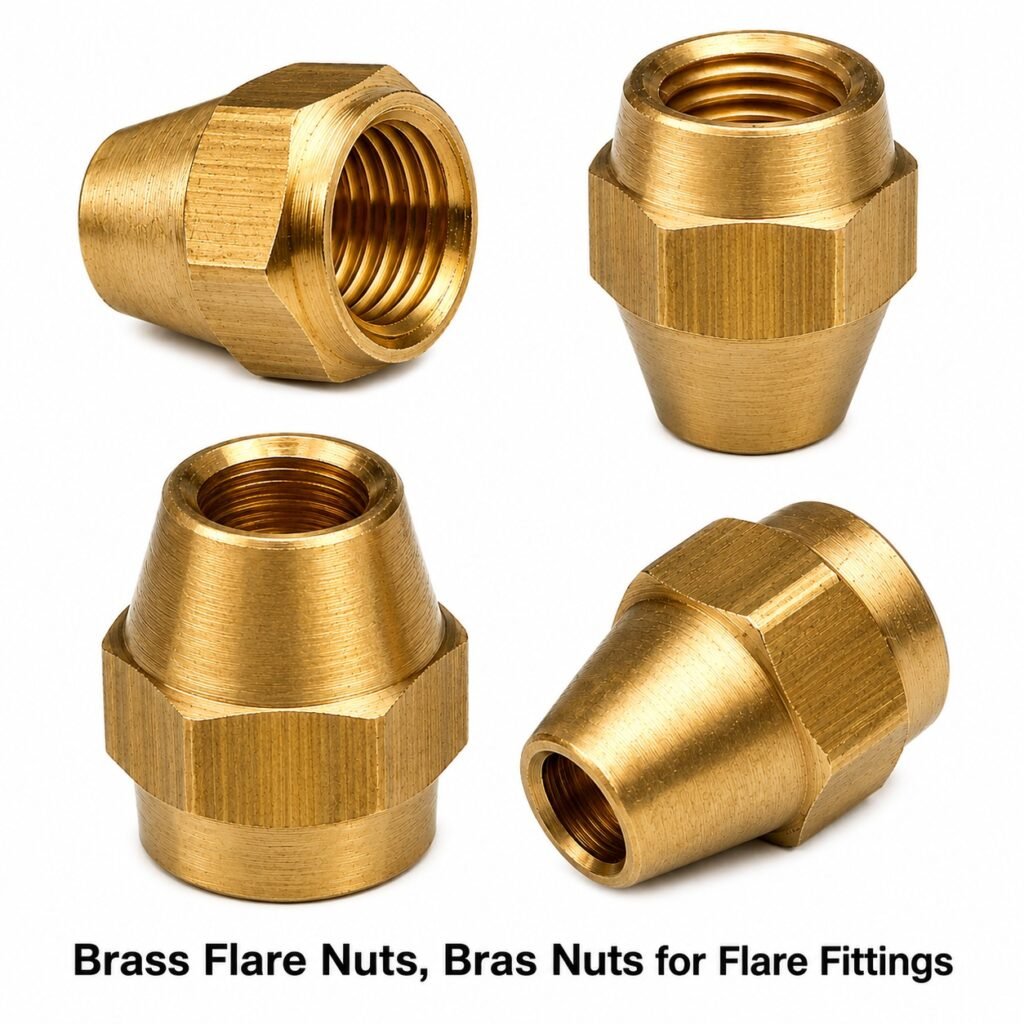
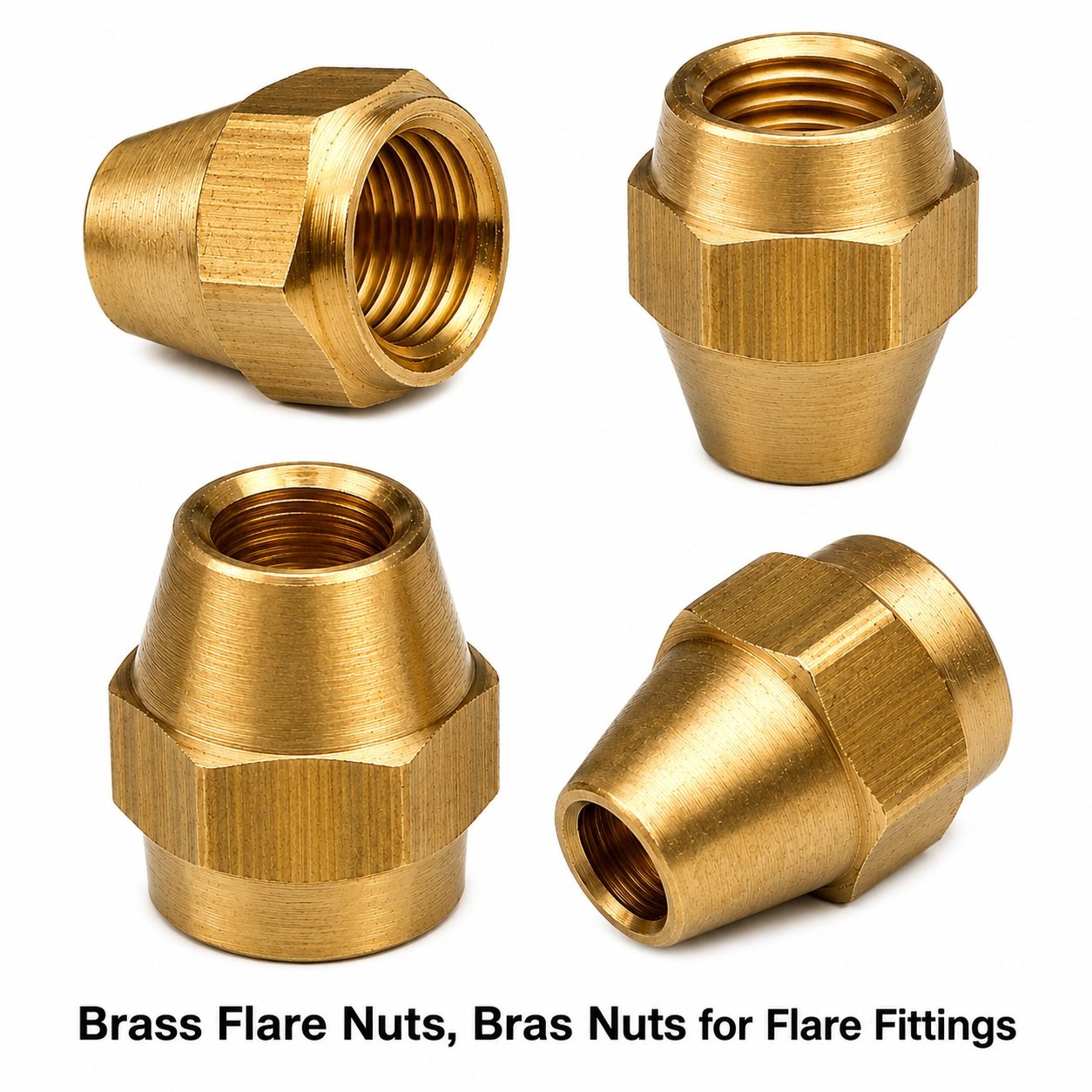
Stainless Steel Fittings India is a specialized manufacturer, exporter, and supplier of precision-machined Brass Flare Nuts engineered for SAE 45° and 37° flared tube connections used across refrigeration, HVAC, LPG/CNG fuel-gas, hydraulic brake, and instrumentation tubing systems. A brass flare nut is a hexagonal, internally threaded fastener that draws a flared tube end against the conical seat of a mating male flare fitting, producing a metal-to-metal seal without gaskets, O-rings, or thread sealant. Machined from free-cutting brass alloy CW614N (C36000) on CNC turning centers, each nut is held to controlled tolerances for thread pitch, flare-seat angle, and hexagon size, ensuring interchangeability with copper, aluminum, and thin-wall steel tubing. Current ex-works pricing is US$ 13.10/Kg, with mill certificates and export documentation supplied on every shipment.
Detailed Product Overview
Flare Nut Design and Function
A brass flare nut consists of three functional zones: a hexagonal wrench-flat body for torque application, an internal female thread that mates with the male flare fitting body, and a tapered bore that lets the flared tube end seat freely inside the nut while the nut itself carries no sealing surface. As the nut is tightened, it draws the flared tube face into contact with the 45° (SAE) or 37° (JIC/AN) conical seat machined on the mating fitting, compressing the two surfaces into a leak-tight metal joint. Because the seal is formed by the tube flare and fitting nose rather than the nut threads, flare nuts are frequently paired with flare sleeves, back nuts, and olive-style components across refrigeration line sets, brake hose assemblies, and instrumentation manifolds. This decoupling of clamping force from the sealing surface allows repeated assembly and disassembly without loss of seal integrity, which matters for maintenance-intensive HVAC and hydraulic circuits.
37° vs 45° SAE Flare Angle Compatibility
Flare nuts are manufactured in two principal seat-angle families: the 45° SAE flare, common to refrigeration, air-conditioning, and automotive brake and fuel lines across North America and much of Asia, and the 37° JIC/AN flare used predominantly in hydraulic, aerospace, and high-pressure instrumentation circuits. The two families are not interchangeable — a 45° flared tube seated against a 37° fitting nose, or vice versa, produces line contact rather than surface contact, causing premature leakage under vibration or thermal cycling. Stainless Steel Fittings India machines flare nuts to both angle standards on request, with thread and hex dimensions cross-checked against SAE J513, SAE J514, and ISO 8434-2 reference data before dispatch. Customers ordering replacement flare nuts for existing assemblies should specify both thread size and flare angle to avoid seat mismatch.
Material Composition and Machinability
Brass flare nuts are produced from CW614N (equivalent to C36000 free-cutting brass), a copper-zinc-lead alloy selected for its machinability, adequate strength, and corrosion resistance in water, refrigerant, and fuel-gas service. Lead content, typically 1.5-2.5%, improves chip formation during high-speed CNC turning, allowing tight control of thread pitch diameter and flare-seat finish without secondary polishing. Where dezincification resistance is required, such as for potable water or marine applications, Stainless Steel Fittings India offers DZR brass (CZ132) as an alternative alloy machined on the same tooling with adjusted cutting parameters. Both alloys retain enough ductility to withstand repeated tightening cycles without thread galling, a common failure mode in lower-grade recycled brass castings.
Metal-to-Metal Sealing Without Gaskets
Unlike compression fittings that rely on a separate ferrule or O-ring, flare joints depend entirely on accurate mating geometry between the flared tube face and the fitting seat, with the nut supplying only clamping force. This metal-to-metal mechanism eliminates elastomer components that can degrade under refrigerant exposure, high-temperature fuel gas, or hydraulic fluid contact, making brass flare nuts suitable where gasket materials would require periodic replacement. Correct torque application is critical: under-tightening leaves a gap at the flare seat, while over-tightening can deform the tube flare or gall the nut threads. Stainless Steel Fittings India supplies torque reference charts based on SAE J1508 with every flare nut shipment for field assembly guidance.
Compatibility with Copper, Aluminum and Steel Tubing
Brass flare nuts are dimensionally compatible with annealed copper tube, aluminum refrigeration tube, and thin-wall steel hydraulic tube, provided tube outer diameter and wall thickness fall within the flaring tool’s rated range for the nut’s thread size. Copper tube is the most common substrate in refrigeration and plumbing flare joints because it flares without cracking, while aluminum tube is favored in weight-sensitive automotive and mobile hydraulic circuits. Steel tube flare joints, more common in brake and high-pressure instrumentation lines, require higher nut torque and correspondingly higher-strength brass to prevent thread stripping. Stainless Steel Fittings India verifies bore and thread dimensions against each customer’s tube specification before production.
Surface Finish and Corrosion Resistance
Standard brass flare nuts are supplied in a bright natural finish suitable for indoor refrigeration and HVAC service. For outdoor, marine, or high-humidity installations, nickel plating (5-8 microns) improves resistance to tarnishing and white corrosion products that can form on unprotected brass. Chrome plating is available for visible plumbing and decorative gas-fitting applications requiring a bright, non-tarnishing surface. Plated finishes are applied after machining and prior to final thread inspection, ensuring plating thickness does not interfere with thread engagement or flare-seat sealing surfaces.
Dimensional Precision and CNC Turning
Each flare nut is produced on CNC turret lathes with live tooling for hex broaching, holding thread pitch diameter, flare-bore taper, and across-flats hex dimension within tolerances referenced to ASME B1.1 (UNF threads) or ISO 965 (metric threads). In-process gauging with go/no-go thread gauges and optical comparators for flare-bore angle ensures consistent mating performance across production batches, which matters for OEM customers assembling flare joints on automated lines where manual fit-up adjustment is not practical.
Variant Configurations – Short Barrel, Long Barrel and Cap Nuts
Beyond the standard through-bore flare nut, Stainless Steel Fittings India manufactures long-barrel flare nuts for extended tube engagement in vibration-prone assemblies, reduced-profile short-barrel nuts for space-constrained installations, and blind flare cap nuts used to plug unused flare ports on manifolds and valve bodies. Reducing flare nuts, which mate a larger external thread with a smaller internal flare bore, are also available for adapting between differing tube sizes without an intermediate reducer fitting.
Key Features of Brass Flare Nuts
- Machined from free-cutting brass CW614N (C36000) per BS EN 12164 / ASTM B453
- SAE 45° and 37° JIC flare seat angles available
- Thread standards: UNF, NPT, NPTF, BSP, BSPT, and Metric (M10-M22)
- Size range: 1/8″ to 1″ tube OD (3 mm to 25 mm)
- Bright natural, nickel-plated, and chrome-plated finish options
- Working pressure up to 500 PSI depending on tube size and wall thickness
- Operating temperature range: -20°C to +120°C
- RoHS and REACH compliant; DZR brass available for potable water service
Hexagonal Wrench Flats and Torque Transfer
The hexagonal body of a brass flare nut provides the flat wrenching surfaces required to apply and react torque during assembly, without which the nut would slip under a spanner. Hex size is proportioned to tube OD and thread size so that standard flare-nut wrenches, crowfoot sockets, and open-end spanners can access the nut in confined refrigeration line sets and engine-bay hydraulic runs. Correct hex sizing also prevents rounding of the flats during high-torque assembly on steel tube joints, a common cause of field rework when worn or non-standard nuts are reused.
SAE 45° Flare Seat Geometry
The 45° SAE flare seat is a conical surface machined onto the mating male fitting nose; the flare nut itself carries no sealing geometry but transmits axial clamping load through its threads to draw the tube’s flared face against this seat. Seat angle accuracy directly affects contact stress distribution around the flare circumference — an undersized or oversized angle concentrates load at the tube ID or OD edge rather than across the full seat width, increasing leakage risk under pressure cycling. Flare nuts are dimensioned to rotate freely over the tube flare without binding, so tightening applies clamping force only, not torque directly to the sealing surface.
Free-Cutting Brass Alloy CW614N / C36000
CW614N, also designated C36000 or CZ121 depending on regional standard, is a copper-zinc alloy containing 1.5-2.5% lead to promote free machining. This composition allows continuous, well-broken chip formation during automatic bar-fed CNC turning, essential for economically producing high volumes of small-diameter flare nuts to tight thread and flare-bore tolerances. The alloy offers tensile strength adequate for typical flare-joint clamping loads while remaining machinable enough to hold thread form without secondary tapping in most production runs.
Leak-Proof Sealing Without Elastomers
Because the flare joint seals through direct metal contact between the tube flare and fitting seat, the assembly contains no rubber, PTFE, or fiber gasket material that could be attacked by refrigerants, glycol-based coolants, or aromatic fuel components. This is a key reason flare nuts remain the preferred connection method in R-410A and R-134a refrigerant circuits, LPG and CNG fuel lines, and hydraulic brake systems, where elastomer compatibility with the working fluid cannot always be guaranteed over the equipment’s service life.
Multiple Thread Standards – UNF, NPT, BSP, Metric
Brass flare nuts are produced with UNF threads (SAE J512/J513) for North American automotive and refrigeration markets, NPT and NPTF threads for general US industrial gas and fluid lines, BSP and BSPT threads for UK, Middle East, and Asia-Pacific markets, and metric threads (ISO 965) for European and Japanese OEM equipment. Supplying a single flare-nut design across all five thread standards lets Stainless Steel Fittings India support multi-country OEM assembly lines and EPC contractors sourcing components for export projects from a single manufacturing base.
Refrigerant and Fuel Gas Compatibility
Flare nuts used in refrigerant service must tolerate exposure to HFC and HFO refrigerant blends and compressor lubricants, plus the thermal cycling of compressor start-stop operation, without loss of thread integrity or flare-seat flatness. In fuel-gas service, brass flare nuts are commonly used on copper LPG and CNG supply lines in domestic, commercial-kitchen, and industrial burner installations, where the metal-to-metal seal avoids the permeation and swelling issues associated with elastomer-sealed alternatives.
Technical Specifications
| Tube OD | Thread Size (SAE 45°) | Flare Angle | Hex A/F (mm) | Length (mm) | Bore ID (mm) | Max Working Pressure |
|---|---|---|---|---|---|---|
| 1/8″ | 5/16-24 UNF | 45° | 11.0 | 18 | 4.5 | 500 PSI |
| 3/16″ | 3/8-24 UNF | 45° | 12.5 | 20 | 6.0 | 500 PSI |
| 1/4″ | 7/16-20 UNF | 45° | 15.9 | 22 | 7.5 | 450 PSI |
| 5/16″ | 1/2-20 UNF | 45° | 17.5 | 24 | 9.0 | 400 PSI |
| 3/8″ | 5/8-18 UNF | 45° | 19.0 | 26 | 11.0 | 350 PSI |
| 1/2″ | 3/4-16 UNF | 45° | 22.2 | 30 | 14.5 | 300 PSI |
| 5/8″ | 7/8-14 UNF | 45° | 25.4 | 32 | 17.5 | 250 PSI |
| 3/4″ | 1 1/16-14 UNF | 45° | 28.6 | 35 | 21.0 | 200 PSI |
| 7/8″ | 1 3/16-12 UNF | 45° | 31.8 | 38 | 24.0 | 175 PSI |
| 1″ | 1 5/16-12 UNF | 45° | 34.9 | 42 | 27.0 | 150 PSI |
37° JIC flare nuts, NPT, BSP, BSPT, and metric thread variants are machined to the equivalent tube OD range on request; dimensions above are the standard SAE 45° reference series. Price: US$ 13.10/Kg.
Raw Material Grades
| Grade | Standard | Cu % | Pb % | Zn % | Fe % max | Typical Use |
|---|---|---|---|---|---|---|
| CW614N | EN 12164 | 57-59 | 1.6-2.5 | Remainder | 0.3 | General purpose flare nuts and fittings |
| C36000 | ASTM B453 | 60-63 | 2.5-3.7 | Remainder | 0.35 | US-market flare nuts |
| CZ121 | BS 2874 | 58-62 | 1.5-2.5 | Remainder | 0.3 | UK / Commonwealth market |
| C37700 | ASTM B283 | 58-61 | 1.5-2.5 | Remainder | 0.3 | Hot-forged flare nut blanks |
| CZ132 (DZR) | BS EN 12165 | 59.5-61.5 | 1.7-2.8 | Remainder + As | 0.3 | Dezincification-resistant, potable water |
International Equivalent Standards
| Country / Region | Standard | Brass Grade Designation |
|---|---|---|
| India | IS 320 / IS 407 | Free-Cutting Brass Rod |
| United Kingdom | BS 2874 / EN 12164 | CZ121 / CW614N |
| United States | ASTM B453 / SAE J513 | C36000 |
| Germany / EU | DIN EN 12164 | CW614N |
| China | GB/T 5231 | H59 / H62 (equivalent) |
| Japan | JIS H3250 | C3604BD |
Product Types and Variants
| Variant | Description | Typical Use |
|---|---|---|
| Standard Flare Nut | Through-bore body, SAE 45° seat | General refrigeration and HVAC |
| Long Barrel Flare Nut | Extended body for added tube engagement | Vibration-prone assemblies |
| Short Barrel Flare Nut | Reduced-length body | Space-constrained installations |
| Flare Cap Nut (Blind) | Solid end, no through bore | Sealing unused manifold ports |
| Reducing Flare Nut | Larger external thread, smaller flare bore | Adapting between tube sizes |
| Metric Flare Nut | ISO 965 metric threads | European and Japanese OEM equipment |
| 37° JIC Flare Nut | 37° seat angle | Hydraulic and instrumentation circuits |
Applications in Industry
| Industry | Application |
|---|---|
| HVAC & Refrigeration | Split AC line sets, condenser and evaporator connections |
| LPG / CNG Fuel Gas | Domestic and commercial gas supply lines |
| Automotive | Brake lines, fuel lines, power-steering lines |
| Hydraulics | Instrumentation tubing, hydraulic control circuits |
| Plumbing | Water heater and solar-thermal tube connections |
| Marine | Fuel and freshwater tube fittings |
| Compressed Air | Pneumatic tubing connections in industrial plants |
| Electrical Panel Building | Enclosure cooling-tube and gland connections for switchgear and panel OEMs |
Manufacturing Process
Brass flare nuts are produced through a controlled sequence of bar-fed CNC machining, hex forming, and finishing operations designed to hold flare-seat and thread tolerances across large production batches.
- Raw Material Selection and Incoming Inspection: Certified CW614N/C36000 brass rod is verified for chemical composition and hardness before release to production.
- Bar Feeding and CNC Turning: Automatic bar-fed lathes turn the outer profile, flare bore taper, and internal thread relief in a single setup.
- Hex Broaching or Milling: Wrench flats are broached or milled to the specified across-flats dimension for standard spanner and socket access.
- Thread Cutting or Rolling: Internal threads are cut or rolled to UNF, NPT, BSP, BSPT, or metric form depending on order specification.
- Flare Bore Machining and Deburring: The conical flare-relief bore is finish-machined and deburred to prevent tube-flare damage during assembly.
- Surface Finishing: Parts are polished to a bright natural finish or electroplated with nickel or chrome per customer requirement.
- Dimensional and Thread Gauge Inspection: Each batch is checked with go/no-go thread gauges, hex micrometers, and optical comparators for flare angle.
- Packaging and Export Documentation: Finished nuts are bagged or boxed by size, labeled, and shipped with mill test certificates and compliance declarations.
Quality Standards and Certifications
| Standard / Certification | Scope |
|---|---|
| ISO 9001:2015 | Quality management system certification |
| ASTM B453 / SAE J513 | Free-cutting brass rod and flare fitting dimensional reference |
| BS EN 12164 / 12165 | European brass rod standards for machining and DZR grades |
| IS 407 | Indian standard for brass rods and sections |
| RoHS Directive 2011/65/EU | Restriction of hazardous substances |
| REACH Regulation (EC) 1907/2006 | Chemical substance registration compliance |
| Third-Party Inspection | SGS / Bureau Veritas / Intertek pre-shipment inspection available on request |
Why Choose Stainless Steel Fittings India
- 20+ years of manufacturing experience in precision brass and stainless steel fittings
- In-house CNC turning, hex broaching, and plating facilities for full process control
- Competitive pricing starting at US$ 13.10/Kg with volume-based discounts for OEM and EPC orders
- ISO 9001:2015-certified manufacturing facility in India
- Multi-standard thread capability (UNF, NPT, BSP, BSPT, Metric) from a single production line
- Mill test certificates, RoHS/REACH declarations, and pre-shipment inspection reports supplied on request
- Established export experience to North America, Europe, the Middle East, and Southeast Asia
- Dedicated technical support for OEM drawing review and custom flare-nut development
Frequently Asked Questions
Q1: What is a brass flare nut used for?
A: A brass flare nut clamps a flared tube end against the conical seat of a male flare fitting, creating a metal-to-metal seal used in refrigeration, HVAC, LPG/CNG gas lines, hydraulic brake systems, and instrumentation tubing.
Q2: What is the difference between 37° and 45° flare nuts?
A: 45° SAE flare nuts are used in refrigeration, automotive, and general plumbing lines, while 37° JIC/AN flare nuts are used in hydraulic and aerospace instrumentation circuits. The two seat angles are not interchangeable.
Q3: What material are brass flare nuts made from?
A: They are machined from free-cutting brass alloy CW614N (C36000), with DZR brass (CZ132) available where dezincification resistance is required for potable water service.
Q4: What sizes of brass flare nuts are available?
A: Stainless Steel Fittings India supplies brass flare nuts from 1/8″ to 1″ tube OD (3 mm to 25 mm) as standard, with custom sizes machined on request.
Q5: What is the price of Brass Flare Nuts?
A: Current pricing starts at US$ 13.10/Kg, ex-works India. Final pricing depends on size, thread standard, finish, and order quantity.
Q6: Can brass flare nuts be reused after disassembly?
A: Yes, provided the flare-seat surface on the tube is undamaged and the nut threads show no galling. Repeated over-torquing can deform the tube flare and should be avoided.
Q7: Are brass flare nuts compatible with refrigerant gases like R-410A?
A: Yes. Brass flare nuts are widely used in R-410A and R-134a refrigerant circuits because the metal-to-metal seal avoids elastomer compatibility issues associated with gasketed joints.
Q8: What is the difference between a flare nut and a compression nut?
A: A flare nut clamps a flared tube face directly against a fitting seat with no separate sealing element, while a compression nut compresses a ferrule or olive around an unflared tube to form the seal.
Q9: Do you supply metric brass flare nuts for European equipment?
A: Yes. Metric flare nuts to ISO 965 thread form are manufactured for European and Japanese OEM equipment alongside standard UNF, NPT, and BSP variants.
Q10: Do you provide mill test certificates and RoHS/REACH compliance documents?
A: Yes. Every shipment of Brass Flare Nuts is supplied with mill test certificates, RoHS and REACH compliance declarations, and export documentation as standard.
Global Equivalent Terms
| Language | Main Term (Brass Flare Nuts) | Related Terms |
|---|---|---|
| Spanish | Tuercas de Abocardado de Latón | Tuerca Abocinada, Racor de Latón, Tuerca para Tubo Abocardado |
| Russian | Латунные развальцовочные гайки | Гайка для вальцованных соединений, Латунный фитинг, Гайка раструбная |
| French | Écrous d’Évasement en Laiton | Écrou à Collet Évasé, Raccord Évasé en Laiton, Écrou de Raccord |
| Portuguese | Porcas de Flare de Latão | Porca Abocardada, Conexão de Latão, Porca para Tubo Flangeado |
| Italian | Dadi a Cannotto in Ottone | Dado Svasato, Raccordo in Ottone, Dado per Tubo Svasato |
Related Brass Pipe Fittings Products
- Brass Pipe Fittings
- Brass Plumbing Fittings
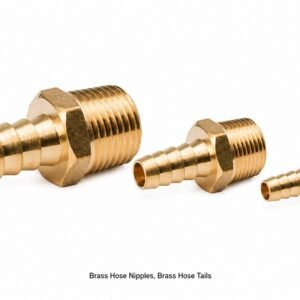
- Brass Hose Nipples / Brass Hose Tails
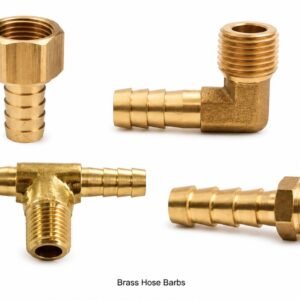
- Brass Hose Barbs
- Brass Garden Hose Fittings
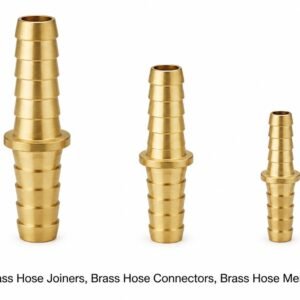
- Brass Hose Jointers / Connectors
- Stainless Steel 37 Degree Flare Fittings Nuts & Sleeves
Request a Quote for Brass Flare Nuts
Contact Stainless Steel Fittings India for technical datasheets, sample approval, and bulk order quotations on Brass Flare Nuts. Current pricing is US$ 13.10/Kg ex-works India, subject to size, thread standard, and finish. Our engineering team supports OEM drawing review, custom flare-nut development, and export documentation for electrical OEMs, EPC contractors, power utilities, and distributors worldwide.

Reviews
There are no reviews yet.