
Introduction to Stainless Steel Milling: Why It Matters

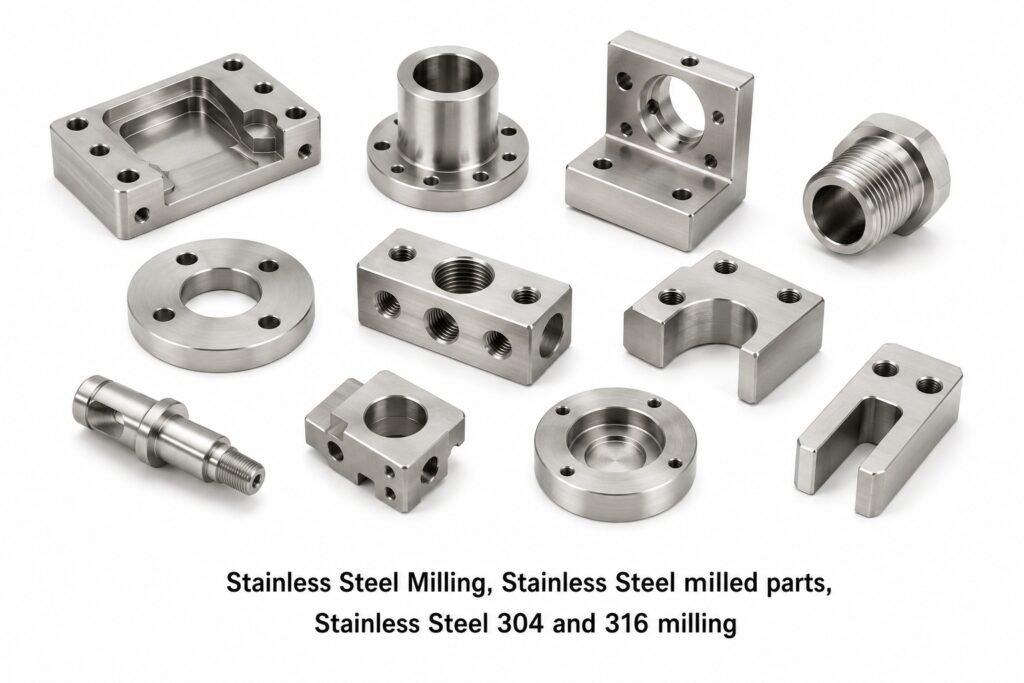
Stainless steel milling is one of the most technically demanding machining processes in precision manufacturing. The combination of work-hardening tendencies, low thermal conductivity, and abrasive carbide inclusions makes stainless steel — particularly the austenitic grades AISI 304 and AISI 316 — a challenging yet rewarding material to machine. When executed with precision engineering expertise, milled stainless steel components deliver exceptional dimensional accuracy, surface finish, and long-term corrosion resistance in the most demanding industrial environments.
From pharmaceutical fluid handling systems and marine hardware to chemical processing equipment and food-grade machinery, stainless steel milled components are the backbone of modern industrial infrastructure. This guide provides a comprehensive, technically authoritative overview of the entire milling process for SS 304 and SS 316 — from raw material chemistry to finished component quality standards.
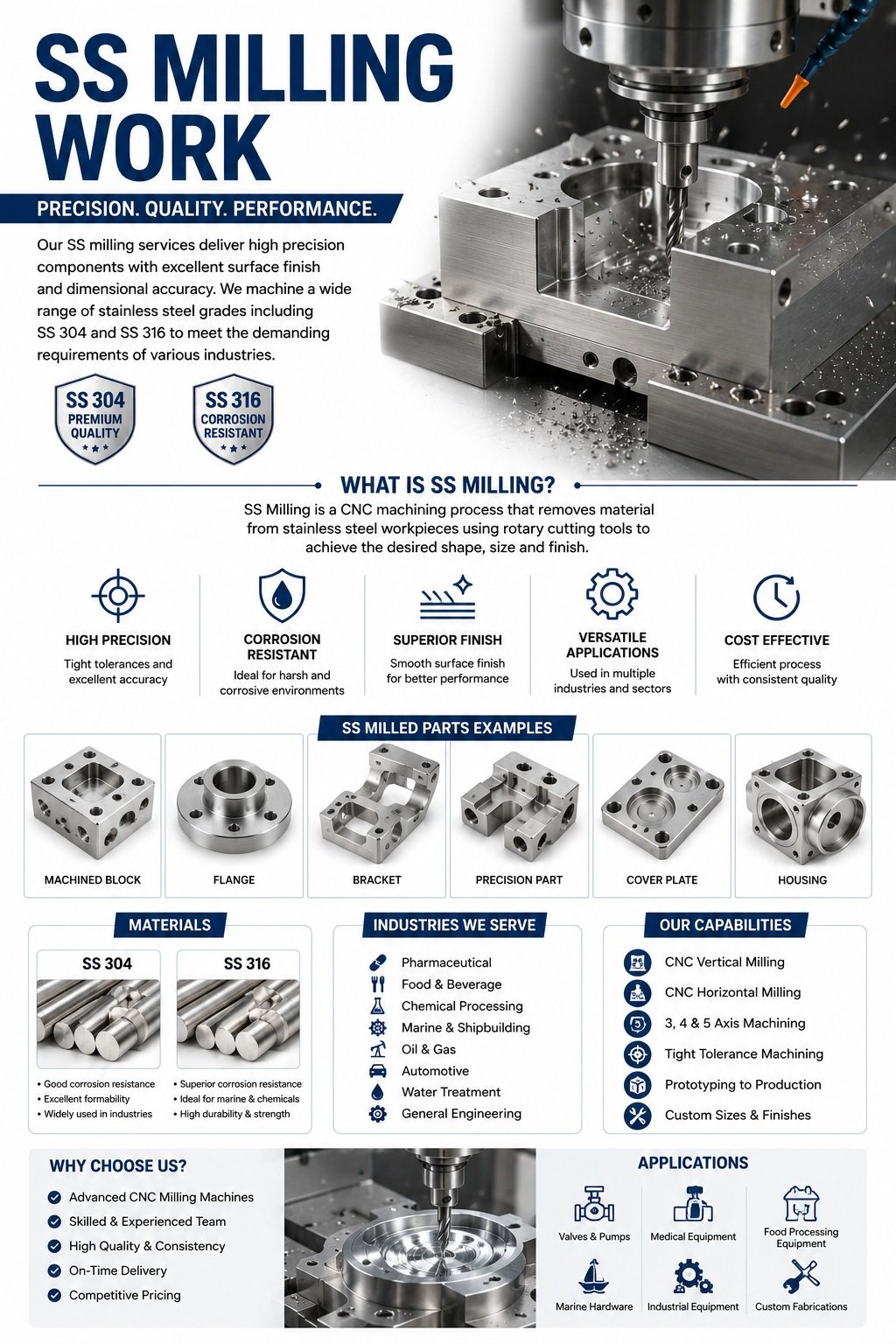
Understanding the Raw Material: SS 304 vs SS 316 Chemical Composition
The foundation of any precision-milled stainless steel component lies in the raw material chemistry. Both AISI 304 and AISI 316 are austenitic stainless steels from the 300-series family, sharing a face-centred cubic (FCC) crystal structure that provides excellent toughness and non-magnetic properties in the annealed state.
Chemical Composition Table: SS 304 vs SS 316
| Element | AISI 304 (% by weight) | AISI 316 (% by weight) | Role in Performance |
|---|---|---|---|
| Carbon (C) | ≤ 0.08 | ≤ 0.08 | Hardness; controlled to prevent sensitisation |
| Chromium (Cr) | 18.0 – 20.0 | 16.0 – 18.0 | Passive oxide layer formation; corrosion resistance |
| Nickel (Ni) | 8.0 – 10.5 | 10.0 – 14.0 | Austenitic structure stabiliser; ductility |
| Molybdenum (Mo) | — | 2.0 – 3.0 | Pitting and crevice corrosion resistance (chlorides) |
| Manganese (Mn) | ≤ 2.0 | ≤ 2.0 | Austenite stabiliser; deoxidiser |
| Silicon (Si) | ≤ 0.75 | ≤ 0.75 | Deoxidiser; oxidation resistance |
| Phosphorus (P) | ≤ 0.045 | ≤ 0.045 | Controlled to prevent hot cracking |
| Sulphur (S) | ≤ 0.03 | ≤ 0.03 | Machinability (controlled); reduces corrosion if elevated |
| Nitrogen (N) | ≤ 0.10 | ≤ 0.10 | Strength enhancer; austenite stabiliser |
| Iron (Fe) | Balance | Balance | Base metal |
The critical differentiator is the 2–3% molybdenum content in SS 316, which dramatically improves resistance to chloride-induced pitting corrosion — making it the preferred grade for marine, pharmaceutical, and chemical milling applications.
International Grade Equivalents
Stainless steel grades are specified differently across international standards. The following table provides direct equivalents for SS 304 and SS 316 across major global standards bodies, essential for global procurement and export documentation.
International Standards Equivalence Table
| Standard Body | SS 304 Equivalent | SS 316 Equivalent | Region / Application |
|---|---|---|---|
| AISI / ASTM (USA) | 304 / S30400 | 316 / S31600 | North America; Global reference |
| EN / DIN (Europe) | 1.4301 / X5CrNi18-10 | 1.4401 / X5CrNiMo17-12-2 | European Union; Germany |
| BS (United Kingdom) | 304 S31 | 316 S31 | UK engineering standards |
| JIS (Japan) | SUS 304 | SUS 316 | Japanese Industrial Standard |
| IS (India) | IS 6911: 04Cr18Ni10 | IS 6911: 04Cr17Ni12Mo2 | Bureau of Indian Standards |
| GB (China) | 0Cr18Ni9 / S30408 | 0Cr17Ni12Mo2 / S31608 | Chinese National Standard |
| GOST (Russia) | 08X18H10 | 08X17H13M2 | Russian / CIS Standard |
| UNS (USA) | S30400 | S31600 | Unified Numbering System |
Mechanical Properties of SS 304 and SS 316 Bar Stock for Milling
Understanding the mechanical properties of the raw bar stock is critical for setting up milling parameters. The following table summarises key mechanical data for annealed (solution-treated) condition, which is the standard supply condition for milling stock.
| Property | SS 304 (Annealed) | SS 316 (Annealed) | Unit |
|---|---|---|---|
| Tensile Strength (UTS) | 515 – 620 | 515 – 690 | MPa |
| 0.2% Proof Stress (Yield) | ≥ 205 | ≥ 205 | MPa |
| Elongation at Break | ≥ 40 | ≥ 40 | % |
| Hardness (Brinell) | ≤ 215 | ≤ 217 | HB |
| Hardness (Rockwell B) | ≤ 95 | ≤ 96 | HRB |
| Density | 7.93 | 8.00 | g/cm³ |
| Thermal Conductivity (20°C) | 16.2 | 16.3 | W/m·K |
| Modulus of Elasticity | 193 | 193 | GPa |
| Work Hardening Rate | High | Moderate-High | — |
The Milling Process: Step-by-Step Manufacturing of Stainless Steel Components
CNC milling of stainless steel components involves a precisely controlled sequence of operations. Each stage must be optimised for stainless steel’s unique machining challenges — primarily its tendency to work-harden rapidly, built-up edge (BUE) formation on cutting tools, and high heat generation due to low thermal conductivity.
Stage 1: Material Procurement and Incoming Inspection
High-quality milled components begin with certified raw material. Bar stock, plate, or billets of SS 304 or SS 316 are procured with material test certificates (MTCs) conforming to EN 10204 Type 3.1 (third-party mill certification). Incoming inspection includes:
- Chemical composition verification via Optical Emission Spectrometry (OES) or X-Ray Fluorescence (XRF) — confirms grade conformance
- Dimensional inspection — checks bar diameter, flatness of plate, and length tolerances
- Surface quality inspection — checks for laps, seams, or cold shuts in bar stock
- Hardness testing — Brinell or Rockwell testing confirms material is in the annealed condition and free from cold work
- Magnetic permeability check — important for pharmaceutical and electronic applications
Stage 2: CNC Programming and Process Planning
Precision milling of complex stainless steel components requires sophisticated CAM (Computer-Aided Manufacturing) programming. Key parameters that must be defined before first cut include:
- Cutting strategy: Climb milling (down-milling) is preferred for stainless steel as it reduces work-hardening and improves surface finish compared to conventional (up-milling)
- Depth of cut (axial and radial): Stainless steel requires sharp, decisive cuts — shallow depths cause rubbing and accelerated work-hardening
- Tool path optimisation: Trochoidal milling paths (circular arc toolpaths) are used for high-efficiency machining of stainless to manage heat and chip load
- Fixture design: Low-stress workholding using soft jaws or vacuum fixturing to prevent deformation of thin-walled components
Stage 3: Cutting Tool Selection for Stainless Steel
Tool selection is critical. The correct tooling can mean the difference between a high-quality component and a scrapped workpiece. The following table summarises optimal cutting tool specifications for SS 304 and SS 316 milling.
| Tool Type | Recommended Specification | Reason for Selection | Application |
|---|---|---|---|
| End Mill Material | Sub-micron grain solid carbide (K10–K20 grade) | High hardness, wear resistance, sharp edge retention | General profiling, slotting, contouring |
| Coating | AlTiN or AlCrN PVD coating | High heat resistance (oxidises at 900°C+), low friction | High-speed dry or MQL milling |
| Helix Angle | 38° – 45° | Efficient chip evacuation; reduces cutting forces | Finishing passes; thin walls |
| Number of Flutes | 4–5 flutes (roughing); 4–6 (finishing) | Balance between chip room and stiffness | All stainless milling |
| Corner Radius | 0.5 – 2.0 mm radius (bull nose) | Prevents corner chipping; improves surface finish | Floor finishing, shoulder milling |
| Face Mill Inserts | PVD-coated carbide Grade P25/M25 | Balanced toughness and wear resistance | Face milling large surfaces |
| Drill Type | Solid carbide with TiAlN coating; 130° point angle | Prevents work-hardening at drill tip; sharp cutting edges | Hole drilling in milling operations |
Stage 4: Cutting Parameters for SS 304 and SS 316
Recommended cutting parameters are fundamental to achieving consistent quality. The following values are based on industry best practice for CNC machining centres with adequate coolant delivery.
| Parameter | SS 304 – Roughing | SS 304 – Finishing | SS 316 – Roughing | SS 316 – Finishing |
|---|---|---|---|---|
| Surface Speed (Vc) | 80–120 m/min | 120–160 m/min | 70–100 m/min | 100–140 m/min |
| Feed per Tooth (fz) | 0.03–0.06 mm | 0.01–0.03 mm | 0.02–0.05 mm | 0.01–0.025 mm |
| Axial Depth of Cut (ap) | 1.0–2.0× D | 0.1–0.3× D | 0.8–1.5× D | 0.1–0.25× D |
| Radial Depth of Cut (ae) | 20–30% D | 5–15% D | 15–25% D | 5–10% D |
| Coolant | Flood coolant (emulsion 8–10%) | Flood + air blast | Flood coolant (emulsion 8–10%) | Flood + air blast |
| Spindle Speed (12mm tool) | 2,100–3,200 RPM | 3,200–4,200 RPM | 1,900–2,800 RPM | 2,800–3,700 RPM |
Stage 5: Coolant Management and Heat Control
Thermal management is perhaps the single most important factor in stainless steel milling quality. Stainless steel’s low thermal conductivity (approximately 16 W/m·K, compared to 50 W/m·K for carbon steel) means heat concentrates at the cutting zone rather than conducting away through the workpiece. This causes:
- Rapid tool wear through crater and flank wear mechanisms
- Work-hardening of the machined surface (strain-hardened layer up to 0.2 mm deep)
- Built-up Edge (BUE) formation — micro-welding of stainless to the tool cutting edge
- Dimensional drift as the component thermally expands during cutting
Solutions include high-pressure coolant systems (70–100 bar through-tool coolant), use of minimum quantity lubrication (MQL) with ester-based oils for finishing, and cryogenic machining (liquid nitrogen) for ultra-precision applications where surface integrity is critical.
Stage 6: CNC Machining Centre Operations
Modern stainless steel milled components are produced on 3-axis, 4-axis, or 5-axis CNC machining centres. The choice of machine depends on component complexity:
- 3-Axis Milling: Suitable for prismatic components — flanges, plates, brackets, manifold blocks
- 4-Axis Milling: Adds rotational A or B axis — ideal for cylindrical components with cross-drilled holes, ports, and angular features
- 5-Axis Simultaneous Milling: Full contouring capability — used for impellers, complex valve bodies, turbine components, and medical implants
- Mill-Turn Centres: Combined milling and turning on one platform — maximises accuracy through reduced setups for rotational components with milled features
Stage 7: Deburring, Edge-Breaking and Surface Preparation
All milled stainless steel components require post-machining deburring and edge preparation before surface treatment. Methods include:
- Manual deburring: Hand files, carbide scrapers — used for accessible edges on simple geometry
- Tumble deburring (Vibratory finishing): Bulk batch processing of small components in ceramic or plastic media — achieves consistent edge radii of 0.05–0.2 mm
- Electrochemical deburring (ECM): Precision deburring of complex internal passages and cross-drilled holes inaccessible to mechanical methods
- Brush deburring: Abrasive nylon brushes on CNC machines — in-process deburring without component removal
Stage 8: Surface Finishing of Milled Stainless Components
Surface finish specification is critical for function and aesthetics. The following finishes are standard for milled SS 304 and SS 316 components.
| Surface Finish | Ra Value (μm) | Process | Application |
|---|---|---|---|
| As-Milled | 0.8 – 3.2 | CNC milling (finishing pass) | General engineering; non-critical surfaces |
| Ground | 0.1 – 0.8 | Surface or cylindrical grinding | Sealing faces, bearing surfaces, precision interfaces |
| Electropolished | 0.05 – 0.4 (improvement ~50%) | Electrochemical material removal in acid bath | Pharmaceutical, food, semiconductor — removes surface peaks |
| Passivated | No change to Ra | Nitric or citric acid bath per ASTM A967 | Restores chromium oxide passive layer; all applications |
| Bead Blasted | 1.6 – 6.3 | Glass bead or alumina media blast | Decorative matte finish; uniform appearance |
| Mirror Polished | < 0.05 | Sequential abrasive polishing + buffing | Hygienic surfaces; decorative architectural |
Stage 9: Dimensional Inspection and Quality Control
Precision milled stainless components are subject to rigorous dimensional and quality inspection protocols:
- Coordinate Measuring Machine (CMM) inspection: Sub-micron accuracy 3D measurement of all critical dimensions, form, and position tolerances per GD&T (ASME Y14.5) or ISO GPS standards
- Surface Roughness Testing: Contact profilometry (stylus) or non-contact interferometry measures Ra, Rz, Rmax values
- Hardness Testing: Ensures no unacceptable work-hardening of the surface layer
- Dye Penetrant Inspection (DPI): Detects surface-breaking cracks or porosity per ASTM E165
- Ferrite Testing: Delta ferrite measurement (Feritscope) ensures specifications are met for weldability or magnetic requirements
- Material Test Certificate (MTC): EN 10204 3.1 certification accompanies all critical components
Common Types of Stainless Steel Milled Components
The versatility of CNC milling allows production of an enormous range of stainless steel components. Below are the principal categories supplied in SS 304 and SS 316.
| Component Type | Typical Grade | Key Features | Industries |
|---|---|---|---|
| Manifold Blocks | SS 316 | Multi-port fluid distribution; complex internal channels | Hydraulics, pneumatics, chemical |
| Valve Bodies | SS 316 / 316L | Pressure-rated; precision bore and seat geometry | Oil & gas, pharmaceutical, food |
| Flanges and Adapters | SS 304 / SS 316 | Bolt pattern accuracy; flat face or raised face | Piping systems, process plants |
| Pump Housings | SS 316 | Complex curved profiles; tight bore tolerances | Chemical, marine, pharmaceutical |
| Structural Brackets | SS 304 | High strength-to-weight; welded or bolted interfaces | Architecture, food equipment, marine |
| Sensor Bodies | SS 316L | Thin walls; high surface finish; pressure port threads | Instrumentation, process control |
| Custom Fittings | SS 304 / SS 316 | Non-standard thread profiles; hex flats; OD/ID precision | OEM; special applications |
| Medical Implants / Instruments | SS 316L | Ultra-high finish; biocompatible; ISO 13485 compliant | Medical devices, surgical instruments |
| Heat Exchanger Parts | SS 316 | Thin walls; high thermal conductivity; corrosion resistance | Chemical, pharmaceutical, HVAC |
| CNC Turned/Milled Fittings | SS 304 / SS 316 | Combination turning/milling; threaded connections | Fluid systems; instrumentation |
SS 304 vs SS 316: Selecting the Right Grade for Milled Components
Choosing between SS 304 and SS 316 for a milled component application involves careful consideration of the service environment, cost constraints, and regulatory requirements.
| Criteria | SS 304 | SS 316 |
|---|---|---|
| Chloride Environments (seawater, bleach, brine) | Not recommended (pitting risk) | Excellent resistance (Mo content) |
| Pharmaceutical / FDA Applications | Acceptable (non-wetted parts) | Preferred / mandatory for wetted surfaces |
| Food & Beverage Contact | Acceptable (dry/low chloride) | Preferred for high-chloride foods (meat, dairy brine) |
| General Atmospheric Environments | Excellent | Excellent (slight cost premium) |
| Elevated Temperature Service (300–800°C) | Good (sensitisation risk 450–850°C) | Good (use 316L for welded service) |
| Weldability (post-weld corrosion) | Good; use 304L for critical welds | Good; use 316L to avoid sensitisation |
| Raw Material Cost (relative) | Base reference | 15–25% premium (Mo content) |
| Machinability (relative) | Slightly easier (lower work-hardening rate) | Comparable; slightly more tool wear |
Quality Standards and Certifications for Milled Stainless Components
Reputable manufacturers of precision milled stainless steel components operate under stringent quality management systems and comply with multiple international standards. Key certifications and standards include:
- ISO 9001:2015 — Quality Management System for manufacturing processes
- ASTM A276 / A276M — Standard specification for stainless steel bars and shapes (raw material)
- ASTM A240 / A240M — Stainless steel plate, sheet, and strip (for flat milled components)
- EN 10088-3 — European standard for stainless steel semi-finished products, bars, rods, wire, sections
- ASME B46.1 — Surface texture measurement standard
- ASTM A967 / ASTM A380 — Passivation and cleaning of stainless steel components
- RoHS / REACH compliance — Restriction of hazardous substances for export components
- FDA 21 CFR Part 177 — Food contact compliance for SS 316 pharmaceutical/food components
Dimensional Tolerances for CNC Milled Stainless Components
The achievable tolerances for CNC milled stainless steel components depend on machine capability, workholding rigidity, and thermal management. The following table indicates standard and precision tolerance grades.
| Feature Type | Standard Tolerance | Precision Tolerance | High-Precision Tolerance |
|---|---|---|---|
| Linear Dimensions (ISO 2768-m) | ± 0.1 mm | ± 0.05 mm | ± 0.01 mm |
| Hole Diameter | H7 (IT7) | H6 (IT6) | H5 (IT5) |
| Shaft Diameter | h8 (IT8) | h6 (IT6) | h5 (IT5) |
| Flatness | 0.05 mm / 100 mm | 0.02 mm / 100 mm | 0.005 mm / 100 mm |
| Surface Roughness (Ra) | 1.6 μm | 0.8 μm | 0.2 μm |
| Parallelism / Perpendicularity | 0.05 mm | 0.02 mm | 0.005 mm |
| Thread (M/UN/NPT) | 6H / 2B | 6H / 2B | 5H / 3B |
Applications of Stainless Steel Milled Components by Industry
The versatility and durability of SS 304 and SS 316 milled components make them indispensable across a wide range of industries. Each sector has specific requirements that drive grade selection and finishing specifications.
- Pharmaceutical and Biotech: SS 316L milled valve bodies, manifolds, and sensor housings — electropolished to Ra < 0.4 μm for cleanroom compliance; FDA and EU GMP compliant
- Food and Beverage Processing: SS 316 milled pump housings, impellers, and fittings — passivated and electropolished; meets 3-A Sanitary Standard and EHEDG guidelines
- Marine and Offshore: SS 316 milled deck fittings, valve blocks, and hydraulic components — molybdenum content critical for saltwater resistance
- Chemical and Petrochemical: SS 316 milled manifolds and valve bodies for aggressive chemical service — NACE MR0175 and ASTM A351 CF8M casting equivalent
- Oil and Gas: SS 316 precision milled instrumentation fittings, subsea components — API 6A, API 6D, NORSOK M-630 compliant
- Architecture and Construction: SS 304 milled structural brackets, balustrade fittings, curtain wall components — exposed atmospheric service
- Medical Devices: SS 316L milled surgical instruments, implant components — ISO 10993 biocompatibility; ISO 13485 quality system
Why Choose India for CNC Milled Stainless Steel Components?
India has emerged as a globally competitive precision machining destination, offering exceptional value without compromising on quality. Precision stainless steel milling facilities in India combine modern multi-axis CNC equipment, ISO 9001 quality systems, and EN 10204 certified raw material sourcing with significant cost advantages over European, US, and Japanese alternatives.
India’s precision machining cluster — concentrated in Maharashtra, Gujarat, Tamil Nadu, and Punjab — supplies milled stainless steel components to customers in the EU, USA, UK, Australia, UAE, and Southeast Asia, providing EN/ASTM/JIS-compliant components with full documentation.
Request a Quote for Custom Milled Stainless Steel Components
Whether you need SS 304 or SS 316 milled components in standard or custom configurations, our engineering team is ready to support your project from drawing review to finished component delivery. We supply precision milled stainless steel parts to ISO 9001 standards with full EN 10204 3.1 material certification.
We offer: Custom CNC milling in SS 304 and SS 316 | Tolerances to ±0.01 mm | Electropolishing & passivation | EN 10204 3.1 MTCs | Fast international shipping