Introduction to Stainless Steel 316 Pressing and AISI 316 Pressed Parts
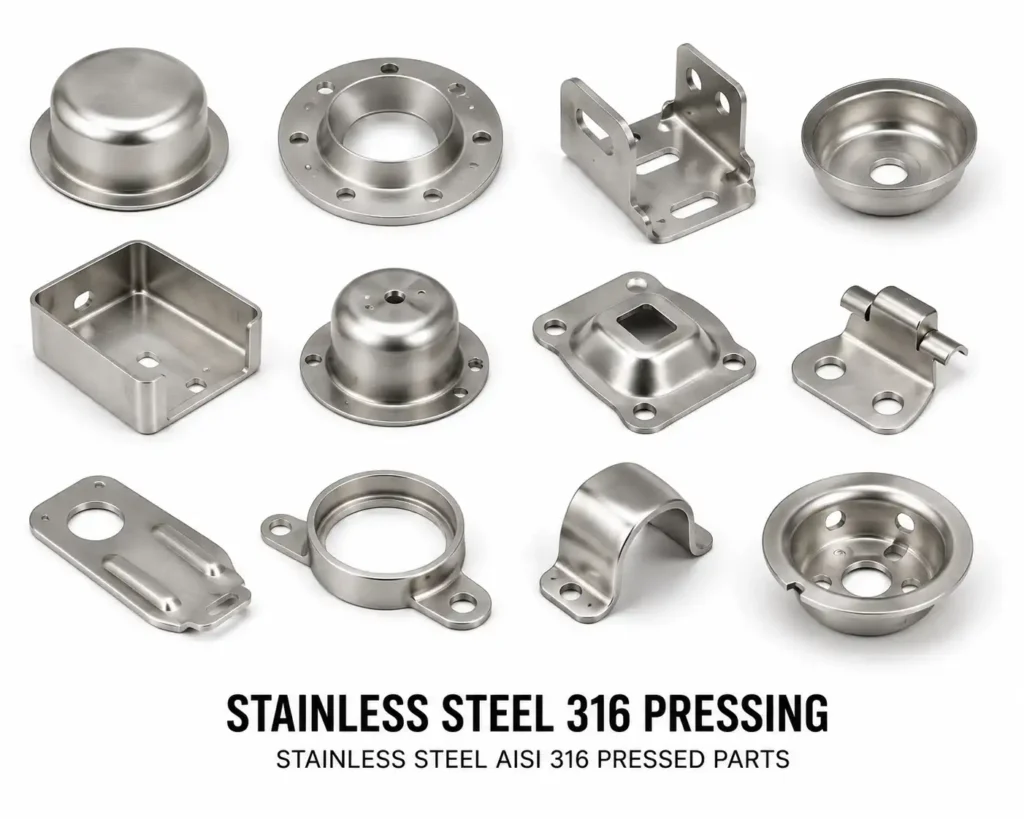
Stainless Steel 316 pressing and AISI 316 pressed parts represent the highest tier of corrosion-resistant cold-formed components for demanding industrial, marine, chemical, pharmaceutical, and offshore applications. AISI 316 (EN 1.4401) and its low-carbon counterpart AISI 316L (EN 1.4404) are the most widely specified stainless steel grades for press forming where chloride resistance, molybdenum-enhanced pitting resistance, and superior performance in aggressive media are essential. As a specialist manufacturer and exporter of stainless steel 316 pressed parts from India, we produce precision components that meet the most stringent international standards and customer specifications.
What Makes AISI 316 Stainless Steel Ideal for Pressing?
AISI 316 stainless steel contains 16-18% chromium, 10-14% nickel, and 2-3% molybdenum. The molybdenum addition is the defining characteristic that differentiates 316 from 304: it provides a Pitting Resistance Equivalent Number (PREN = %Cr + 3.3x%Mo + 16x%N) of approximately 25-26, compared to ~19 for AISI 304. This makes 316 the minimum acceptable grade for marine, coastal, offshore, chemical, and food/pharmaceutical applications where chloride-induced pitting, crevice corrosion, and stress corrosion cracking (SCC) are primary failure modes.
For pressing operations, AISI 316 and 316L offer very good formability, with the following key parameters: tensile strength 515-690 MPa; yield strength 205-310 MPa; elongation at fracture 40%+; strain hardening exponent (n-value) ~0.45-0.50; Limiting Drawing Ratio (LDR) ~2.0-2.1. These properties make AISI 316 suitable for complex pressing, deep drawing, and multi-stage forming operations, though with slightly lower drawability compared to AISI 304 due to its higher alloy content.
AISI 316 Stainless Steel Sub-Grades and Variants Used for Pressing
- AISI 316 / EN 1.4401 / UNS S31600: Standard 316 grade. 16-18% Cr, 10-14% Ni, 2-3% Mo, max 0.08% C. For pressed components not subject to post-press welding. General chemical and marine applications. Tensile strength min 515 MPa, yield strength min 205 MPa.
- AISI 316L / EN 1.4404 / UNS S31603: Low-carbon 316. Max 0.03% C. The most widely specified variant for pressed components where welding follows pressing. Prevents sensitisation (intergranular corrosion at weld heat-affected zones). Yield strength min 170 MPa. The industry standard for pharmaceutical, food-grade, marine, and chemical pressed parts.
- AISI 316H / EN 1.4919 / UNS S31609: High-carbon 316 (0.04-0.10% C). Higher creep strength at elevated temperatures. For pressed 316 components used in high-temperature heat exchanger and pressure vessel applications above 500 degrees C.
- AISI 316Ti / EN 1.4571 / UNS S31635: Titanium-stabilised 316. Ti/C ratio minimum 5:1. Used for 316 pressed parts subject to sensitisation temperature range (425-860 degrees C) in service. Automotive exhaust components, heat exchanger pressed parts, high-temperature chemical equipment. Continuous service to 800 degrees C.
- AISI 316LN / EN 1.4406 / UNS S31653: Low-carbon, nitrogen-enhanced 316L. Nitrogen addition (0.10-0.22%) increases yield strength by 30-40% above standard 316L without reducing toughness or formability. Used for 316 pressed parts requiring higher strength with maintained chloride resistance.
- AISI 316 Mod / EN 1.4435 / UNS S31603: 316L with higher nickel (12.5-15%) and lower carbon (max 0.020%). Pitting resistance improved. Used in pharmaceutical and food industry pressed parts per ASME BPE standard.
- EN 1.4432 / UNS S31603: 316L with higher Mo content (2.5-3.0%). Enhanced pitting resistance above standard 316L. Used for marine and offshore pressed 316 components.
- EN 1.4436 / UNS S31600: 316 with Mo 2.5-3.0%. Higher Mo version of standard 316 for more aggressive chloride environments.
Alloy Comparison Table: 316 vs Related Stainless Steel Grades
| Grade | EN No. | UNS | Cr% | Ni% | Mo% | C max% | PREN | Key Feature |
|---|---|---|---|---|---|---|---|---|
| 316 | 1.4401 | S31600 | 16-18 | 10-14 | 2-3 | 0.08 | ~25 | Standard Mo grade |
| 316L | 1.4404 | S31603 | 16-18 | 10-14 | 2-3 | 0.03 | ~25 | Low C for welding |
| 316H | 1.4919 | S31609 | 16-18 | 10-14 | 2-3 | 0.04-0.10 | ~25 | High temp creep |
| 316Ti | 1.4571 | S31635 | 16-18 | 10-14 | 2-3 | 0.08 | ~25 | Ti stabilised |
| 316LN | 1.4406 | S31653 | 16-18 | 10-14 | 2-3 | 0.03 | ~27 | N for strength |
| 1.4435 | 1.4435 | S31603 | 17-19 | 12.5-15 | 2.5-3 | 0.020 | ~27 | Pharma/BPE grade |
| 1.4432 | 1.4432 | S31603 | 16-18 | 11-14 | 2.5-3 | 0.03 | ~27 | Higher Mo 316L |
| 317L | 1.4438 | S31703 | 18-20 | 11-15 | 3-4 | 0.03 | ~30 | Higher Mo upgrade |
| 2205 Duplex | 1.4462 | S32205 | 22-23 | 4.5-6.5 | 3-3.5 | 0.03 | ~35 | High strength+CR |
Types of AISI 316 Pressed Parts We Manufacture
- 316 Pressed Brackets and Mounting Hardware: Structural brackets, angle brackets, U-brackets, Z-brackets, and custom mounting hardware in 316L sheet. Used in marine, chemical, food, and pharmaceutical installations.
- 316 Deep Drawn Parts: Seamless cups, shells, cans, cylinders, and complex hollow components in 316 and 316L. Medical device housings, pharmaceutical vessel inserts, food processing cups.
- 316 Pipe Clamps: Single bolt and double bolt pipe clamps, U-bolt clamps, saddle clamps, and hygienic pipe clamps in 316L. For marine, offshore, food, pharmaceutical, and chemical piping.
- 316 Pressed Boxes and Enclosures: Junction boxes, instrument housings, control enclosures, and watertight boxes in 316L. For marine, offshore ATEX Zone 1/2, chemical, and food-grade applications.
- 316 Sheet Metal Components: Laser-cut, punched, bent, rolled, and welded sheet metal parts in 316 and 316L. Cladding panels, HVAC components, equipment guards, covers, and supports.
- 316 Pressed Gaskets and Shims: Precision-blanked flat gaskets, shimming plates, and profile gaskets in 316L sheet. Chemical resistance to most process media at ambient and elevated temperatures.
- 316 Stamped Washers and Plates: Flat washers, spring washers, backing plates, and distribution plates in 316L. For bolted connections in marine, chemical, and food processing equipment.
- 316 Pressed Impellers and Pump Components: Pump shrouds, impeller vanes, and wear rings pressed from 316L sheet for chemical and process pump applications.
- 316 Medical Device Components: Surgical tray components, implant packaging components, sterile instrument trays, and equipment housing parts in 316L with electropolished finish.
Manufacturing Process for 316 Pressed Parts
- Material Sourcing: 316L coils and sheets sourced from certified European, Japanese, or Indian mills with EN 10204 Type 3.1 material test certificates. Chemical composition verified by in-house XRF spectrometer on every coil receipt. Carbon content confirmed maximum 0.03% for all 316L material.
- 316-Specific Forming Considerations: AISI 316/316L is slightly harder to press than 304 due to higher alloy content and lower work-hardening coefficient. Press speeds are reduced by 15-20% compared to 304. Blank holder forces are increased by 10-15%. Tool clearances are set at 12-15% per side vs 10% for 304.
- Lubrication: Chlorine-free EP lubricants (Fuchs Renoform 6802, Quaker Ferrocoat N6130) are used for all 316L pressing operations to prevent chloride contamination. Post-pressing alkaline degreasing and passivation are mandatory.
- Inter-pass Annealing: Solution annealing at 1050-1100 degrees C in controlled atmosphere (N2/H2) furnace after every 2-3 draw passes. Rapid quenching in water immediately after annealing to prevent sensitisation in the 425-860 degrees C temperature range.
- Post-Pressing Operations: Trimming, piercing, burr removal, passivation per ASTM A967 Method C (citric acid) or Method A (nitric acid), and optional electropolishing to Ra 0.25-0.4 micron.
- Weld Repair (if required): TIG welding with 316L (AWS A5.9 ER316L) filler wire. Gas purge with argon on root side. Post-weld passivation mandatory. No 316 (high carbon) filler wire used on 316L components to maintain corrosion resistance.
- Final Inspection: CMM dimensional inspection, surface roughness measurement (Ra), salt spray per ASTM B117 (minimum 1000 hours for 316L), dye penetrant test (PT) for all critical pressed 316 parts, and 100% PMI by XRF to confirm 316L vs 316 vs 304 grade identity.
Technical Properties of AISI 316L for Pressing
- Density: 7.99 g/cm3
- Elastic Modulus: 193 GPa (25 degrees C)
- Thermal Conductivity: 16 W/m.K (100 degrees C)
- Thermal Expansion: 16 x 10^-6 /K (20-300 degrees C)
- Electrical Resistivity: 74 nOhm.m
- Tensile Strength (annealed): 515 MPa min
- Yield Strength 0.2% Proof: 170 MPa min (316L), 205 MPa min (316)
- Elongation: 40% min
- Hardness: Max 217 HB (95 HRB)
- Impact Strength (Charpy V): Greater than 100 J at -196 degrees C
- Maximum Service Temperature: 870 degrees C continuous; 925 degrees C intermittent (316); 800 degrees C (316Ti)
- Magnetic Permeability (annealed): Mu approximately 1.005-1.06 (non-magnetic)
International Terminology Table – Stainless Steel 316 Pressing
| Term (English) | German | Russian | Spanish | Portuguese | French | Italian |
|---|---|---|---|---|---|---|
| Stainless Steel 316 Pressing | Edelstahl 316 Tiefziehen / Pressen | Прессование нержавеющей стали 316 | Prensado de acero inoxidable 316 | Prensagem de aco inoxidavel 316 | Emboutissage acier inoxydable 316 | Pressatura acciaio inossidabile 316 |
| AISI 316 Pressed Parts | Gepresste Teile aus AISI 316 | Прессованные детали из нержавейки AISI 316 | Piezas prensadas AISI 316 | Pecas prensadas AISI 316 | Pieces embouties AISI 316 | Parti pressate AISI 316 |
| 316L Stainless Steel | 316L Edelstahl / Nichtrostender Stahl 316L | Нержавеющая сталь 316L | Acero inoxidable 316L | Aco inoxidavel 316L | Acier inoxydable 316L | Acciaio inossidabile 316L |
| Marine Grade Stainless Steel | Edelstahl Meeresqualitat | Нержавеющая сталь морского класса | Acero inoxidable grado marino | Aco inoxidavel grau marinho | Acier inoxydable qualite marine | Acciaio inossidabile grado marino |
| 316 Stamped Components | Gestanzte Teile aus 316 | Штампованные компоненты из 316 | Componentes estampados 316 | Componentes estampados 316 | Composants emboutils 316 | Componenti stampati 316 |
| Molybdenum Stainless Steel | Molybdan-Edelstahl | Молибденовая нержавеющая сталь | Acero inoxidable con molibdeno | Aco inoxidavel com molibdenio | Acier inoxydable au molybdene | Acciaio inossidabile al molibdeno |
| 316 Pressed Bracket | Gepresste Konsole aus 316 | Прессованный кронштейн из 316 | Escuadra prensada en 316 | Suporte prensado em 316 | Equerre emboutie en 316 | Staffa pressata in 316 |
| 316 Deep Drawn Part | Tiefgezogenes Teil aus 316 | Деталь глубокой вытяжки из стали 316 | Pieza embutida de acero 316 | Peca estampada em aco 316 | Piece emboutie en 316 | Parte imbutita in acciaio 316 |
Frequently Asked Questions
Q1: What is the difference between AISI 316 and AISI 316L for pressed parts?
A: AISI 316 (EN 1.4401) and 316L (EN 1.4404) are essentially identical in corrosion resistance, mechanical properties, and forming behaviour, differing only in carbon content: 316 allows up to 0.08% C while 316L limits carbon to maximum 0.03%. The critical application difference is that 316L is mandatory for pressed parts that will be welded during or after fabrication. In the 425-860 degrees C sensitisation temperature range, carbon precipitates as chromium carbides at grain boundaries, depleting the grain boundary zone of chromium below the 10.5% threshold required for passivation. 316L’s ultra-low carbon prevents sensitisation, ensuring full corrosion resistance is maintained in the weld heat-affected zone. For fully pressed (unwelded) parts, 316 and 316L are interchangeable in corrosion performance.
Q2: Why does 316L stainless steel press at a lower speed than 304?
A: AISI 316L has a slightly lower work-hardening coefficient (n-value ~0.45-0.50) compared to 304 (n-value ~0.50-0.55), and its higher alloy content increases internal friction and heat generation during plastic deformation. Higher press speeds generate more heat at the die-workpiece interface, increasing the risk of material adhesion (galling) to the die, particularly with 316L which has a greater tendency to cold-weld compared to 304. Reducing press speed by 15-20% reduces interface temperature, minimises galling, and extends tool life. Additionally, 316L’s higher strength at elevated temperatures means slower forming allows more time for stress redistribution, reducing fracture risk at tight radii.
Q3: What is the PREN of 316L and why is it important?
A: The Pitting Resistance Equivalent Number (PREN) for AISI 316L is approximately 24-26, calculated as PREN = %Cr + 3.3x%Mo + 16x%N. Using typical 316L composition (17% Cr, 2.2% Mo, 0.05% N): PREN = 17 + (3.3 x 2.2) + (16 x 0.05) = 17 + 7.26 + 0.8 = 25.06. The PREN is a single-number indicator of resistance to chloride pitting and crevice corrosion. Grades with PREN above 40 (super duplex) resist attack in seawater (3.5% NaCl). AISI 316L with PREN ~25 is resistant to most industrial and marine atmospheric chloride exposures but can suffer pitting in direct seawater immersion, concentrated brine, or chloride solutions exceeding approximately 1,000-3,000 ppm Cl- at elevated temperatures.
Q4: Can AISI 316L pressed parts be used in contact with concentrated sulfuric acid?
A: AISI 316L has limited resistance to concentrated (greater than 70%) sulfuric acid at ambient temperatures. In dilute sulfuric acid (below 5%) at ambient temperature, 316L performs adequately with corrosion rates below 0.1 mm/year. At elevated temperatures or intermediate concentrations (10-70%), corrosion rates increase dramatically, and 316L is not suitable. For sulfuric acid service, higher-alloy grades including Alloy 20 (UNS N08020), Hastelloy C-276 (UNS N10276), or AISI 904L (EN 1.4539) pressed parts should be specified. Alloy 20 contains 20% Cr, 34% Ni, 2% Mo, and 3% Cu, providing outstanding resistance to sulfuric acid across a wide concentration and temperature range.
Q5: What passivation method should be used for 316L pressed parts?
A: Per ASTM A967, the following passivation methods are acceptable for 316L pressed parts: Method 1 – Nitric acid passivation (20-45% HNO3 at 20-50 degrees C for 20-30 minutes); Method 2 – Citric acid passivation (4-10% citric acid at 60-71 degrees C for 4-10 minutes or 20-45 degrees C for 20-30 minutes). For pharmaceutical and food-grade 316L pressed parts, citric acid passivation (Method 2) is preferred as it is non-hazardous, produces no nitrogen oxide fumes, and is environmentally benign. After passivation, parts should be rinsed with deionised water and dried in clean air. The chromium oxide passive layer formed is 2-5 nm thick and contains a Cr/Fe ratio of approximately 3:1, compared to 1:1 for the as-formed surface.
Q6: Are AISI 316 pressed parts suitable for use with chlorine gas or sodium hypochlorite?
A: AISI 316L has good resistance to dilute sodium hypochlorite (NaOCl) at concentrations below 1-2% at ambient temperature (as used in potable water disinfection and CIP cleaning). However, at concentrations above 2%, elevated temperatures, or low pH (below 5), the risk of pitting and SCC increases dramatically even for 316L. For pressed parts in chlorine gas service or concentrated hypochlorite, higher-alloy grades including Duplex 2205 (EN 1.4462), 6-Mo grades (254 SMO, EN 1.4547), or Hastelloy C-276 must be considered. Gasket and seal materials in 316L pressed assemblies must also be selected carefully for compatibility with chlorine-bearing media – use EPDM or PTFE seals.
Q7: What is the maximum forming reduction per draw pass for 316L pressed parts?
A: For AISI 316L deep drawing, the recommended maximum reduction per draw pass is: First draw: 40-45% reduction (blank diameter to cup diameter ratio = draw ratio ~1.8-2.0). Subsequent draws: 20-25% reduction per pass. The Limiting Drawing Ratio (LDR) for 316L is approximately 2.0-2.1, slightly lower than 304 (LDR ~2.0-2.2) due to its lower strain-hardening coefficient. Exceeding these limits risks fracture at the punch radius during drawing. Intermediate annealing at 1050-1100 degrees C in controlled atmosphere (N2/H2) is required after every 2-3 passes to restore ductility. Over-annealing must be avoided (temperatures above 1120 degrees C can cause grain growth that reduces LDR and increases orange peel surface roughness).
Q8: What electropolishing specification applies to pharmaceutical grade 316L pressed parts?
A: For pharmaceutical bioreactor and process equipment applications per ASME BPE (Bioprocessing Equipment) standard: product-contact surfaces of 316L pressed parts require electropolishing to Ra maximum 0.5 micron (20 microinch) for general bioprocessing, Ra max 0.38 micron (15 microinch) for injectable (parenteral) manufacturing, and Ra max 0.25 micron (10 microinch) for the most demanding sterile applications. Electropolishing for pharmaceutical grade 316L uses phosphoric-sulfuric acid electrolyte at 50-70 degrees C with controlled current density (20-80 A/dm2). The process removes 10-30 micron of surface material, preferentially dissolving iron from the surface and producing a chromium-enriched (Cr/Fe ratio greater than 2:1) passive layer with superior corrosion resistance. Post-electropolish passivation per ASTM A967 and rinse with WFI (Water for Injection) quality water.
Applications of Stainless Steel 316 Pressed Parts
- Marine and Offshore: Bracket fittings, pipe clamps, cable tray components, handrail hardware, deck drainage channels, FPSO component housings, subsea clamp bodies
- Chemical Processing: Reactor vessel pressed inserts, pump impellers and casing components, valve body pressed shells, heat exchanger tube support plates, column internals
- Pharmaceutical: Bioreactor vessel pressed components, CIP/SIP system parts, sterile filling machine components, instrument housings, BPE-compliant pressed fittings
- Food and Beverage: Tri-clamp ferrules, dairy pipeline components, food processing machine guards, hygienic conveyor parts, commercial kitchen equipment
- Water Treatment: Desalination plant components, reverse osmosis system parts, UV treatment system housings, chlorination equipment components
- Architecture: Coastal facade brackets, marine structure handrail fittings, swimming pool hardware, pier and jetty structural components
- Medical Devices: Surgical instrument components, implant packaging, sterilisation container components, medical imaging equipment parts
Get a Quote for Stainless Steel 316 Pressed Parts
As a specialist manufacturer and exporter of stainless steel 316 pressed parts and AISI 316 pressings from India, we supply precision-formed components to the most demanding industries worldwide. Our complete 316L pressing capability encompasses deep drawing, stamping, press braking, roll forming, and multi-stage forming, supported by in-house toolroom, controlled-atmosphere annealing, passivation, and electropolishing.
Contact us today with your component drawing, specification, required quantity, and application details. Our engineering team will provide a comprehensive DFM analysis and techno-commercial quotation within 24 hours. We export stainless steel 316 pressed parts to Germany, USA, UK, France, Netherlands, Italy, Australia, Canada, UAE, Singapore, and 40+ countries. ISO 9001:2015 certified. EN 10204 Type 3.1 mill test certificates and NACE MR0175/ISO 15156 compliance documentation available.