Introduction to Stainless Steel Sheet Metal Parts and Sheet Metal Components
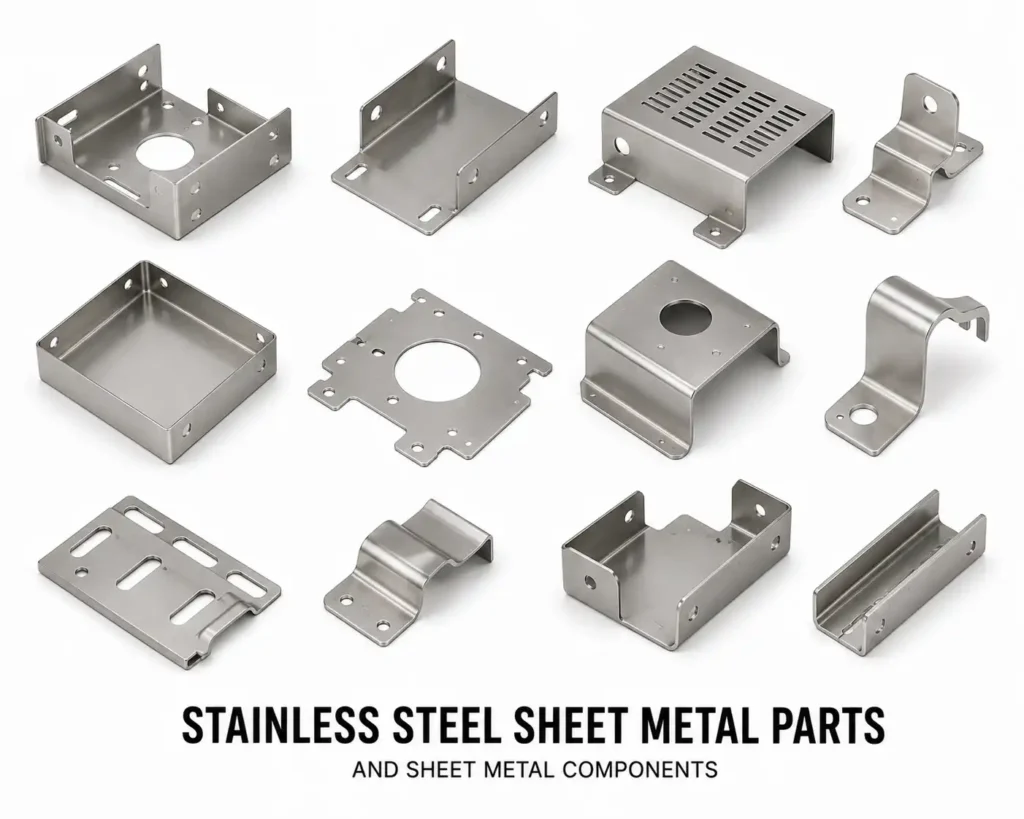
Stainless steel sheet metal parts and sheet metal components encompass the full spectrum of precision-formed, cut, and fabricated components produced from flat stainless steel sheet and coil stock. This includes blanked parts, punched components, bent profiles, deep drawn shells, rolled sections, laser-cut profiles, and complex multi-operation pressed assemblies. As a leading manufacturer and exporter of stainless steel sheet metal parts from India, we serve diverse end-user industries including construction, HVAC, automotive, food processing, pharmaceutical, marine, chemical, and electronics, delivering precision components that meet the most demanding international specifications.
What Are Stainless Steel Sheet Metal Parts?
Stainless steel sheet metal parts are components produced from flat stainless steel sheet (typically 0.3 mm to 12 mm thick) using processes including laser cutting, punching, blanking, bending, press braking, rolling, deep drawing, stamping, spinning, and hydroforming. Sheet metal fabrication is distinguished from machining by the fact that the starting material is two-dimensional flat stock, and the final component is produced through plastic deformation rather than material removal. This results in high material efficiency (typically 60-90% material utilisation vs 30-70% for machined parts) and high production rates at competitive unit costs.
Manufacturing Processes for Stainless Steel Sheet Metal Parts
- Laser Cutting: Fiber laser systems (1-20 kW) cut stainless steel sheet with kerf widths of 0.1-0.3 mm, cut accuracy to +/-0.1 mm, and sheet thicknesses up to 30 mm. No hard tooling required, making laser cutting ideal for prototypes, low-volume parts, and complex profiles. Cutting speeds for 316L stainless: 2 mm = 8,000 mm/min; 6 mm = 2,500 mm/min; 12 mm = 700 mm/min (3 kW fiber laser).
- CNC Punching: Turret punch presses with 20-72 tool stations produce punched, notched, louvred, and embossed features in stainless steel sheet at rates of 200-1,200 hits/minute. Tool life for stainless steel punching: M2 HSS dies – 50,000-100,000 hits; PM tool steel (CPM Rex) – 200,000-500,000 hits; TiN-coated – 500,000+ hits.
- Progressive Die Stamping: Multiple blanking, piercing, forming, and bending operations performed in a single press stroke on a continuous coil strip. Production rates 50-1,000 parts/minute. Economic lot size: 10,000+ pieces. Tolerances: +/-0.05 mm (blanking), +/-0.1 mm (formed features).
- CNC Press Brake Bending: Precision sheet metal bending using CNC-controlled servo-hydraulic press brakes. Bending accuracy: +/-0.1 degree angle, +/-0.1 mm dimension. Minimum bend radius: 0.5xT (304/316), 1.0xT (duplex). Maximum sheet length: 6,000 mm. Press force: up to 1,000 tonnes.
- Deep Drawing: Forming of seamless hollow components (cups, cans, shells) from flat blanks using punch and die. Multiple draw passes for high depth-to-diameter ratios. See Deep Drawn Parts section for full technical details.
- Roll Forming: Continuous bending of flat sheet into constant cross-section profiles (channels, angles, tubes, complex sections) using a series of roller dies. Produces accurate, high-volume profiles in material thicknesses 0.3 to 6.0 mm. Used for stainless steel trim profiles, structural sections, and enclosure extrusions.
- Spinning: Rotary cold-forming of sheet metal discs over a mandrel to produce axisymmetric components (domes, cones, hemispheres). Used for vessel heads, lighting reflectors, and architectural features in stainless steel.
- Hydroforming: High-pressure fluid (300-700 MPa) used to form complex hollow shapes from sheet metal over a single-sided tool. Achieves tighter radii and more complex profiles than conventional pressing with reduced tooling cost. Used for automotive and aerospace stainless sheet metal parts.
Material Alloys for Stainless Steel Sheet Metal Parts
Austenitic Grades
- AISI 304 / EN 1.4301 / UNS S30400: The universal stainless sheet metal grade. Exceptional formability: uniform elongation 40%+; n-value ~0.5; r-value ~1.0. 18% Cr, 8% Ni. Used for the majority of stainless steel sheet metal components across all industries. Tensile strength 515-620 MPa. Non-magnetic in annealed condition.
- AISI 304L / EN 1.4307 / UNS S30403: Low-carbon 304 for sheet metal components with welded joints. Max 0.03% C prevents sensitisation. Slightly reduced yield strength (170 MPa min vs 205 MPa for 304).
- AISI 304H / EN 1.4948 / UNS S30409: High-carbon 304 for elevated-temperature sheet metal applications requiring higher creep strength.
- AISI 304DDQ / DDQ2: Deep Drawing Quality grade for complex sheet metal forms. Enhanced purity and grain size optimisation. n-value greater than 0.52. Reduces forming defects in multi-stage operations.
- AISI 316 / EN 1.4401 / UNS S31600: Molybdenum-bearing (2-3% Mo) austenitic for sheet metal parts in chloride-bearing and marine environments. PRE ~25. Used for coastal cladding, marine components, and chemical processing sheet metal parts.
- AISI 316L / EN 1.4404 / UNS S31603: Low-carbon 316. The standard pharmaceutical, food, and marine grade sheet metal. Max 0.03% C. Electropolishable. Weldable without sensitisation risk.
- AISI 316Ti / EN 1.4571 / UNS S31635: Ti-stabilised 316 for sheet metal parts in high-temperature chemical environments up to 800 degrees C.
- AISI 321 / EN 1.4541 / UNS S32100: Ti-stabilised 304 for exhaust system and heat exchanger sheet metal components operating continuously above 400 degrees C.
- AISI 310S / EN 1.4845 / UNS S31008: 25% Cr, 20% Ni. For furnace, kiln, and high-temperature process sheet metal components up to 1100 degrees C.
- AISI 317L / EN 1.4438 / UNS S31703: 3-4% Mo. For sheet metal parts in pulp and paper, chemical processing, and aggressive corrosion environments.
- Alloy 20 / UNS N08020: For sheet metal components in sulfuric acid environments.
- 6-Mo 254 SMO / EN 1.4547 / UNS S31254: 6% Mo, PRE ~43. For sheet metal components in desalination, seawater systems, and flue gas desulfurisation applications.
- 904L / EN 1.4539 / UNS N08904: 4-5% Mo, 23-28% Ni. For highly corrosive acid environments including dilute sulfuric and phosphoric acid service sheet metal components.
Ferritic Grades
- AISI 430 / EN 1.4016 / UNS S43000: 16-18% Cr. High r-value (~1.4) makes it excellent for deep drawn sheet metal parts. Magnetic, lower cost. Used in appliances, automotive trim, and decorative architectural cladding.
- AISI 409 / EN 1.4512 / UNS S40900: 11% Cr automotive exhaust grade. Sheet metal components for mufflers, heat shields, and catalytic converter housings.
- AISI 441 / EN 1.4509 / UNS S44100: Nb+Ti stabilised ferritic. Improved weldability and formability. Used in washing machine drums, dishwasher inner parts, and automotive fuel systems.
- AISI 444 / EN 1.4521 / UNS S44400: 18% Cr, 2% Mo. For solar water heater panels and hot water storage tank sheet metal components.
- AISI 446 / EN 1.4762 / UNS S44600: 23-27% Cr. High-temperature ferritic for furnace and combustion system sheet metal parts up to 1175 degrees C.
Duplex and Super Duplex Grades
- Duplex 2205 / EN 1.4462 / UNS S32205: 22% Cr, 5% Ni, 3% Mo. Yield strength ~480 MPa. For sheet metal parts requiring high strength in corrosive environments. Offshore structural sheet metal components, chemical plant parts, desalination equipment.
- Super Duplex 2507 / EN 1.4410 / UNS S32750: For the most demanding corrosive sheet metal applications. PRE above 40.
- Lean Duplex 2101 / EN 1.4162 / UNS S32101: Low-nickel duplex. Cost-effective sheet metal alternative for structural components requiring strength above austenitic grades.
- Duplex 2304 / EN 1.4362 / UNS S32304: 23% Cr, 4% Ni, no Mo. For sheet metal structural components where chloride resistance is less critical but strength improvement over 304 is required.
Precipitation Hardening Grades
- 17-4 PH / EN 1.4542 / UNS S17400: For aerospace, defence, and precision sheet metal components requiring maximum strength with minimal wall thickness. Condition H900: 1310 MPa tensile strength.
- 15-5 PH / UNS S15500: Improved toughness PH grade for sheet metal components in aerospace structures.
Technical Specifications
- Sheet Thickness Range: 0.3 mm to 12 mm (laser cutting and punching); 0.3 mm to 8 mm (pressing and bending)
- Sheet Width: Up to 2,000 mm coil width
- Laser Cut Accuracy: +/-0.1 mm profile, +/-0.05 mm hole position
- Bent Part Accuracy: +/-0.1 degrees angle, +/-0.2 mm dimension
- Surface Finish Options: No.1 hot-rolled, 2B cold-rolled (Ra 0.1-0.5 micron), No.2D dull finish, No.4 brushed (Ra 0.2-0.8 micron), No.6 Tampico finish, No.7 reflective finish, No.8 mirror (Ra 0.05 micron), BA bright annealed, electropolished (Ra 0.1-0.4 micron)
- Standards: EN 10088-2, ASTM A240, JIS G4304/G4305, ISO 9001:2015
Applications of Stainless Steel Sheet Metal Parts
- Architecture and Construction: Facade cladding panels, roofing, decorative screens, balustrade infill panels, lift and escalator components, door and window furniture
- HVAC and Building Services: Ventilation ductwork, diffusers, dampers, terminal units, smoke control ducting, fan casings
- Food and Beverage: Processing equipment panels and covers, conveyor side guards, food storage containers, commercial kitchen equipment, bottling line components
- Pharmaceutical: Equipment covers and guards, clean room furniture panels, instrument housings, process vessel components
- Automotive: Exhaust system components, underbody shields, fuel tank support straps, decorative trim, radiator components
- Electronics: Chassis and subframes, EMI shielding components, heat sink fins and plenums, rackmount equipment panels
- Marine: Handrail support components, deck drainage channels, porthole surrounds, navigation equipment housings
- Chemical and Process: Equipment guards and covers, cable tray components, instrument mounting hardware, sampling system panels
International Terminology Table — Stainless Steel Sheet Metal Parts
| Term (English) | German | Russian | Spanish | Portuguese | French | Italian |
|---|---|---|---|---|---|---|
| Sheet Metal Parts | Blechteile / Blechformteile | Детали из листового металла | Piezas de chapa metalica | Pecas de chapa metalica | Pieces en tole | Parti in lamiera |
| Stainless Steel Sheet Metal Parts | Edelstahl-Blechteile | Детали из нержавеющей стали из листа | Piezas de chapa de acero inoxidable | Pecas de chapa de aco inoxidavel | Pieces en tole d’acier inoxydable | Parti in lamiera di acciaio inossidabile |
| Sheet Metal Components | Blechbauteile / Blechkomponenten | Компоненты из листового металла | Componentes de chapa metalica | Componentes de chapa metalica | Composants en tole metallique | Componenti in lamiera metallica |
| Sheet Metal Fabrication | Blechbearbeitung / Blechfertigung | Обработка листового металла | Fabricacion de chapa metalica | Fabricacao de chapa metalica | Fabrication de tole metallique | Lavorazione della lamiera |
| Stamped Sheet Metal Part | Gestanztes Blechteil | Штампованная деталь из листового металла | Pieza de chapa estampada | Peca de chapa estampada | Piece de tole emboutie | Parte in lamiera stampata |
| Laser Cut Sheet Metal | Lasergeschnittenes Blech | Листовой металл лазерной резки | Chapa metalica cortada por laser | Chapa metalica cortada a laser | Tole decoupee au laser | Lamiera tagliata a laser |
| Bent Sheet Metal Component | Gebogenes Blechteil | Гнутая деталь из листового металла | Componente de chapa doblada | Componente de chapa dobrada | Composant en tole pliee | Componente in lamiera piegata |
| Precision Sheet Metal | Prazisionsblechteil | Точный листовой металл | Chapa metalica de precision | Chapa metalica de precisao | Tole de precision | Lamiera di precisione |
Frequently Asked Questions
Q1: What is the difference between sheet metal pressing and stamping?
A: Pressing and stamping are largely synonymous terms in the sheet metal industry, both referring to operations that use dies and press equipment to form flat sheet into finished shapes. Historically, “pressing” has been more commonly used in the UK and European context, while “stamping” is more common in North American usage. Technically, pressing can refer to a broader range of operations including hydraulic pressing of heavier gauge material, while stamping typically implies higher-speed mechanical press operations on lighter gauge sheet (up to 3 mm). Both terms are used interchangeably for stainless steel sheet metal forming operations.
Q2: What is the most critical factor in selecting a stainless steel grade for sheet metal components?
A: The most critical factor is the corrosive environment classification, determined by the PREN (Pitting Resistance Equivalent Number = %Cr + 3.3x%Mo + 16x%N). For reference: indoor dry environments – AISI 304 (PREN ~19) is adequate; urban or mildly industrial outdoor environments – AISI 304 with regular maintenance or AISI 316 (PREN ~25); coastal environments within 5 km of the sea – AISI 316L minimum; within 500 m of the sea or submerged in seawater – Duplex 2205 (PREN ~35) or 254 SMO (PREN ~43); subsea or sour gas service – Super Duplex 2507 (PREN above 40). Secondary factors are mechanical strength requirements, temperature, weldability, and cost.
Q3: How do you prevent galling when machining holes in stainless steel sheet metal parts?
A: Galling (adhesive wear or cold welding) during punching or drilling of stainless steel sheet is controlled by: (1) Use of appropriate tooling – TiN or TiAlN coated punches with polished flanks (Ra 0.1 micron); (2) Sufficient clearance – 12-15% of material thickness per side for austenitic grades (vs 10% for mild steel); (3) High-pressure sulfurised or chlorinated cutting fluid for drilling and tapping; (4) Reduced punch speed and feed rate for 316 and duplex grades; (5) Sharp tools – dull tooling increases heat generation and galling risk dramatically; (6) Use PM tool steel grades such as CPM Rex M4 or CPM 10V for punches handling high-strength grades.
Q4: Can stainless steel sheet metal parts be anodised?
A: No. Anodising is an electrolytic oxidation process applicable only to aluminium and titanium, which form stable, controllable oxide films. Stainless steel cannot be conventionally anodised. However, stainless steel sheet metal parts can be colour-tinted using: (1) PVD (Physical Vapour Deposition) coating – produces gold, black, rose gold, bronze, and other colours without affecting corrosion resistance; (2) Chemical colouring (Inco Process / electrochemical colouring) – produces interference colours from pale yellow to blue to black by controlled thickening of the chromium oxide passive film; (3) Powder coating or liquid paint – applied to sand-blasted or zinc-phosphate-pretreated surface for applications where colour is required at the expense of bare-metal corrosion performance.
Q5: What welding processes are used for stainless steel sheet metal fabrication?
A: The primary welding processes for stainless steel sheet metal are: TIG/GTAW (Tungsten Inert Gas) – preferred for thin sheet (0.5-3 mm) and sanitary welds; weld quality: full penetration, low heat input, minimal distortion; uses argon or argon-helium shielding. MIG/GMAW (Metal Inert Gas) – for sheet thicknesses 1.5 mm and above; higher deposition rates; requires gas shielding (98% Ar / 2% O2 for austenitic grades). Laser welding – for precision thin-sheet fabrication (0.2-3 mm); narrow HAZ (0.1-0.5 mm); autogenous or with wire; high speed (1-10 m/min). Resistance welding (spot/seam) – for lap joints in sheet metal assemblies up to 3+3 mm; high-speed production. Plasma welding – for precision keyhole welding of sheet 3-10 mm in single pass. Filler metals: 308L for 304, 316L for 316, 309L for dissimilar joints.
Q6: What are the flatness tolerances for stainless steel sheet metal panels?
A: Flatness (bow and twist) tolerances for stainless steel sheet per EN 10088-2 and ASTM A480: For 2B finish sheets (thickness 0.5-2 mm, width up to 1,250 mm): maximum bow = 0.5% of sheet length; for precision laser-cut parts (after stress relief): flatness deviation 0.3 mm/1,000 mm; after press brake bending: flatness of flange faces 0.2 mm/100 mm (standard) or 0.1 mm/100 mm (precision). Distortion after welding must be corrected by controlled thermal straightening or press straightening; maximum post-weld flatness deviation for facade panels is typically 1.0 mm/1,000 mm per architectural specification.
Why Choose Our Stainless Steel Sheet Metal Parts from India?
- Complete sheet metal manufacturing capability: laser cutting, CNC punching, press braking, deep drawing, roll forming, and welding
- Fiber laser cutting with 6 kW and 12 kW machines for rapid prototype and production cutting
- CNC press brakes up to 600T and 6,000 mm bending length
- Full in-house surface finishing: electropolishing, passivation, brushing, and bead blasting
- ISO 9001:2015 certified with EN 10204 Type 3.1 material certification
- Competitive export pricing with DDP delivery to USA, Europe, Australia, UAE, and Asia-Pacific
Get a Quote for Stainless Steel Sheet Metal Parts
We are a specialist manufacturer and exporter of precision stainless steel sheet metal parts and sheet metal components from India. From simple laser-cut blanks to complex multi-stage pressed and welded assemblies, we have the capability, experience, and quality management systems to deliver components to your exact specification.
Send us your drawings, CAD files, or specifications today and receive a detailed technical and commercial quotation within 24 hours. We supply stainless steel sheet metal components to Germany, USA, UK, France, Netherlands, Italy, Australia, Canada, UAE, Singapore, and 40+ countries. ISO 9001:2015 certified. EN 10204 Type 3.1 material certificates provided as standard.