
Introduction to Stainless Steel Deep Drawn Parts
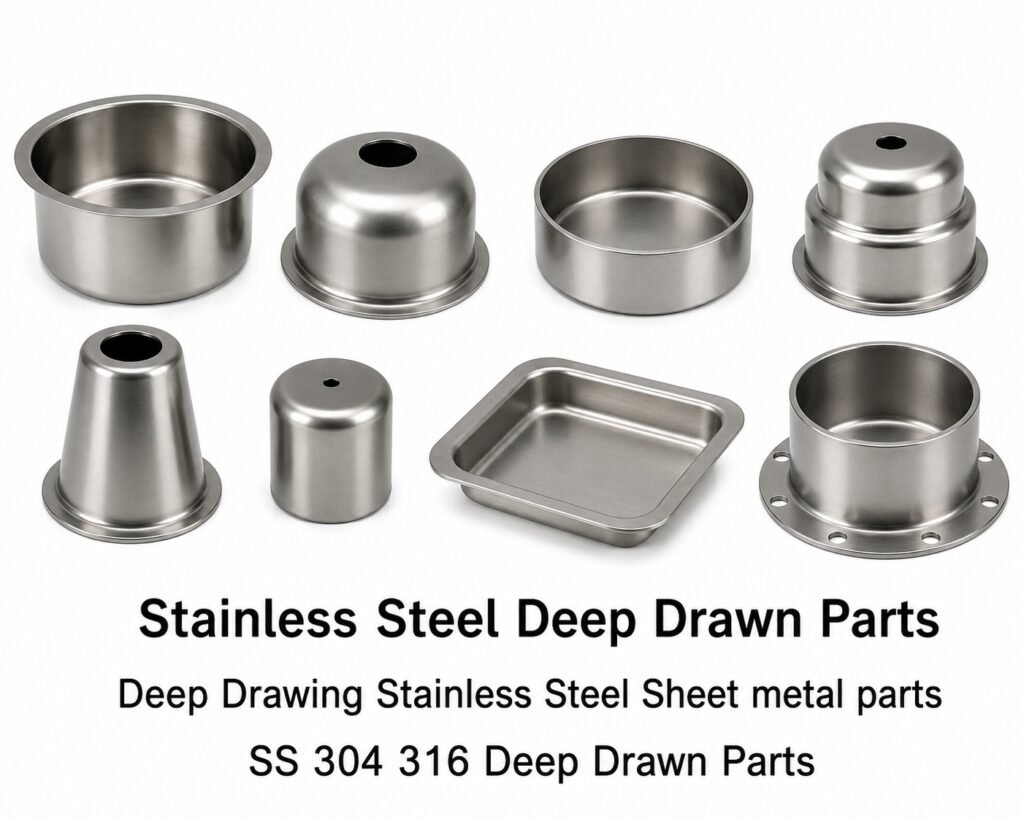
Stainless steel deep drawn parts are seamless, hollow components manufactured by progressively forcing flat stainless steel blanks through a series of hardened dies to produce cylindrical, conical, rectangular, or complex-shaped components without welding or joining seams. As a specialist manufacturer and exporter of deep drawn stainless steel parts from India, we produce components for the automotive, medical, pharmaceutical, food processing, defence, aerospace, chemical, and consumer goods industries. Deep drawn stainless steel parts offer superior structural integrity, pressure containment capability, and surface finish compared to fabricated or cast alternatives.
What is the Deep Drawing Process for Stainless Steel?
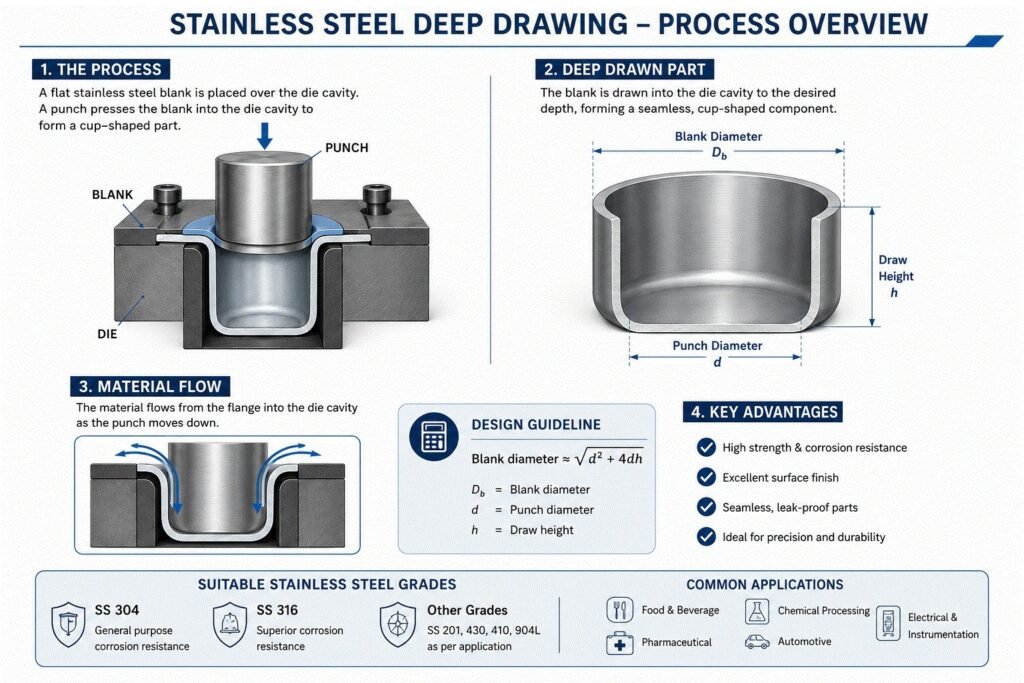
Deep drawing is a sheet metal forming process in which a flat circular (or shaped) blank is clamped over a die cavity and drawn into the die by a punch to form a hollow cup or shell. The term “deep drawing” applies when the drawn depth exceeds the part diameter (depth-to-diameter ratio greater than 0.5). Multiple draw reductions (typically 30-40% reduction per draw pass) are required to achieve deep parts without material failure. For stainless steel, the Limiting Drawing Ratio (LDR) is approximately 2.0-2.2 for austenitic grades and 1.8-2.0 for ferritic grades, compared to 2.2-2.4 for mild steel.
The process is characterised by the following parameters: Blank Holder Force (BHF) to prevent wrinkling; punch speed (typically 10-100 mm/s for stainless); draw ratio; annealing between draw passes; and lubrication (typically extreme pressure (EP) drawing lubricants or PTFE film for stainless steel).
Material Alloys for Stainless Steel Deep Drawn Parts
Austenitic Grades (Most Common for Deep Drawing)
- AISI 304 / EN 1.4301 / UNS S30400: The primary grade for deep drawn stainless steel parts. High work-hardening rate (n-value ~0.5) provides excellent drawability. Normal Anisotropy Ratio (r-value) approximately 0.9-1.1. LDR up to 2.2. Used for kitchenware, sinks, cookware, automotive components, and industrial vessels.
- AISI 304L / EN 1.4307 / UNS S30403: Low-carbon 304 for deep drawn components requiring post-draw welding. Prevents sensitisation during heat-affected zone thermal cycling. Max 0.03% C.
- AISI 304DDQ (Deep Drawing Quality) / EN 1.4301 DDQ: Specially processed for enhanced deep drawing performance. Higher purity (reduced inclusions), optimised grain size (ASTM 5-8), and controlled carbon and nitrogen levels improve LDR and reduce earing. n-value >0.52.
- AISI 316L / EN 1.4404 / UNS S31603: For deep drawn parts requiring superior corrosion resistance in chloride-bearing media. Marine, chemical, and pharmaceutical applications. Slightly lower drawability than 304 due to higher alloy content. LDR ~2.0.
- AISI 321 / EN 1.4541 / UNS S32100: Ti-stabilised austenitic. For deep drawn parts operating at elevated temperatures (400-900 degrees C). Automotive exhaust cups, heat exchanger tubes, and high-temperature housings.
- AISI 310S / EN 1.4845 / UNS S31008: 25/20 grade for deep drawn furnace parts, kiln cups, and high-temperature component housings.
- Alloy 20 / UNS N08020: For deep drawn chemical processing vessels and cups requiring sulfuric acid resistance.
- Alloy 825 / UNS N08825: Ni-Fe-Cr alloy with 3% Mo and 2% Cu. For severely corrosive chemical deep drawn components including sour gas service.
Ferritic Grades
- AISI 430 / EN 1.4016 / UNS S43000: Good deep drawability due to high r-value (~1.4) compared to austenitic grades. Used for decorative housings, appliance components, and automotive trims. Lower cost due to absence of nickel. Magnetic.
- AISI 409 / EN 1.4512 / UNS S40900: Standard automotive exhaust grade. Deep drawn into muffler shells, end caps, and heat shields. Lower cost with adequate corrosion resistance for underbody automotive applications.
- AISI 441 / EN 1.4509 / UNS S44100: Nb+Ti stabilised ferritic. Improved drawability with Lankford value r >1.4. Used for deep drawn parts in washing machines, dishwashers, and automotive fuel system components.
- AISI 444 / EN 1.4521 / UNS S44400: 18/2 ferritic with 2% Mo. Used for deep drawn hot water heater liners and solar collector components.
Duplex Grades
- Duplex 2205 / EN 1.4462 / UNS S32205: Deep drawing of duplex grades is more challenging due to lower ductility (elongation ~25% vs 40%+ for austenitic). Requires higher blank holder forces, reduced draw ratios, and intermediate annealing. Used for high-pressure, corrosion-resistant deep drawn housings and vessels in oil and gas applications.
Precipitation Hardening Grades
- 17-4 PH / EN 1.4542 / UNS S17400: Deep drawn in annealed condition (Condition A), then age-hardened post-drawing to achieve tensile strength up to 1310 MPa (Condition H900). Used for aerospace sensor housings, instrument cases, and high-strength military deep drawn components.
- 15-5 PH / UNS S15500: Improved toughness alternative to 17-4 PH for deep drawn aerospace and defence applications.
Deep Drawing Process Parameters for Stainless Steel
- Blank Diameter Calculation: For cylindrical cups: Blank Diameter = sqrt(d^2 + 4dh) where d = cup diameter and h = cup height. For complex shapes, FEM (Finite Element Method) simulation using software such as Autoform, Pamstamp, or DYNAFORM is used.
- Draw Reduction Ratios: First draw: 40-45% reduction (DR1 = 0.55-0.60). Subsequent draws: 20-30% reduction per pass. Total draws required: 3-6 for deep parts.
- Annealing: Inter-pass annealing at 1050-1100 degrees C in controlled atmosphere (N2/H2 mixture or vacuum) to restore ductility and relieve work hardening. Critical for deep parts requiring more than 3 draw passes.
- Lubrication: Chlorinated EP drawing compounds (Fuch Renoform, Quaker Ferrocoat) or dry-film PTFE/MoS2 lubricants. Lubricant removal post-drawing by alkaline degreasing to prevent chloride pitting on 316L parts.
- Press Equipment: Double-action hydraulic presses with programmable blank holder force. Press capacity 50T to 2000T depending on part size. Transfer presses for high-volume production.
- Tooling: Hardened D2 tool steel dies (HRC 58-62), TiN-coated or CVD-diamond-coated for extended tool life with austenitic grades. Tool clearance: (material thickness x 1.05 to 1.15) for austenitic grades.
Technical Specifications of Deep Drawn Stainless Steel Parts
- Blank Thickness Range: 0.3 mm to 8.0 mm
- Minimum Part Diameter: 5 mm (micro deep drawing)
- Maximum Part Diameter: 800 mm (large deep drawn vessels)
- Maximum Depth-to-Diameter Ratio: Up to 5:1 (with multiple draws and annealing)
- Dimensional Tolerance: Diameter: +/-0.1 mm (standard), +/-0.05 mm (precision grade). Height: +/-0.2 mm
- Wall Thickness Variation: Typical: 15-25% thinning at punch radius. Maximum: 30% thinning allowable for pressure vessels
- Surface Finish: Internal: Ra 0.4-1.6 micron (die polished). External: As-drawn or electropolished (Ra 0.25-0.4 micron)
- Standards: ASTM A240, EN 10088-2, ISO 9001:2015, ASME Section VIII (pressure vessels), FDA 21 CFR Part 177 (food contact)
Applications of Stainless Steel Deep Drawn Parts
- Medical and Surgical: Surgical instrument cups, implant housings, sterilisation tray components, dental instrument cases, orthopaedic instrument containers
- Pharmaceutical: Parenteral drug vials, CIP/SIP vessel inserts, process reactor components, sterile filling machine parts
- Food Processing: Deep drawn dairy cups, food service containers, kitchen equipment bowls and pots, industrial food processing vessels
- Automotive: Fuel filter housings, oil filter canisters, brake cylinder cups, exhaust component shells, airbag housing components
- Aerospace and Defence: Sensor housings, actuator cylinders, hydraulic reservoir cups, missile body components, ordnance components
- Electronics and Electrical: Battery cases, capacitor cans, microwave filter cups, EMI shielding enclosures, precision instrument housings
- Chemical Processing: Reactor vessel liner cups, dosing pump cylinder liners, valve body shells, pressure gauge bourdon tube blanks
- Consumer Products: Thermos and vacuum flask liners, cookware, premium cosmetic packaging, watch cases and backs
International Terminology Table — Stainless Steel Deep Drawn Parts
| Term (English) | German | Russian | Spanish | Portuguese | French | Italian |
|---|---|---|---|---|---|---|
| Deep Drawn Parts | Tiefziehteile / Tiefgezogene Teile | Детали глубокой вытяжки | Piezas embutidas profundas | Pecas estampadas profundas | Pieces embouties profondes | Parti imbutite profonde |
| Stainless Steel Deep Drawn Parts | Tiefziehteile aus Edelstahl | Детали глубокой вытяжки из нержавеющей стали | Piezas embutidas de acero inoxidable | Pecas estampadas profundas em aco inoxidavel | Pieces embouties en acier inoxydable | Parti imbutite in acciaio inossidabile |
| Deep Drawing Process | Tiefziehverfahren / Tiefziehprozess | Процесс глубокой вытяжки | Proceso de embuticion profunda | Processo de estampagem profunda | Procede d’emboutissage profond | Processo di imbutitura profonda |
| Deep Drawn Cup | Tiefgezogener Napf / Tiefziehnapf | Стакан глубокой вытяжки | Copa embutida profunda | Copo estampado profundo | Gobelet embouti profond | Coppa imbutita profonda |
| Deep Drawn Cylinder | Tiefgezogener Zylinder | Цилиндр глубокой вытяжки | Cilindro embutido profundo | Cilindro estampado profundo | Cylindre embouti profond | Cilindro imbutito profondo |
| Draw Ratio | Ziehverhaltnis | Коэффициент вытяжки | Relacion de embuticion | Relacao de estampagem | Taux d’emboutissage | Rapporto di imbutitura |
| Limiting Drawing Ratio | Grenzziehverhaltnis (LZV) | Предельный коэффициент вытяжки | Relacion limite de embuticion | Relacao limite de estampagem | Taux limite d’emboutissage | Rapporto limite di imbutitura |
| Work Hardening | Kaltverfestigung | Наклеп / Деформационное упрочнение | Endurecimiento por deformacion | Encruamento / Endurecimento por deformacao | Ecrouissage | Incrudimento |
Frequently Asked Questions
Q1: How many draw passes are needed for stainless steel deep drawn parts?
A: The number of draw passes depends on the required depth-to-diameter ratio (h/d). For austenitic stainless steel (304 or 316L), with first draw reduction of approximately 40-45% and subsequent reductions of 20-25% per pass: h/d of 0.5 to 1.0 typically requires 1-2 passes; h/d of 1.0 to 2.5 requires 3-4 passes; h/d above 2.5 requires 5+ passes with intermediate annealing after every 2-3 passes. Inter-pass annealing at 1050-1100 degrees C is mandatory to restore ductility and avoid fracture during subsequent draws.
Q2: What is the difference between deep drawing and stamping/pressing?
A: Stamping (pressing) is a broad term covering blanking, punching, and shallow forming where the depth of draw is less than the part diameter (h/d less than 0.5). Deep drawing specifically refers to forming hollow components where the depth exceeds the blank diameter, requiring blank holder force to prevent wrinkling and controlled lubrication to prevent galling. Deep drawn parts are seamless by nature – they have no welded seam, making them ideal for pressure containment, corrosion resistance, and hygienic applications.
Q3: What surface defects occur during stainless steel deep drawing and how are they prevented?
A: Common defects include: (1) Wrinkling – caused by insufficient blank holder force; prevented by increasing BHF or adding draw beads; (2) Tearing/Fracture – caused by excessive draw ratio, insufficient lubrication, or work hardening; prevented by reducing draw ratio, intermediate annealing, and improved lubrication; (3) Earing – caused by crystallographic anisotropy; minimised by using DDQ-grade material with low Delta-r value; (4) Orange peel surface – caused by coarse grain size; prevented by specifying ASTM grain size 5-8 material; (5) Die lines – caused by die surface roughness; prevented by polishing die to Ra 0.1 micron or less.
Q4: Are deep drawn stainless steel parts suitable for high-pressure applications?
A: Yes. Deep drawn parts have excellent pressure containment capability due to their seamless construction and work-hardened microstructure. For ASME Section VIII (pressure vessel) applications, the part must be designed with appropriate wall thickness accounting for draw thinning (typically 15-25% wall reduction). 316L deep drawn pressure vessels are routinely rated for working pressures from 10 to 350 bar depending on diameter and wall thickness. Burst pressure is typically 4-5x the rated working pressure for properly designed austenitic parts.
Q5: Can stainless steel deep drawn parts be electropolished?
A: Yes. Electropolishing is highly recommended for medical, pharmaceutical, and food-grade deep drawn parts. The process removes the outer Beilby layer (containing surface contamination and inclusions from the drawing process), the drawing lubricant residues, and micro-roughness, producing a chromium-rich passive surface with Ra down to 0.1-0.4 micron. Electropolishing is especially important for the internal surfaces of deep drawn vessels where mechanical polishing is impractical. Parts must be thoroughly degreased and alkaline cleaned before electropolishing to remove all EP drawing lubricant residues.
Q6: What is the minimum wall thickness for stainless steel deep drawn parts?
A: Starting from a minimum blank thickness of 0.3 mm (for micro deep drawn parts), wall thicknesses down to 0.2 mm are achievable in precision deep drawing of austenitic grades. In standard production, minimum blank thickness is typically 0.5 mm. Wall thinning occurs primarily at the punch radius (up to 30% reduction) while the flange and side wall maintain near-original thickness. Ironing (a secondary operation) can be used to achieve uniform wall thickness within 5% variation throughout the drawn part height.
Q7: What quality inspections are required for stainless steel deep drawn parts?
A: Standard quality inspections include: dimensional verification per CMM or optical comparator; surface roughness measurement (Ra) by profilometer; visual inspection for cracks, tears, and surface defects per AQL 1.0 Level II; magnetic permeability testing (for austenitic parts where non-magnetic property is critical); wall thickness verification by ultrasonic gauge; leak testing by pneumatic pressure test or helium mass spectrometry (for hermetic applications); and PMI (Positive Material Identification) by XRF for 316L and duplex grades. Material certificates to EN 10204 Type 3.1 are supplied as standard.
Why Choose Our Deep Drawn Stainless Steel Parts from India?
- Specialist deep drawing facility with double-action hydraulic presses from 50T to 1500T
- In-house FEM simulation using Autoform for optimised blank development and tooling design
- Complete in-house toolroom with CNC machined and TiN-coated deep drawing dies
- Intermediate annealing capability in controlled-atmosphere furnace (N2/H2)
- Electropolishing, passivation, and precision finishing services in-house
- ISO 9001:2015 certified with EN 10204 Type 3.1 mill certification for all materials
- Export supply to medical device manufacturers, pharma, aerospace, and automotive OEMs worldwide
Get a Quote for Stainless Steel Deep Drawn Parts
Looking for an experienced manufacturer of stainless steel deep drawn parts in India? We specialise in complex, tight-tolerance deep drawn components for demanding applications. Submit your drawing, specification, or sample for a free DFM review and competitive tooling and piece-price quotation.
Contact our technical team today with your part dimensions, required material grade, annual volume, and finish requirements. We will revert with a detailed techno-commercial proposal within 24 hours. We supply deep drawn stainless steel parts globally to the USA, Germany, UK, France, Netherlands, Italy, Australia, UAE, and 40+ countries.