Introduction to Stainless Steel Pipe Clamps
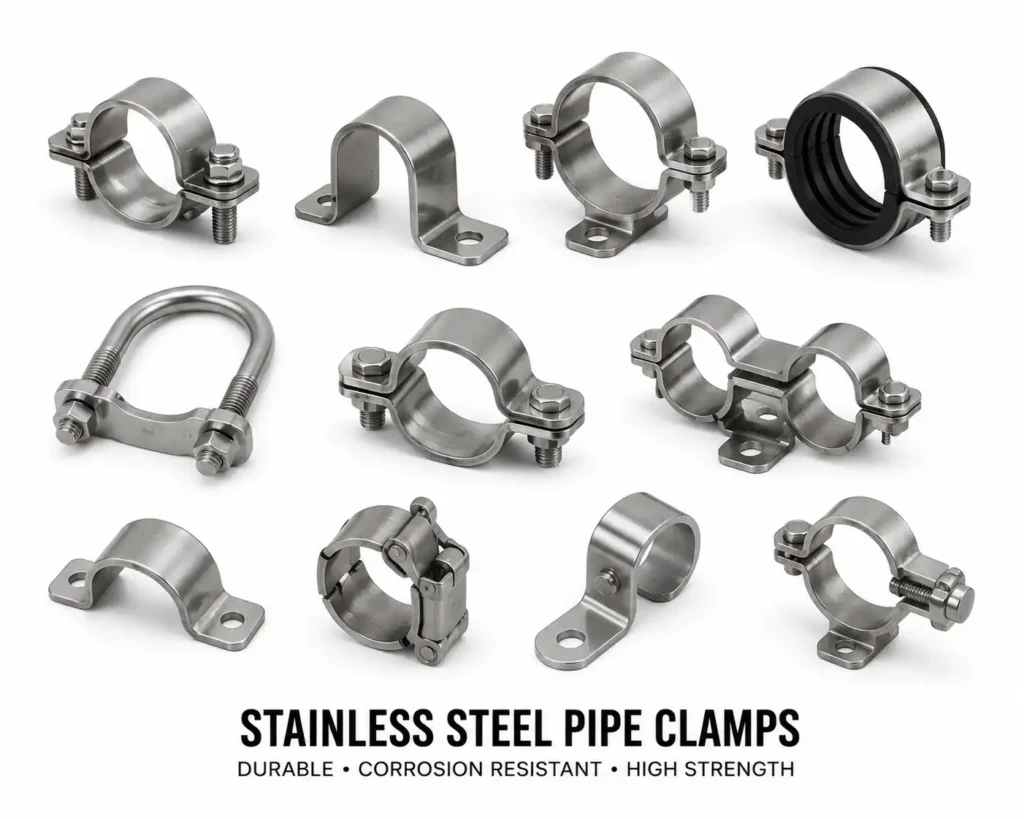
Stainless steel pipe clamps are precision-engineered pipe support, restraint, and fixing components manufactured from cold-formed or deep-drawn stainless steel sheet. Used extensively in plumbing, HVAC, oil and gas, chemical processing, marine, pharmaceutical, food and beverage, and construction applications, stainless steel pipe clamps provide robust, corrosion-resistant support for pipe runs in both ambient and extreme environments. As a leading manufacturer and exporter of stainless steel pipe clamps from India, we produce components conforming to EN, ASTM, DIN, BS, and ISO standards for global supply.
Types of Stainless Steel Pipe Clamps
Stainless steel pipe clamps are available in a broad range of designs, each suited to specific pipe support, isolation, and fixation requirements:
- Single Bolt Pipe Clamps (P-Clamps / Saddle Clamps): Single-piece pressed bracket with a single fixing bolt. Used for light to medium pipe support on walls and structural members. Available in rubber-lined versions for vibration isolation.
- Double Bolt Heavy Duty Clamps: Two-piece clamping arrangement with twin bolt closure. Provides higher clamping force for larger diameter pipes (DN50 to DN600) and high-pressure applications.
- U-Bolt Pipe Clamps: Pressed stainless steel U-shaped rod with two threaded legs and a pressed backplate. Conforms to DIN 3570, BS 4116. Used for structural pipe support in process plants.
- Cushioned / Lined Pipe Clamps: Clamp body with EPDM, neoprene, or NBR elastomer lining. Provides vibration damping, thermal insulation break, and protection for pipe coating from abrasion. Used in HVAC and marine applications.
- Riser / Vertical Pipe Clamps: Designed with integral pipe support shoulder to carry axial (gravity) loads in vertical pipe runs. Prevents pipe slip in riser installations.
- Gang / Multiple Pipe Clamps: Multi-pipe clamp arrangements on a single backing bar. Used for cable tray, conduit, and multiple pipe bundles in offshore topsides and process plants.
- Pipe Guide Clamps: Allow axial movement (thermal expansion) while restraining lateral pipe displacement. Use PTFE or bronze sliding pads.
- Split Ring Pipe Clamps: Two-piece split ring clamp body. Easy installation and removal around in-situ pipework without disconnection. Used in maintenance-intensive environments.
- Clevis Hanger Clamps: Pressed stainless steel clevis with adjustable rod for suspended pipe support from structural beams and ceilings.
- Hygienic / Sanitary Tri-Clamp Ferrules: Pressed stainless steel tri-clamp ferrule ends for hygienic pipeline connections per ISO 2852, BS 4825, and 3A Sanitary Standards.
Material Alloys for Stainless Steel Pipe Clamps — Complete Technical Reference
Alloy selection for stainless steel pipe clamps depends critically on the pipe medium, ambient environment, temperature range, and regulatory requirements. The following alloys are used in our pipe clamp manufacturing:
Austenitic Grades
- AISI 304 / EN 1.4301 / UNS S30400: 18% Cr, 8% Ni. Standard grade for indoor plumbing, HVAC, and general industrial pipe clamps. Tensile strength 515 MPa min. Non-magnetic in annealed condition. Weldable with 308L filler.
- AISI 304L / EN 1.4307 / UNS S30403: Low-carbon 304 (max 0.03% C). For welded clamp assemblies where sensitisation risk must be eliminated. Slightly reduced yield strength.
- AISI 316 / EN 1.4401 / UNS S31600: 16-18% Cr, 10-14% Ni, 2-3% Mo. For marine, coastal, chemical, and offshore pipe clamps. Superior pitting corrosion resistance (PRE ~25). Essential for service involving chloride-bearing media or saline atmosphere.
- AISI 316L / EN 1.4404 / UNS S31603: Low-carbon 316. The most widely specified grade for marine and chemical pipe clamps globally. Max 0.03% C. Preferred over 316 for all welded clamp constructions.
- AISI 316Ti / EN 1.4571 / UNS S31635: Titanium-stabilised 316. Retains corrosion resistance after welding at elevated temperatures. Used for high-temperature pipe support clamps up to 800 degrees C.
- AISI 321 / EN 1.4541 / UNS S32100: Ti-stabilised. Used for exhaust pipe and steam line clamps operating continuously above 400 degrees C.
- AISI 310S / EN 1.4845 / UNS S31008: 25% Cr, 20% Ni. For furnace and high-temperature process pipe clamps up to 1100 degrees C.
- AISI 317L / EN 1.4438 / UNS S31703: 3-4% Mo. Superior resistance to pitting and crevice corrosion in aggressive chemical service. Used for clamps on concentrated chloride and acid pipelines.
- Alloy 20 / UNS N08020: 20% Cr, 34% Ni, 2% Mo, 3% Cu. Exceptional sulfuric acid resistance. Used for clamps on sulfuric acid plant piping.
- 6-Mo (254 SMO) / EN 1.4547 / UNS S31254: 20% Cr, 18% Ni, 6% Mo, 0.2% N. PRE ~43. For highly aggressive chloride service where duplex grades cannot provide adequate resistance. Used in desalination and FGD pipe clamps.
Ferritic Grades
- AISI 430 / EN 1.4016 / UNS S43000: 16-18% Cr. For interior, mildly corrosive pipe clamp applications. Magnetic. Lower cost than austenitic grades.
- AISI 409 / EN 1.4512 / UNS S40900: 11% Cr. Automotive exhaust pipe clamps. Good oxidation resistance to 700 degrees C.
- AISI 441 / EN 1.4509 / UNS S44100: Nb+Ti stabilised ferritic. Used for automotive and appliance pipe clamp systems requiring improved weldability.
- AISI 444 / EN 1.4521 / UNS S44400: 18% Cr, 2% Mo. Improved chloride resistance. Alternative to 316 for lower-cost pipe clamp applications in moderate corrosive environments.
Duplex and Super Duplex Grades
- Duplex 2205 / EN 1.4462 / UNS S32205: 22% Cr, 5% Ni, 3% Mo, 0.15% N. PRE ~35. Yield strength ~480 MPa – approximately double that of 316L. Superior resistance to chloride stress corrosion cracking (SCC). Used for offshore, subsea, and sour service pipe clamps. Recognised by NACE MR0175/ISO 15156.
- Super Duplex 2507 / EN 1.4410 / UNS S32750: 25% Cr, 7% Ni, 4% Mo, 0.28% N. PRE above 40. For most severe seawater service, deep subsea, and sour gas applications. Used where cathodic protection is absent.
- Super Duplex Zeron 100 / UNS S32760 / EN 1.4501: 25% Cr, 7% Ni, 3.5% Mo, 0.7% W, 0.25% N. PRE ~40. Improved toughness vs 2507 at sub-zero temperatures. Used in North Sea and Arctic offshore pipe clamp systems.
- Lean Duplex 2101 / EN 1.4162 / UNS S32101: Low-nickel duplex. Cost-effective alternative for moderate chloride service with strength advantage.
Precipitation Hardening Grades
- 17-4 PH / EN 1.4542 / UNS S17400: High-strength clamps for aerospace and defence pipe support systems where weight and space are critical. Condition H900: 1310 MPa tensile strength.
Manufacturing Process for Pressed Stainless Steel Pipe Clamps
- Strip Slitting: Master coils (width up to 1500 mm) are precision-slit to the exact blank width required for each clamp size, minimising material waste.
- Progressive Die Stamping: Multi-stage progressive dies carry out blanking, piercing, forming, and coining operations in a single press stroke. Achieves ±0.1 mm dimensional tolerance at high production rates (50-500 parts/minute for small clamps).
- Deep Drawing (for tubular clamp bodies): Circular blanks are deep-drawn in a series of drawing and redrawing operations to form seamless cylindrical clamp shells. Limiting Drawing Ratio (LDR): ~2.0 for 304, ~1.9 for 316 (due to lower work-hardening coefficient).
- Bending and Radius Forming: Computer-controlled servo-hydraulic press brakes form clamp backplates and flanges. Minimum bend radius: 1.0xT for austenitic grades, 1.5xT for ferritic and duplex.
- Deburring and Edge Conditioning: All sheared and punched edges deburred to Ra 1.6 micron max, edge radius minimum 0.1 mm, preventing seal damage and operator injury.
- Rubber/Elastomer Lining (for lined clamps): EPDM, neoprene, or NBR liners are vulcanised or adhesively bonded to the clamp interior. Shore A hardness 40-60 per specification.
- Passivation: All clamp components passivated per ASTM A967 (nitric acid or citric acid process) or AMS 2700 Method 1. Final chromium oxide layer thickness: 2-5 nm.
- Assembly and Hardware: Clamps assembled with A2-70 (304 equivalent) or A4-80 (316 equivalent) stainless steel bolts and nuts per ISO 3506. Torque verification on assembled clamps.
- Testing and Inspection: Dimensional inspection on CMM, salt spray per ASTM B117 (500 hours minimum for 304, 1000 hours for 316L), clamping force verification, and full PMI by XRF on 316L and duplex clamps.
Technical Specifications
- Pipe Size Range: DN8 (1/4 inch) to DN600 (24 inch) and custom sizes up to DN1200
- Sheet Thickness: 1.0 mm to 6.0 mm depending on pipe size and pressure class
- Working Temperature Range: -196 degrees C to +870 degrees C (grade-dependent)
- Design Pressure: Up to PN160 for heavy-duty clamp designs
- Surface Finish: 2B mill finish, No.4 brushed, electropolished (Ra 0.4 micron), or passivated
- Hardness Standards: Compliant with NACE MR0175/ISO 15156 for sour service (22 HRC max for duplex grades)
- Standards: DIN 3570, EN 13480, ISO 1461, ASTM A182, ASME B31.3, BS 4116, NACE MR0175
Applications of Stainless Steel Pipe Clamps
- Oil and Gas: Topside piping, subsea flowline clamps, riser clamps, process skid pipe supports, FPSO clamps
- Chemical Processing: Acid line clamps, solvent pipeline supports, cryogenic service clamps, reactor inlet/outlet pipe clamps
- Marine and Offshore: Deckhead pipe clamps, bulkhead penetration clamps, engine room pipe supports, bilge system clamps
- Pharmaceutical and Biotech: Hygienic pipeline clamps, CIP/SIP service pipe supports, cleanroom HVAC pipe clamps
- Food and Beverage: Tri-clamp ferrule assemblies, dairy pipeline clamps, brewhouse pipe support systems, CIP circuit clamps
- HVAC and Building Services: Chilled water pipe clamps, steam condensate line clamps, refrigerant pipe supports, pressurised water pipe clamps
- Automotive: Exhaust pipe clamps, fuel line clamps, turbocharger pipe support clamps
- Water Treatment: Desalination plant pipe clamps, UV water treatment line clamps, chlorination system clamps
International Terminology Table — Stainless Steel Pipe Clamps
| Term (English) | German | Russian | Spanish | Portuguese | French | Italian |
|---|---|---|---|---|---|---|
| Stainless Steel Pipe Clamps | Edelstahl-Rohrschellen | Хомуты для труб из нержавеющей стали | Abrazaderas de tuberia de acero inoxidable | Abracadeiras de tubulacao em aco inoxidavel | Colliers de tuyauterie en acier inoxydable | Fascette per tubi in acciaio inossidabile |
| Pipe Clamp | Rohrschelle / Rohrklemme | Хомут для трубы / Трубный хомут | Abrazadera de tuberia | Abracadeira de tubo | Collier de tube / Etrier de tube | Fascetta per tubo / Morsetto per tubo |
| Heavy Duty Pipe Clamp | Schwerlast-Rohrschelle | Тяжелый хомут для труб | Abrazadera de tuberia de servicio pesado | Abracadeira pesada para tubo | Collier de tube lourd | Fascetta per tubi pesante |
| U-Bolt Pipe Clamp | U-Bolzen Rohrschelle | U-образный хомут для трубы | Abrazadera U para tuberia | Abracadeira tipo U para tubo | Collier U pour tuyauterie | Fascetta a U per tubo |
| Cushioned Pipe Clamp | Gedampfte Rohrschelle | Амортизирующий хомут | Abrazadera con amortiguador | Abracadeira com amortecedor | Collier de tube amortisseur | Fascetta ammortizzata per tubi |
| Pipe Saddle Clamp | Rohrsattelschelle | Седловой хомут для трубы | Abrazadera de silla de tuberia | Abracadeira de sela para tubulacao | Collier selle pour tuyauterie | Fascetta a sella per tubo |
| Hygienic Pipe Clamp | Hygienische Rohrschelle | Гигиенический хомут для трубы | Abrazadera higienica para tuberia | Abracadeira higienica para tubo | Collier hygiénique pour tube | Fascetta igienica per tubo |
| Offshore Pipe Clamp | Offshore-Rohrschelle | Морской хомут для трубы | Abrazadera offshore para tuberia | Abracadeira offshore para tubo | Collier offshore pour tuyauterie | Fascetta offshore per tubi |
Frequently Asked Questions
Q1: What stainless steel grade should I use for offshore pipe clamps?
A: For offshore and marine environments involving exposure to seawater spray, splash, or immersion, minimum AISI 316L (EN 1.4404) is required. For fully immersed or splash zone clamps where cathodic protection cannot be guaranteed, Duplex 2205 (EN 1.4462) or Super Duplex 2507 (EN 1.4410) are specified. All subsea clamps must also comply with NACE MR0175/ISO 15156 hardness limits (22 HRC max) for sour service applications. PRE (Pitting Resistance Equivalent = %Cr + 3.3x%Mo + 16x%N) should be a minimum of 35 for offshore splash zone applications.
Q2: What is the difference between DIN 3570 and EN 13480 pipe clamps?
A: DIN 3570 is a German standard specifically defining U-bolt pipe clamps, covering dimensions, materials, and load ratings for pipe sizes from DN15 to DN500. EN 13480 is a comprehensive European standard for metallic industrial piping that includes pipe support design requirements (Part 3, Section 12) including clamp design factors, load combinations, and material selection. For general construction, DIN 3570 clamps are widely used. For process piping in industrial plants, EN 13480-compliant clamp designs with formal stress analysis are required.
Q3: Can stainless steel pipe clamps be used on galvanised or carbon steel pipes?
A: Yes, but galvanic isolation is essential. Direct contact between stainless steel and galvanised steel in the presence of an electrolyte creates a galvanic cell where zinc (less noble) will corrode preferentially. EPDM or neoprene-lined stainless steel clamps should be used, or a non-conductive separator tape installed between the clamp and pipe. For direct connection to carbon steel structures, plastic-sleeved bolts, isolating washers, and non-conductive backplates (or glass fibre isolation kits) must be used. This is especially critical in marine and outdoor environments.
Q4: What torque should be applied to stainless steel pipe clamp bolts?
A: Torque values for stainless steel clamp bolts depend on bolt size, grade, and lubrication state. For A4-80 (316 equivalent) M10 bolts with dry condition: approximately 25 Nm. With MoS2 lubricant: approximately 15 Nm. Stainless steel fasteners are susceptible to galling (cold welding) during tightening, which can cause bolt seizure and breakage. Anti-seize lubricant (such as Molykote D-321 or copper-based anti-seize) should always be applied to stainless steel bolt threads before assembly. Torque should be applied in controlled increments using calibrated torque wrenches per ASME B31.3 requirements.
Q5: Are hygienic stainless steel pipe clamps suitable for pharmaceutical applications?
A: Yes. Hygienic tri-clamp ferrules and pipe clamps in AISI 316L (EN 1.4404) with electropolished internal surfaces (Ra max 0.5 micron) are widely used in pharmaceutical, biotech, and food processing. Clamps must meet ISO 2852 (sanitary clamp) dimensions, 3A Sanitary Standards, and EHEDG guidelines. For injectable drug manufacturing (parenteral), surfaces must meet Ra 0.25 micron internal requirement with electropolish per ASME BPE standard. All elastomeric seals must be FDA 21 CFR 177.2600 compliant (silicone or EPDM).
Q6: How do I calculate the correct pipe clamp size?
A: Pipe clamp selection requires: (1) pipe outside diameter (OD) – clamp bore = pipe OD + insulation thickness (if insulated); (2) pipe weight per metre x span length for span load calculation; (3) operating temperature for thermal expansion calculation; (4) pipe medium corrosivity for material grade selection; (5) design pressure for pressure rating verification; (6) vibration level for damping requirement (use lined clamps if machine-induced vibration exceeds 5 mm/s RMS). Standard clamp internal bore = pipe OD +0/-0.5 mm for uninsulated pipes.
Q7: What surface finish is required for food-grade stainless steel pipe clamps?
A: For food contact surfaces per EC 1935/2004 and FDA 21 CFR Part 177, external surface Ra 0.8 micron (as-pressed 2B finish) is acceptable. For surfaces in direct product contact (internal pipe clamp surfaces, tri-clamp ferrule faces), Ra 0.8 micron max is the minimum; Ra 0.4 micron is recommended for viscous products; Ra 0.25 micron electropolished is required for aseptic processing. The EHEDG Hygienic Equipment Design guideline mandates that no crevices, gaps, or shadow areas exist in food-contact clamp assemblies where microbiological contamination could accumulate.
Q8: What is the allowable span between pipe clamp supports?
A: Maximum allowable span depends on pipe size, wall thickness, operating temperature, pipe material, and deflection limit. For stainless steel process piping per ASME B31.3 with maximum deflection of 3 mm, indicative spans are: DN25 (1 inch) – 1.8 m; DN50 (2 inch) – 2.7 m; DN100 (4 inch) – 4.0 m; DN200 (8 inch) – 5.5 m; DN300 (12 inch) – 7.0 m. Spans must be reduced by 25-35% for elevated temperature service above 300 degrees C due to reduced modulus of elasticity and creep effects. Formal span calculations should be performed per EN 13480-3 Annex A or ASME B31.3 Appendix D.
Why Source Stainless Steel Pipe Clamps from India?
- ISO 9001:2015 certified manufacturing with in-house toolroom and progressive die capability
- Full range from DN8 to DN600 in all stainless steel grades including duplex and super duplex
- EN 10204 Type 3.1 material test certificates provided as standard
- NACE MR0175/ISO 15156 compliant duplex and super duplex pipe clamps
- Competitive ex-works pricing with 20-40 week minimum lead times for custom designs
- Established export approvals for Germany, UK, Netherlands, USA, Australia, Singapore, and UAE
Get a Quote for Stainless Steel Pipe Clamps
Looking for a trusted manufacturer and exporter of stainless steel pipe clamps from India? Our engineering team specialises in supplying custom and standard pipe clamps in AISI 304, 316L, duplex 2205, and super duplex 2507 to OEMs, EPC contractors, and distributor networks worldwide.
Contact us today with your pipe size, quantity, grade, and application details. We will provide a detailed techno-commercial quotation within 24 hours, including material certification details, dimensional drawing review, and competitive pricing. We supply pipe clamps globally to the oil and gas, chemical, marine, pharmaceutical, and construction industries.