
Introduction to Stainless Steel Brackets and Pressed Stainless Steel Brackets
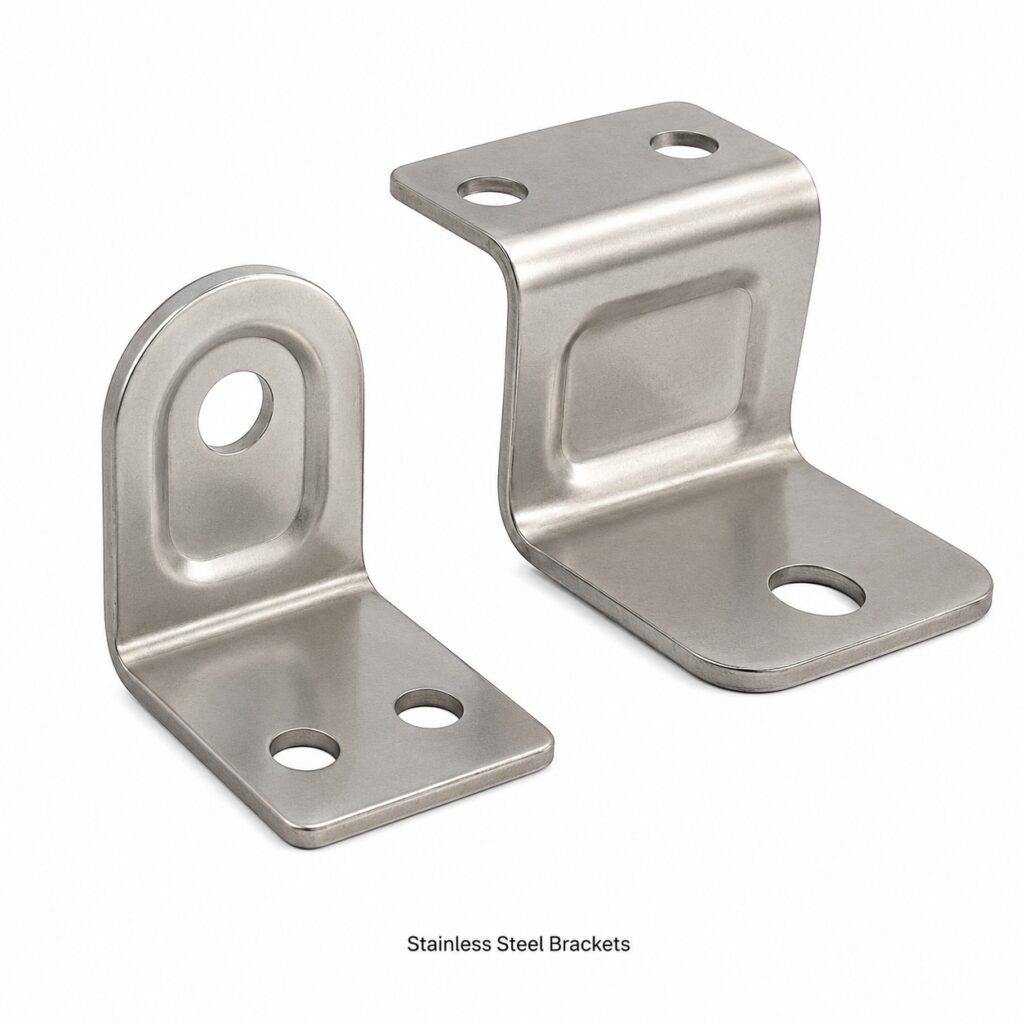
Stainless steel brackets and pressed stainless steel brackets are precision-engineered structural and mounting components manufactured through advanced cold-forming, deep-drawing, and stamping processes. As a global supplier of high-quality stainless steel pressed brackets from India, we deliver components that meet the most demanding specifications in construction, marine, pharmaceutical, food processing, automotive, and industrial sectors. Our pressed stainless steel brackets combine superior corrosion resistance, high mechanical strength, and tight dimensional tolerances to ensure long service life even in aggressive environments.
What Are Pressed Stainless Steel Brackets?
Pressed stainless steel brackets are structural metal components formed by applying controlled compressive force to flat stainless steel sheet stock using precision dies and stamping presses. The cold-forming process induces work hardening, increasing the yield strength of the material beyond its annealed state. These brackets are used for mounting, supporting, fixing, clamping, and connecting structural members across a wide range of industries.
The pressing process allows complex geometries including flanges, ribs, channels, gussets, and embossments to be formed in a single or multi-stage die operation, making pressed brackets highly cost-effective for medium-to-high volume production runs compared to machined alternatives.
Material Alloys for Stainless Steel Brackets — Complete Technical Reference
The selection of stainless steel alloy for pressed brackets is critical and depends on the corrosive environment, mechanical load requirements, temperature range, and fabrication constraints. Below is a comprehensive reference of all major alloys used:
Austenitic Stainless Steel Alloys
- AISI 304 / EN 1.4301 (UNS S30400): The most widely used grade. 18% Cr, 8% Ni. Excellent formability, good corrosion resistance in mild environments. Tensile strength: 515-620 MPa. Yield strength: 205-310 MPa. Elongation: 40%+.
- AISI 304L / EN 1.4307 (UNS S30403): Low-carbon variant, max 0.03% C. Preferred for welded assemblies to avoid sensitisation. Ideal for pressed brackets requiring post-weld operations.
- AISI 316 / EN 1.4401 (UNS S31600): 16-18% Cr, 10-14% Ni, 2-3% Mo. Superior resistance to chloride pitting and crevice corrosion. Essential for marine, offshore, and chemical plant brackets. Tensile strength: 515-690 MPa.
- AISI 316L / EN 1.4404 (UNS S31603): Low-carbon 316. Max 0.03% C. Preferred for welded brackets in corrosive media. Same corrosion resistance as 316 with improved weld integrity.
- AISI 316Ti / EN 1.4571 (UNS S31635): Titanium-stabilised 316. Used for high-temperature applications up to 800 degrees C. Prevents sensitisation in welded structures.
- AISI 321 / EN 1.4541 (UNS S32100): Titanium-stabilised 304. Excellent resistance to sensitisation. Used for brackets in exhaust systems and heat exchangers up to 900 degrees C.
- AISI 310S / EN 1.4845 (UNS S31008): 25% Cr, 20% Ni. Superior high-temperature oxidation resistance up to 1100 degrees C. Used for furnace and kiln brackets.
- AISI 317L / EN 1.4438 (UNS S31703): Higher Mo content (3-4%). Superior chloride resistance for highly aggressive environments.
- Alloy 20 / UNS N08020: 20% Cr, 34% Ni, 2-3% Mo, 3-4% Cu. Exceptional resistance to sulfuric acid. Used in chemical processing brackets.
Ferritic Stainless Steel Alloys
- AISI 430 / EN 1.4016 (UNS S43000): 16-18% Cr, no Ni. Good corrosion resistance, lower cost, magnetic. Used for interior and mild-exposure brackets.
- AISI 409 / EN 1.4512 (UNS S40900): 11% Cr, Ti-stabilised. Automotive-grade. Used for exhaust and underbody brackets.
- AISI 441 / EN 1.4509 (UNS S44100): Nb+Ti stabilised. Good formability, used in appliance and automotive brackets.
- AISI 444 / EN 1.4521 (UNS S44400): 18% Cr, 2% Mo. Elevated chloride resistance. Alternative to 316 for pressed brackets where weldability is less critical.
Duplex and Super Duplex Alloys
- Duplex 2205 / EN 1.4462 (UNS S32205): 22% Cr, 5% Ni, 3% Mo, 0.15% N. Dual austenite-ferrite microstructure. Yield strength ~480 MPa (2x austenitic). Exceptional resistance to chloride stress corrosion cracking. Used for high-load, offshore brackets.
- Super Duplex 2507 / EN 1.4410 (UNS S32750): 25% Cr, 7% Ni, 4% Mo, 0.28% N. PREN above 40. Extreme seawater and sour gas service brackets.
- Lean Duplex LDX 2101 / EN 1.4162 (UNS S32101): Low-nickel duplex. Cost-effective alternative for moderate corrosion environments with higher strength requirement.
Martensitic Alloys
- AISI 410 / EN 1.4006 (UNS S41000): 12% Cr. Hardenable to HRC 40. Used for brackets requiring wear resistance and moderate corrosion resistance.
- AISI 420 / EN 1.4028 (UNS S42000): Higher carbon martensitic. Used for cutlery and hardened brackets.
Precipitation Hardening Grades
- 17-4 PH / EN 1.4542 (UNS S17400): 17% Cr, 4% Ni, 4% Cu. Age-hardened to condition H900: tensile strength up to 1310 MPa. Used for aerospace and high-stress structural brackets where space is limited.
- 15-5 PH / UNS S15500: Improved toughness variant of 17-4 PH. Used for precision aerospace brackets.
Manufacturing Process: How Pressed Stainless Steel Brackets Are Made
- Material Procurement and Certification: Mill-certified coils or sheets procured to EN 10088, ASTM A240, or equivalent standards with full chemical analysis and mechanical property certifications (EN 10204 Type 3.1 or 3.2).
- Blanking and Shearing: Flat blanks cut to precise net dimensions using hydraulic or mechanical presses with hardened tool steel dies. Progressive die blanking achieves +/-0.05 mm tolerance.
- Forming and Pressing: Blanks are cold-formed in single-stage or progressive dies using press forces ranging from 10 to 1000+ tonnes. Work hardening during pressing increases tensile strength by 15-40%.
- Piercing and Punching: Mounting holes, slots, and apertures punched in the same press operation or dedicated punching stations, maintaining positional accuracy to +/-0.1 mm.
- Trimming and Deburring: Edges trimmed to final profile and deburred using vibratory finishing, tumbling, or robotic deburring to achieve edge radius 0.1 mm and Ra 1.6 micron.
- Heat Treatment (if required): Annealing at 1050-1100 degrees C (austenitic grades) relieves press stresses. Solution annealing followed by quenching restores corrosion resistance in sensitised zones.
- Surface Finishing: Electropolishing (to Ra 0.4 micron), passivation per ASTM A967 or AMS 2700, 2B cold-rolled, No. 4 brushed, or mirror-polished (No. 8) finishes applied per customer specification.
- Inspection and Quality Control: CMM dimensional verification, salt spray testing per ASTM B117 (minimum 1000 hours for 316L), dye penetrant inspection, hardness testing per ASTM E18, and PMI using XRF analyser.
Technical Specifications
- Sheet Thickness Range: 0.5 mm to 10 mm
- Dimensional Tolerances: +/-0.05 mm (blanking), +/-0.1 mm (forming), +/-0.15 mm (overall)
- Surface Roughness: Ra 0.4 to 3.2 micron depending on finish specification
- Press Force: 10 T to 1500 T single-action, double-action, and triple-action hydraulic presses
- Minimum Bend Radius: 0.5xT for 304; 1.0xT for 316; 1.5xT for duplex grades
- Maximum Blank Size: 2000 mm x 1000 mm
- Standard Compliance: ISO 9001:2015, EN 10088, ASTM A240, ASME SA240, BS EN ISO 3834
Applications of Pressed Stainless Steel Brackets
- Construction and Architecture: Structural facade brackets, glass curtain wall fixing brackets, balustrade and handrail mounting brackets, underfloor heating support brackets
- Marine and Offshore: Cable tray support brackets, pipe saddle brackets, deckhead mounting brackets, HVAC duct support brackets in saline environments
- Food and Beverage: Conveyor support brackets, tank mounting brackets, hygienic wall brackets, FDA/EC 1935/2004 compliant pressed brackets
- Pharmaceutical: GMP-compliant equipment mounting brackets, clean room hardware brackets to cGMP 21 CFR Part 11 environments
- Automotive and Transport: Exhaust system mounting brackets, fuel line support brackets, chassis stiffening brackets, EV battery tray brackets
- Electronics and Electrical: PCB mounting brackets, cable management pressed brackets, DIN rail mounting brackets, EMI shielding brackets
- Oil and Gas: Instrumentation mounting brackets, subsea clamp and support brackets, pipeline guide and anchor brackets
International Terminology Table
| Term (English) | German | Russian | Spanish | Portuguese | French | Italian |
|---|---|---|---|---|---|---|
| Stainless Steel Brackets | Edelstahlwinkel / Edelstahlkonsolen | Кронштейны из нержавеющей стали | Escuadras de acero inoxidable | Suportes de aco inoxidavel | Equerres en acier inoxydable | Staffe in acciaio inossidabile |
| Pressed Stainless Steel Brackets | Gepresste Edelstahlwinkel | Прессованные кронштейны из нержавейки | Escuadras de acero inoxidable prensado | Suportes prensados de aco inoxidavel | Equerres embouties en acier inoxydable | Staffe pressate in acciaio inossidabile |
| Stamped Brackets | Gestanzte Winkel | Штампованные кронштейны | Escuadras estampadas | Suportes estampados | Equerres embouties | Staffe stampate |
| Sheet Metal Brackets | Blechwinkel / Blechkonsolen | Кронштейны из листового металла | Escuadras de chapa metalica | Suportes de chapa metalica | Equerres en tole metallique | Staffe in lamiera metallica |
| Cold Formed Brackets | Kaltgeformte Winkel | Кронштейны холодной штамповки | Escuadras formadas en frio | Suportes conformados a frio | Equerres formees a froid | Staffe formate a freddo |
| Mounting Brackets | Montagekonsolen / Haltewinkel | Монтажные кронштейны | Escuadras de montaje | Suportes de montagem | Equerres de montage | Staffe di montaggio |
| Structural Brackets | Strukturkonsolen / Tragwinkel | Несущие кронштейны | Escuadras estructurales | Suportes estruturais | Equerres structurelles | Staffe strutturali |
| Corrosion Resistant Brackets | Korrosionsbestandige Winkel | Коррозионностойкие кронштейны | Escuadras resistentes a la corrosion | Suportes resistentes a corrosao | Equerres resistantes a la corrosion | Staffe resistenti alla corrosione |
Frequently Asked Questions
Q1: What is the difference between a stamped and a pressed stainless steel bracket?
A: The terms are largely interchangeable in practice. Stamping typically refers to high-speed blanking, punching, and forming operations on thin sheet (up to 3 mm) using progressive or compound dies in mechanical presses. Pressing is a broader term that includes both cold stamping and heavier forming operations on thicker sheet (up to 10 mm) using hydraulic presses. Both processes result in brackets formed without material removal, relying instead on plastic deformation.
Q2: Which stainless steel grade is best for outdoor architectural brackets?
A: For coastal and urban atmospheric exposure, AISI 316 (EN 1.4401) or 316L (EN 1.4404) is recommended due to its molybdenum content (2-3%), which enhances resistance to chloride-induced pitting. In highly aggressive coastal zones (within 500m of the sea), super duplex 2507 or EN 1.4410 should be considered. For inland environments, AISI 304 (EN 1.4301) is cost-effective and performs well.
Q3: Can pressed stainless steel brackets be electropolished?
A: Yes. Electropolishing is a recommended post-processing step that removes the Beilby layer and micro-roughness, producing a chromium-rich passive film with surface roughness Ra 0.4 micron or less. This is especially important for pharmaceutical, food-grade, and cleanroom brackets where biofilm accumulation must be minimised. Electropolishing improves corrosion resistance by 30-50% compared to mechanically polished surfaces.
Q4: What minimum wall thickness is achievable when pressing stainless steel brackets?
A: For standard pressed brackets, minimum sheet thickness is typically 0.5 mm for 304 and 316 grades. Very thin-walled brackets (0.3-0.5 mm) can be achieved using precision micro-stamping with hardened D2 or PM HSS dies, but formability decreases as thickness decreases. The minimum bend radius is 0.5xT for 304 and 1.0xT for duplex grades.
Q5: What certifications should pressed stainless steel brackets carry for use in the EU?
A: For structural applications, EN 1090-1 (CE marking for structural steel components) applies. Food contact applications require EC 1935/2004 compliance. Marine hardware may require DNV GL, Bureau Veritas, or Lloyds Register approval. General manufacturing quality is certified under ISO 9001:2015. Material certificates should be EN 10204 Type 3.1 (mill certificates) or 3.2 (third-party verified).
Q6: How are pressed stainless steel brackets joined to structures?
A: Pressed stainless steel brackets are joined using: (1) mechanical fasteners – A2 or A4 stainless steel bolts/screws per ISO 3506; (2) welding – TIG/GTAW preferred for austenitic grades, with 308L filler for 304, 316L filler for 316; (3) adhesive bonding using structural epoxy or MS polymer for facade applications; (4) riveting using stainless steel blind rivets. Galvanic isolation is essential when connecting to carbon steel structures.
Q7: What is the maximum temperature for AISI 316 pressed brackets in service?
A: AISI 316 has a continuous service temperature limit of 870 degrees C in oxidising atmospheres and 925 degrees C intermittently. However, sensitisation (chromium carbide precipitation at grain boundaries) occurs between 425-860 degrees C with prolonged exposure. For elevated-temperature bracket applications, 316Ti (1.4571) or 321 (1.4541) with titanium stabilisation should be specified.
Q8: Are pressed stainless steel brackets suitable for cryogenic applications?
A: Yes. Austenitic stainless steels retain excellent impact toughness and ductility at cryogenic temperatures down to -196 degrees C (liquid nitrogen service) and even -269 degrees C (liquid helium). The face-centred cubic (FCC) crystal structure of austenitic grades does not undergo ductile-to-brittle transition, making them ideal for LNG, LPG, and cryogenic storage bracket applications. Charpy impact values typically exceed 100 J at -196 degrees C.
Why Choose Our Pressed Stainless Steel Brackets from India?
- ISO 9001:2015 certified manufacturing facility with full in-house tooling and die manufacturing
- Export experience to 45+ countries including USA, Germany, UK, Australia, UAE, Singapore
- Annual production capacity exceeding 500 metric tonnes of pressed stainless steel components
- Full material traceability with EN 10204 Type 3.1 mill test certificates
- Short lead times: 2-4 weeks for standard brackets, 4-8 weeks for complex tooled parts
- Competitive pricing: 30-50% cost advantage over European and North American suppliers
- Custom tooling developed in-house with no third-party tooling costs passed to customers
Get a Quote for Pressed Stainless Steel Brackets
Looking for a reliable manufacturer and exporter of pressed stainless steel brackets from India? We supply to OEM manufacturers, engineering contractors, and industrial distributors worldwide. Whether you need standard L-brackets in 316L or complex multi-bend structural brackets in duplex 2205, our team is ready to assist.
Contact us today with your drawing, specification, or sample. We offer free DFM (Design for Manufacturability) review, competitive tooling quotes, and fast sample delivery. Request your quote now and receive a detailed techno-commercial proposal within 24 hours.
We supply pressed stainless steel brackets to industries in Germany, USA, UK, Australia, Canada, UAE, Singapore, Netherlands, Italy, France, and 40+ other countries.