
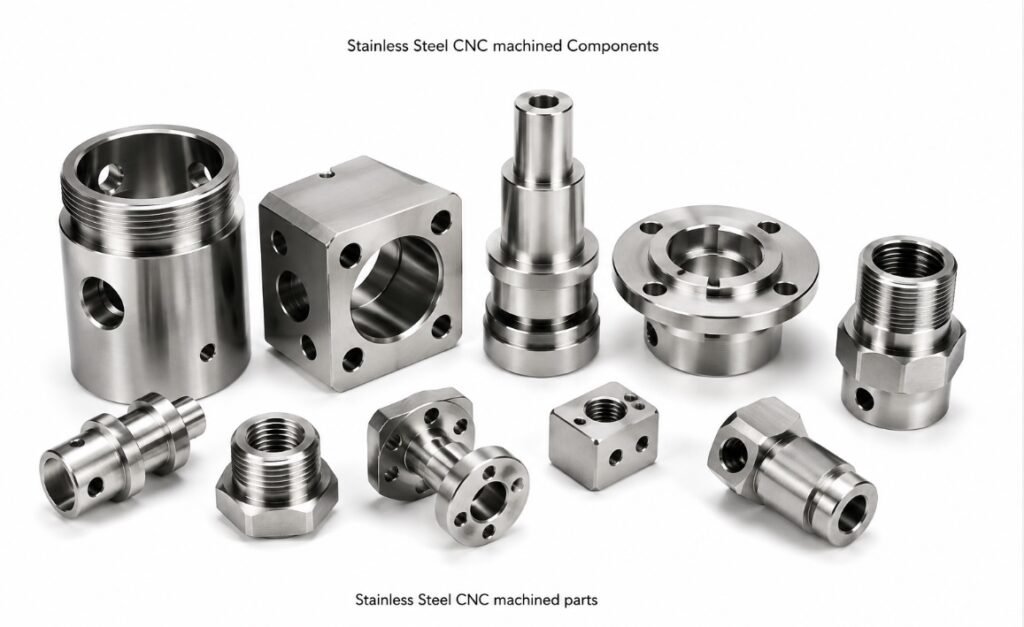
Stainless steel CNC machining is one of the most precise and reliable manufacturing methods used in modern industrial production. Whether you are producing custom components for the aerospace, automotive, pharmaceutical, or oil & gas industry, CNC (Computer Numerical Control) machining of stainless steel offers unmatched dimensional accuracy, surface finish, and repeatability. This complete guide covers everything you need to know about stainless steel CNC machining — from material grades and machining challenges to applications, tolerances, and why SSP is your trusted manufacturing partner.
What Is Stainless Steel CNC Machining?
CNC machining is a subtractive manufacturing process in which computer-controlled cutting tools remove material from a solid stainless steel billet or bar stock to produce a finished part. The process is guided by a CAD (Computer-Aided Design) model translated into CNC program code (G-code), which precisely controls the movement of the cutting tools.
For stainless steel, CNC machining encompasses a range of operations including turning, milling, drilling, boring, tapping, and grinding. Each process can be performed on advanced multi-axis CNC machines that allow complex geometries to be produced in a single setup, minimising errors and lead times.
Common Stainless Steel Grades Used in CNC Machining
Not all stainless steel grades machine the same way. The choice of grade has a significant impact on tool wear, surface finish, and overall machining efficiency. Below are the most widely used grades in precision CNC machining:
- SS 303 – The most machinable austenitic stainless steel, containing added sulphur for improved chip breaking. Ideal for screws, bolts, nuts, and fittings.
- SS 304 / 304L – The most commonly used stainless steel globally. Good corrosion resistance and formability. Widely used in food processing, medical, and general engineering parts.
- SS 316 / 316L – Contains molybdenum for superior resistance to chlorides and marine environments. Preferred for pharmaceutical, chemical, and marine applications.
- SS 410 / 420 – Martensitic grades offering high hardness and wear resistance. Used for valves, pumps, and cutlery.
- SS 430 – Ferritic grade with moderate corrosion resistance. Used in automotive trim and decorative applications.
- Duplex SS 2205 – Combines properties of austenitic and ferritic steel. High strength and excellent resistance to stress corrosion cracking. Ideal for oil & gas and petrochemical equipment.
Key Challenges in Machining Stainless Steel
Stainless steel is inherently difficult to machine compared to mild steel or aluminium. Understanding these challenges is key to achieving precision results:
- Work Hardening – Austenitic grades like 304 and 316 tend to harden rapidly during cutting. Incorrect feeds and speeds can lead to tool chipping and a poor surface finish.
- Heat Generation – Stainless steel has low thermal conductivity, meaning heat generated during cutting is concentrated at the cutting edge rather than dissipated into the chip. This accelerates tool wear significantly.
- Built-Up Edge (BUE) – The tendency for workpiece material to adhere to the cutting tool, affecting surface finish and dimensional accuracy.
- Tool Wear – High cutting forces and heat require the use of high-quality carbide or coated tooling with appropriate geometry.
- Vibration and Chatter – Improper fixturing or cutting parameters can result in vibration, reducing surface quality and part accuracy.
SSP overcomes these challenges through decades of experience, advanced multi-axis CNC machining centres, high-performance cutting tools, and optimised machining parameters for each stainless steel grade.
CNC Machining Processes for Stainless Steel
CNC Turning
In CNC turning, the stainless steel workpiece rotates while a stationary cutting tool removes material to create cylindrical shapes. Used for manufacturing shafts, pins, bushings, fittings, and threaded components. Multi-spindle and Swiss-type CNC lathes are used for high-volume precision parts.
CNC Milling
CNC milling involves rotating cutting tools removing material from a fixed workpiece. It is used to produce flat surfaces, slots, pockets, complex contours, and holes. 3-axis, 4-axis, and 5-axis CNC milling machines are used depending on component complexity.
CNC Drilling and Tapping
High-precision drilling produces holes with tight tolerances, while tapping creates internal threads. Both processes are routinely performed as part of a complete CNC machining cycle on machining centres.
CNC Grinding
Grinding is used for parts that require very tight dimensional tolerances (±0.001 mm) and superior surface finishes. Used after rough machining to achieve the final dimensions on critical components.
CNC Swiss Machining
Swiss-type CNC lathes are ideal for producing long, slender precision components in large volumes with exceptional accuracy. Widely used for medical implants, instrumentation components, and miniature hydraulic parts.
Tolerances and Surface Finish
CNC machining of stainless steel can achieve exceptional dimensional accuracy and surface quality, making it suitable for the most demanding engineering applications:
- Standard tolerances: ±0.05 mm to ±0.1 mm
- Precision tolerances: ±0.01 mm to ±0.02 mm
- High-precision tolerances: ±0.001 mm (with grinding)
- Surface finish (Ra): 0.4 µm to 3.2 µm as-machined; down to 0.1 µm with polishing or grinding
SSP routinely manufactures components to tight tolerances for customers in the USA, UK, Germany, Australia, and other precision-demanding markets.
Applications of Stainless Steel CNC Machined Parts
Stainless steel CNC machined components are used across a wide range of industries due to their strength, corrosion resistance, and precision:
- Oil & Gas: Valve bodies, manifolds, connectors, tube fittings, pump components
- Pharmaceutical & Food Processing: Hygienic fittings, sanitary clamps, impellers, mixing components
- Automotive: Precision shafts, sensor housings, brackets, fasteners
- Aerospace: Structural brackets, hydraulic fittings, fasteners in SS 316 and duplex grades
- Marine: Deck hardware, underwater connectors, pump parts in SS 316L
- Medical Devices: Surgical instrument components, implant parts, diagnostic equipment housings
- General Engineering: Custom machine components, jigs, fixtures, and tooling
Post-Machining Finishes for Stainless Steel
After CNC machining, stainless steel components can undergo various surface treatments to enhance appearance, corrosion resistance, or functional performance:
- Passivation – Removes free iron and contaminants, restoring the natural chromium oxide passive layer for maximum corrosion resistance (per ASTM A967 / AMS 2700).
- Electropolishing – Electrochemical process that smooths and brightens the surface, improves corrosion resistance, and removes burrs. Ideal for pharmaceutical and food-grade components.
- Bead Blasting – Produces a uniform matte or satin finish, widely used in decorative and architectural applications.
- Mirror Polishing – Achieves a bright, reflective finish for premium aesthetic applications.
- PVD Coating – Applied for decorative colour finishes with improved surface hardness.
Quality Control in Stainless Steel CNC Machining
Precision CNC machining demands rigorous quality control throughout the manufacturing process. At SSP, our quality assurance programme includes:
- Incoming raw material inspection with material test reports (MTRs)
- In-process dimensional inspection using CMM (Coordinate Measuring Machine), micrometers, and gauges
- Final inspection with full dimensional reports
- Surface roughness measurement
- Thread gauging for all threaded features
- Documentation in accordance with ISO 9001 quality management standards
Why Choose SSP for Stainless Steel CNC Machined Components?
With over 25 years of manufacturing experience, SSP (Stainless Steel Fittings India) is a trusted manufacturer and exporter of precision stainless steel CNC machined components for global OEM and industrial customers. Here is what sets us apart:
- In-House CNC Machining Facility – Modern multi-axis CNC turning and milling centres for complete control over quality and lead times.
- Full Range of SS Grades – Capability to machine SS 304, 316, 316L, 303, 410, 420, 430, Duplex 2205, and other special alloys.
- Export-Quality Manufacturing – Supplying precision components to customers in the USA, UK, Germany, Australia, France, Canada, and across Europe and the GCC.
- Custom Component Manufacturing – From prototypes to high-volume production runs based on customer drawings and specifications.
- Competitive Pricing – Indian manufacturing cost advantages combined with world-class quality standards.
- Fast Quotation – Submit your drawings and receive a competitive quote within 24–48 hours.
Conclusion
Stainless steel CNC machining is the preferred method for producing precision components that demand tight tolerances, excellent surface finish, and reliable performance in demanding environments. From SS 304 food-grade fittings to SS 316L pharmaceutical components and duplex steel oil & gas parts, CNC machining delivers the versatility and accuracy that modern engineering applications require.
SSP brings together decades of expertise, advanced machining technology, and a commitment to quality to deliver precision stainless steel CNC machined components that meet your exact specifications. Contact us today with your drawings and requirements for a fast, competitive quotation.
SS 316 vs SS 304: Which Grade Is Right for Your Application?
One of the most common questions in precision CNC machining is whether to choose SS 316 or SS 304 for a given application. While both are austenitic stainless steel grades widely used in manufacturing, they differ significantly in performance, cost, and machinability.
SS 316 contains 2–3% molybdenum, which gives it outstanding resistance to chlorides, acids, and marine environments. This makes it the preferred choice for pharmaceutical equipment, offshore marine hardware, chemical processing parts, and medical implants. SS 304, on the other hand, offers good corrosion resistance at a lower cost and is more easily machined, making it ideal for food processing equipment, architectural components, and general engineering parts that do not face aggressive chemical exposure.
From a machinability standpoint, SS 304 typically rates at 45–55% relative machinability compared to free-cutting steel, while SS 316 falls slightly lower at 35–45%. The higher nickel and molybdenum content in 316 makes it somewhat more challenging to cut — it work-hardens more aggressively and generates more heat at the cutting zone. This means slower cutting speeds, more frequent tool changes, and higher tooling costs when machining SS 316 compared to SS 304.
In practical terms, if your component will operate in a harsh, chloride-rich or acidic environment — such as a coastal facility, a pharmaceutical clean room, or a chemical processing plant — SS 316 or SS 316L is the correct choice despite its higher cost and machining complexity. For less demanding environments, SS 304 offers excellent value with easier machinability.
Expert Tips for Machining SS 316 Successfully
SS 316 and SS 316L present unique challenges that require specific machining strategies to achieve precision results, manage tool wear, and keep costs under control. Based on decades of experience machining stainless steel components, here are the key techniques that make the difference:
Tool Selection
For SS 316, carbide tools significantly outperform high-speed steel (HSS). Cobalt-enriched carbide grades with coatings such as TiAlN (Titanium Aluminium Nitride) or AlTiN (Aluminium Titanium Nitride) provide the best results by reducing friction and improving heat resistance at the cutting edge. Sharp cutting edges with positive rake angles are essential to minimise work hardening by ensuring the tool cuts cleanly through the material rather than rubbing against it. Variable-helix end mills designed specifically for austenitic stainless steels help reduce chatter and improve chip evacuation during milling operations.
Cutting Parameters
Correct cutting parameters are critical when machining SS 316. Cutting speeds should be kept approximately 30–40% lower than those used for carbon steel to prevent rapid work hardening. Feed rates must be maintained at a consistent, moderate level — feeding too slowly causes rubbing and excessive heat, while too fast a feed risks tool breakage. Deeper cuts are generally preferable to shallow ones, as this ensures the cutting edge engages below the work-hardened surface layer from the previous pass. Maintaining adequate chip load is equally important to prevent the tool from merely rubbing the surface and generating heat without cutting effectively.
Coolant Strategy
Effective coolant application is non-negotiable when machining SS 316. High-pressure coolant directed precisely at the cutting edge helps to break chips, reduce temperatures, and flush away swarf before it re-welds to the workpiece surface. Oil-based coolants are preferred for heavy roughing operations, while water-soluble coolants with corrosion inhibitors work well for general machining and finishing passes. Minimum Quantity Lubrication (MQL) systems can also be effective for semi-finishing and finishing operations, reducing coolant consumption while maintaining good surface quality.
Managing Work Hardening
Work hardening is one of the most significant challenges when machining austenitic stainless steels such as SS 316. The material hardens rapidly when subjected to cutting forces, particularly if the tool is allowed to dwell or rub rather than cut. To minimise work hardening, always use sharp tools, maintain consistent feed rates without pausing mid-cut, and take deeper cuts rather than multiple shallow passes over the same area. When using a worn tool, the increased cutting forces accelerate work hardening — so regular tool inspection and replacement are essential for maintaining dimensional accuracy and surface quality.
Optimal Depth of Cut for SS 316 Precision Machining
Managing the depth of cut is a critical element of precision machining for SS 316 stainless steel. The recommended depth of cut varies depending on the operation being performed:
- Roughing operations: 1.0–3.0 mm depth of cut — optimised for efficient material removal while managing cutting forces.
- Semi-finishing operations: 0.3–0.8 mm depth of cut — balances removal rate with dimensional accuracy.
- Finishing operations: 0.1–0.3 mm depth of cut — minimises tool deflection and maximises surface finish quality.
Multiple light passes during finishing often yield better dimensional accuracy and surface finish than fewer heavy cuts. Constant engagement strategies — where the tool maintains a consistent contact arc with the material — help keep cutting forces stable and reduce the risk of chatter and deflection that can compromise part accuracy.
Surface Finish Options for Stainless Steel CNC Machined Parts
CNC machining of stainless steel can achieve a wide range of surface finishes depending on the application requirements. The surface finish directly affects the component’s functional performance, corrosion resistance, and appearance — and each finishing option carries a different cost implication. It is important to specify the minimum surface roughness that meets your functional requirements rather than automatically demanding the finest finish, as unnecessary precision drives up machining time and cost.
As-machined finishes typically range from Ra 0.8 µm to Ra 3.2 µm depending on the cutting parameters, tooling, and operation type. For many structural and mechanical components, an as-machined finish is entirely adequate. Where appearance or hygienic requirements demand a finer surface, post-machining finishing operations can be applied:
- Passivation – Removes free iron and surface contaminants, restoring the chromium oxide passive layer for maximum corrosion resistance. Standard for SS 316 pharmaceutical and food-grade components per ASTM A967 or AMS 2700.
- Electropolishing – An electrochemical process that smooths, brightens, and deburrs the surface simultaneously, improving corrosion resistance and producing a finish as fine as Ra 0.1 µm. Widely used for pharmaceutical, food processing, and medical device components.
- Bead Blasting – Produces a uniform matte or satin finish with good corrosion resistance. Commonly specified for decorative, architectural, and general industrial components.
- Mirror Polishing – Mechanical polishing to achieve a highly reflective finish. Used for premium architectural and consumer-facing components.
- Barrel Tumbling – Rounds sharp edges and produces a smooth, consistent surface over high volumes of small parts. Cost-effective for batch processing of fasteners, fittings, and connectors.
Cost Comparison: SS 316 vs Other Common Engineering Alloys
Understanding the cost drivers for SS 316 CNC machining helps engineers and procurement teams make informed material decisions. Several factors contribute to the higher cost of SS 316 compared to other commonly machined materials:
- Raw material cost – SS 316 contains significant quantities of nickel and molybdenum, both of which are relatively expensive alloying elements. This places SS 316 at a higher material cost than SS 304 or mild steel.
- Machinability – With a relative machinability index of approximately 35–45% compared to free-cutting steel (rated at 100%), SS 316 requires slower cutting speeds, more frequent tool changes, and higher-specification tooling. These factors add to machining time and tooling costs.
- Work hardening behaviour – The tendency of SS 316 to work harden during cutting means that improper machining parameters can rapidly destroy tooling, further increasing costs.
Despite its higher upfront cost, SS 316 frequently delivers a lower total cost of ownership in demanding applications. Its extended service life, reduced maintenance requirements, and superior resistance to corrosion and chemical attack mean that the investment in SS 316 components pays for itself over time — particularly in marine, pharmaceutical, chemical processing, and food industry applications where component failure or contamination carries significant financial or regulatory consequences.
Ensuring Precision and Dimensional Accuracy in SS 316 Machined Components
Achieving and maintaining tight dimensional tolerances in SS 316 machining requires a disciplined approach to every stage of the manufacturing process — from raw material selection through to final inspection. The following best practices form the foundation of precision SS 316 component manufacturing at SSP:
- Rigid workholding – Secure, vibration-free fixturing is essential. Any movement of the workpiece during cutting translates directly into dimensional errors and surface quality problems.
- Machine rigidity – High-precision CNC machining centres with minimal spindle runout and rigid construction are necessary to maintain tolerances during SS 316 machining.
- Thermal management – Heat buildup in SS 316 causes dimensional expansion during machining. Controlled coolant application and allowing the workpiece to reach a stable temperature before final measurements help maintain accuracy.
- In-process measurement – Regular dimensional checks using calibrated gauges, micrometers, and CMM (Coordinate Measuring Machine) equipment during production allow deviations to be detected and corrected before they affect the entire batch.
- Tool condition monitoring – Worn or damaged cutting tools are a primary cause of dimensional drift in stainless steel machining. Systematic tool life management and proactive replacement ensure consistent results across production runs.
SSP’s quality management system, aligned with ISO 9001, integrates these controls throughout the production process — from incoming raw material inspection with material test reports (MTRs) through to final dimensional and surface finish inspection with full documentation.