High Quality Stainless Steel 316 Stampings from India
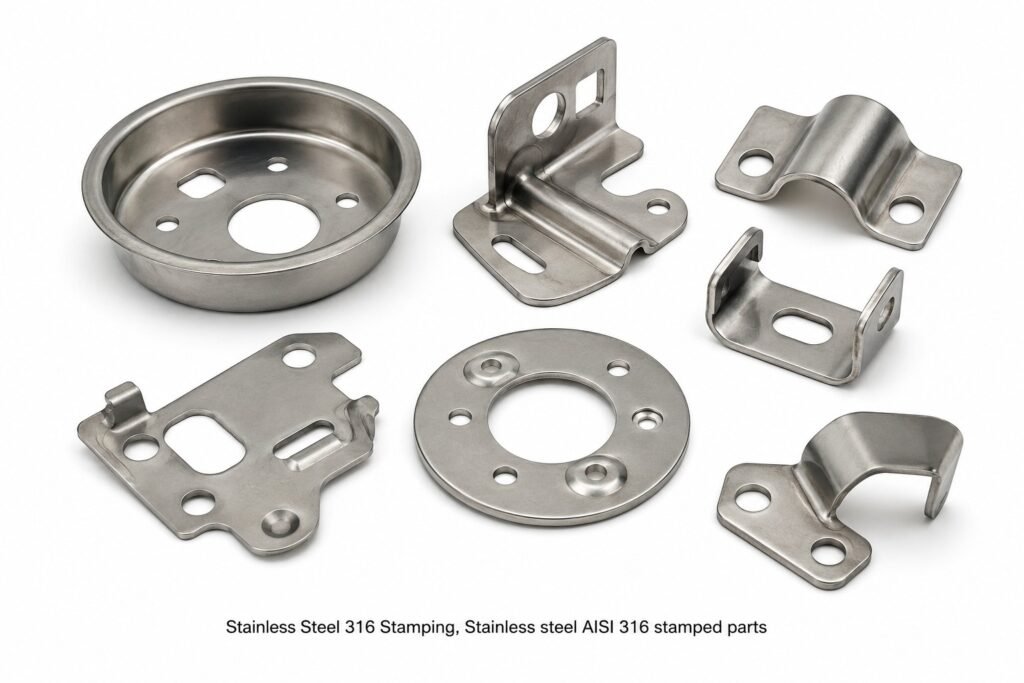
Stainless Steel 316 stamping is one of the most technically demanding cold-forming processes in precision metalworking. As a molybdenum-bearing austenitic stainless steel, AISI 316 offers exceptional resistance to chloride-induced pitting corrosion, elevated-temperature oxidation, and intergranular attack — properties that make it the alloy of choice for stamped components deployed in marine, chemical processing, pharmaceutical, automotive, electrical, and hydraulic applications. This comprehensive guide covers every dimension of SS 316 stamping: material science, international equivalents, stamping process engineering, tooling technology (compound dies and progressive dies), industry-specific applications, quality standards, and how to source high-end stamped parts from India’s leading manufacturer.
What Is Stainless Steel 316 Stamping?
Metal stamping is a cold-working manufacturing process that uses dies and presses to transform flat sheet metal or coil stock into finished or semi-finished parts. When the base material is AISI 316 stainless steel, the process is referred to as Stainless Steel 316 Stamping. Operations encompass blanking, piercing, bending, drawing, forming, coining, embossing, and trimming — all executed at room temperature using progressive, compound, or transfer die systems.
The molybdenum content (2–3%) that distinguishes SS 316 from the more common SS 304 also makes it work-harder more aggressively, which places rigorous demands on press tonnage selection, lubrication strategy, die clearances, and punch/die material selection. Properly engineered SS 316 stampings deliver dimensional tolerances as tight as ±0.01 mm, surface finishes of Ra 0.4–0.8 µm, and mechanical properties that surpass those of cast or machined equivalents due to the grain-refinement benefits of cold working.
AISI 316 Material Specifications
Understanding the metallurgy of AISI 316 is fundamental to designing reliable stamped components. The table below summarises the key chemical and mechanical data:
Chemical Composition (Weight %)
| Element | Min % | Max % |
|---|---|---|
| Chromium (Cr) | 16.00 | 18.00 |
| Nickel (Ni) | 10.00 | 14.00 |
| Molybdenum (Mo) | 2.00 | 3.00 |
| Carbon (C) | — | 0.08 |
| Manganese (Mn) | — | 2.00 |
| Silicon (Si) | — | 0.75 |
| Phosphorus (P) | — | 0.045 |
| Sulfur (S) | — | 0.030 |
| Nitrogen (N) | — | 0.10 |
| Iron (Fe) | Balance | Balance |
Mechanical Properties (Annealed Condition)
| Property | Value | Unit |
|---|---|---|
| Tensile Strength (UTS) | 515 min | MPa |
| Yield Strength (0.2% Proof) | 205 min | MPa |
| Elongation (50 mm gauge) | 40 min | % |
| Hardness (Brinell) | 217 max | HBW |
| Hardness (Rockwell B) | 95 max | HRB |
| Hardness (Vickers) | 220 max | HV |
| Modulus of Elasticity | 193 | GPa |
| Density | 8.0 | g/cm³ |
| Thermal Conductivity (100°C) | 16.3 | W/m·K |
| Coefficient of Thermal Expansion | 15.9 | µm/m·°C (0–100°C) |
| Specific Heat Capacity | 500 | J/kg·K |
| Electrical Resistivity | 74 | µΩ·cm |
Physical and Corrosion Characteristics
SS 316 achieves a pitting resistance equivalent number (PREN) of approximately 23–26, calculated as PREN = %Cr + 3.3×%Mo + 16×%N. The molybdenum addition stabilises the passive oxide film against chloride attack, making SS 316 stampings suitable for direct seawater exposure, chlorinated environments, and body-implantable devices. The alloy is non-magnetic in the annealed state, though cold working during stamping can induce a slight ferromagnetic response due to strain-induced martensite formation — a factor that must be considered in electrical and MRI-adjacent applications.
International Standard Equivalents for AISI 316
Global procurement requires cross-referencing AISI 316 across multiple national and international standards. The following equivalences are widely accepted in engineering practice:
| Standard Body | Designation | Common Name |
|---|---|---|
| AISI / ASTM (USA) | 316 / S31600 | Type 316 |
| EN / DIN (Europe) | 1.4401 | X5CrNiMo17-12-2 |
| EN / DIN (Low Carbon) | 1.4404 | X2CrNiMo17-12-2 (316L equiv.) |
| BS (United Kingdom) | 316S31 | — |
| JIS (Japan) | SUS316 | — |
| GB / GB/T (China) | 0Cr17Ni12Mo2 | — |
| IS (India) | IS 6911 Grade 316 | — |
| GOST (Russia) | 03Kh17N14M3 | — |
| NF (France) | Z6CND17-11 | — |
| SS (Sweden) | 2347 | — |
| UNS | S31600 | — |
When sourcing SS 316 stamped parts internationally, always request mill test certificates (MTCs) per EN 10204 3.1 or 3.2, referencing the applicable UNS or DIN designation to avoid grade substitutions.
Available Forms for SS 316 Stamping Stock
Stamping operations begin with properly specified input stock. For Stainless Steel 316 stamping, the following forms are commonly used:
- Cold Rolled Sheet (CR) — 2B or BA Finish: Thickness range 0.3 mm to 6.0 mm. The 2B finish (bright anneal + skin pass) offers good formability and uniform surface for further finishing. BA (bright annealed) finish is preferred for decorative and medical parts.
- Hot Rolled Plate (HR) — No. 1 Finish: Thickness 3 mm to 12 mm, used for heavy-duty stampings requiring high structural integrity.
- Precision Slit Coil Stock: Width tolerance ±0.05 mm, used in progressive die stamping lines for high-volume production. Coil OD up to 1500 mm, weight up to 5 tonnes.
- Strip Steel: Narrow cold-rolled strip, width 5 mm to 650 mm, for fine blanking and micro-stamping operations.
The Stamping Process: Step-by-Step Engineering Overview
1. Part Design and DFM Analysis
Design for Manufacturability (DFM) analysis is the critical first step. Engineers evaluate bend radii (minimum 1.0×t for 316 to prevent cracking), hole-to-edge distances (minimum 1.5×t), draw ratios (limiting draw ratio of ~1.8–2.0 for 316), and springback compensation requirements. FEA simulation using software such as AutoForm or Dynaform predicts thinning, wrinkling, and fracture risk before any tooling is cut.
2. Blank Development
The flat blank shape is calculated using CAD unfolding algorithms accounting for k-factor (typically 0.40–0.45 for 316 in 90° bends). Precise blank development minimises material scrap and prevents edge cracking during deep drawing.
3. Tooling Design
For SS 316, die clearance (per side) is set at 5–8% of material thickness, slightly higher than for mild steel, to reduce galling and punch wear. Punch and die materials are selected from D2 tool steel (HRC 60–62), PM-HSS, or cemented tungsten carbide (TiCN-coated) for high-volume runs. Die sets are mounted on precision ball-cage guide pillars for parallelism within 0.005 mm.
4. Press Selection and Tonnage Calculation
Blanking force is calculated as F = L × t × UTS, where L is the shear perimeter, t is thickness, and UTS is the ultimate tensile strength of the material (≥515 MPa for 316). A 20–30% safety factor is applied. Progressive dies for complex SS 316 parts typically require presses in the 80–400 tonne range, operating at 40–200 strokes per minute depending on part complexity and material gauge.
5. Lubrication
Austenitic stainless steel is prone to galling, adhesive wear, and built-up edge (BUE) during cold forming. High-pressure EP (extreme pressure) chlorine-free lubricants, drawn-quality mineral oils with sulphur-based additives, or PTFE-based dry-film lubricants are applied to both blank surfaces. Lubricant selection must consider downstream cleaning requirements, especially for food-contact, pharmaceutical, or welded assemblies.
6. Stamping Operations
Individual operations may include blanking (shearing the outline), piercing (creating holes), lancing, notching, bending (V-die, wipe, rotary), deep drawing, ironing, embossing, coining, thread forming (without cutting), and trimming. Multi-stage progressive dies combine these in a single tool, while compound dies perform blanking and piercing simultaneously in one press stroke.
7. Post-Stamping Operations
Typical finishing steps include deburring (vibratory, electrochemical, or laser), passivation per ASTM A967 (nitric acid or citric acid treatment to restore the chromium-oxide passive layer), pickling, electropolishing (for Ra <0.2 µm), and precision straightening or sizing. Thread tapping, spot welding, and riveting are also commonly performed as secondary operations.
Compound Dies for SS 316 Stamping
A compound die is a single-station tooling configuration that performs two or more cutting operations — most commonly blanking and piercing — simultaneously in a single press stroke. This makes compound dies extremely efficient for producing flat, multi-hole stampings with high dimensional accuracy and excellent flatness, as the blank is held under compression during both operations.
Engineering Advantages of Compound Dies
In a compound die, the outer punch (which forms the blank outer profile) is actually an inverted die — the blanking action occurs from the bottom, while piercing punches work from the top. This inverted geometry results in a flat, burr-minimised part with hole positions held to ±0.01 mm relative to the outer profile. For SS 316, compound dies are particularly advantageous because the simultaneous shearing action reduces the net load on individual cutting edges compared to tandem operations, extending die life in the hard, work-hardening material.
Compound dies are preferred for SS 316 stampings requiring tight hole-to-edge tolerances, gaskets, terminal blanks, electrical contacts, shims, valve plates, and hydraulic orifice discs. Die materials for compound tooling in SS 316 typically consist of D2 steel or PM-M4 HSS punches and inserts with TiCN or TiAlN PVD coatings to resist the adhesive wear tendencies of the austenitic matrix.
Compound Die Design Parameters for SS 316
Critical design parameters include: punch-to-die clearance of 6–8% per side for material thicknesses from 0.5 to 3.0 mm; stripping force calculated at 10–15% of blanking force due to the tendency of 316 to grip punch surfaces; die block hardness of HRC 60–64; punch hardness of HRC 62–64; die plate material of D2 or carbide; and stripper plate with precision guide bushings to maintain punch alignment under lateral loading.
Progressive Tooling for High-Volume SS 316 Stamping
Progressive die stamping is the workhorse technology for high-volume, high-precision SS 316 stamped parts. In a progressive die, coil stock is fed through a series of stations — each performing a specific operation — in a single tool mounted in one press. Each press stroke advances the strip by a fixed pitch (the feed length), and at the final station, the finished part is separated from the carrier strip.
Progressive Die Stations for SS 316 Parts
A typical progressive die for a complex SS 316 hydraulic bracket might include the following station sequence: pilot hole piercing (for precise strip feeding), outer profile notching, internal hole piercing, bending station one (form flange), bending station two (final angle), embossing or coining, and final cutoff/blanking. Strip widths may range from 20 mm for small electrical contacts to 500 mm for automotive structural brackets.
Feed System and Strip Control
Servo-driven electronic feeders with closed-loop pitch control maintain feed accuracy to ±0.02 mm per stroke. Pilot pins engage precision pierced holes in the strip at each station, compensating for any accumulated feed error. In-die sensors monitor strip height, pilot force, and breakage — critical for unmanned high-speed production of SS 316 parts where undetected misfeeds can destroy expensive tooling.
Progressive Die Life for SS 316
Due to SS 316’s work-hardening behaviour, progressive die life is typically 30–50% shorter than for equivalent 304 stampings, which in turn run harder than mild steel. With coated PM-HSS or carbide tooling and consistent lubrication management, well-maintained progressive dies achieve 500,000 to 2,000,000+ strokes for blanking/piercing operations in material up to 2 mm thick. Fine blanking dies for SS 316 in hydraulic spool valve components may require carbide inserts and run at 20,000–50,000 parts per die set before regrinding.
Industry Applications of SS 316 Stamped Parts
Automotive Industry
The automotive sector increasingly specifies SS 316 stampings for exhaust system brackets, EGR (exhaust gas recirculation) valve components, fuel injection system clips and retainers, sensor housings, turbocharger heat shields, and catalytic converter internal supports. The combination of high-temperature oxidation resistance (continuous service to 870°C), vibration fatigue strength, and corrosion resistance in road-salt environments makes SS 316 the premium choice over mild steel or even SS 304 for underbody and powertrain stampings. Progressive die stampings for automotive applications undergo 100% in-line vision inspection, statistical process control (SPC) charting of critical dimensions, and PPAP (Production Part Approval Process) documentation per IATF 16949.
Electrical and Electronics Industry
SS 316 stampings are extensively used in electrical switchgear, busbar supports, terminal blocks, enclosure hardware, EMI shielding clips, relay housings, and cable management brackets. The non-magnetic property of annealed SS 316 is critical in switchgear and motor control centres operating near sensitive instrumentation. High-precision compound-die stampings produce electrical contacts and terminal blanks to IEC 60068 and UL 508A standards with hole position tolerances of ±0.015 mm and surface finishes compatible with silver or gold electroplating. The inherent corrosion resistance eliminates the need for zinc or cadmium plating, meeting RoHS and WEEE compliance requirements from the outset.
Hydraulic Industry
Hydraulic system components represent one of the most demanding applications for SS 316 stampings. Valve body plates, orifice discs, spool valve seats, accumulator end caps, pressure gauge connectors, manifold plates, and filter housings must withstand operating pressures from 100 to 700 bar, cyclical fatigue loading of millions of cycles, and aggressive hydraulic fluid chemistries. Fine-blanked SS 316 valve plates for hydraulic motors achieve flatness of 0.003 mm/100 mm, perpendicularity of bore-to-face of 0.005 mm, and surface finish Ra of 0.2–0.4 µm — tolerances that eliminate the need for subsequent grinding in many designs. Compound die stampings for hydraulic orifice discs are produced with hole diameters from 0.3 mm to 8.0 mm to ±0.005 mm tolerance.
Marine and Offshore Industry
Deck hardware, hose clamps, cable glands, pipe clamps, hull fittings, and structural brackets in marine environments require the pitting corrosion resistance that only SS 316 provides among the standard austenitic grades. Stamped SS 316 parts for offshore platforms comply with NORSOK M-630 and DNV GL material standards.
Pharmaceutical and Food Processing
SS 316 (and particularly 316L) stampings in pharmaceutical processing equipment — agitator blades, filter screens, vessel clip-rings, and instrument housings — must meet ASME BPE (Bioprocessing Equipment) surface finish requirements of Ra ≤ 0.5 µm and be compatible with CIP/SIP (clean-in-place / sterilise-in-place) procedures. The low carbon variant 316L (UNS S31603, EN 1.4404) is preferred where post-weld sensitisation is a concern.
Quality Standards and Certifications
High-end SS 316 stamping operations conform to a comprehensive framework of quality standards:
- ASTM A240 / A240M: Standard specification for chromium and chromium-nickel stainless steel plate, sheet, and strip for pressure vessels and for general applications.
- ASTM A480 / A480M: General requirements for flat-rolled stainless and heat-resisting steel plate, sheet, and strip.
- ASTM A967: Standard specification for chemical passivation treatments for stainless steel parts.
- EN 10088-2: Technical delivery conditions for sheet/plate/strip of corrosion-resisting steels for general purposes.
- ISO 9001:2015: Quality Management System certification for the manufacturing facility.
- IATF 16949:2016: Automotive quality management system, including APQP, FMEA, control plans, MSA, and SPC requirements.
- ISO 13485: Medical device quality management for pharmaceutical and implantable device stampings.
- PED 2014/68/EU: Pressure Equipment Directive compliance for hydraulic and pressure-containing stamped components.
- RoHS 2 / WEEE: Restriction of hazardous substances in electrical stampings.
Dimensional Capabilities and Tolerances
Our Stainless Steel 316 stamping capabilities span a broad dimensional range:
| Parameter | Capability |
|---|---|
| Material Thickness | 0.2 mm – 8.0 mm |
| Blank Size (max) | 600 mm × 1200 mm |
| Hole Diameter (min) | 0.3 mm (=t for t ≥ 0.3 mm) |
| Linear Dimension Tolerance | ±0.01 mm (fine blanking), ±0.05 mm (conventional) |
| Hole Position Tolerance | ±0.015 mm |
| Flatness | 0.05 mm / 100 mm (conventional), 0.005 mm (fine blank) |
| Bend Angle Tolerance | ±0.5° |
| Surface Finish | Ra 0.2 µm – 1.6 µm |
| Annual Volume Capability | Up to 50 million pieces per annum |
Comparison: SS 316 vs. SS 304 vs. SS 316L for Stamping
| Property | SS 304 | SS 316 | SS 316L |
|---|---|---|---|
| Cr-Ni-Mo (%) | 18-8-0 | 16-10-2 | 16-10-2 |
| Carbon (max %) | 0.08 | 0.08 | 0.03 |
| UTS (MPa min) | 515 | 515 | 485 |
| PREN | 18–20 | 23–26 | 23–26 |
| Stamping Difficulty | Moderate | High | High |
| Weld Sensitisation Risk | Moderate | Moderate | Very Low |
| Cost Index (relative) | 1.00 | 1.25–1.40 | 1.30–1.45 |
| Best For | General indoor use | Chloride/high-temp environments | Welded assemblies, pharma |
Why Source SS 316 Stamped Parts from India?
India has emerged as a globally competitive hub for precision stainless steel stampings, combining engineering excellence, skilled toolmaking capability, and significant cost advantages over Western manufacturers. Indian stamping manufacturers supplying automotive OEMs, European hydraulic companies, and US electrical equipment makers have invested heavily in CNC machined tool rooms, CMM (coordinate measuring machine) inspection facilities, servo-press technology, and ERP-driven quality management systems. Typical cost savings of 30–50% versus EU/US sources, with lead times of 8–14 weeks for new progressive tooling and 2–4 weeks for repeat orders, make India-sourced SS 316 stampings highly competitive on a total landed cost basis for buyers across North America, Europe, the Middle East, and Southeast Asia.
Frequently Asked Questions (FAQ)
Q1: What is the minimum thickness of SS 316 sheet that can be stamped?
SS 316 sheet can be stamped from as thin as 0.2 mm using fine blanking or precision stamping processes. For conventional progressive die stamping, 0.3–0.5 mm is a practical minimum. Below 0.5 mm, special thin-strip tooling with ultra-close clearances (2–4% per side) and servo-controlled presses are required to prevent distortion and burr formation.
Q2: Why does SS 316 require higher press tonnage than SS 304?
The molybdenum addition in SS 316 raises both its initial yield strength and its work-hardening rate compared to SS 304. As the material deforms during blanking, drawing, or bending, it rapidly increases in hardness, requiring proportionally higher force to continue the operation. This means that press tonnage calculations for SS 316 should use a 10–15% uplift factor over equivalent SS 304 operations, and binder pressure in deep drawing must be carefully managed to prevent both wrinkling (too low) and splitting (too high).
Q3: What die clearance is recommended for blanking SS 316?
The recommended die clearance (per side) for blanking SS 316 is 6–8% of material thickness. For example, for 1.5 mm thick SS 316 sheet, the clearance would be 0.09–0.12 mm per side (total 0.18–0.24 mm on diameter for round blanks). Insufficient clearance increases punch load and accelerates die wear due to galling, while excessive clearance produces large rollover zones and secondary burrs.
Q4: Can SS 316 be deep drawn, and what are the limits?
Yes. SS 316 can be deep drawn to a Limiting Draw Ratio (LDR) of approximately 1.8–2.0 in a single draw operation, compared to ~2.1–2.2 for SS 304 and ~2.3–2.5 for low-carbon steel. Multi-stage redrawing with intermediate annealing (solution annealing at 1010–1120°C) extends depth-of-draw capability significantly. Deep-drawn SS 316 cups are used for hydraulic accumulators, pressure sensor housings, Bourdon tube blanks, and canister shells.
Q5: What is the difference between a compound die and a progressive die?
A compound die performs multiple operations (typically blanking + piercing) simultaneously at a single station in one press stroke, producing a finished flat part with excellent hole-to-edge concentricity. It is best suited for medium-volume runs of flat parts with complex hole patterns. A progressive die performs a sequence of operations at multiple stations as the strip advances through the tool, enabling the production of three-dimensional formed parts with a very high level of automation and output rates exceeding 200 parts per minute for small stampings.
Q6: How is surface finish maintained in SS 316 stampings?
The input material finish (2B, BA, or No. 4) is largely preserved on non-sheared surfaces if proper lubrication is used. Sheared edges have a characteristic rollover/burnish/fracture/burr zone profile. Post-stamping electropolishing achieves Ra ≤ 0.2 µm, removes the surface-depleted chrome layer, and enhances corrosion resistance. Vibratory mass finishing in ceramic media deburrs and burnishes edges to Ra 0.4–0.8 µm without the dimensional risk of grinding.
Q7: What is passivation, and is it required for SS 316 stampings?
Passivation is a chemical treatment — typically in 20–50% nitric acid solution at 50–60°C for 20–30 minutes, or citric acid at 50–60°C — that removes free iron and other surface contaminants introduced during stamping, tooling contact, or handling, restoring the natural chromium-oxide passive film. For SS 316 stampings used in food, pharmaceutical, chemical, marine, or hydraulic applications, passivation per ASTM A967 or AMS 2700 is strongly recommended and often contractually mandated. Citric acid passivation is preferred for environmental and operator safety reasons.
Q8: Do you supply SS 316L stampings as well?
Yes. SS 316L (UNS S31603, EN 1.4404) stampings are available for applications requiring post-stamp welding, where the standard 316 carbon content could promote sensitisation (carbide precipitation at grain boundaries, reducing corrosion resistance in HAZ). 316L stampings are standard for pharmaceutical vessel components, food processing equipment, and any assembly where TIG or MIG welding is performed without subsequent solution annealing.
Q9: What industries do you primarily serve with SS 316 stampings?
Our primary markets for SS 316 and SS 316L stampings include: automotive (exhaust, powertrain, and under-hood components), hydraulic systems (valve plates, manifolds, orifice discs), electrical switchgear and panel building, marine and offshore hardware, pharmaceutical and bioprocessing equipment, oil and gas instrumentation, food processing machinery, and architectural/decorative hardware. We hold active approvals with automotive Tier 1 and Tier 2 suppliers and European hydraulic OEMs.
Q10: What is your typical lead time and minimum order quantity (MOQ)?
For new tooling (progressive or compound die), engineering and tooling lead time is typically 6–10 weeks from approved drawing to first-off samples. For repeat production orders on existing tooling, lead time is 3–5 weeks. MOQ depends on part complexity: for progressive die stampings, typical MOQ is 5,000–10,000 pieces per run; for compound die parts, 1,000–3,000 pieces. We can accommodate prototype quantities of 50–200 pieces using soft tooling or laser-cut blanks for early-stage design validation.
Our SS 316 Stamping Manufacturing Capabilities
Our stamping facility is equipped to deliver world-class SS 316 stamped components. Our press shop operates mechanical and servo-hydraulic presses from 30 to 400 tonnes, with bed sizes up to 1200 × 800 mm. Our in-house tool room houses CNC wire EDM, CNC die-sinking EDM, CNC milling centres (±0.002 mm positioning accuracy), surface grinding, and co-ordinate measuring machines (CMM) with probe accuracies to 0.001 mm. Our quality laboratory is equipped with optical emission spectrometers for material verification, salt spray test chambers (ASTM B117), micro-hardness testers, tensile testing machines, and 3D scanning capability for first-article inspection and reverse engineering.
We are ISO 9001:2015 certified and supply to IATF 16949 automotive quality requirements. All raw material is sourced from reputable mills with EN 10204 3.1 mill test certificates. Traceability is maintained from coil heat number through to finished part despatch documentation.
Get a Quote for SS 316 Stamped Parts
Ready to discuss your Stainless Steel 316 stamping requirements? Whether you need compound die flat stampings, progressive die formed components, deep-drawn shells, or fine-blanked precision parts in AISI 316, SS 316L, or any equivalent international grade, our engineering team is ready to review your drawings, advise on DFM improvements, and provide a competitive tooling and production quotation.
Contact us today with your part drawings, material specification, annual volume, and required tolerances. We typically respond within 24 hours with a preliminary technical assessment and indicative pricing. Our export experience with customers in the USA, UK, Germany, Netherlands, UAE, Singapore, and Australia means seamless documentation, competitive ocean freight options, and zero-hassle import clearance support.
Call us, email us, or fill in our enquiry form — and let India’s precision stainless steel stamping specialists deliver the quality and value your application demands.