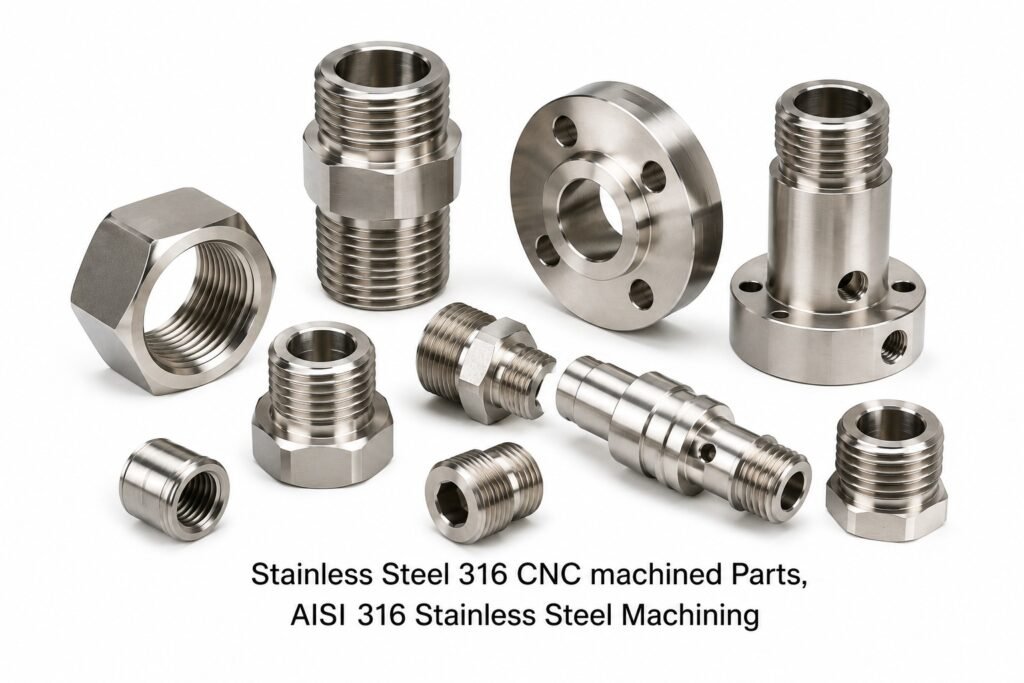
Stainless Steel 316 CNC Machined Parts represent the pinnacle of precision manufacturing — combining the superior corrosion resistance and mechanical strength of AISI 316 stainless steel with the tight tolerances and complex geometries achievable only through Computer Numerical Control (CNC) machining. Whether you are sourcing components for the pharmaceutical, marine, petrochemical, food processing, or medical device industry, SS 316 CNC machining delivers components that meet the most exacting dimensional and surface finish requirements.
In this comprehensive guide, we cover everything you need to know about AISI 316 stainless steel machining — from material composition and mechanical properties to machining parameters, surface treatments, tolerances, applications, and frequently asked questions. If you are looking for a reliable supplier of Stainless Steel 316 CNC machined components from India, this article is the definitive resource.
What is AISI 316 Stainless Steel?
AISI 316 (also designated UNS S31600, EN 1.4401, DIN X5CrNiMo17-12-2) is an austenitic chromium-nickel stainless steel with the addition of 2–3% molybdenum. This molybdenum addition dramatically enhances pitting and crevice corrosion resistance, especially in chloride-rich environments — making it the preferred grade over 304 for marine, chemical, and pharmaceutical applications.
The grade is non-magnetic in the annealed condition and exhibits excellent weldability, formability, and toughness at both elevated and sub-zero temperatures. SS 316 is also available as 316L (low carbon), 316H (high carbon for elevated temperature service), and 316Ti (titanium stabilized).
AISI 316 Stainless Steel Chemical Composition Chart
The table below lists the standard chemical composition of AISI 316 and its variants as per ASTM A276, ASTM A479, and EN 10088 standards:
| Element | SS 316 (%) | SS 316L (%) | SS 316H (%) | SS 316Ti (%) |
|---|---|---|---|---|
| Carbon (C) | 0.08 max | 0.03 max | 0.04–0.10 | 0.08 max |
| Manganese (Mn) | 2.00 max | 2.00 max | 2.00 max | 2.00 max |
| Silicon (Si) | 0.75 max | 0.75 max | 0.75 max | 0.75 max |
| Phosphorus (P) | 0.045 max | 0.045 max | 0.045 max | 0.045 max |
| Sulfur (S) | 0.030 max | 0.030 max | 0.030 max | 0.030 max |
| Chromium (Cr) | 16.0–18.0 | 16.0–18.0 | 16.0–18.0 | 16.0–18.0 |
| Nickel (Ni) | 10.0–14.0 | 10.0–14.0 | 10.0–14.0 | 10.0–14.0 |
| Molybdenum (Mo) | 2.0–3.0 | 2.0–3.0 | 2.0–3.0 | 2.0–3.0 |
| Nitrogen (N) | 0.10 max | 0.10 max | – | 0.10 max |
| Titanium (Ti) | – | – | – | 5x(C+N) min, 0.70 max |
| Iron (Fe) | Balance | Balance | Balance | Balance |
AISI 316 Stainless Steel Mechanical Properties
Understanding the mechanical properties of SS 316 is critical when selecting it for CNC machining applications. The following values apply to annealed bar/plate in accordance with ASTM A276 and EN 10088-3:
| Property | SS 316 | SS 316L | SS 316H | Unit |
|---|---|---|---|---|
| Tensile Strength (UTS) | 515 | 485 | 515 | MPa (min) |
| Yield Strength (0.2% proof) | 205 | 170 | 205 | MPa (min) |
| Elongation | 40 | 40 | 40 | % (min) |
| Hardness (Brinell) | 217 | 217 | 217 | HB (max) |
| Hardness (Rockwell B) | 95 | 95 | 95 | HRB (max) |
| Density | 7.99 | 7.99 | 7.99 | g/cm³ |
| Modulus of Elasticity | 193 | 193 | 193 | GPa |
| Poisson’s Ratio | 0.27–0.30 | 0.27–0.30 | 0.27–0.30 | – |
| Thermal Conductivity (at 100°C) | 16.3 | 16.3 | 16.3 | W/m·K |
| Coefficient of Thermal Expansion | 16.0 | 16.0 | 16.0 | µm/m·°C (0–100°C) |
| Melting Range | 1370–1400 | 1370–1400 | 1370–1400 | °C |
| Max Service Temperature (continuous) | 870 | 870 | 870 | °C |
CNC Machining of AISI 316 Stainless Steel – Technical Overview
CNC machining of SS 316 is more challenging than machining plain carbon steel or even SS 304 due to its pronounced work-hardening tendency, high strength, low thermal conductivity, and high toughness. These properties require careful selection of cutting tools, speeds, feeds, and coolants to achieve the desired surface finish and dimensional accuracy while maximizing tool life.
1. Work Hardening
AISI 316 has a significantly higher work-hardening rate than carbon steel. Once the surface layer is work-hardened, the tool must cut through the hardened layer on each subsequent pass, dramatically increasing cutting forces and tool wear. This demands sharp tools, consistent chip loads, and minimal dwelling in cut.
2. Thermal Management
SS 316 has approximately one-third the thermal conductivity of carbon steel (16.3 W/m·K vs. ~50 W/m·K). Heat generated at the cutting zone cannot dissipate quickly, concentrating it at the tool tip. This accelerates crater wear and built-up edge formation. Flood coolant or high-pressure through-spindle coolant is strongly recommended.
3. Tool Material Selection
The recommended cutting tool materials for SS 316 CNC machining include:
- Carbide (Coated): TiAlN or AlTiN-coated solid carbide end mills and drills are the first choice for turning and milling SS 316. The coating provides heat resistance and reduces built-up edge.
- High-Speed Steel (M2 / M42 HSS): Acceptable for low-speed drilling and tapping operations when carbide is unavailable.
- Ceramic Inserts: Suitable for high-speed finishing passes but prone to fracture in interrupted cuts.
- CBN (Cubic Boron Nitride): Ideal for turning hardened SS 316 or when very fine surface finish (Ra ≤ 0.4 µm) is required.
Recommended CNC Machining Parameters for SS 316
| Operation | Cutting Speed (Vc) m/min | Feed Rate (f) mm/rev or mm/tooth | Depth of Cut (ap) mm | Coolant |
|---|---|---|---|---|
| CNC Turning (Rough) | 80–150 | 0.20–0.40 mm/rev | 2.0–5.0 | Flood / High-pressure |
| CNC Turning (Finish) | 150–220 | 0.05–0.15 mm/rev | 0.3–1.0 | Flood |
| CNC Milling (Rough) | 40–80 | 0.05–0.12 mm/tooth | 2.0–4.0 | Flood |
| CNC Milling (Finish) | 80–130 | 0.02–0.06 mm/tooth | 0.3–1.0 | Flood / Mist |
| Drilling (Carbide) | 30–60 | 0.05–0.15 mm/rev | Full diameter | High-pressure internal |
| Tapping / Threading | 5–15 m/min | Per pitch | – | Tapping fluid |
| Boring (Fine) | 100–180 | 0.05–0.10 mm/rev | 0.1–0.5 | Flood |
| Reaming | 8–15 | 0.10–0.30 mm/rev | 0.1–0.25 per side | Flood |
Types of Stainless Steel 316 CNC Machined Parts
Our precision CNC machining facility manufactures a vast range of SS 316 components across multiple industries. Common part types include:
Turned Parts (CNC Lathe)
- Shafts, spindles, and arbors with diameters from 2 mm to 500 mm
- Flanges, bushings, and sleeves
- Threaded rods, studs, and custom fasteners
- Nozzles, nipples, and tube fittings
- Precision pins and dowels (h6/h7 tolerance)
Milled Parts (CNC Machining Centre)
- Valve bodies and manifolds
- Pump housings and impeller casings
- Brackets, plates, and adaptor blocks
- Heat exchanger end caps
- Custom enclosures and housings for instrumentation
Prismatic & Multi-Axis Parts (4-axis / 5-axis CNC)
- Complex aerospace structural components
- Surgical instruments and orthopaedic implant components
- Turbine blades and compressor discs
- Hydraulic manifold blocks with internal porting
Dimensional Tolerances and Surface Finish
CNC machining of AISI 316 stainless steel can routinely achieve the following tolerances and surface finishes:
| Parameter | Standard CNC | Precision CNC | Ultra-Precision CNC |
|---|---|---|---|
| Linear Dimensional Tolerance | ±0.1 mm | ±0.025 mm | ±0.005 mm |
| Hole Diameter Tolerance | H9 | H7 | H6 |
| Surface Roughness (Ra) | 3.2 µm | 1.6 µm | 0.4 µm |
| Roundness / Circularity | 0.050 mm | 0.010 mm | 0.002 mm |
| Parallelism / Flatness | 0.05 mm | 0.01 mm | 0.003 mm |
| Cylindricity | 0.05 mm | 0.010 mm | 0.003 mm |
| Thread Tolerance Class | 6g / 6H | 5g / 5H | 4g / 4H |
Post-Machining Surface Treatments for SS 316 Parts
Although AISI 316 provides excellent inherent corrosion resistance, post-machining surface treatments further enhance surface quality, hygiene, and performance:
- Electropolishing: Removes the outer microstructure layer, reduces surface roughness by 50%, enhances corrosion resistance, and produces a bright mirror finish. Widely used in pharmaceutical and food-grade applications (FDA, 3-A Dairy, EHEDG compliance).
- Passivation (ASTM A967 / AMS 2700): Immersion in nitric or citric acid removes free iron contamination from the machined surface, maximizing the natural chromium oxide passive film.
- Mechanical Polishing: Using progressively finer abrasives to achieve Ra 0.8 µm, Ra 0.4 µm, or Ra 0.2 µm finishes (Grit 180 → 320 → 600 → mirror).
- Bead Blasting: Creates a uniform matte/satin finish, hiding machining marks while retaining corrosion resistance.
- PVD / DLC Coating: Physical Vapour Deposition or Diamond-Like Carbon coatings add hardness (up to 3000 HV), wear resistance, and low friction for high-wear SS 316 components.
- Nitriding (Kolsterising): A low-temperature surface hardening process that raises surface hardness to over 1000 HV while retaining corrosion resistance — ideal for SS 316 bearing surfaces.
Industry Applications of SS 316 CNC Machined Parts
Stainless Steel 316 CNC machined components serve a diverse spectrum of industries where corrosion resistance, cleanliness, and precision are non-negotiable:
| Industry | Typical SS 316 CNC Machined Parts | Key Requirement |
|---|---|---|
| Pharmaceutical & Biotech | Reactor agitators, valve stems, pump heads, manifolds | FDA compliance, electropolish finish, Ra ≤ 0.8 µm |
| Marine & Offshore | Propeller shafts, hull fittings, subsea connectors | Chloride resistance, MPI/UT inspection |
| Chemical & Petrochemical | Valve bodies, impellers, nozzles, flanges | NACE MR0175, HIC resistance |
| Food & Beverage | Filling heads, conveyor pins, mixing shafts | 3-A Dairy, smooth surface, no crevices |
| Medical & Surgical | Bone screws, surgical tools, endoscope components | ISO 13485, Ra ≤ 0.4 µm, biocompatibility |
| Oil & Gas | Downhole tool components, BOP parts, instrumentation | ASTM A276/A479, NACE MR0175 |
| Semiconductor | Ultra-pure gas fittings, vacuum chamber components | Electropolish, Ra ≤ 0.2 µm, particle cleanliness |
| Aerospace & Defence | Hydraulic manifolds, actuator housings, brackets | AS9100, NADCAP, tight tolerances ±0.005 mm |
| Desalination & Water Treatment | Pump impellers, valve bodies, pressure vessel internals | High chloride resistance, PREN > 24 |
SS 316 vs SS 304 CNC Machining – Comparison
| Property | SS 316 | SS 304 |
|---|---|---|
| Molybdenum Content | 2.0–3.0% | None |
| Pitting Resistance Equiv. No. (PREN) | ~24–26 | ~18–20 |
| Chloride Resistance | Excellent | Moderate |
| Tensile Strength | 515 MPa | 515 MPa |
| Cost (relative) | 20–30% higher | Base |
| Machinability Rating | ~45% of B1112 | ~50% of B1112 |
| Weldability | Excellent | Excellent |
| Best For | Marine, chemical, pharma, food | General architectural, light industrial |
Quality Standards and Certifications for SS 316 CNC Machined Parts
Our SS 316 CNC machined parts are manufactured and inspected in compliance with internationally recognized standards:
- Material Standards: ASTM A276, ASTM A479, ASTM A582, EN 10088-3, BS 970 Part 1 (316S31)
- Dimensional Inspection: ISO 286, ASME Y14.5 (GD&T), DIN ISO 2768
- Surface Finish: ISO 1302, ASME B46.1
- NDT Inspection: Dye Penetrant Testing (DPT per ASTM E165), Magnetic Particle Inspection (MPI), Ultrasonic Testing (UT per ASTM E317)
- Chemical Testing: PMI (Positive Material Identification) via XRF — every heat of material verified
- Quality Management: ISO 9001:2015 certified manufacturing
- Pharmaceutical / Food Grade: FDA 21 CFR, 3-A Sanitary Standards, EHEDG guidelines
Why Source SS 316 CNC Machined Parts from India?
India has emerged as one of the world’s leading precision machining hubs, offering a compelling combination of technical expertise, modern equipment, and competitive pricing. Here is why global buyers prefer Indian manufacturers for SS 316 CNC machined components:
- Cost Advantage: Labour and overhead costs in India are 40–60% lower than in Europe, the USA, or Japan, without compromising quality.
- Technical Expertise: Highly skilled machinists and engineers with decades of experience in stainless steel precision machining.
- Advanced Equipment: Modern CNC turning centres (up to 12-axis Swiss-turn), 5-axis machining centres, CMMs, and laser measurement systems.
- Certifications: ISO 9001, IATF 16949, AS9100, PED 2014/68/EU compliant manufacturers.
- Export Experience: Well-established supply chains to USA, Europe, Middle East, Australia, and Southeast Asia with competitive sea and air freight options.
- Full Traceability: Full material traceability with Mill Test Certificates (MTCs) as per EN 10204 3.1/3.2.
Frequently Asked Questions (FAQ) – AISI 316 Stainless Steel CNC Machining
Q1: What is the difference between SS 316 and SS 316L for CNC machining?
A: SS 316L has a maximum carbon content of 0.03% (vs. 0.08% for SS 316). This lower carbon makes 316L more resistant to sensitization (intergranular corrosion) in the heat-affected zone of welds. For most CNC machined parts that are not welded, standard 316 is preferred due to its slightly higher strength. For welded assemblies operating in corrosive environments, 316L is strongly recommended to prevent carbide precipitation at grain boundaries.
Q2: Why is SS 316 harder to machine than SS 304?
A: SS 316 contains 2–3% molybdenum, which solid-solution strengthens the austenitic matrix and increases its work-hardening rate relative to SS 304. The result is higher cutting forces, greater heat generation at the tool tip, and accelerated tool wear. SS 316 has a machinability rating of approximately 45% relative to free-machining brass (B1112 = 100%), compared to ~50% for SS 304. Despite this, with proper tooling and parameters, SS 316 can be machined to exceptional accuracy.
Q3: What tolerances can be achieved on SS 316 CNC turned parts?
A: Standard CNC turning achieves ±0.05–±0.1 mm tolerances. With precision grinding or fine boring, tolerances of ±0.005 mm (5 microns) and hole tolerances of ISO H6 (±0.005 mm for a 50 mm hole) are achievable. Surface roughness can be held to Ra 0.4 µm in turning and as low as Ra 0.2 µm with superfinishing or electropolishing.
Q4: What surface finish is required for pharmaceutical-grade SS 316 machined parts?
A: Pharmaceutical and biotech applications typically require a minimum Ra of 0.8 µm (32 µin) for product-contact surfaces, per FDA and 3-A Sanitary Standards. For ultra-hygienic applications (e.g., bioreactor internals), electropolished finishes of Ra ≤ 0.4 µm or even Ra ≤ 0.2 µm are specified. Electropolishing not only improves surface finish but also removes embedded particles, micro-crevices, and free iron, significantly improving cleanability and corrosion resistance.
Q5: What is the PREN of SS 316 and why does it matter?
A: The Pitting Resistance Equivalent Number (PREN) is a calculated index of a stainless steel’s resistance to pitting corrosion in chloride-containing environments. PREN = %Cr + 3.3×%Mo + 16×%N. For SS 316, PREN typically ranges from 23 to 26, compared to ~18–20 for SS 304. A PREN above 18 is generally considered adequate for seawater splash zones, and above 40 is required for full seawater immersion (duplex or super-duplex grades).
Q6: Can SS 316 CNC machined parts be welded after machining?
A: Yes. SS 316 has excellent weldability using TIG (GTAW), MIG (GMAW), or Plasma Arc processes. When welding standard 316 (not 316L), a post-weld annealing heat treatment at 1010–1120°C followed by rapid quenching is recommended to dissolve any carbide precipitation and restore optimal corrosion resistance. For 316L, post-weld heat treatment is generally not required.
Q7: What are the typical lead times for custom SS 316 CNC machined parts?
A: Lead times depend on part complexity, quantity, and required certifications. Standard turned parts (simple geometries): 2–5 working days for samples; 2–4 weeks for production quantities. Complex 5-axis machined components: 1–3 weeks for samples; 4–8 weeks for production. Rush orders with expedited material procurement are available for urgent requirements.
Q8: What is the maximum size of SS 316 parts you can machine?
A: Our CNC turning capacity covers shaft diameters up to 500 mm and lengths up to 3,000 mm. CNC milling/machining centres handle workpieces up to 2,500 × 1,500 × 1,200 mm (X×Y×Z). For larger components, we collaborate with certified partner facilities under the same quality management system.
Q9: How do I specify material certifications for SS 316 CNC parts?
A: Request an EN 10204 3.1 Mill Test Certificate (MTC) as a minimum. This certifies that the material meets the ordered specification and is issued by the material manufacturer. For critical applications (nuclear, aerospace, pressure vessels), an EN 10204 3.2 certificate — where the MTC is countersigned by an independent third-party inspector (e.g., TÜV, Lloyds, BV, SGS) — may be required.
Q10: Do you offer Positive Material Identification (PMI) testing?
A: Yes. We perform 100% PMI using portable XRF (X-Ray Fluorescence) analysers to verify the chemical composition of every piece before machining begins. This eliminates the risk of material mix-up and ensures full compliance with your specification — especially critical in oil & gas and pharmaceutical supply chains.
Get a Free Quote for Your SS 316 CNC Machined Parts
Are you looking for a reliable, ISO 9001 certified manufacturer of Stainless Steel 316 CNC machined components in India? Whether you need a single prototype or high-volume production, we offer:
- ✅ Competitive pricing with full material traceability (EN 10204 3.1 MTC)
- ✅ Tolerances up to ±0.005 mm
- ✅ Surface finishes from Ra 3.2 µm to mirror-electropolished Ra 0.2 µm
- ✅ Fast lead times — prototype in 3–5 days, production in 2–4 weeks
- ✅ 100% PMI (XRF) + dimensional inspection with CMM reports
- ✅ Export packing, sea / air freight, DDP / FOB / CIF Incoterms
📧 Email us your drawings (PDF, DXF, STEP, IGES) and receive a detailed quotation within 24 hours.
📞 Call our technical sales team to discuss your specific machining requirements for AISI 316 stainless steel parts.
Conclusion
AISI 316 stainless steel CNC machined parts combine the outstanding corrosion resistance of a molybdenum-bearing austenitic alloy with the dimensional precision and repeatability that only CNC machining can deliver. From pharmaceutical manifolds to subsea connectors and surgical instruments, SS 316 CNC components are the material of choice wherever chloride exposure, hygienic design, and tight tolerances converge.
By partnering with an experienced Indian manufacturer offering competitive pricing, advanced multi-axis machining, full material traceability, and a comprehensive suite of post-machining services (passivation, electropolishing, NDT), you gain a significant cost and quality advantage. Contact us today to discuss your AISI 316 CNC machining requirements and receive a competitive quote.