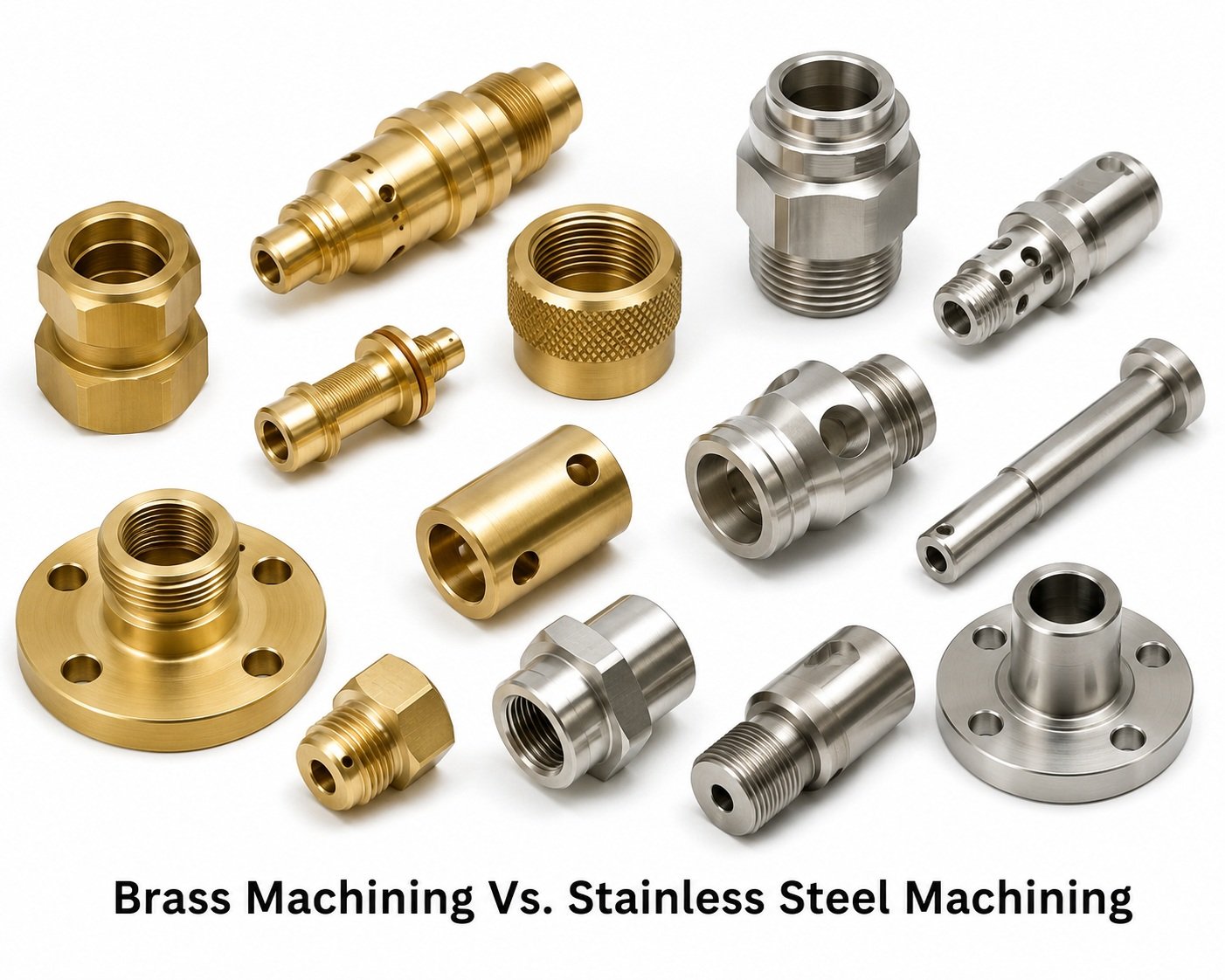
Selecting the right material for a CNC turned or milled component is not a stylistic choice — it is an engineering decision that ripples through cycle time, tool life, surface finish, corrosion performance, and ultimately, cost per piece. Two of the most requested materials in precision machine shops are free-cutting brass alloys and austenitic or martensitic stainless steels. On the surface both can be turned into fittings, connectors, valve bodies, and hydraulic components, but underneath the surface finish, the metallurgy, chip formation behavior, tooling strategy, and economics are almost opposite. This guide breaks down brass machining versus stainless steel machining from a shop-floor, tolerance-sheet, and cost-sheet perspective so that engineers, buyers, and machinists can specify the correct material the first time, whether the end use is a plumbing fitting, a hydraulic adapter, or a sanitary process connector.
1. Metallurgical Fundamentals: What You Are Actually Cutting
Machinability begins with crystal structure and alloying elements, not with a spec sheet claim. Brass is a copper-zinc alloy, and the free-machining grades used in fittings and connectors — C36000 (free-cutting brass) and C26000 (cartridge brass) — contain roughly 1.5 to 3 percent lead. That lead does not dissolve into the copper-zinc matrix; instead it forms microscopic globules distributed through the grain structure. Under the cutting edge, these lead inclusions act as internal chip breakers and solid lubricants, causing the chip to fracture into short, manageable segments rather than tearing or work hardening.
Stainless steel is a completely different animal metallurgically. Austenitic grades such as 303, 304, and 316 are iron-chromium-nickel alloys with a face-centered cubic crystal structure that is inherently tough and ductile. Grade 303 is the “free-machining” stainless, sulfur-added (approximately 0.15 to 0.35 percent S) to create manganese sulfide inclusions that provide a similar, though far less effective, chip-breaking benefit compared to lead in brass. Grades 304 and 316 contain no such additive and are considerably gummier under the tool. Martensitic and precipitation-hardening grades like 410, 416, and 17-4PH behave differently again: 416 is sulfurized for machinability, while 17-4PH is typically machined in the solution-annealed condition before precipitation hardening to 35-45 HRC, at which point machinability drops sharply.
1.1 Common Brass Alloys Used in Precision Machining
C36000 free-cutting brass remains the benchmark alloy against which every other machinable metal is measured, largely because of its lead content and excellent thermal conductivity. C26000 cartridge brass, lower in lead, is chosen when higher ductility for cold forming or crimping is needed alongside machining. C46400 naval brass adds tin for improved resistance to saltwater corrosion and is used in marine hardware, while C48500 leaded naval brass balances marine durability with reasonable machinability. Regulatory pressure around lead content in potable water fittings has pushed the industry toward low-lead and lead-free alloys such as C69300 and C87850 (a cast equivalent), which substitute bismuth and selenium for lead to preserve chip control while meeting drinking-water safety standards; these alloys machine acceptably well but generally require slightly reduced speeds and sharper tooling compared to traditional leaded brass.
1.2 Common Stainless Steel Grades Used in Precision Machining
Grade 303 is the default choice whenever a stainless part must be machined economically and the application does not demand maximum corrosion resistance, because its sulfur content noticeably improves chip control versus 304. Grade 304 is the general-purpose austenitic stainless for fittings, brackets, and enclosures exposed to normal atmospheric and mild chemical conditions. Grade 316, with 2-3 percent molybdenum, is specified for chloride exposure, marine environments, and pharmaceutical or food-contact applications, at the cost of noticeably lower machinability and higher built-up-edge tendency than 304. Grade 410 is a lower-cost martensitic stainless offering moderate corrosion resistance with the ability to be hardened by heat treatment, commonly used for shafts and valve trim. Grade 416 adds sulfur to 410’s chemistry specifically to improve machinability for high-volume turned parts such as fasteners and valve stems. Grade 17-4PH is a precipitation-hardening stainless offering the highest strength-to-corrosion-resistance ratio of the common grades, but it is markedly harder to machine, especially once aged to peak hardness, and shops typically machine it in the solution-treated (Condition A) state and age it afterward wherever geometry allows.
2. Machinability Index and Chip Formation Behavior
Machinability index is typically benchmarked against B1112 steel at 100 percent. On this scale, C36000 free-cutting brass rates between 100 and 150 percent — meaning it can, in some operations, be cut faster than the steel reference standard. Stainless 303 rates around 78 percent, 304 drops to roughly 45 percent, and 316 falls further still to 36-40 percent due to added molybdenum increasing toughness and heat resistance. 17-4PH in the hardened condition can fall below 30 percent.
Chip formation is the clearest shop-floor indicator of this gap. Brass produces small, comma-shaped or powdery chips that fall away from the tool face with minimal built-up edge (BUE) risk. Stainless steel, particularly 304 and 316, generates long, stringy, continuous chips that wrap around the tool, the workpiece, or the tailstock if chip control is not engineered into the toolpath through peck cycles, chip breaker geometries, or high-pressure coolant. Work hardening compounds this: every pass over a previously machined stainless surface hardens that skin layer, so a dull edge or excessive dwell time causes progressively worse tool wear on the next pass. Specific cutting force, a measure of how much energy is needed to remove a given volume of material, illustrates the gap numerically: brass typically requires roughly 700-1000 N/mm², while austenitic stainless requires 2000-2800 N/mm², nearly triple the cutting force for the same chip cross-section. Brass does not work-harden in any comparable way, which is part of why repeatability in high-volume screw-machine production is dramatically higher with brass.
3. Cutting Speeds, Feeds, and Tooling Strategy
Because brass is free-cutting and thermally forgiving, it tolerates significantly higher surface speeds. Typical practice on CNC lathes:
| Parameter | Free-Cutting Brass (C360) | Austenitic Stainless (304/316) |
| Turning surface speed | 120-215 m/min (carbide) | 60-120 m/min (carbide) |
| Drilling surface speed | 45-90 m/min | 15-30 m/min |
| Feed rate (turning) | 0.15-0.40 mm/rev | 0.08-0.25 mm/rev |
| Tapping speed | 15-25 m/min | 5-10 m/min |
| Relative cycle time (same part) | 1.0x baseline | 1.8x-2.6x baseline |
Tooling geometry diverges as well. Brass favors positive rake, polished-face carbide or even uncoated high-speed steel and PCD (polycrystalline diamond) tooling for extremely high-volume automatic bar work, with sharp, low-clearance edges since built-up edge is rarely a concern and edge sharpness improves surface finish directly. Stainless steel demands sharp but more robust cutting edges, typically coated carbide (TiAlN or AlCrN coatings) to resist heat and abrasive wear, honed or slightly chamfered edges to prevent chipping under the higher cutting forces, and positive-rake inserts with dedicated chip-breaker geometry to manage the ribbon chip problem described above. Rigidity of the machine, work-holding, and tool overhang matters far more in stainless work because the higher cutting forces and work-hardening tendency amplify any deflection into chatter, dimensional drift, and premature tool failure.
3.1 Machine Platform Considerations: Swiss-Type, Turret, and Multi-Spindle
Sliding-headstock Swiss-type lathes are the dominant platform for small-diameter brass connectors and fittings because the guide-bushing support allows very high length-to-diameter ratios to be machined without deflection, and the free-cutting nature of brass lets these machines run at their upper spindle speed limits for maximum throughput. Fixed-headstock turret lathes and multi-spindle automatics are equally common for larger brass fittings produced in high volume. Stainless steel components are more frequently produced on heavier, more rigid turning centers with substantial spindle horsepower and torque headroom, because the elevated cutting forces described above will expose any lack of rigidity as chatter or tool deflection long before they would on an equivalent brass job. Multi-spindle automatics running stainless steel also require closer attention to synchronized coolant delivery across every spindle position, since uneven cooling across stations directly translates into inconsistent tool wear and part-to-part dimensional variation.
3.2 Threading and Tapping Technique
Thread quality is one of the most visible differentiators between the two materials. Brass threads cleanly with cut dies, form taps, or single-point threading inserts, and its low work-hardening tendency means form tapping (cold-forming threads without cutting a chip) is widely used to increase tap life and improve thread strength. Stainless steel is far less forgiving of form tapping unless the hole is sized precisely and lubrication is excellent, because the material work-hardens rapidly under the deformation involved; many shops instead prefer cut taps, thread milling, or single-point threading with rigid tool paths and generous lubrication to avoid torque spikes and tap breakage, particularly in blind holes where chip evacuation is already a challenge.
4. Tool Wear Mechanisms and Tool Life
Tool wear in brass machining is dominated by abrasive flank wear from the alloy itself, which is comparatively gentle. A single carbide or HSS tool can often produce thousands of parts before requiring an index or reground edge in a well-tuned Swiss-type or CNC lathe operation. There is minimal cratering, minimal thermal softening of the tool, and negligible built-up edge because lead acts as a lubricant at the shear zone.
Stainless steel wears tools through a combination of abrasive wear (from carbide-forming chromium and molybdenum), adhesive wear (galling and micro-welding of the workpiece to the tool face due to poor thermal conductivity concentrating heat at the edge), and notch wear at the depth-of-cut line caused by work hardening of the prior pass. Tool life on 304/316 stainless is commonly a fraction of that on brass for an equivalent insert grade — shops routinely plan for insert changes every 150-400 parts on demanding stainless jobs versus thousands of parts on brass, though this varies enormously with part geometry, coolant strategy, and machine rigidity. Coolant type and delivery pressure (through-tool coolant at 20-70 bar is common on modern Swiss lathes) become a first-order variable in stainless machining in a way that brass rarely requires, since brass can often be cut dry or with minimal flood coolant purely for chip evacuation and finish, not for thermal management.
5. Surface Finish and Achievable Tolerances
Brass machining routinely achieves mirror-like finishes directly off the tool, with Ra values of 0.4-0.8 µm achievable without secondary polishing, thanks to the self-lubricating shear behavior of the lead-rich phase. This is precisely why brass is the default choice for decorative fittings, valve stems, and instrument components where an as-turned bright finish is a specification requirement, not just an aesthetic bonus.
Stainless steel requires more deliberate process control to reach comparable finishes. Typical as-turned Ra on 304/316 with well-optimized parameters lands around 0.8-1.6 µm, and achieving sub-0.4 µm finishes usually requires finishing passes with high positive rake tooling, reduced feed rates, or secondary operations such as burnishing, polishing, or electropolishing. Tolerance capability is comparable on paper — both materials are routinely held to ±0.01-0.02 mm on CNC turning centers and Swiss lathes — but holding that tolerance consistently over a long production run is more difficult in stainless because of thermal growth during the cut (heat is trapped near the cutting zone due to low thermal conductivity) and because work hardening can cause dimensional drift pass to pass if tool wear is not tightly monitored.
6. Thermal Behavior and Coolant Strategy
The thermal conductivity gap between the two materials (roughly 115-125 W/m·K for brass versus 16-21 W/m·K for austenitic stainless) is arguably the single most consequential physical property difference in this entire comparison. In brass, heat generated at the shear zone conducts rapidly away into the bulk of the part and the chip, keeping the cutting edge relatively cool even at higher surface speeds. In stainless steel, that same heat has nowhere to go quickly, so it concentrates at the tool-chip interface, accelerating diffusion wear, edge softening on uncoated tools, and thermal expansion of the workpiece during the cut.
This is why stainless steel machining strategies lean heavily on flood coolant or high-pressure through-tool coolant systems, coated carbide inserts rated for high-temperature stability, and deliberately reduced surface speeds compared to what the machine and tool could otherwise sustain. Brass machining, in contrast, can frequently run dry or with minimal coolant purely to aid chip evacuation, and shops that do use coolant on brass are usually optimizing surface finish or managing swarf rather than fighting heat.
7. Cost Analysis: Material, Cycle Time, and Total Cost Per Part
Raw material cost is volatile and tracks base metal commodity pricing, but as a general rule, free-cutting brass bar stock and 300-series stainless bar stock are often in a broadly similar price band per kilogram, with brass sometimes trading at a premium during copper price spikes and stainless at a premium during nickel price spikes. Material cost alone therefore rarely decides the outcome — processing cost usually does.
Cycle time is where the economics diverge sharply. Because brass tolerates roughly double the surface speed and feed rate of 304/316 stainless in most operations, and because tool changes are far less frequent, the same geometry machined in brass on the same machine can be produced in roughly 40-60 percent of the time required for stainless. Tooling consumption cost per part is also materially lower for brass given the multiple-fold difference in insert life discussed earlier. Secondary finishing costs (deburring, passivation, polishing) differ too: stainless parts destined for food, medical, or corrosive environments typically require a passivation step (commonly nitric or citric acid treatment per ASTM A967) to restore the passive chromium oxide layer disturbed by machining, adding a process step and cost that brass parts never require. Brass parts may need anti-tarnish plating (nickel or chrome plating) if long-term appearance is critical, which is its own added cost.
Consider a representative example: a hex-bodied hydraulic adapter with two threaded ports and a through bore. On a CNC Swiss lathe, this geometry might cycle in roughly 45-55 seconds in C36000 brass at typical shop parameters, versus 90-120 seconds for the identical geometry in 316 stainless once appropriate speeds, feeds, and peck-drilling cycles for chip control are applied. Multiply that gap across a production run of 50,000 pieces and the machine-hour difference alone can dwarf the raw material cost difference between the two alloys, which is why experienced estimators weight cycle time and tool consumption more heavily than bar stock price when quoting either material.
When these factors are combined — material, cycle time, tooling wear, and finishing — brass components are typically 20-45 percent cheaper to produce than an equivalent stainless steel component on a per-piece basis at moderate to high volumes, assuming corrosion resistance and mechanical strength requirements allow brass to be used at all. At low volumes, the gap narrows because setup and programming costs dominate over cycle-time-driven machining costs.
8. Typical Parts and Application Fit
Free-cutting brass is the default material for plumbing and pneumatic fittings, hose barbs, compression fittings, gas valve components, instrument connectors, electrical terminals and connectors, decorative hardware, and low-pressure hydraulic fittings where the operating environment is not highly corrosive or subject to chloride exposure, and where good electrical or thermal conductivity is beneficial. Its combination of fast machining, excellent finish, natural anti-galling properties in threaded connections, and reasonable corrosion resistance in mild environments make it the volume workhorse for these product families.
Stainless steel is specified when the application demands corrosion resistance beyond what brass can offer — chloride exposure, marine environments, chemical processing, food and pharmaceutical contact surfaces, high-pressure hydraulic and instrumentation fittings, medical devices, and structural or high-strength fasteners. Typical stainless machined components include flanges, hydraulic adapters, high-pressure valve bodies, sanitary tri-clamp fittings, shafts, and threaded connectors for oilfield, marine, and process industries. Where both corrosion resistance and strength at elevated temperature are required, martensitic or precipitation-hardening grades like 410, 416, or 17-4PH are chosen despite their reduced machinability, because no copper alloy can match their mechanical performance envelope.
9. Corrosion Resistance and Long-Term Performance
Brass resists corrosion well in fresh water, most oils, and ordinary atmospheric exposure, but it is vulnerable to dezincification in aggressive water chemistries and to stress corrosion cracking (season cracking) in ammonia-bearing environments, which is why fittings for certain industrial or marine applications specifically avoid brass in favor of stainless or dezincification-resistant (DZR) brass variants. Stainless steel forms a self-healing passive chromium oxide layer that provides substantially superior resistance to chlorides, acids, and oxidizing environments, particularly in the 316 grade with its molybdenum addition, which is why it dominates marine, chemical, and food-grade applications despite its higher machining cost.
10. Sustainability and Regulatory Considerations
Both materials are highly recyclable and machine shops typically reclaim swarf for smelting credit, which helps offset raw material cost on both sides of the comparison. Brass intended for potable water systems is increasingly regulated toward low-lead or lead-free compositions in many jurisdictions, which shops must account for when selecting alloy and adjusting parameters, since the substitute alloying elements used to preserve machinability behave slightly differently under the tool than traditional leaded brass. Stainless steel carries no such lead-content restriction and is broadly accepted across food, medical, and potable water standards without additional alloy substitution, which can simplify compliance documentation for regulated industries even though the machining cost is higher.
Frequently Asked Questions
1. Is brass easier to machine than stainless steel?
Yes. Free-cutting brass alloys such as C36000 machine significantly faster and with far less tool wear than austenitic stainless steels like 304 or 316, primarily because of brass’s lead content, higher thermal conductivity, and lack of work hardening.
2. Which is cheaper to machine, brass or stainless steel?
Brass is generally cheaper to machine on a per-part basis at moderate to high volumes due to shorter cycle times and lower tooling consumption, even though raw bar stock pricing between the two materials can be similar depending on commodity market conditions.
3. Can stainless steel achieve the same surface finish as brass?
Stainless steel can achieve comparable or even superior finishes to brass, but it typically requires more careful parameter control, sharper tooling, and sometimes secondary operations such as polishing or electropolishing, whereas brass often reaches a bright finish directly off the tool.
4. What is the best stainless steel grade for CNC machining?
Grade 303 is widely regarded as the most machinable stainless steel for general CNC turning due to its sulfur content, while 316 is preferred when superior corrosion resistance is required despite its lower machinability.
5. Why does stainless steel wear out cutting tools faster than brass?
Stainless steel wears tools faster because of its low thermal conductivity, which concentrates heat at the cutting edge, combined with work hardening and abrasive chromium and molybdenum content, all of which accelerate flank, crater, and notch wear compared to the gentle abrasive wear seen in brass.
6. What coolant should be used for machining stainless steel versus brass?
Stainless steel generally requires flood coolant or high-pressure through-tool coolant to manage heat and control chip formation, while brass can often be machined dry or with minimal coolant since it is thermally forgiving and self-lubricating due to its lead content.
7. Can brass be used in high-pressure or high-temperature applications?
Brass is generally limited to low and moderate pressure and temperature applications compared to stainless steel, since it has lower tensile strength at elevated temperature and can be prone to stress corrosion cracking, making stainless steel the preferred choice for demanding high-pressure or high-temperature service.
8. Why is lead added to brass for machining?
Lead is added to free-cutting brass alloys such as C36000 because it forms soft microscopic inclusions in the copper-zinc matrix that act as internal chip breakers and lubricants, allowing the chip to fracture cleanly and reducing friction and heat at the cutting edge.
9. Is 316 stainless steel harder to machine than 304?
Yes. Grade 316 contains added molybdenum for improved corrosion resistance, which increases toughness and heat resistance, making it noticeably more difficult to machine than 304, with lower cutting speeds and shorter tool life typically required.
10. What causes work hardening in stainless steel machining?
Work hardening occurs because the austenitic crystal structure of stainless steel deforms plastically under cutting forces, increasing surface hardness in the deformed layer; repeated light cuts or a dull tool passing over this hardened skin accelerates tool wear and can cause dimensional drift.
11. Which material is better for threaded fittings, brass or stainless steel?
Brass is generally preferred for threaded fittings in mild environments because it threads cleanly, resists galling naturally, and machines quickly, while stainless steel is chosen for threaded connections exposed to corrosive, high-pressure, or high-temperature service despite requiring more careful tapping technique to avoid galling and thread damage.
12. Do brass parts need passivation like stainless steel parts?
No. Passivation is a chemical treatment specific to stainless steel that restores its passive chromium oxide layer after machining; brass does not form this type of passive layer and instead may require anti-tarnish plating if long-term surface appearance is a requirement.
13. What is the typical tool life difference between brass and stainless steel machining?
Tool life on brass can extend to thousands of parts per cutting edge under well-tuned conditions, while stainless steel, particularly 304 and 316, often requires an insert change every 150 to 400 parts on demanding jobs, though this varies significantly with geometry, coolant strategy, and machine rigidity.
14. Can CNC Swiss-type lathes machine both brass and stainless steel efficiently?
Yes, Swiss-type lathes are commonly used for both materials, but brass jobs typically run at higher spindle speeds and feed rates to maximize throughput, while stainless steel jobs require more conservative parameters, robust tooling, and reliable high-pressure coolant delivery to control heat and chip formation.
Conclusion
Brass machining and stainless steel machining are not interchangeable processes that merely swap raw material — they are two distinct machining disciplines shaped by fundamentally different metallurgy, thermal behavior, and chip formation. Brass rewards speed, tolerates lighter machines, and delivers outstanding as-turned finish at low tooling cost, making it the natural choice for high-volume fittings and connectors in non-aggressive environments. Stainless steel demands rigid machines, coated tooling, engineered coolant strategy, and tighter process control, but it delivers corrosion resistance and mechanical performance that brass simply cannot match. The right choice always starts with the functional requirement of the part — corrosion exposure, mechanical load, and service environment — and only then optimizes for machining economics within that constraint.
Need help deciding which material and machining process is right for your next fitting or connector program? Talk to our engineering team for a free technical consultation and a machining cost estimate tailored to your part drawing, volume, and application environment. Contact us today to get your project quoted.