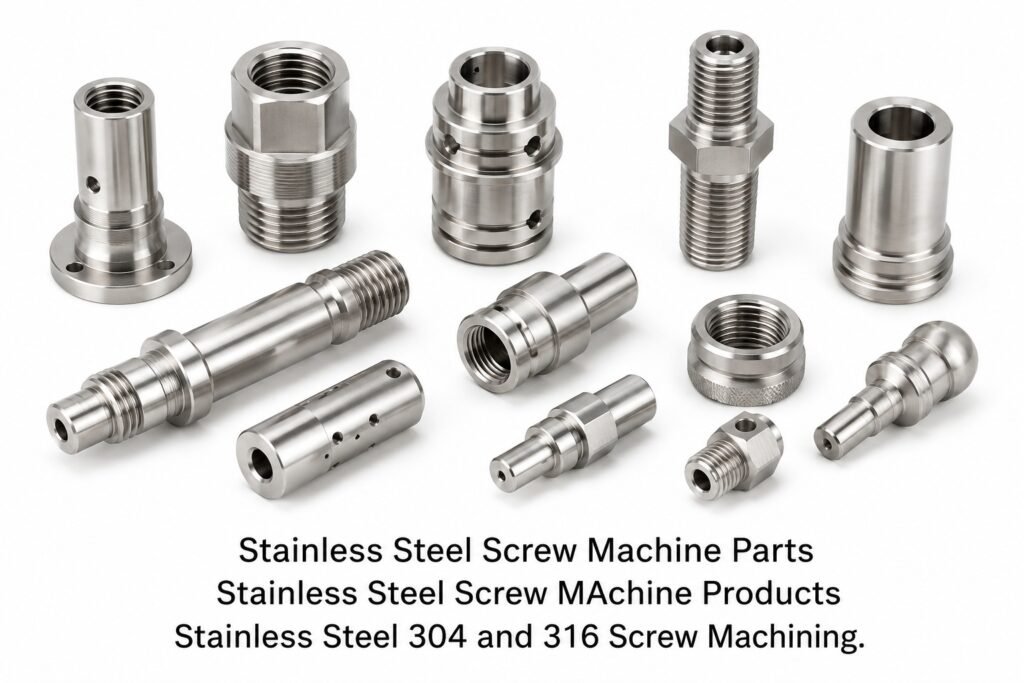
Stainless Steel Screw Machine Parts in 304 and 316, Stainless Steel Screw Machine products
Introduction to Stainless Steel Screw Machine Parts
Stainless steel screw machine parts represent one of the highest-precision categories of machined components manufactured globally. Produced on automatic screw machines — also known as Swiss-type lathes or multi-spindle automatics — these parts are critical to industries ranging from aerospace and oil & gas to medical devices, electronics, and automotive engineering. The combination of stainless steel’s inherent corrosion resistance, mechanical strength, and biocompatibility with the dimensional accuracy of modern screw machining yields components that meet the most demanding specifications in global manufacturing.
This comprehensive technical guide covers everything engineers, procurement professionals, and quality managers need to know about stainless steel screw machine parts and products — from raw material selection and alloy grades to the step-by-step manufacturing process, international standards, tolerances, and industry applications.
What Are Screw Machine Parts?
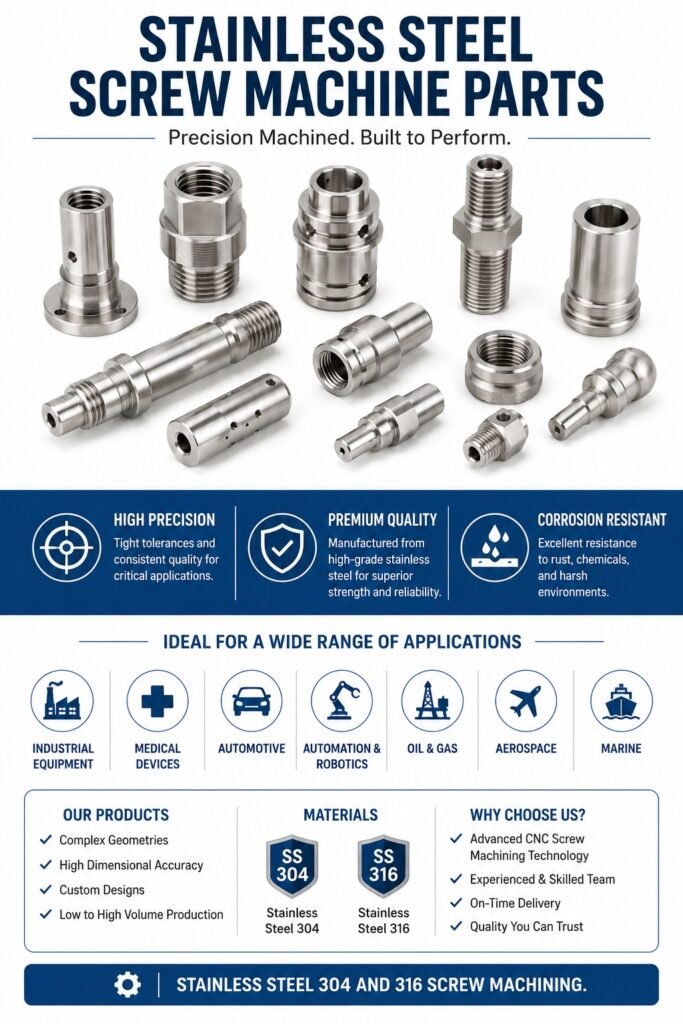
Screw machine parts are small-to-medium precision components turned from bar stock on automatic or semi-automatic lathes (screw machines). The term “screw machine” is a historical designation for automatic lathes that were originally developed to mass-produce threaded fasteners, but today these machines produce a vast range of turned parts: bushings, studs, fittings, connectors, pins, shafts, valve bodies, nozzles, and complex multi-feature components.
Key characteristics of screw machine products include:
- High-volume production: Suited for runs from thousands to millions of pieces
- Tight tolerances: Typically ±0.005 mm to ±0.025 mm (±0.0002″ to ±0.001″)
- Multi-feature geometry: Turned diameters, threads, bores, cross-holes, knurls, and flats in one operation
- Material versatility: Any bar-stock material including stainless steel, brass, aluminum, titanium
- Excellent repeatability: CNC-controlled cam or servo drives ensure part-to-part consistency
Why Stainless Steel for Screw Machine Products?
Stainless steel is selected for screw machine parts when the application demands corrosion resistance, temperature performance, hygienic properties, or long service life that carbon steel or brass cannot deliver. The primary advantages include:
- Corrosion resistance: Chromium oxide passive layer resists oxidation, acids, and chlorides
- Mechanical strength: Tensile strengths from 480 MPa (annealed 304) to over 1700 MPa (17-4PH H900)
- Temperature range: Cryogenic (-196°C) to high-temperature service (up to 900°C for 310S)
- Biocompatibility: FDA/USP compliance for medical and food-contact applications
- Aesthetic finish: Bright, electropolished, or passivated surfaces for visible components
- Non-magnetic options: Austenitic grades for electronics and MRI-compatible devices
Stainless Steel Grades for Screw Machine Parts — Raw Material Guide
Selecting the correct stainless steel grade is fundamental to part performance, machinability, and cost. The table below covers the most widely used grades in screw machining operations globally.
Table 1: Primary Stainless Steel Grades for Screw Machine Parts
| Grade (UNS) | Type | C % | Cr % | Ni % | Mo % | Other | Tensile Strength (MPa) | Hardness (HRB) | Key Features |
|---|---|---|---|---|---|---|---|---|---|
| 303 (S30300) | Austenitic Free-Machining | 0.15 max | 17–19 | 8–10 | — | S 0.15 min | 620 | 88 | Best machinability in SS; sulfur-enhanced chip breaking |
| 304 (S30400) | Austenitic | 0.08 max | 18–20 | 8–10.5 | — | — | 515 | 92 | Workhorse grade; excellent corrosion resistance |
| 304L (S30403) | Austenitic Low Carbon | 0.03 max | 18–20 | 8–12 | — | — | 480 | 88 | Reduced sensitization; weldable components |
| 316 (S31600) | Austenitic | 0.08 max | 16–18 | 10–14 | 2–3 | — | 515 | 95 | Superior chloride/acid resistance; marine grade |
| 316L (S31603) | Austenitic Low Carbon | 0.03 max | 16–18 | 10–14 | 2–3 | — | 485 | 90 | Best for welded assemblies; pharmaceutical/food |
| 416 (S41600) | Martensitic Free-Machining | 0.15 max | 12–14 | — | — | S 0.15 min | 620 | 26 HRC | Best machinability of martensitic SS; heat-treatable |
| 430F (S43020) | Ferritic Free-Machining | 0.12 max | 16–18 | — | — | S 0.15 min | 515 | 88 | Magnetic; good machinability; moderate corrosion resistance |
| 17-4 PH (S17400) | Precipitation Hardening | 0.07 max | 15–17.5 | 3–5 | — | Cu 3–5, Nb 0.15–0.45 | 1310 (H900) | 43 HRC | Very high strength; aerospace and defense |
| 2205 (S32205) | Duplex | 0.03 max | 21–23 | 4.5–6.5 | 2.5–3.5 | N 0.14–0.2 | 620 | 31 HRC | Dual-phase; high strength + corrosion resistance |
| 310S (S31008) | Austenitic High-Temp | 0.08 max | 24–26 | 19–22 | — | — | 515 | 95 | Heat-resistant to 1100°C; furnace parts |
Table 2: International Equivalents for Stainless Steel Screw Machine Grades
| Common Grade | UNS (USA) | AISI | EN / DIN (Europe) | BS (UK) | JIS (Japan) | IS (India) | GB (China) |
|---|---|---|---|---|---|---|---|
| 303 | S30300 | 303 | 1.4305 / X8CrNiS18-9 | 303 S31 | SUS303 | — | Y1Cr18Ni9 |
| 304 | S30400 | 304 | 1.4301 / X5CrNi18-10 | 304 S31 | SUS304 | 04Cr18Ni9 | 06Cr19Ni10 |
| 304L | S30403 | 304L | 1.4307 / X2CrNi18-9 | 304 S11 | SUS304L | 02Cr19Ni10 | 022Cr19Ni10 |
| 316 | S31600 | 316 | 1.4401 / X5CrNiMo17-12-2 | 316 S31 | SUS316 | 04Cr17Ni12Mo2 | 06Cr17Ni12Mo2 |
| 316L | S31603 | 316L | 1.4404 / X2CrNiMo17-12-2 | 316 S11 | SUS316L | 02Cr17Ni12Mo2 | 022Cr17Ni12Mo2 |
| 416 | S41600 | 416 | 1.4005 / X12CrS13 | 416 S21 | SUS416 | — | Y1Cr13 |
| 430F | S43020 | 430F | 1.4104 / X14CrMoS17 | — | SUS430F | — | — |
| 17-4 PH | S17400 | 630 | 1.4542 / X5CrNiCuNb16-4 | — | SUS630 | — | 05Cr17Ni4Cu4Nb |
| 2205 Duplex | S32205 | 2205 | 1.4462 / X2CrNiMoN22-5-3 | — | SUS329J3L | — | 022Cr23Ni5Mo3N |
Table 3: Chemical Composition of Free-Machining Stainless Steel Grades (Weight %)
| Grade | C max | Mn max | P max | S min | Si max | Cr | Ni | Mo | Special Additions |
|---|---|---|---|---|---|---|---|---|---|
| 303 | 0.15 | 2.00 | 0.20 | 0.15 | 1.00 | 17–19 | 8–10 | 0.60 opt | S for chip breaking |
| 303Se | 0.15 | 2.00 | 0.20 | 0.06 max | 1.00 | 17–19 | 8–10 | — | Se 0.15 min (replaces S) |
| 416 | 0.15 | 1.25 | 0.06 | 0.15 | 1.00 | 12–14 | — | 0.60 opt | S for machinability |
| 430F | 0.12 | 1.25 | 0.06 | 0.15 | 1.00 | 16–18 | 0.75 max | — | S for machinability |
| 316F | 0.08 | 2.00 | 0.045 | 0.10 | 1.00 | 16–18 | 10–14 | 2–3 | S enhanced for turning |
Types of Stainless Steel Screw Machine Products
The range of components producible on screw machines from stainless steel bar stock is enormous. Below is a classification by product family:
Table 4: Categories of Stainless Steel Screw Machine Products
| Product Category | Examples | Common Grades | Typical Industries | Critical Dimensions |
|---|---|---|---|---|
| Threaded Fasteners | Screws, bolts, studs, nuts, inserts | 303, 304, 316, 18-8 | General engineering, marine, chemical | Thread pitch, minor/major diameter, length |
| Precision Pins & Shafts | Dowel pins, roll pins, pivot pins, axles | 303, 416, 17-4PH | Aerospace, defense, instrumentation | Diameter tolerance, straightness, surface finish |
| Bushings & Spacers | Plain bushings, flanged bushings, sleeve spacers | 303, 304, 316 | Automotive, pumps, valves, machinery | ID/OD concentricity, length, bore finish |
| Valve & Fluid Control Parts | Valve stems, ball seats, needle tips, orifice inserts | 316, 316L, 17-4PH, Duplex 2205 | Oil & gas, chemical processing, pharmaceutical | Seat geometry, surface finish Ra, leak-tightness |
| Fittings & Connectors | Compression fittings, ferrules, tube fittings, adapters | 316, 316L, 304 | Instrumentation, hydraulic, pneumatic | Thread form, seating angle, pressure rating |
| Medical & Dental Components | Bone screws, implant posts, cannula tips, endoscope parts | 316LVM, 17-4PH, 303 | Medical devices, dental | Surface finish Ra <0.4 μm, dimensional accuracy ±0.005 mm |
| Electronic & Electrical Parts | Connector bodies, contact pins, standoffs, EMI shield inserts | 303, 304, 316 | Electronics, telecommunications, aerospace | Non-magnetic, thread integrity, plating adhesion |
| Hydraulic & Pneumatic Components | Check valve bodies, cartridge valves, manifold fittings | 316, 316L, Duplex 2205 | Hydraulics, offshore, process plant | Pressure rating, internal bore finish, thread sealing |
| Food & Beverage Parts | Nozzle tips, flow restrictors, sanitary fittings, valve bodies | 316L, 304L | Food processing, dairy, brewing | Surface finish Ra <0.8 μm, full electropolish |
| Automotive Parts | Sensor housings, fuel injector parts, ABS components, exhaust studs | 304, 303, 430F | Automotive OEM, Tier 1 suppliers | Dimensional accuracy, thread runout, heat resistance |
Stainless Steel Screw Machine Manufacturing Process — Step by Step
Modern stainless steel screw machine production involves a highly engineered process flow, from raw material certification through final inspection and packing. Each stage contributes to the dimensional accuracy, surface quality, and metallurgical integrity of the finished part.
Step 1: Raw Material Selection and Certification
All stainless steel bar stock used for screw machine parts must be sourced from certified mill suppliers with full traceability. Key requirements include mill test certificates (MTCs) per EN 10204 3.1 or 3.2, heat/lot number traceability, chemical composition verification (ASTM A484/A484M), and mechanical property testing (ASTM A276 or EN 10088-3). Free-machining grades such as 303 and 416 contain controlled sulfur additions (0.15% minimum) that create manganese sulfide (MnS) inclusions — these act as internal lubricants and chip-breakers, dramatically improving machinability compared to 304 or 316.
Step 2: Bar Stock Preparation
Bar stock arrives in straightened, precision-ground condition (typically h9 or h10 tolerance) in lengths of 3–4 meters. Before loading, the bar is inspected for straightness (max bow: 0.5 mm per 1000 mm), surface condition, and diameter tolerance. Bars are cut to feeder length and loaded into the bar feeder magazine of the screw machine.
Step 3: Machine Setup and Tooling
Setup is the most critical phase for dimensional quality. For CNC Swiss-type lathes, this includes:
- Guide bushing selection: Precision carbide or hardened steel guide bushings matched to bar diameter (clearance 0.005–0.015 mm)
- Tool setting: Carbide inserts (PVD-coated TiAlN recommended for stainless) set to precise heights and offsets using presetter
- Coolant system: High-pressure coolant (50–100 bar) or minimum quantity lubrication (MQL) for heat management
- Cam or CNC program verification: Dry run cycle with measurement of first-off parts
- First Article Inspection (FAI): Full dimensional and visual check per AS9102 or customer drawing before production run
Step 4: Machining Operations
A typical stainless steel screw machine part undergoes several simultaneous or sequential operations within a single machine cycle:
Table 5: Machining Operations and Parameters for Stainless Steel
| Operation | Description | Cutting Speed (m/min) | Feed Rate (mm/rev) | Tool Material | Coolant |
|---|---|---|---|---|---|
| OD Turning | Reduce bar to required outer diameter | 80–150 (303); 60–100 (316) | 0.05–0.20 | PVD-coated carbide (TiAlN) | High-pressure soluble oil |
| Facing | Square face on part end | 60–120 | 0.05–0.10 | PVD carbide | Flood coolant |
| Drilling | Center holes, through holes, blind holes | 20–50 (surface speed) | 0.05–0.15 | Carbide drill (140° tip angle) | High-pressure through-tool coolant |
| Boring | Precision internal diameters | 80–130 | 0.05–0.08 | Carbide boring bar | High-pressure coolant |
| Threading | External/internal threads (single or multi-start) | 40–80 | Per pitch | HSS or carbide tap/die; thread whirling | Sulphurized cutting oil |
| Knurling | Diamond or straight knurl for grip | 15–30 | 0.5–2.0 mm/rev | Hardened knurl wheels | Sulphurized oil |
| Grooving/Parting | Undercuts, recesses, and part separation | 40–80 | 0.02–0.08 | PVD carbide grooving insert | Flood coolant |
| Reaming | Precision bore finishing | 10–30 | 0.05–0.20 | Carbide reamer | High-pressure coolant |
| Milling (live tooling) | Flats, slots, cross-holes, hexagons | 60–120 | 0.03–0.10 per tooth | Carbide end mills (AlTiN coated) | Flood/MQL |
| Polygon Turning | Square, hex, or multi-lobe profiles | Synchronised to spindle | 0.03–0.08 | Polygon turning head | Flood coolant |
Step 5: In-Process Quality Control
Statistical Process Control (SPC) is applied continuously during production. Operators use air gauges, digital micrometers, and CMM probes for real-time diameter and length verification. Critical-to-quality (CTQ) dimensions are monitored with Cp/Cpk targets ≥ 1.33 (typically ≥ 1.67 for aerospace or medical parts). Vision systems inspect thread form and surface finish at machine output.
Step 6: Post-Machining Surface Finishing
Depending on application requirements, stainless steel screw machine parts undergo one or more post-machining finishing operations:
- Deburring: Vibratory finishing, tumbling, hand deburring, or electrochemical deburring
- Passivation: Nitric acid (per ASTM A967) or citric acid passivation to restore chromium oxide passive layer — mandatory for 303, 304, and 316 parts after machining
- Electropolishing: Anodic dissolution in phosphoric/sulfuric acid electrolyte; removes 5–40 μm per surface, improves Ra by 50%, and significantly enhances corrosion resistance — standard for pharmaceutical, semiconductor, and medical parts
- Pickling: HNO₃/HF acid treatment to remove heat tint and weld scale
- Tumble polishing: Burnishing media with compounds to achieve bright cosmetic finish
- PVD/CVD coating: TiN, TiAlN, CrN coatings for wear-critical applications
- PTFE/Dry film lubrication: For self-lubricating threaded fasteners or sliding components
Step 7: Heat Treatment (Where Required)
Martensitic and precipitation-hardening grades require heat treatment to achieve target mechanical properties:
Table 6: Heat Treatment Conditions for Stainless Steel Screw Machine Parts
| Grade | Treatment Type | Temperature (°C) | Quench Medium | Resulting Hardness | Tensile Strength (MPa) |
|---|---|---|---|---|---|
| 416 | Quench & Temper | Austenitize: 980°C; Temper: 205–370°C | Oil or air | 26–38 HRC | 820–1100 |
| 17-4 PH (H900) | Solution + Age | Solution: 1040°C; Age: 482°C/1h | Air cool | 43 HRC max | 1310 |
| 17-4 PH (H1025) | Solution + Age | Solution: 1040°C; Age: 552°C/4h | Air cool | 35 HRC max | 1070 |
| 17-4 PH (H1150) | Solution + Age | Solution: 1040°C; Age: 621°C/4h | Air cool | 28 HRC max | 860 |
| 304/316 (Annealing) | Full Anneal (stress relief) | 1010–1120°C | Water quench or rapid air | 88–95 HRB | 480–515 |
| 2205 Duplex | Solution Anneal | 1020–1100°C | Water quench | 31 HRC max | 620 min |
Step 8: Final Inspection and Quality Certification
Before dispatch, finished screw machine parts undergo comprehensive final inspection covering:
- Dimensional inspection: 100% gauging for critical dimensions or AQL sampling per ISO 2859 / MIL-STD-1916
- Visual inspection: Surface defects, burrs, scratches, thread damage
- Thread gauging: GO/NO-GO gauges per ASME B1.1 (UN), ISO 68-1 (metric), or BSPP/BSPT (British)
- Surface roughness: Contact profilometer (Ra measurement) or non-contact optical measurement
- Hardness testing: Rockwell or Brinell per ASTM E18 / E10
- Material verification: PMI (Positive Material Identification) using XRF analyzer — confirms grade on 100% or sampled basis
- Corrosion testing: Salt spray test (ASTM B117), copper sulfate test, or humidity test for passivation verification
- Pressure testing: For valve bodies and fittings — hydrostatic or pneumatic leak testing
Machinability Comparison of Stainless Steel Grades
Machinability is a crucial factor when specifying grades for screw machine production. It directly impacts tool life, cycle time, surface finish, and production cost per piece.
Table 7: Machinability Ratings of Stainless Steel Grades (AISI B1112 Free-Machining Carbon Steel = 100%)
| Grade | Machinability Rating (%) | Chip Type | Tool Wear Rate | Achievable Ra (μm) | Notes |
|---|---|---|---|---|---|
| 303 (Free-machining) | 78% | Short, broken chips | Low | 0.4–1.6 | Best SS for screw machines; sulfur-enhanced |
| 416 (Martensitic FM) | 85% | Short, broken chips | Low–Medium | 0.4–1.6 | Highest machinability in stainless family |
| 430F (Ferritic FM) | 70% | Short chips | Low–Medium | 0.8–3.2 | Magnetic; good for electronic components |
| 304 | 45% | Long, stringy | High | 0.8–3.2 | Work-hardens rapidly; requires sharp tools |
| 304L | 42% | Long, stringy | High | 0.8–3.2 | Slightly better than 304 but still challenging |
| 316 | 40% | Long, stringy | Very High | 0.8–3.2 | Gummy; work-hardens; Mo increases difficulty |
| 316L | 38% | Long, stringy | Very High | 0.8–3.2 | Toughest to machine in austenitic series |
| 17-4 PH (H900) | 50% | Medium chips | High | 0.4–1.6 | Machine in annealed state; age-harden after |
| 2205 Duplex | 35% | Long, tough chips | Very High | 0.8–3.2 | Most difficult; requires rigid setup, sharp tools |
Dimensional Tolerances and Standards
Stainless steel screw machine parts are manufactured to internationally recognized dimensional tolerance standards. The applicable standards depend on the application sector and customer specification.
Table 8: Standard Tolerances for Screw Machine Parts
| Feature | Standard Commercial | Precision | High-Precision (Medical/Aerospace) | Applicable Standard |
|---|---|---|---|---|
| Turned Diameter | ±0.05 mm | ±0.025 mm | ±0.005–0.010 mm | ISO 286 / ASME B4.1 |
| Turned Length | ±0.10 mm | ±0.05 mm | ±0.025 mm | ISO 286 |
| Thread Class | 6g/6H | 5g/5H | 4g/4H or 3B (UNJF) | ISO 965 / ASME B1.1 |
| Bore Diameter | ±0.05 mm | ±0.015 mm | ±0.005 mm | ISO 286 |
| Concentricity (TIR) | 0.10 mm | 0.025 mm | 0.010 mm | ASME Y14.5 / ISO 1101 |
| Perpendicularity | 0.10 mm | 0.025 mm | 0.010 mm | ASME Y14.5 / ISO 1101 |
| Surface Finish Ra | 1.6–3.2 μm | 0.8–1.6 μm | 0.1–0.4 μm (EP) | ISO 1302 / ASME B46.1 |
| Angular Tolerance | ±1° | ±0.5° | ±0.1° | ISO 286 / ASME B4.1 |
Industry Applications of Stainless Steel Screw Machine Products
Stainless steel screw machine products serve critical functions across virtually every major industry sector. The following table maps applications to grades and performance requirements:
Table 9: Industry Applications Cross-Reference
| Industry | Typical Parts | Preferred Grades | Critical Requirements | Key Standards |
|---|---|---|---|---|
| Oil & Gas | Valve stems, wellhead fittings, instrument connectors, manifold bodies | 316L, 2205 Duplex, 316Ti, Super Duplex | H₂S resistance, high pressure, NACE MR0175 | NACE MR0175, API 6A, ASTM A276 |
| Aerospace & Defense | Structural fasteners, hydraulic fittings, sensor bodies, actuator pins | 17-4 PH (H900/H1025), 316L, 303 | High strength-to-weight, fatigue resistance, traceability | AMS 5643, AMS 5621, AS9100 |
| Medical Devices | Bone screws, implant anchors, surgical instrument components, cannulas | 316LVM (ASTM F138), 17-4 PH, 303 | Biocompatibility, Ra <0.4 μm, sterilizability, ISO 10993 | ISO 13485, ASTM F138, FDA 21 CFR |
| Pharmaceutical | Filling machine parts, pump components, valve seats, instrumentation fittings | 316L, 316LVM, 304L | Electropolished Ra <0.8 μm, full passivation, USP Class VI | ASME BPE, FDA GMP, EN ISO 14159 |
| Food & Beverage | Sanitary fittings, nozzles, mixing equipment parts, valve components | 316L, 304L | Hygienic design, EP finish, CIP/SIP compatible | 3A Sanitary Standards, EHEDG, FDA |
| Automotive | Sensor housings, brake system fittings, exhaust fasteners, fuel system parts | 303, 304, 430F, 17-4 PH | High volume, tight tolerances, corrosion resistance | IATF 16949, SAE J429, DIN standards |
| Electronics & Semiconductor | Connector bodies, contact pins, PCB standoffs, EMI inserts | 303, 304 (non-magnetic), 316 | Non-magnetic, plating adhesion, low outgassing | IPC standards, JEDEC, MIL-STD-810 |
| Marine & Offshore | Deck hardware, anchor chain pins, instrument fittings, cable glands | 316, 316L, Duplex 2205 | Seawater resistance, crevice corrosion resistance | DNV-GL, Lloyd’s Register, ASTM B117 |
| Chemical Processing | Pump shafts, impeller fasteners, reactor fittings, heat exchanger tube plugs | 316L, 317L, Alloy 20, Duplex 2205 | Chemical compatibility, pitting resistance (PREN >40) | ASME B31.3, NACE standards, PED |
Pitting Resistance Equivalent Numbers (PREN) of Key Stainless Steel Grades
The PREN (Pitting Resistance Equivalent Number) is a calculated index used to compare the pitting corrosion resistance of stainless steels in chloride environments. Formula: PREN = %Cr + 3.3x%Mo + 16x%N
Table 10: PREN Values for Stainless Steel Screw Machine Grades
| Grade | Cr % | Mo % | N % | PREN (approx.) | Corrosion Classification |
|---|---|---|---|---|---|
| 304 | 18.2 | – | 0.08 | 19.5 | Moderate – indoor/mild environments |
| 303 | 18.0 | – | – | 18.0 | Slightly reduced vs 304 due to sulfur inclusions |
| 316 | 17.0 | 2.25 | 0.05 | 25.2 | Good – marine splash zone, dilute acids |
| 316L | 17.0 | 2.25 | 0.05 | 25.2 | Good – as 316 but better weld zone resistance |
| 317L | 18.5 | 3.3 | 0.05 | 30.4 | Very good – concentrated acids |
| 2205 Duplex | 22.0 | 3.1 | 0.17 | 35.3 | Excellent – seawater, chlorinated environments |
| Super Duplex 2507 | 25.0 | 3.9 | 0.27 | 42.7 | Superior – aggressive offshore, desalination |
| 6Mo (254 SMO) | 20.0 | 6.1 | 0.20 | 46.3 | Outstanding – seawater immersion, bleach plants |
| 904L | 20.0 | 4.4 | – | 34.5 | Excellent – sulfuric acid, phosphoric acid |
Quality Standards and Certifications for Stainless Steel Screw Machine Parts
Reputable manufacturers of stainless steel screw machine products maintain a comprehensive portfolio of quality certifications and work to international standards. The applicable standards framework encompasses:
- ISO 9001:2015 – Quality Management System (universal baseline)
- AS9100 Rev D – Aerospace Quality Management System
- ISO 13485:2016 – Medical Device Quality Management System
- IATF 16949:2016 – Automotive Quality Management System
- ASTM A276/A276M – Standard Specification for Stainless Steel Bars and Shapes
- ASTM A484/A484M – General Requirements for Stainless Steel Bars, Billets, and Forgings
- EN 10088-3 – Stainless steels: Technical delivery conditions for semi-finished products, bars, rods, wire, sections
- ASTM A967/A967M – Chemical Passivation Treatments for Stainless Steel Parts
- ASME B16.11 / B1.1 / B1.13M – Fitting and thread standards
- NACE MR0175 / ISO 15156 – Materials for H2S service (sour service)
- PED 2014/68/EU – Pressure Equipment Directive (Europe)
- RoHS / REACH – Hazardous substance compliance for electronics applications
Frequently Asked Questions (FAQ) – Stainless Steel Screw Machine Parts
Q1: What is the difference between 303 and 304 stainless steel for screw machine parts?
A: Grade 303 is a free-machining version of 304, containing a minimum of 0.15% sulfur added as manganese sulfide inclusions. These inclusions act as chip-breakers, increasing machinability rating from approximately 45% (304) to 78% (303). The trade-off is that 303 has slightly lower corrosion resistance than 304 because the MnS inclusions can act as initiation sites for crevice corrosion. For most industrial screw machine applications not involving aggressive chloride environments, 303 is the preferred choice for cost and productivity reasons. For food, pharmaceutical, or marine applications, 304 or 316 should be specified instead.
Q2: Can 316L stainless steel be effectively machined on screw machines?
A: Yes, but it requires careful attention to cutting parameters and tooling. Grade 316L is the most challenging of the common austenitic grades to machine due to its high work-hardening rate, gummy chip characteristics, and tendency to built-up edge (BUE) on cutting tools. Successful machining of 316L on screw machines requires sharp PVD TiAlN-coated carbide inserts, high-pressure coolant at 50+ bar, aggressive cutting parameters to prevent rubbing, and frequent tool changes to maintain edge sharpness. Using 316F (the free-machining version of 316) where corrosion requirements permit will significantly improve productivity.
Q3: What surface finish Ra values are achievable on stainless steel screw machine parts?
A: As-machined surface finishes on stainless steel screw machine parts typically range from Ra 0.8 to Ra 3.2 micrometers depending on the grade, tooling, and operation. With optimized cutting parameters and fine finishing passes, Ra values of 0.4 to 0.8 micrometers can be achieved directly off the machine. Post-machining electropolishing can further reduce Ra by up to 50%, achieving Ra below 0.4 micrometers for pharmaceutical and medical applications. Tumble/vibratory polishing achieves Ra 0.8 to 1.6 micrometers with good cosmetic appearance.
Q4: What is passivation and why is it mandatory for machined stainless steel parts?
A: Passivation is a chemical treatment (typically citric or nitric acid) that removes free iron and surface contaminants from machined stainless steel parts and restores or enhances the natural chromium oxide passive layer. Machining operations introduce free iron contamination from tool materials, machine surfaces, and shop coolants. Without passivation, these iron particles can corrode rapidly, causing rouging, staining, and premature corrosion of the part. ASTM A967 and ASTM A380 govern passivation requirements. For any stainless steel screw machine part destined for corrosive, food-contact, or medical environments, passivation is a non-negotiable finishing step.
Q5: What is the advantage of 17-4 PH stainless steel for screw machine parts?
A: Grade 17-4 PH (UNS S17400, also called Type 630) is a precipitation-hardening stainless steel that combines the corrosion resistance of austenitic grades with tensile strengths approaching tool steels. In the H900 condition, it achieves 1310 MPa tensile strength and 1170 MPa yield strength, making it ideal for aerospace fasteners, defense components, high-pressure valve stems, and medical orthopedic implants. Crucially, it can be machined in the annealed or solution-treated (Condition A) state at approximately 50% machinability rating, then age-hardened after machining to avoid distortion. This is a major process advantage over machining fully hardened steels.
Q6: What thread standards apply to stainless steel screw machine parts for export?
A: The applicable thread standard depends on the destination market and industry. UN/UNC/UNF (ASME B1.1) applies to North America; Metric M and MJ threads (ISO 68-1, ISO 724) apply to Europe, Asia, and most global markets; BSP (BSPP/BSPT) per BS EN ISO 228 and BS 21 applies to UK and legacy Commonwealth markets; NPT/NPTF (ASME B1.20.1) applies to North American pipe connections; and UNJ/MJ threads apply to fatigue-critical aerospace applications per AS8879. When manufacturing screw machine parts for export, it is essential to specify the exact thread standard, class of fit, and inspection gauge requirements on the engineering drawing.
Q7: What is the PREN number and why does it matter for specifying screw machine materials?
A: PREN (Pitting Resistance Equivalent Number) is a calculated value that predicts the resistance of a stainless steel grade to pitting corrosion in chloride-containing environments. It is calculated as: PREN = %Cr + 3.3x%Mo + 16x%N. A PREN above 40 is generally considered suitable for seawater immersion service. When specifying screw machine material grades for applications involving chlorides, acids, or marine exposure, engineers should specify a minimum PREN value rather than just a grade designation, since actual composition variation within a grade can result in different levels of real-world corrosion performance.
Q8: What is the difference between Swiss-type screw machines and multi-spindle screw machines?
A: Swiss-type lathes (sliding headstock automatics) excel at producing long, slender, high-precision parts with L/D ratios up to 30:1 because the bar stock is supported by a guide bushing very close to the cutting zone, eliminating deflection. They are ideal for watch components, medical devices, and aerospace instrumentation parts in diameters from 0.5 mm to 32 mm. Multi-spindle screw machines run multiple spindles simultaneously (typically 4, 6, or 8 spindles), dramatically increasing throughput for simpler, shorter parts in very high volumes. They are used for fasteners, fittings, and standard connectors in medium-to-large production runs. CNC Swiss-types dominate modern precision screw machine shops due to their flexibility and programming ease.
Q9: How do duplex stainless steels compare to 316L for screw machine applications?
A: Duplex 2205 offers approximately twice the yield strength of 316L (450 MPa vs 220 MPa minimum) and significantly better chloride pitting resistance (PREN approximately 35 vs 25). This allows thinner wall sections for equivalent pressure ratings, reducing component weight and material cost. However, duplex grades are considerably more difficult to machine than 316L due to their dual-phase microstructure, higher work-hardening rate, and greater toughness. They require rigid machine setups, sharp carbide tools, high coolant pressure, and slower cutting speeds. Duplex is specified when 316L has proven inadequate for pitting or stress corrosion cracking in chloride service, particularly in subsea, chemical, and desalination applications.
Q10: What quality documentation is typically provided with stainless steel screw machine parts?
A: A comprehensive quality documentation package from a certified screw machine parts manufacturer typically includes: Material Test Certificate (MTC) per EN 10204 3.1 or 3.2 for witnessed testing, Certificate of Conformance (CoC) stating compliance with drawing, specification, and applicable standards, Dimensional Inspection Report (First Article or statistical sample), Passivation Certificate per ASTM A967, PMI (Positive Material Identification) report via XRF analysis, Surface finish measurement records (Ra values), Thread gauge calibration certificates, and heat treatment records for PH or martensitic grades. For aerospace and medical customers, a complete First Article Inspection Report (FAIR per AS9102) or Device History Record (DHR per ISO 13485) is provided.
Q11: Can stainless steel screw machine parts be supplied with RoHS and REACH compliance?
A: Yes. Stainless steel itself (austenitic grades 304, 316, etc.) is inherently compliant with RoHS Directive 2011/65/EU and its amendment (EU) 2015/863, as it does not contain restricted substances such as cadmium, mercury, hexavalent chromium (Cr6+), PBB, or PBDE above threshold limits. REACH compliance (Regulation EC 1907/2006) requires that any Substances of Very High Concern (SVHC) present above 0.1% w/w in articles be declared. Reputable manufacturers maintain RoHS/REACH compliance declarations for all standard stainless steel grades and can provide written declarations upon request. Note that some coatings, plating, or cutting fluids used in processing may contain restricted substances, and these must be managed separately.
Q12: What are typical lead times and minimum order quantities for stainless steel screw machine parts?
A: Lead times and minimum order quantities (MOQs) vary significantly by complexity, grade, and production method. Standard catalog items (screws, pins, bushings) typically have 1 to 3 week lead times with MOQ as low as 100 pieces from stock. Custom precision parts requiring new tooling typically need 4 to 8 weeks for setup, tooling, and FAI, with MOQs from 500 to 5,000 pieces depending on part size and complexity. High-complexity parts with multi-spindle, live tooling, or tight tolerances require 6 to 12 weeks for development, with MOQs typically 1,000 to 10,000 pieces. Aerospace and medical FAIR-qualified parts need 8 to 16 weeks for first article approval, with production runs starting from 250 to 500 pieces. Many manufacturers offer blanket order programs with scheduled releases to reduce per-shipment lead times to 2 to 4 weeks once a part is qualified.
Q13: What is the role of coolant in stainless steel screw machine operations?
A: Coolant plays a critical triple role in stainless steel screw machining. First, thermal management: stainless steel’s low thermal conductivity means heat concentrates at the cutting edge, and high-pressure coolant at 50 to 150 bar removes heat before it damages the tool or workpiece. Second, lubrication: coolant reduces friction, built-up edge formation, and surface tearing, which is especially important for work-hardening austenitic grades. Third, chip evacuation: high-velocity coolant jets break up and flush away chips that would otherwise pack around the tool or scratch the finished surface. Synthetic or semi-synthetic water-miscible coolants at 8 to 10% concentration are standard, with sulphurized cutting oils preferred for threading operations. For medical and food-contact parts, food-grade synthetic coolants compliant with NSF H1/H3 certifications must be used.
Stainless Steel Screw Machine Parts vs. Other Manufacturing Methods
Understanding when to choose screw machining over alternative manufacturing routes is essential for cost-effective procurement. The following comparison helps engineers make the right process selection:
Table 11: Process Comparison – Screw Machining vs. Alternative Methods
| Parameter | Screw Machining | CNC Turning (Job Shop) | Investment Casting | Metal Injection Molding (MIM) | Cold Heading |
|---|---|---|---|---|---|
| Volume Range | 500 to millions/year | 1 to 10,000/year | 500 to 50,000/year | 10,000 to millions/year | 10,000 to millions/year |
| Dimensional Tolerance | +/-0.005 to +/-0.05 mm | +/-0.005 to +/-0.10 mm | +/-0.25 to +/-0.5 mm | +/-0.05 to +/-0.30 mm | +/-0.05 to +/-0.25 mm |
| Part Complexity | Moderate to high (rotationally symmetric) | Very high (any geometry) | Very high (any shape) | Very high (any shape) | Low to moderate (axisymmetric) |
| Material Waste | 20-50% (chips) | 30-60% (chips) | Less than 5% | Less than 3% | Less than 5% |
| Surface Finish (as-produced) | Ra 0.8-3.2 um | Ra 0.4-3.2 um | Ra 3.2-12.5 um | Ra 1.6-6.3 um | Ra 0.8-3.2 um |
| Tooling Cost | Low-Medium (standard inserts) | Low (standard inserts) | High (ceramic tooling/dies) | Very high (injection tooling) | High (heading dies) |
| Unit Cost (high volume) | Very low | High | Medium | Low (amortized tooling) | Very low |
| Lead Time (new part) | 2-8 weeks | 1-4 weeks | 8-16 weeks | 12-24 weeks | 8-16 weeks |
| Best For | Precision turned parts, fasteners, connectors, medical | Prototypes, low-volume complex parts | Near-net-shape complex geometries | Very small complex parts in high volume | Simple fasteners in extreme volumes |
Environmental and Sustainability Considerations
The manufacture of stainless steel screw machine parts has a well-defined environmental footprint, and responsible manufacturers implement practices to minimize it. Stainless steel is 100% recyclable without loss of properties — the recycled content of most stainless steel bar stock is 60% to 90%, predominantly from steel mill scrap. Chips and turnings generated during screw machining are segregated by grade, baled, and returned to steel mills for remelt, creating a closed-loop material cycle. Cutting fluid management systems recover, filter, and reuse coolant, minimizing discharge and disposal costs. Modern CNC screw machines with servo drives consume significantly less energy than older cam-driven multi-spindle machines, and some shops have adopted Minimum Quantity Lubrication (MQL) systems that reduce coolant consumption by up to 95% compared to flood coolant operations.
How to Specify Stainless Steel Screw Machine Parts — Engineering Drawing Requirements
A well-prepared engineering drawing is the single most important document for ensuring that manufactured parts meet functional requirements. For stainless steel screw machine parts, the drawing or specification should clearly state:
- Material grade: Full UNS designation (e.g., S31603) plus ASTM specification (e.g., ASTM A276 Grade 316L) – never just “stainless steel”
- Material condition: Annealed, cold-drawn, ground (e.g., “annealed, cold-drawn, ground to h9 tolerance”)
- Dimensional tolerances: Per ISO 2768 class or explicit tolerances on each critical dimension
- Geometric tolerances: Per ASME Y14.5 or ISO 1101 (GD&T) for concentricity, perpendicularity, runout
- Thread specification: Thread standard, nominal size, pitch, class of fit, and inspection gauge reference
- Surface finish: Ra value in micrometers and measurement method/cutoff length per ISO 1302
- Finishing requirements: Passivation standard (ASTM A967, Method A or B), electropolishing specification, or other treatments
- Inspection requirements: AQL level, FAI requirements (AS9102 or equivalent), traceability requirements
- Documentation requirements: MTC type (3.1 or 3.2), CoC format, PMI requirement
Call to Action — Partner with India’s Premier Stainless Steel Screw Machine Parts Manufacturer
Get Precision Stainless Steel Screw Machine Parts — Engineered to Your Exact Specification
We are a leading manufacturer and exporter of stainless steel screw machine parts and screw machine products, supplying precision-machined components to customers across the USA, UK, Europe, Middle East, Australia, and Southeast Asia. Our capabilities include:
- Full range of stainless steel grades: 303, 304, 304L, 316, 316L, 17-4 PH, 2205 Duplex, 310S, and special alloys
- Swiss-type CNC screw machines (diameter range: 1 mm to 65 mm)
- Multi-spindle screw machines for high-volume standard parts
- In-house passivation, electropolishing, and heat treatment
- Full dimensional inspection lab with CMM, air gauges, and surface measurement
- ISO 9001:2015 certified quality system
- EN 10204 3.1 material certification and PMI testing on all orders
- Export packing with full traceability documentation
- Custom packaging for medical, aerospace, and semiconductor customers
Industries served: Oil and Gas | Aerospace | Medical Devices | Pharmaceutical | Food and Beverage | Automotive | Electronics | Marine | Chemical Processing
Request a Quote Today: Send us your engineering drawing or part print and receive a competitive quotation within 24 hours. Our engineering team will review your specifications and recommend the optimal grade, process route, and finishing option for your application.
Contact us now to discuss your stainless steel screw machine parts requirements — from prototype quantities to high-volume production runs, we deliver quality on time, every time.
Conclusion
Stainless steel screw machine parts and products represent a technically demanding and commercially critical segment of precision-engineered components. The selection of the correct stainless steel grade — whether the free-machining 303 for high-volume turned parts, the universally corrosion-resistant 316L for pharmaceutical and marine service, the ultra-high-strength 17-4 PH for aerospace fasteners, or the chloride-resistant 2205 Duplex for offshore applications — is the foundational decision that determines both manufacturing feasibility and long-term in-service performance.
Modern CNC Swiss-type and multi-spindle screw machines, combined with PVD-coated carbide tooling, high-pressure coolant systems, and rigorous SPC-based quality control, enable the consistent production of precision stainless steel components to tolerances that were once considered impossible in volume manufacturing. Post-machining passivation, electropolishing, and certified inspection ensure that every part delivered meets both dimensional and corrosion performance requirements.
For procurement engineers, specifying the full UNS grade designation, applicable ASTM or EN material standard, dimensional tolerances, surface finish Ra, and required documentation on the engineering drawing is essential to receiving parts that perform as intended. For design engineers, understanding machinability ratings, PREN values, and heat treatment options enables optimal material selection from the outset.
Whether your application demands simple threaded inserts in 303 stainless or complex multi-feature aerospace valve stems in 17-4 PH, the stainless steel screw machining industry has the materials, machines, and expertise to deliver. Contact a qualified manufacturer with your drawings to begin the journey from raw bar stock to high-performance precision components.