Introduction to Stainless Steel Investment Casting

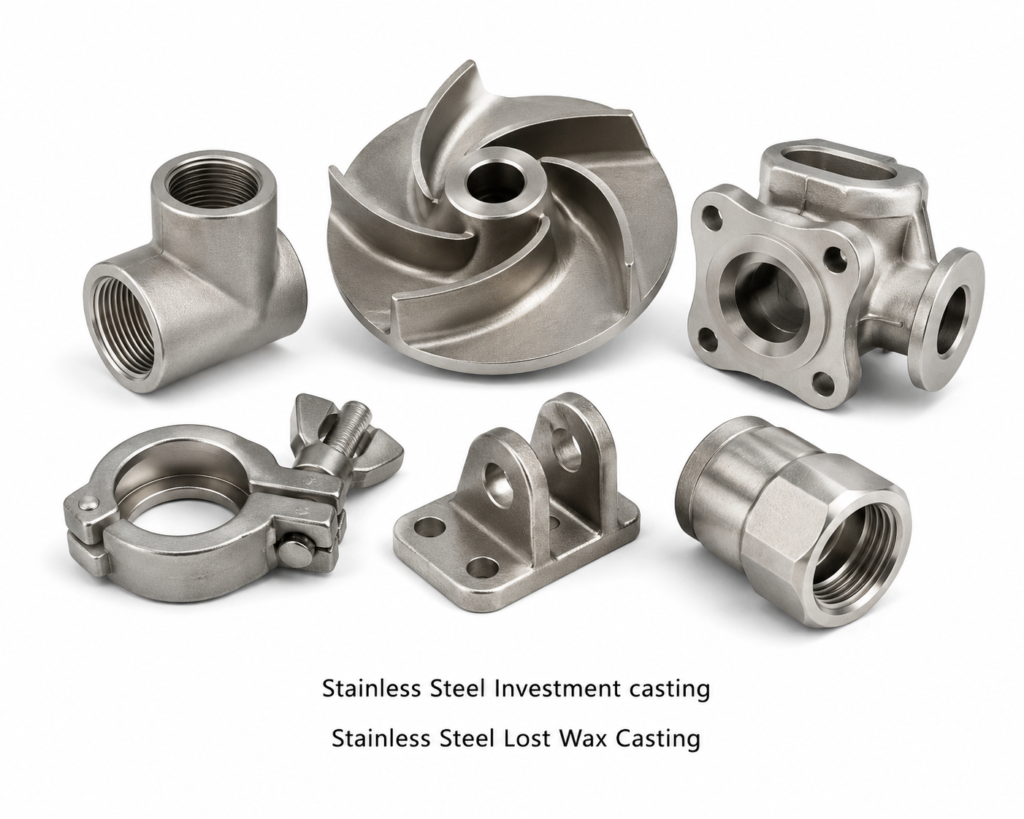
Stainless steel investment casting — also widely known as lost wax casting — is one of the oldest and most precise metal forming processes still in active industrial use today. It enables the production of near-net-shape, dimensionally accurate, and surface-quality stainless steel components with complex internal and external geometries that are either impossible or prohibitively expensive to achieve by machining from solid bar stock. As a leading manufacturer and exporter of stainless steel investment castings from India, we produce precision castings to international quality standards for customers in oil and gas, valve manufacturing, pump industry, food processing, pharmaceutical, marine, and general engineering sectors worldwide.
This comprehensive guide explains every aspect of the stainless steel investment casting process — from wax pattern creation and ceramic shell building to dewaxing, casting, knockout, cleaning, heat treatment, and post-casting finishing and inspection. It also covers stainless steel alloy selection, achievable tolerances and surface finishes, design guidelines, quality standards, and key industries and applications.
What is Investment Casting?
Investment casting is a precision manufacturing process in which a wax pattern (or a cluster of wax patterns) is coated with a ceramic slurry to build a ceramic shell mould. The wax is then melted out (invested out) of the ceramic shell, leaving a precise cavity into which molten stainless steel is poured. After solidification and shell removal, the casting is cleaned, heat treated, and finished to produce the final component.
The term “investment casting” derives from the act of “investing” (coating or surrounding) the wax pattern with a refractory ceramic material. The synonymous term “lost wax casting” refers to the loss of the wax pattern during the dewaxing stage of the process. Investment casting produces castings with exceptional dimensional accuracy, smooth as-cast surface finishes (typically Ra 3.2–12.5 µm), and the ability to hold wall thicknesses as thin as 0.75–1.5 mm.
The Stainless Steel Investment Casting Process: Step by Step
Step 1: Master Pattern and Die Design
The investment casting process begins with creating a master pattern — a precise physical model of the component — which is used to produce an injection die (also called an injection mould or die tool). The die is typically machined from aluminium or steel using CNC machining to replicate the exact geometry of the desired casting, with appropriate dimensional allowances (die shrinkage factors) for wax shrinkage (0.5–1.5%) and casting metal shrinkage (1.5–2.5% for stainless steel).
Step 2: Wax Pattern Injection
Injection-grade wax is melted and injected into the aluminium die under controlled pressure (typically 2–8 bar) and temperature (60–80°C), producing a wax pattern that is an exact replica of the final casting. For investment casting of complex stainless steel components such as valve bodies with internal passages, water-soluble wax cores or ceramic cores are used to form internal cavities.
Step 3: Wax Pattern Assembly and Tree Building
Individual wax patterns are inspected and assembled onto a central wax runner system (tree or sprue) by hot-tooling (locally melting the joint surfaces). Multiple patterns are assembled on a single tree to maximise casting yield per heat. A typical investment casting tree for stainless steel contains 10–100+ patterns depending on component size and weight. The tree assembly is then inspected for wax joint integrity and dimensional accuracy.
Step 4: Ceramic Shell Building (Investing)
The wax tree is dipped into a ceramic slurry (typically colloidal silica binder with zircon flour for the primary coat and alumino-silicate or mullite for backup coats), then stuccoed with coarser refractory sand to build shell thickness. This dipping and drying cycle is repeated 7–10 times over 2–4 days to build a ceramic shell of 6–12 mm thickness, sufficient to withstand the metallostatic pressure of liquid stainless steel during casting.
Shell building parameters for stainless steel investment casting:
- Primary coat slurry: Colloidal silica + zircon flour (viscosity 30–40 seconds, Zahn cup 4)
- Primary stucco: 90–120 mesh zircon sand
- Backup coat slurry: Colloidal silica + alumino-silicate flour
- Backup stucco: 30–50 mesh fused silica or mullite sand
- Number of layers: 7–10 (2 primary + 5–8 backup)
- Inter-layer drying time: 2–4 hours at 22–25°C, 40–60% RH
- Final shell thickness: 8–12 mm
Step 5: Dewaxing
After the ceramic shell is fully dried and cured, the wax is removed by steam autoclave dewaxing (most common) or flash fire dewaxing. In steam autoclave dewaxing, the shell is placed in an autoclave at 150–180°C and 5–8 bar steam pressure for 5–10 minutes. The wax melts rapidly and flows out of the shell, with about 90–95% of the wax recovered for recycling. Flash fire dewaxing uses a high-temperature oven (900–1000°C for 3–5 minutes) to vaporise the wax rapidly, preventing pressure build-up in the ceramic shell that could cause cracking.
Step 6: Shell Firing (Pre-heat)
After dewaxing, the ceramic shells are fired in a burnout oven at 900–1050°C for 30–90 minutes to burn off residual wax, develop ceramic shell strength through sintering, and preheat the shell to casting temperature. Preheating the shell prevents thermal shock when liquid stainless steel (poured at 1550–1650°C) contacts the room-temperature ceramic, which would cause shell cracking and casting defects.
Step 7: Metal Melting and Pouring
Stainless steel stock is melted in an induction furnace (typically a medium-frequency induction furnace of 100–1000 kg capacity) under an inert argon gas shield or in vacuum (for reactive grades) to prevent oxidation and nitrogen pick-up. The melt is refined and adjusted to the target chemistry using ferro-alloys (ferrochrome, ferronickel, ferromolybdenum) and degassed before pouring.
Key melting and pouring parameters for stainless steel investment casting:
- Melting temperature: 1560–1620°C depending on alloy
- Pouring temperature: 1550–1650°C (15–80°C superheat)
- Shell preheat temperature: 800–1050°C
- Melting atmosphere: Induction under argon or air (for standard grades)
- Pouring time: 5–30 seconds per tree
Step 8: Cooling and Shell Knockout
After pouring, the filled shells are allowed to cool in air at room temperature or in controlled cooling fixtures for complex alloys. After solidification (typically 15–60 minutes), the ceramic shell is removed by vibration knocking (pneumatic hammer), abrasive blasting (steel shot or grit blasting at 4–8 bar), chemical dissolution (caustic leaching for silica shells), or high-pressure water jetting, exposing the as-cast stainless steel tree.
Step 9: Cutoff and Dressing
Individual castings are separated from the tree by abrasive wheel cutting, band sawing, or plasma cutting. Gate stubs (sprues) on the castings are then ground down to the casting surface using abrasive grinding wheels. Weld repair of minor surface defects (porosity, cold shuts) is performed using TIG welding with matching filler wire, followed by post-weld heat treatment (PWHT) per ASTM A903.
Step 10: Heat Treatment
Most stainless steel investment castings require heat treatment to achieve specified mechanical properties and corrosion resistance:
- Austenitic SS (CF8/304, CF8M/316): Solution annealing at 1040–1120°C, water quench — dissolves carbides, maximises corrosion resistance
- Duplex SS (CD4MCuN/2205): Solution annealing at 1120–1150°C, rapid water quench — balances austenite/ferrite ratio
- Martensitic SS (CA15/410): Normalise at 950–1010°C + temper at 620–760°C — achieves strength/hardness
- 17-4 PH Investment Castings: Solution treat at 1040°C + age at 480–620°C (H900–H1150) — achieves ultra-high strength
- Precipitation Hardening (CB7Cu-1/17-4 PH): H900 condition: 480°C age, 1 hour — tensile strength up to 1310 MPa
Stainless Steel Alloys for Investment Casting
CF8 (Cast Grade 304 Stainless Steel)
CF8 is the cast equivalent of wrought 304 stainless steel (18% Cr, 8% Ni), complying with ASTM A351 CF8. It is the most commonly specified austenitic stainless steel investment casting alloy for general corrosion service, water handling, food processing, and chemical processing applications operating at temperatures up to 815°C. CF8 investment castings are supplied in the solution-annealed condition (1040–1120°C, water quench).
- Tensile Strength: 485 MPa (min)
- Yield Strength (0.2%): 207 MPa (min)
- Elongation: 35% (min)
- Hardness: ≤150 HBW
CF8M (Cast Grade 316 Stainless Steel)
CF8M is the cast equivalent of wrought 316 stainless steel (18% Cr, 10% Ni, 2.5% Mo), complying with ASTM A351 CF8M. The addition of molybdenum provides superior pitting and crevice corrosion resistance compared to CF8, making CF8M the preferred alloy for investment cast valve bodies, pump components, and fittings in chloride-bearing, marine, chemical, and offshore environments.
- Tensile Strength: 485 MPa (min)
- Yield Strength (0.2%): 207 MPa (min)
- Elongation: 30% (min)
- Hardness: ≤170 HBW
CF3 and CF3M (Low Carbon 304L/316L Investment Castings)
CF3 and CF3M are low-carbon versions of CF8 and CF8M respectively (carbon ≤0.03%), providing superior sensitisation resistance in the heat-affected zone of welds. CF3M investment castings are specified for welded assemblies, pressure vessel nozzles, and fittings used in corrosive environments where sensitisation (chromium carbide precipitation at grain boundaries) is a concern.
CA15 (Cast Grade 410 Martensitic Stainless Steel)
CA15 is the cast equivalent of wrought 410 stainless steel (12% Cr, 1% Ni max), complying with ASTM A217 CA15. It provides moderate corrosion resistance with good hardenability, making it suitable for investment cast pump impellers, valve trims, turbine components, and mining equipment exposed to mildly corrosive environments and requiring moderate hardness and wear resistance (up to 22 HRC after heat treatment).
CB7Cu-1 / CB7Cu-2 (17-4 PH Investment Castings)
CB7Cu-1 and CB7Cu-2 are precipitation-hardening stainless steel casting alloys equivalent to wrought 17-4 PH and 15-5 PH, complying with ASTM A747. These alloys provide exceptional combinations of high strength (tensile strength up to 1310 MPa in H900 condition), good corrosion resistance, and reasonable toughness for investment cast aerospace fasteners, pump shafts, impellers, valve stems, and structural aerospace components.
CD4MCuN (Duplex 2205 Investment Casting)
CD4MCuN is a duplex stainless steel casting alloy with approximately 25% Cr, 5% Ni, 2% Mo, providing a balanced austenitic-ferritic microstructure with excellent resistance to stress corrosion cracking (SCC), pitting corrosion, and erosion-corrosion. Used for investment cast impellers, pump casings, and valve bodies in desalination, seawater handling, and chloride-rich chemical process environments. Solution annealed to achieve 40–60% ferrite (ASTM A890 Grade 5A).
CN7M (Alloy 20 / 20Cb-3)
CN7M (ASTM A351 CN7M) is a high-nickel austenitic stainless steel casting alloy containing approximately 29% Ni, 20% Cr, 2% Mo, and 3.5% Cu, offering excellent corrosion resistance to hot sulphuric acid, phosphoric acid, and chloride environments. Used for investment cast pump casings, impellers, and fittings in the fertiliser, pharmaceutical, food processing, and chemical processing industries.
HH, HK, HT (Heat-Resistant Stainless Steel Castings)
Heat-resistant austenitic stainless steel casting alloys (ASTM A297 HH, HK, HT) containing 25–35% Cr and 10–66% Ni are used for investment cast radiant tubes, furnace parts, heat treatment fixtures, and petrochemical reformer components operating at 700–1150°C. These alloys provide excellent oxidation resistance, carburisation resistance, and high-temperature creep strength.
Design Guidelines for Stainless Steel Investment Castings
Wall Thickness
- Minimum wall thickness: 1.5–2.0 mm for small castings (<0.5 kg); 2.0–3.0 mm for medium castings (0.5–5 kg)
- Maximum wall thickness: Limited by risering and solidification considerations; thick sections should be cored
- Uniform wall thickness transitions minimise shrinkage porosity and stress concentrations
Draft Angles
Investment casting requires minimal or zero draft angles on most surfaces (unlike die casting or sand casting). Standard draft: 0–1° for external surfaces and 0–2° for internal surfaces. Undercuts can be accommodated using ceramic cores or collapsible wax cores, a major advantage over other casting processes.
Radii and Fillets
- Minimum external corner radius: 0.8–1.5 mm
- Minimum internal fillet radius: 1.5–3.0 mm
- Generous radii improve metal flow, reduce hot tearing, and minimise stress concentrations
Holes and Cores
- Minimum straight-through hole diameter: 3 mm (small castings); 5 mm (medium castings)
- Maximum aspect ratio for cored holes: length:diameter ≤ 4:1
- Complex internal passages: achievable using preformed ceramic cores or water-soluble wax cores
Lettering and Logos
Investment casting can reproduce raised lettering, logos, part numbers, and date codes directly on the casting surface without additional machining or stamping operations, with character heights of 3–5 mm minimum and depth of 0.5–1.5 mm.
Tolerances and Surface Finish of Investment Castings
Dimensional Tolerances
Stainless steel investment castings achieve significantly tighter tolerances than sand castings or die castings without any machining:
- Linear Dimensions: ±0.25–0.5 mm for dimensions up to 25 mm (per DCTG 4–6, ISO 8062-3)
- Linear Dimensions: ±0.5–1.5 mm for dimensions 25–250 mm
- Investment Casting Tolerances (Standard): ±0.1 mm/25 mm (±0.004 in/inch)
- Investment Casting Tolerances (Precision): ±0.05 mm/25 mm for premium tooling and process control
- Flatness: ±0.25–0.5 mm for surfaces up to 100 mm
- Roundness: ±0.25–0.5 mm for bores up to 50 mm
Surface Finish
- As-cast (primary zircon coat): Ra 3.2–6.3 µm (125–250 µin) — typical for most investment castings
- As-cast (improved primary coat): Ra 1.6–3.2 µm — achievable with premium zircon slurry
- After bead blasting: Ra 3.2–6.3 µm (uniform matte finish)
- After shot blasting: Ra 6.3–12.5 µm
- After electropolishing: Ra 0.4–1.6 µm
- After precision machining critical surfaces: Ra 0.8–1.6 µm
Post-Casting Finishing and Machining
CNC Machining of Investment Castings
Investment castings are frequently machined on CNC turning and milling centres to achieve tight tolerances on critical dimensions (bores, sealing faces, threads) that exceed the as-cast capability. Stainless steel investment castings for valve bodies, pump casings, and flanged fittings typically require: face milling of sealing and flanged faces (Ra 1.6–3.2 µm), boring of valve seat and ball bores (H8–H7 tolerance), thread machining (NPT, BSP, BSPT, metric), drilling of bolt hole patterns, and precision reaming of bearing bores and alignment holes.
Passivation
Passivation per ASTM A967 (citric acid or nitric acid treatment) removes free iron and surface contamination from the as-cast and machined stainless steel surface, restoring the passive chromium oxide layer and maximising corrosion resistance. Mandatory for food grade, pharmaceutical, and medical investment castings.
Surface Treatments
- Glass bead blasting: Uniform satin matte finish, Ra 1.5–3.0 µm
- Steel shot blasting: Clean as-cast surfaces, improve fatigue life
- Electropolishing: Ultra-smooth, highly corrosion-resistant surface, Ra ≤0.8 µm
- Pickling and passivation: Remove scale, surface contaminants, and sensitised layers after heat treatment
- Hard chrome plating: Wear resistance on selected surfaces of martensitic SS castings
- Painting/Powder coating: External protection for non-wetted surfaces
Quality Inspection and Testing
Our stainless steel investment castings undergo rigorous inspection throughout the manufacturing process and final inspection before shipment:
In-Process Inspection
- Wax pattern inspection: dimensional check per drawing, visual inspection
- Shell integrity check: visual inspection after each coat, final shell thickness verification
- Heat monitoring: thermocouple measurement of pouring temperature, shell preheat temperature
- Chemical analysis: spectrometric OES (Optical Emission Spectroscopy) analysis of each heat per EN 10204 3.1
Final Inspection
- Dimensional Inspection: CMM, vernier calliper, micrometer, coordinate gauges — 100% critical dimensions
- Visual Inspection: 100% visual per MSS SP-55 (Quality Standard for Steel Castings)
- Radiographic Testing (RT): X-ray or gamma-ray per ASTM E446/E186 for pressure-retaining castings (API, ASTM, ASME requirements)
- Liquid Penetrant Testing (LPT/PT): Per ASTM E165, ASME Section V — 100% on critical surfaces for pressure-retaining castings
- Magnetic Particle Testing (MT): Per ASTM E709 for martensitic and ferritic stainless steel castings
- Ultrasonic Testing (UT): Per ASTM E114 for selected high-integrity castings
- Hydrostatic Testing: Per API 598, ASME B16.34 — valve bodies and pressure-retaining castings tested at 1.5× rated pressure
- PMI (Positive Material Identification): XRF analysis per ASTM E1473
- Hardness Testing: Per ASTM E10 (Brinell), E18 (Rockwell)
- Impact Testing: Charpy V-notch impact at 0°C or -20°C per ASTM A370 for low-temperature service castings
- Ferrite Content: Feritscope measurement (ASTM A800) for duplex and austenitic castings per WRC-1992
Standards and Specifications for Stainless Steel Investment Castings
Our stainless steel investment castings are manufactured and supplied to the following key international standards:
- ASTM A351/A351M – Austenitic Steel Castings (CF8, CF8M, CF3, CF3M, CH20, CK20)
- ASTM A217/A217M – Martensitic SS Castings (CA15, CA40) for Pressure Parts
- ASTM A296/A296M – Corrosion-Resistant Iron-Chromium and Iron-Chromium-Nickel Steel Castings
- ASTM A297/A297M – Heat-Resistant Iron-Chromium and Iron-Chromium-Nickel Steel Castings
- ASTM A743/A743M – Corrosion-Resistant Castings (CF3, CF8, CF8M, CN7M, CA15, CD4MCuN)
- ASTM A744/A744M – Corrosion-Resistant Castings for Severe Service
- ASTM A747/A747M – Precipitation-Hardening SS Castings (CB7Cu-1, CB7Cu-2)
- ASTM A890/A890M – Duplex Stainless Steel Castings
- MSS SP-55 – Quality Standard for Steel Castings for Valves, Flanges, and Fittings
- ASME B16.34 – Valves — Flanged, Threaded, and Welding End
- API 600 – Steel Gate Valves (investment cast bodies)
- API 602 – Gate, Globe, and Check Valves (small bore)
- EN 10213 – Steel Castings for Pressure Purposes (European Standard)
- ISO 11960 – Steel Pipes for Use as Casing or Tubing for Wells
- NACE MR0175/ISO 15156 – Sour service material requirements for oil and gas
Key Industries and Applications
Valve Industry
The largest single application for stainless steel investment castings is the valve manufacturing industry. Investment cast CF8 and CF8M valve bodies (ball valves, gate valves, globe valves, check valves, butterfly valves, needle valves, and diaphragm valves) are produced to ASME B16.34, API 600/602, and MSS SP-55 standards in pressure classes 150# to 2500# (PN20 to PN420). Investment casting enables the complex internal flow paths, integral flanges, and precise seat geometry of valve bodies to be produced with minimal machining. We manufacture valve bodies from DN15 (½ inch) to DN300 (12 inch) as investment castings in CF8, CF8M, CF3, CF3M, CA15, CD4MCuN, and CB7Cu-1 grades.
Pump Industry
Investment cast stainless steel pump components include: impellers (centrifugal, mixed-flow, and axial), diffusers, pump casings, volutes, wear rings, and shaft sleeves. CF8M and CD4MCuN investment cast impellers are used in process pumps per API 610 (OH, BB, VS pump types) for refinery, petrochemical, and chemical process service. The complex 3D blade geometry of centrifugal impellers is ideally suited to investment casting, with blade profiles produced to ±0.5 mm tolerance as-cast.
Oil and Gas / Petrochemical
Stainless steel investment castings for upstream and downstream oil and gas applications include: subsurface safety valve (SSSV) components in 17-4 PH (CB7Cu-1), wellhead connector components, choke valve bodies in CF8M and CD4MCuN, gate valve trim (seats, stems, gates) in CA15 and 17-4 PH, and instrumentation body fittings in 316 (CF8M) for sour service (NACE MR0175 compliant). These castings must meet stringent requirements for PREN (Pitting Resistance Equivalent Number), Charpy impact values, and hardness limits for H2S service.
Food and Beverage Processing
Investment cast CF3M (316L equivalent) stainless steel components for food, dairy, and beverage processing include: sanitary butterfly valve bodies and discs, hygienic pump impellers, mixer blades, homogeniser bodies, CIP/SIP fittings, and aseptic valve bodies. These castings feature smooth, crevice-free internal surfaces (Ra ≤3.2 µm as-cast, polished to Ra ≤0.8 µm) and comply with FDA 21 CFR, 3-A Sanitary Standards, EHEDG guidelines, and EC 1935/2004 food contact material regulations.
Pharmaceutical and Biotechnology
Investment cast 316L stainless steel (CF3M) components for pharmaceutical and biotech applications comply with ASME BPE (Bioprocessing Equipment) standards and cGMP requirements. Applications include: diaphragm valve bodies, sample valves, aseptic fittings, bioreactor ports, and lyophiliser components. Electropolished internal surfaces to Ra ≤0.5 µm and passivated per ASTM A967 are standard requirements.
Marine and Naval
Investment cast duplex 2205 (CD4MCuN) and super duplex 2507 stainless steel components for marine applications include: seawater butterfly valve bodies, sea water strainer bodies, marine pump casings, propeller shaft brackets, and naval hardware with excellent resistance to seawater corrosion, biofouling, and erosion-corrosion. Marine investment castings must comply with DNV GL, Lloyd’s Register, Bureau Veritas, or ABS classification society requirements.
Aerospace and Defence
Precision investment cast stainless steel components for aerospace and defence include: 17-4 PH (CB7Cu-1) castings for turbine engine components, actuation system housings, landing gear fittings, and hydraulic manifolds. Aerospace investment castings are manufactured per AS9100 Rev D quality system, with NADCAP approvals for heat treatment, NDT, and chemical processing. First Article Inspection (FAI) per AS9102 is performed on all new aerospace casting designs.
Advantages of Investment Casting vs. Other Manufacturing Processes
Investment Casting vs. Sand Casting
Investment casting produces significantly superior dimensional accuracy (DCTG 4–6 vs. DCTG 10–12 for sand casting), much better surface finish (Ra 3.2–6.3 µm vs. Ra 12.5–50 µm for sand casting), the ability to produce thinner walls (1.5 mm vs. 5+ mm for sand casting), and the ability to reproduce finer details and sharper edges. Sand casting is preferred for very large castings (>100 kg) where investment casting tooling and labour costs become prohibitive.
Investment Casting vs. CNC Machining from Solid
Investment casting eliminates the material waste inherent in machining from solid bar stock (which can waste 60–90% of the material for complex shapes), reduces machining time and tooling costs, and enables geometries (undercuts, internal passages, complex external contours) that would require multiple setups and exotic tooling to machine. CNC machining is used for finishing investment castings to achieve tight tolerances on critical functional surfaces that exceed as-cast capability.
Investment Casting vs. Forging
Investment casting can produce complex near-net-shape parts with minimal machining, while forging requires more extensive machining to reach final part geometry but provides superior mechanical properties (due to refined grain structure and directional grain flow) in the finished part. For applications requiring maximum fatigue strength and impact resistance, forgings are preferred; for complex geometries with good mechanical properties, investment casting is the more economical choice.
Why Source Stainless Steel Investment Castings from India?
World-Class Investment Foundries
India is home to one of the world’s largest concentrations of investment casting foundries, particularly in the industrial clusters of Rajkot (Gujarat), Pune, and Coimbatore. Indian investment casting foundries operate modern induction melting furnaces, autoclave dewaxing equipment, controlled ceramic shell rooms, and comprehensive in-house testing facilities.
Cost Competitiveness
Indian stainless steel investment castings are typically 35–55% less expensive than equivalent castings from Western Europe, North America, or Japan, driven by lower energy and labour costs, large-scale raw material sourcing, and high foundry utilisation rates — without any compromise in metallurgical quality, dimensional accuracy, or compliance with international standards.
Global Export Experience
Indian investment casting manufacturers have decades of experience supplying stainless steel castings to valve manufacturers, pump companies, OEMs, and engineering companies in Germany, UK, USA, Italy, France, Australia, UAE, and across Southeast Asia. Full documentation (MTCs to EN 10204 3.1/3.2, CMM reports, NDT certificates, heat treatment records, and third-party inspection certificates from SGS, TUV, Bureau Veritas, Lloyd’s) is routinely provided.
Our Stainless Steel Investment Casting Capabilities
As a trusted manufacturer and exporter of stainless steel investment castings from India, our foundry offers:
- All major stainless steel casting alloys: CF8, CF8M, CF3, CF3M, CA15, CA40, CD4MCuN, CB7Cu-1, CB7Cu-2, CN7M, HH, HK, HT, CG8M, CF3MN, CK3MCuN (Super Duplex)
- Casting weight range: 0.05 kg to 100 kg per piece
- Maximum casting dimensions: up to 600 mm
- Annual production capacity: 500+ tonnes of stainless steel investment castings
- In-house CNC machining: turning, milling, drilling, tapping, boring
- Full in-house testing: OES spectrometry, CMM, LPT, RT, UT, hydrostatic testing, hardness, impact, ferrite testing
- Third-party inspection: SGS, TUV, Bureau Veritas, Lloyd’s, DNV, RINA
- Quality certifications: ISO 9001:2015, PED 2014/68/EU (CE marking)
- Production lead times: 8–14 weeks (tooling + production) for new designs; 4–8 weeks for repeat orders
Frequently Asked Questions (FAQ)
What is the minimum order quantity for stainless steel investment castings?
There is no strict minimum order quantity (MOQ) for stainless steel investment castings. We accept orders from as few as 10–50 pieces for development and prototype quantities to support product development. For regular production orders, typical batch sizes are 200–2,000 pieces per production run. Tooling (injection die) costs are amortised over the production volume and are typically quoted separately.
How long does it take to get investment casting tooling made?
Investment casting injection die tooling for a typical stainless steel component is designed and CNC machined in 2–4 weeks for simple single-cavity dies and 4–8 weeks for complex multi-cavity or cored dies. After die delivery, first article samples are produced and submitted for dimensional and visual inspection before production release.
What is the typical lead time for stainless steel investment castings?
For new designs requiring tooling: 8–14 weeks total from order placement to first production castings (2–4 weeks tooling + 2–3 weeks shell building and casting + 1–2 weeks finishing and inspection + 1–2 weeks shipping). For repeat orders with existing tooling: 4–8 weeks from order to shipment depending on order quantity and current foundry loading.
Can you supply stainless steel investment castings with third-party inspection?
Yes. We regularly arrange third-party inspection and certification from SGS, TUV Rheinland, Bureau Veritas, Lloyd’s Register, DNV GL, RINA, and other internationally recognised inspection bodies. Material test certificates to EN 10204 3.2 (third-party certified) are available for pressure-retaining castings for critical service applications.
Conclusion
Stainless steel investment casting is a versatile, high-precision manufacturing process that enables the production of complex, near-net-shape components across a vast range of alloys, industries, and applications. The combination of dimensional accuracy, excellent surface finish, design flexibility, alloy versatility, and cost efficiency makes investment casting the preferred manufacturing process for small-to-medium sized stainless steel components with complex geometries.
As a dedicated manufacturer and exporter of precision stainless steel investment castings from India, we offer the full spectrum of alloys (CF8, CF8M, CF3M, CA15, CD4MCuN, CB7Cu-1, and more), comprehensive in-house metallurgical and dimensional testing, and full compliance with international standards (ASTM, ASME, API, EN). Whether you are sourcing valve bodies, pump impellers, instrumentation fittings, or complex structural components, we are your trusted stainless steel investment casting partner. Contact us today with your drawing and specification requirements.