
Introduction to Stainless Steel Milling
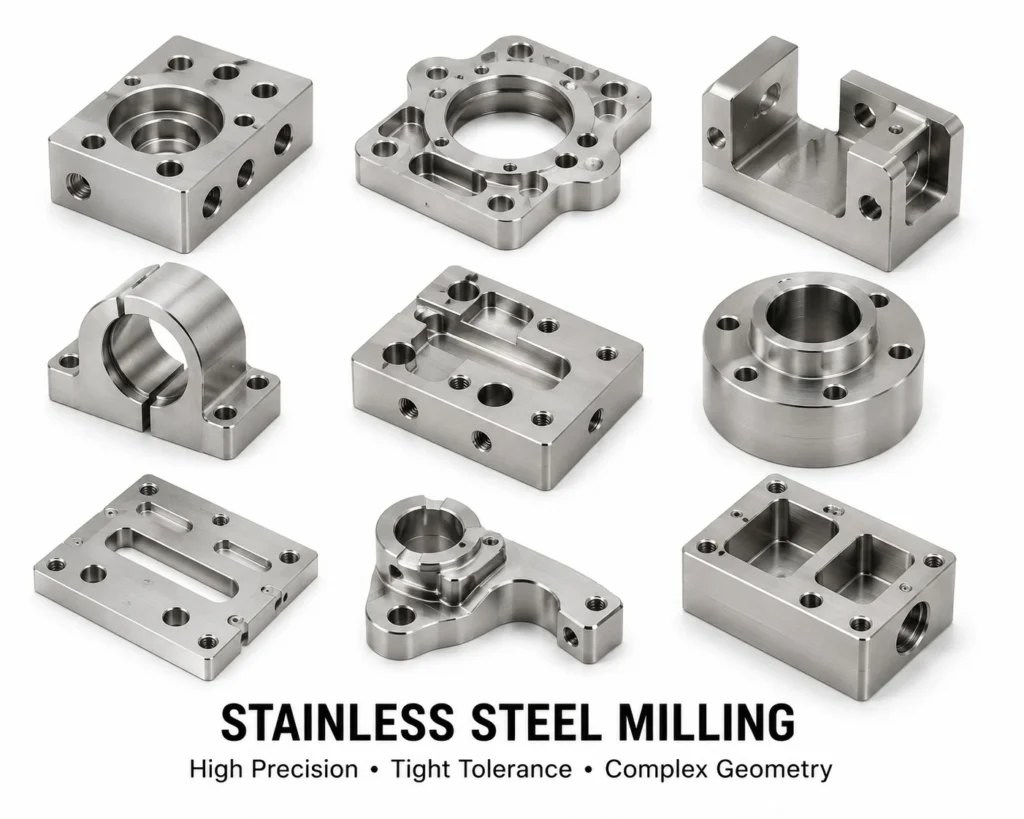
Stainless steel milling is a precision subtractive manufacturing process that uses rotating multi-tooth cutting tools to remove material from a stainless steel workpiece, producing flat surfaces, complex contours, pockets, slots, holes, and intricate three-dimensional geometries. As a core CNC machining operation, milling of stainless steel is critical for manufacturing components across oil and gas, pharmaceutical, food processing, aerospace, medical, and heavy engineering industries.
This comprehensive guide covers the fundamentals of stainless steel milling — including milling processes, machine types, cutting tool selection, machining parameters, stainless steel grades for milling, achievable tolerances and surface finishes, common milled parts, quality standards, and why India is an ideal sourcing destination for precision milled stainless steel components.
What is Stainless Steel Milling?
Milling is a machining process in which a rotating cutting tool (milling cutter) removes material from a workpiece by moving the cutter along multiple axes. Unlike turning where the workpiece rotates, in milling operations the tool rotates while the workpiece is typically clamped on a table that moves in X, Y, and Z directions. Modern CNC milling machines can simultaneously move along 3 to 5 axes, enabling the production of highly complex prismatic and sculptured stainless steel components.
Stainless steel milling requires careful attention to cutting parameters, tool selection, and coolant application due to the material’s tendency to work harden, its low thermal conductivity, and the tough, stringy chips it produces during machining.
Types of Milling Operations on Stainless Steel
Face Milling
Face milling uses a face mill cutter with multiple indexable inserts to produce flat, smooth surfaces on stainless steel workpieces. It is used for squaring up billets, producing flat reference surfaces, and achieving precise parallelism and flatness on structural stainless steel components. Face milling on 304 and 316 stainless steel achieves flatness tolerances of ±0.01 mm/300 mm and surface finishes of Ra 0.8–3.2 µm.
Peripheral (Slab) Milling
In peripheral milling, the cutting action occurs primarily at the periphery (outer edge) of the milling cutter. It is used for milling steps, shoulders, and profiles on stainless steel parts. Peripheral milling is subdivided into climb milling (down milling) and conventional milling (up milling) — climb milling is generally preferred for stainless steel as it produces thinner chips at cut exit, reducing work hardening tendencies.
Slot Milling and Keyway Cutting
Slot milling uses end mills or slotting cutters to produce slots, keyways, T-slots, and dovetail grooves in stainless steel components. Tight tolerance slots in stainless steel require multiple roughing and finishing passes with carbide end mills, along with adequate coolant flow to prevent work hardening and galling within the slot.
Profile Milling and Contouring
CNC profile milling uses ball-nose end mills, bull-nose end mills, and tapered end mills to produce complex 2D and 3D contoured surfaces on stainless steel components such as impeller blades, pump volutes, die inserts, and sculptured aerospace structural parts. 5-axis CNC milling centres provide full simultaneous 5-axis motion for machining undercuts, compound angles, and turbine blade profiles in stainless steel.
Pocketing and Cavity Milling
Pocketing operations create recessed cavities, blind pockets, and through-pockets in stainless steel components. CNC pocket milling strategies such as trochoidal milling (circular arc tool paths) reduce radial engagement and cutting forces during stainless steel milling, improving tool life and material removal rates compared to conventional full-width slotting.
Thread Milling
Thread milling uses a thread mill (a helical end mill with thread form ground on its periphery) to produce internal and external threads in stainless steel. It is preferred over tapping for stainless steel because it avoids the high torques associated with tapping in work-hardening materials, allows the same tool to produce multiple thread sizes, and produces excellent surface quality with minimal burring. Thread milling is widely used for M3 to M100 threads in 316L stainless steel pharmaceutical and food processing fittings.
Drilling and Boring by CNC Milling Centres
Modern CNC milling centres integrate drilling, reaming, boring, and tapping operations alongside milling in a single setup. High-precision boring of stainless steel bores achieves H7 tolerance (±0.010–0.025 mm) using solid carbide boring bars with fine adjustment mechanisms, essential for valve bores, bearing housings, and pump body bores in stainless steel.
CNC Milling Machine Types for Stainless Steel
3-Axis CNC Milling Centres (VMC/HMC)
3-axis CNC machining centres — Vertical Machining Centres (VMC) and Horizontal Machining Centres (HMC) — are the most common machines for milling stainless steel. VMCs are ideal for prismatic parts, while HMCs offer superior chip evacuation and access to multiple part faces. Work envelope: up to 2500 × 1000 × 750 mm. Typical positioning accuracy: ±0.005 mm.
4-Axis CNC Milling with Rotary Indexer
A 4th rotary axis (A or B axis) on a CNC milling centre allows the stainless steel workpiece to be indexed or continuously rotated, enabling machining of circumferential features, helical flutes, cam profiles, and complex part features from multiple faces in a single setup, eliminating the need for multiple fixture setups and improving geometric accuracy.
5-Axis CNC Milling Centres
5-axis simultaneous CNC milling provides full 5-axis interpolation (X, Y, Z linear axes plus A and C or B and C rotary axes), allowing the milling cutter to be optimally tilted relative to the stainless steel surface at all times. Benefits for stainless steel milling include: reduced number of setups, superior surface finish on complex surfaces, ability to reach undercuts and complex features, and shorter cycle times compared to multiple 3-axis operations. 5-axis CNC milling centres such as DMG Mori DMU series and Hermle C series are widely used for impellers, turbine parts, and die & mould work in stainless steel.
Gantry Milling Machines
For large stainless steel structural components and pressure vessel flanges (up to 10 metres in length), gantry (moving column) CNC milling machines provide the work envelope and rigidity necessary for heavy-duty face milling and profile milling operations.
Stainless Steel Grades Most Suitable for Milling
Grade 304/304L Stainless Steel
The most commonly milled stainless steel grade. Grade 304 is used for a vast range of milled components — fittings, flanges, plates, brackets, enclosures, manifolds, and structural parts. Machinability is approximately 45% relative to free-machining B1112 steel. Key milling parameters: cutting speed Vc = 120–200 m/min (coated carbide), feed per tooth fz = 0.06–0.12 mm/tooth, axial depth of cut ap = 0.5–3 mm, radial engagement ae = 20–50% of cutter diameter.
Grade 316/316L Stainless Steel
Grade 316 is the second most frequently milled stainless steel. The addition of molybdenum (2–3%) slightly reduces machinability compared to 304 but provides superior corrosion resistance for pharmaceutical, chemical, and marine applications. Recommended cutting speeds are 10–15% lower than for 304 SS. 316L (low carbon) is the preferred grade for milled welded assemblies in pharma and food applications.
Grade 303 Stainless Steel
Free-machining 303 stainless steel offers significantly better milling performance (~78% machinability) than 304, allowing higher cutting speeds and extended tool life. Used for high-volume milled screw machine products, manifold blocks, valve bodies, and fittings where optimal corrosion resistance is not the primary requirement.
Grade 316Ti / 321 Stainless Steel
Titanium-stabilised 316Ti and 321 stainless steels are milled for high-temperature applications (exhaust manifolds, heat exchanger parts, furnace components) operating at 400–900°C. Milling parameters are similar to 316 but TiAlN-coated tools are recommended to manage the higher cutting temperatures.
Duplex 2205 and Super Duplex 2507
Duplex stainless steels are increasingly milled for subsea components, chemical process equipment, and desalination plant parts. The higher strength and dual-phase microstructure of duplex grades require reduced cutting speeds (Vc = 60–120 m/min), stiffer tooling, higher coolant pressure, and more rigid workholding compared to austenitic grades. Super duplex 2507 is even more challenging to mill, requiring further reductions in cutting speed (Vc = 50–100 m/min) and generous use of flood coolant or high-pressure through-tool coolant.
17-4 PH and 15-5 PH Stainless Steel
Precipitation-hardened stainless steels are milled in the annealed (Condition A) state before age hardening to final strength levels. Machining in the hardened condition (H900, H1025, H1150) is also possible using high-performance carbide end mills with TiAlN coating, targeting Vc = 80–140 m/min. Used for aerospace brackets, fasteners, turbine components, and defence parts.
Cutting Tools for Stainless Steel Milling
Indexable Insert Face Mills
For face milling of stainless steel, modern indexable insert face mills with positive rake geometry, sharp cutting edges, and PVD TiAlN-coated carbide inserts (ISO M20–M30 grade) provide optimal performance. Key tool manufacturers for stainless steel milling inserts include Sandvik Coromant (CoroMill 365, 745), Kennametal (KCSM15B grade), and Mitsubishi Materials (MP9120 grade).
Solid Carbide End Mills
For slot milling, profile milling, and pocketing of stainless steel, solid carbide end mills with the following characteristics are recommended:
- Variable helix angle (37–42°) to break up harmonics and reduce chatter
- 4–6 flutes for finishing; 2–4 flutes for slotting and heavy roughing
- TiAlN, AlTiN, or nACo (nano-crystalline Al/TiN) PVD coating
- Sharp cutting edges with edge radius ≤0.005 mm
- Eccentric primary clearance to maintain sharpness throughout tool life
- Through-coolant holes for internal coolant delivery in slot and pocket milling
High Feed Milling Cutters
High feed milling (HFM) cutters use a very small lead angle (typically 17–20°) to direct cutting forces axially into the spindle, allowing extremely high feed rates (up to 3–8 mm/tooth) at shallow axial depths of cut (0.3–1.5 mm) in stainless steel roughing operations. HFM dramatically increases material removal rates (MRR) in rough milling of stainless steel compared to conventional approaches.
Ball-Nose and Bull-Nose End Mills
For sculptured surface milling (impellers, turbine blades, press dies) in stainless steel, solid carbide ball-nose end mills with TiAlN coating and variable helix provide high-quality machined surfaces in 3D milling operations. Step-over values of 5–15% of tool diameter are used for fine finishing of stainless steel contoured surfaces.
Milling Parameters for Stainless Steel
Recommended Cutting Speeds (Vc)
- 304 SS Face Milling (coated carbide): 150–220 m/min
- 316 SS Face Milling (coated carbide): 120–180 m/min
- 303 SS End Milling: 150–250 m/min
- Duplex 2205 Milling: 80–120 m/min
- 17-4 PH (Annealed) Milling: 90–150 m/min
Feed Per Tooth (fz)
- Roughing (face milling, high feed): 0.08–0.20 mm/tooth
- Semi-finishing (peripheral milling): 0.05–0.12 mm/tooth
- Finishing (profile milling): 0.02–0.06 mm/tooth
Depth of Cut
- Axial depth (ap) Roughing: 1.0–5.0 mm (end milling); up to 0.5 × D (face milling)
- Axial depth (ap) Finishing: 0.1–0.5 mm
- Radial engagement (ae) Slotting: 0.5–1.0 × D
- Radial engagement (ae) Side milling: 0.1–0.3 × D (roughing), 0.02–0.1 × D (finishing)
Coolant Strategy for Stainless Steel Milling
High-pressure flood coolant (minimum 20–70 bar) is strongly recommended for all stainless steel milling operations. Through-spindle coolant (TSC) at 50–70 bar is particularly effective for end milling of deep pockets and slots, directly cooling the cutting zone and flushing chips away from the work area. For dry milling or minimum quantity lubrication (MQL) to reduce coolant usage in the milling of stainless steel, high-performance TiAlN/AlCrN-coated tools with higher heat resistance are required.
Common Milled Stainless Steel Parts and Components
Valve Bodies and Manifold Blocks
CNC milled stainless steel valve bodies (ball valve bodies, gate valve bodies, butterfly valve bodies) and manifold blocks are produced from solid 316L or 2205 duplex stainless steel billets by multi-axis milling operations. Complex internal porting, precisely bored valve seats, flanged connections, and NPT or BSP threaded ports are all produced through CNC milling and drilling operations. Milled valve bodies can be manufactured to ASME B16.34, API 600/602, or EN 12516 pressure-temperature ratings.
Pump and Compressor Components
CNC milled stainless steel pump components include: impellers (centrifugal and axial flow), pump casings and volutes, bearing housings, seal chambers, and diffusers. 5-axis CNC milling is used for complex impeller blade profiles in 316L and duplex 2205 stainless steel for process industry pumps (API 610 compliant), with blade profiles milled to ±0.05 mm tolerance and Ra 0.8–1.6 µm surface finish for optimal hydraulic efficiency.
Flanges and Pipe Fittings
While many stainless steel flanges are forged or rolled, precision CNC face milling is used to achieve flat, smooth raised faces and ring-type joint grooves to ASME B16.5, ASME B16.47, and EN 1092-1 standards. Seating surfaces are face-milled to Ra 3.2–6.3 µm for spiral wound gaskets or Ra 0.8–1.6 µm for metal-to-metal seals.
Instrumentation Fittings and Tube Fittings
Precision CNC milled stainless steel instrument fittings — compression tube fittings, push-in fittings, high-pressure swagelok-type fittings, and manifold valves — are produced from 316L SS round bar stock on multi-spindle CNC milling and turning centres. These fittings are manufactured to Swagelok, Parker, or Hoke dimensions with ±0.01 mm tolerances on critical sealing surfaces.
Pharmaceutical and Food Processing Components
GMP-compliant CNC milled 316L stainless steel components for pharmaceutical, biotechnology, and food processing include: sanitary clamp ferrules with Ra ≤0.8 µm internal surface finish, mixing vessel agitator blades, heat exchanger tube sheets, dosing pump components, and cleanroom hardware. These parts are electropolished after milling to achieve Ra ≤0.4 µm and passivated per ASTM A967.
Aerospace and Defence Structural Parts
High-precision CNC milled stainless steel structural components — brackets, fittings, actuator housings, and hydraulic manifolds — are produced from 17-4 PH, 15-5 PH, and 455 stainless steel in aerospace and defence applications, meeting AS9100 Rev D quality requirements with first article inspection (FAI) to AS9102 standards.
Semiconductor and Electronics Components
Ultra-precision CNC milled 316L stainless steel components for semiconductor equipment include: gas distribution manifolds, vacuum chamber components, wafer handling fixtures, and cleanroom tool fittings. These components feature very tight dimensional tolerances (±0.005 mm), electropolished surfaces (Ra ≤0.25 µm), and ultra-clean packaging to prevent contamination.
Heat Exchanger Tube Sheets and Baffles
Large-diameter stainless steel tube sheets for shell-and-tube heat exchangers are CNC drilled and milled on gantry machining centres. Tube sheet drilling requires precisely positioned and sized holes (typically H8 tolerance) for tube-to-tubesheet expansion or welding, with hole pattern accuracy held to ±0.05 mm over tube sheet diameters up to 3000 mm.
Tolerances and Surface Finish for Milled Stainless Steel Parts
Dimensional Tolerances
- Standard CNC Milling: ±0.05–0.1 mm (ISO 2768-m)
- Precision CNC Milling: ±0.01–0.05 mm (ISO 2768-f)
- Fine Tolerance Milling: ±0.005–0.01 mm
- Bored Holes: H7 (±0.010–0.025 mm depending on diameter)
- Flatness: 0.005–0.02 mm/100 mm
- Perpendicularity/Parallelism: 0.005–0.02 mm/100 mm
Surface Finish (Ra)
- As-milled (rough face milling): Ra 3.2–6.3 µm
- Standard face milling finish: Ra 1.6–3.2 µm
- Fine face milling: Ra 0.8–1.6 µm
- High-speed finish milling: Ra 0.4–0.8 µm
- After grinding: Ra 0.2–0.4 µm
- After electropolishing: Ra 0.1–0.4 µm
Post-Processing of Milled Stainless Steel Parts
Deburring and Edge Break
Milled stainless steel components require thorough deburring to remove sharp edges, burrs, and machining artefacts. Methods include: manual deburring with files and abrasive stones, vibratory barrel finishing (tumble deburring), abrasive flow machining (AFM) for internal passage deburring, and electrochemical deburring (ECD) for precision internal features. Edge breaks of R0.2–0.5 mm are typically specified for aerospace components.
Passivation
Chemical passivation per ASTM A967 (nitric acid or citric acid) restores the chromium oxide passive layer on milled stainless steel surfaces, removing free iron contamination from cutting tools and fixtures and maximising corrosion resistance. Mandatory for medical, food, pharmaceutical, and semiconductor components.
Electropolishing
Electropolishing removes 10–40 µm of surface material from milled stainless steel parts, smoothing surface asperities, enhancing brightness, and creating a highly corrosion-resistant, ultra-clean surface. EP is specified for pharmaceutical API manufacturing vessels, bioreactors, semiconductor vacuum components, and hygienic fittings.
Surface Treatments
Additional surface treatments applicable to milled stainless steel parts include: glass bead blasting (uniform matte finish, Ra 1.5–3.0 µm), shot peening (improved fatigue life and stress corrosion cracking resistance), PVD coating (wear resistance for mould inserts and tooling), and hard chrome plating for dimensional restoration.
Quality Inspection of Milled Stainless Steel Parts
Our milled stainless steel components undergo comprehensive inspection before shipment:
- CMM Dimensional Inspection: 3D coordinate measurement to ±0.002 mm accuracy, full GD&T verification
- Surface Roughness Measurement: Contact profilometry (Ra, Rz, Rmax) per ISO 4287, non-contact optical profilometry for delicate surfaces
- Flatness and Parallelism: Precision surface plate and indicator, or CMM measurement
- Visual and Dimensional Inspection: 100% inspection of critical dimensions on aerospace and medical parts
- PMI (Positive Material Identification): XRF/OES verification of stainless steel grade and chemistry per EN 10204 3.1 MTC
- Hardness Testing: Rockwell, Vickers, or Brinell per ASTM E18/E92/E10
- NDT (Non-Destructive Testing): Liquid penetrant testing (LPT) per ASTM E165 for surface crack detection on critical components
- Ferrite Testing: Feritscope measurement to verify ferrite content in duplex stainless steel milled parts per WRC-1992 diagram
Standards and Certifications
Our milled stainless steel parts are manufactured and tested in compliance with:
- ASTM A276/A484 – Stainless Steel Bar Stock Specifications
- ISO 2768-1/2 – General Tolerances for CNC Milled Parts
- ASME Y14.5 – Geometric Dimensioning and Tolerancing (GD&T)
- ASME B16.5 / B16.34 – Pipe Flanges and Valves
- API 600 / 610 / 6D – Industrial Valve and Pump Standards
- EN 10204 3.1 – Material Test Certificate Standard
- ISO 13485 – Medical Device Quality Management
- AS9100 Rev D – Aerospace Quality Standard
- ATEX / PED 2014/68/EU – Pressure Equipment Directive
Why Choose Stainless Steel Milled Parts from India?
Advanced Milling Infrastructure
India’s precision engineering sector has invested heavily in advanced multi-axis CNC milling infrastructure. Leading Indian manufacturers operate 3-axis, 4-axis, and 5-axis CNC milling centres from world-class machine builders including Mazak (Integrex series), DMG Mori (DMU 5-axis), Haas (VF series), and BFW (Bharat Fritz Werner), capable of machining stainless steel components to exacting international standards.
Cost Advantage
Indian CNC milling manufacturers offer 35–55% cost savings compared to equivalent quality precision milled stainless steel parts from Western European or North American suppliers, driven by lower labour costs, competitive raw material sourcing, and efficient manufacturing processes — without sacrificing quality, tolerances, or delivery reliability.
Engineering Capabilities
Indian precision machining engineers and machinists are highly trained in CNC programming (Mastercam, CATIA, Siemens NX CAM, Hypermill), advanced toolpath strategies, fixturing design, and quality systems (ISO 9001, AS9100, ISO 13485). DFM (Design for Manufacturability) reviews are offered to optimise part designs for efficient, cost-effective CNC milling of stainless steel.
Our Stainless Steel Milling Capabilities
As a trusted manufacturer and exporter of precision milled stainless steel components from India, we offer:
- 3-axis, 4-axis, and 5-axis CNC vertical and horizontal machining centres
- Work envelope up to 2000 × 1000 × 800 mm
- All stainless steel grades: 304, 304L, 316, 316L, 316Ti, 321, 310S, 317L, 2205 Duplex, 2507 Super Duplex, 17-4 PH, 15-5 PH, 630, 420, 410
- Tolerances to ±0.005 mm and surface finishes to Ra 0.4 µm (as-milled)
- Full in-house inspection: CMM (Hexagon Romer), surface profilometer, XRF analyser
- Passivation, electropolishing, bead blasting, deburring, and heat treatment
- Prototype quantities (1–10 pcs) to medium-volume production (up to 5,000 pcs/month)
- CAD/CAM capability: CATIA V5, Siemens NX, SolidWorks, AutoCAD
- ISIR/PPAP documentation for automotive and aerospace customers
Frequently Asked Questions (FAQ)
What is the difference between CNC milling and CNC turning for stainless steel?
In CNC milling, the cutting tool rotates while the workpiece is stationary (or moves linearly), making it ideal for prismatic parts, flat surfaces, pockets, slots, and complex 3D geometries. In CNC turning, the workpiece rotates while the cutting tool moves linearly, making it ideal for cylindrical and rotational components (shafts, bushings, nozzles). Many stainless steel components combine both operations on CNC mill-turn centres for complete machining in one setup.
Can stainless steel be dry milled without coolant?
Dry milling of stainless steel is possible with high-performance AlTiN or TiAlN-coated end mills at reduced cutting speeds (Vc 60–100 m/min), but flood or MQL (Minimum Quantity Lubrication) cooling is strongly preferred. Stainless steel’s low thermal conductivity and tendency to work harden make adequate cooling critical for acceptable tool life and surface quality in milling operations.
What is trochoidal milling and why is it used for stainless steel?
Trochoidal milling (also called dynamic milling) is an advanced CNC toolpath strategy that moves the end mill in a circular arc path, maintaining a low radial engagement (typically 10–20% of cutter diameter) while using the full flute length for cutting. For stainless steel, trochoidal milling significantly reduces cutting forces, cutting temperature, and work hardening, allowing much higher material removal rates and dramatically extended tool life compared to conventional slotting or full-width profiling.
What surface finish is achievable on milled 316L stainless steel for pharmaceutical use?
For pharmaceutical and biotechnology applications (GMP/cGMP compliance), CNC-milled 316L stainless steel surfaces can achieve Ra 0.8 µm as-milled (with fine finishing passes). Post-milling electropolishing reduces Ra to 0.1–0.4 µm (grit equivalent #240–#320), meeting ASME BPE (Bio-Processing Equipment) standard surface finish requirements for product-contact surfaces in bioreactors, tanks, and hygienic piping.
Conclusion
Stainless steel milling is a versatile and essential precision manufacturing process that produces a vast range of high-quality industrial, medical, and aerospace components from all stainless steel grades. The key to successful stainless steel milling lies in selecting the right milling strategy, choosing appropriate coated carbide tools, optimising cutting parameters for the specific grade, and applying high-pressure coolant to manage heat and prevent work hardening.
As a dedicated manufacturer and exporter of precision milled stainless steel components from India, we bring advanced CNC milling capabilities, comprehensive quality systems, and deep materials engineering expertise to every project. Whether you need prototype quantities or full production runs of milled stainless steel parts to international standards, we are your trusted manufacturing partner. Contact us today with your drawings and specifications.